Sleeping on your back or side with your neck in a neutral position is the best cervicogenic headache sleeping posture, while stomach sleeping is the most harmful. That matters because stomach sleeping twists and extends your neck for hours, adding strain to the joints and muscles that can drive head pain.
If you're reading this after another night of waking up with pain at the base of your skull, a stiff neck, and that familiar ache moving toward your temple or eye, you're not overreacting. Sleep can either calm an irritated neck or keep feeding it all night. For people with cervicogenic headache, which is a headache that starts from structures in the neck, your sleep posture is often one of the most practical things you can change tonight.
Migraine and cervicogenic headache are not the same thing. A migraine is a neurological condition that can involve symptoms like nausea, photophobia (light sensitivity), phonophobia (sound sensitivity), aura, and a postdrome or “hangover” phase. A cervicogenic headache begins in the neck and refers pain into the head. Some people live with both, which is one reason mornings can feel confusing and exhausting.
This article is for informational purposes and is not medical advice. Consult a healthcare provider for personalized guidance.
Table of Contents
- Back sleeping that actually supports your neck
- Side sleeping without collapsing into the pillow
- Why stomach sleeping keeps the cycle going
Waking Up with Neck Pain and Headaches
Waking up with a locked-up neck and a headache that seems to climb from the back of your head forward can make the whole day feel lost before it starts. If that pattern sounds familiar, your sleeping position deserves attention.
Research on sleep posture and neck pain supports what many clinicians see in practice. Back and side sleeping reduce pressure on the spine and help limit neck and shoulder strain, while stomach sleeping creates excessive neck extension that can “jam” the neck and throw off spinal alignment, as described by this overview of sleeping positions for neck pain and headaches.
What this means when you wake up sore
A painful morning doesn't always mean you slept “wrong” for one night. More often, it means your neck spent hours in a position it couldn't tolerate well.
That distinction matters. If your pain starts in the neck and then refers into the head, changing your sleep setup isn't just about comfort. It's part of reducing mechanical stress on irritated tissues.
Practical rule: Your goal at night isn't to hold a “perfect” posture. It's to keep your head, neck, and trunk supported well enough that your neck doesn't spend hours twisted, cranked back, or hanging sideways.
A few clues that sleep posture may be contributing include:
- Pain starts in the neck: The headache builds after you notice stiffness or soreness near the upper neck.
- Mornings are worse: Symptoms are strongest when you first get up and improve a bit after moving around.
- Certain positions trigger it: You notice more pain after sleeping face-down or with your head tipped sharply to one side.
Why this matters even if you also get migraine
Some readers will have migraine as well as neck-driven pain. Migraine can include aura, nausea, light sensitivity, sound sensitivity, or dizziness. Cervicogenic headache is different in origin, but neck irritation can still worsen your overall head pain burden.
That's why a small sleep adjustment can still be worth trying, even if your diagnosis is more complicated than one label.
Why Your Sleep Position Triggers Neck Headaches
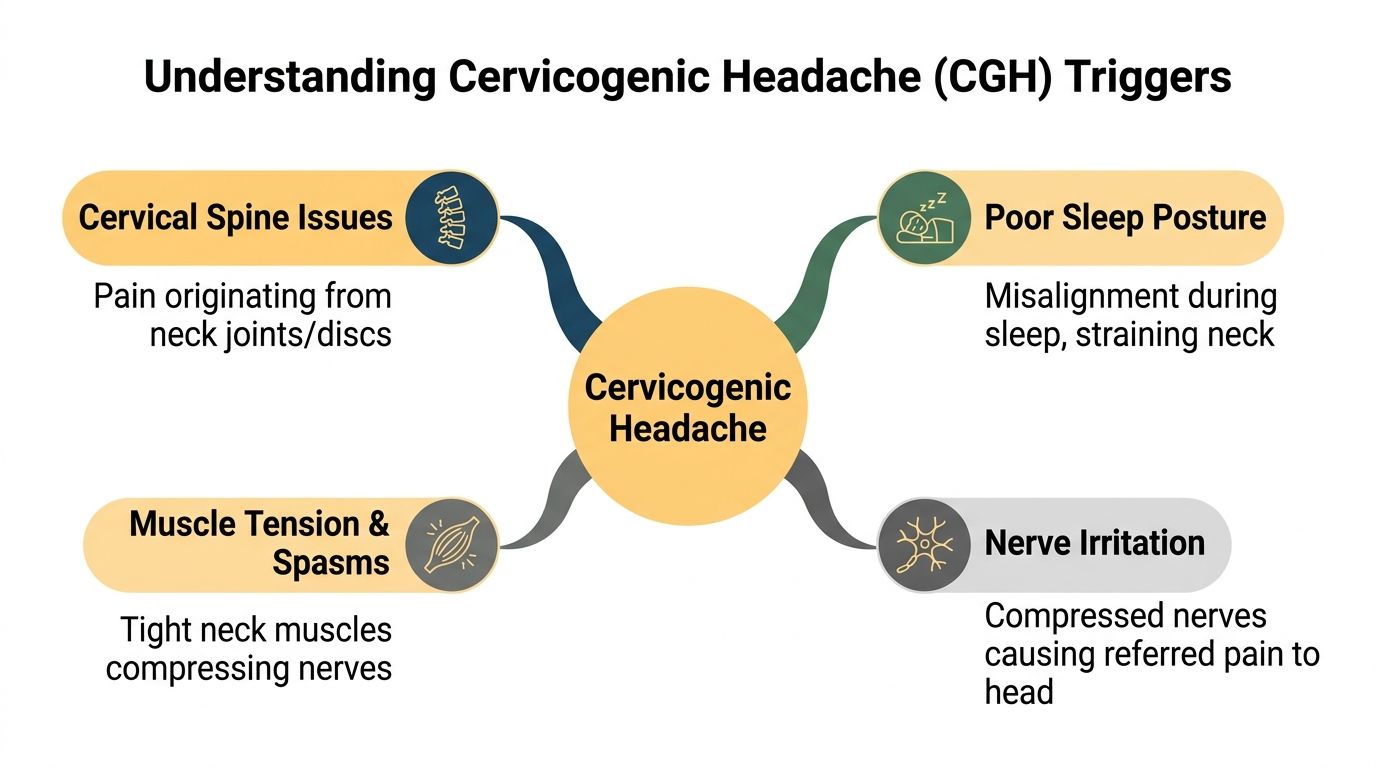
A cervicogenic headache doesn't come from “just sleeping funny.” It comes from physical stress in the neck that refers pain into the head.
What makes a cervicogenic headache different
The neck contains joints, discs, muscles, and nerves that can all contribute to referred head pain. When these tissues become irritated, your brain may register pain in the head even though the source is in the cervical spine.
One important area is the upper cervical region, especially around C2-C3. Recent physical therapy literature highlighted in this discussion of cervicogenic headache mechanisms notes that 70% of cervicogenic headache cases originate from C2-C3 joint dysfunction. That helps explain why a sleep position that repeatedly stresses the upper neck can keep the problem active.
How forward head posture changes the load on your neck
Sleep isn't separate from daytime posture. If you already spend the day with your head drifting forward, your neck starts the night at a disadvantage.
A clinical study found that the frequency of cervicogenic headaches in patients with forward head posture is 53.8%, and patients with cervicogenic headache had a significantly lower Cervical Vertebral Angle, with reduced angle identified as an independent predictor of the condition in the PubMed Central study on forward head posture and cervicogenic headache. In simple terms, a more forward, collapsed neck position is strongly linked to this headache pattern.
That matters for sleep because poor support often recreates the same mechanics you already deal with during the day. A pillow that's too high can push your head forward. A pillow that's too flat can let your head drop back or sideways. A position that rotates your neck for hours adds another layer of strain.
When your neck spends all night outside a neutral position, the tissues don't get a break. They stay loaded.
That ongoing load can show up as:
| Sleep setup problem | What happens to your neck | What you may feel in the morning |
|---|---|---|
| Head pushed too far forward | Upper neck works harder to support the head | Base-of-skull ache, neck stiffness |
| Head tilted sideways too long | Muscles and joints on one side stay compressed | One-sided neck pain and headache |
| Neck rotated for hours | Irritation builds around the upper cervical joints | Pain that wraps toward the temple or eye |
The point isn't to obsess over angles while you're trying to fall asleep. It's to respect the basic biomechanics. If your neck is supported in a neutral position, it usually has a better chance to settle down overnight.
Finding Your Ideal Cervicogenic Headache Sleeping Posture
The best answer is simple. Sleep on your back or your side, and set things up so your neck stays neutral rather than bent, twisted, or dropped.
A helpful visual can make the trade-offs easier to spot at a glance.
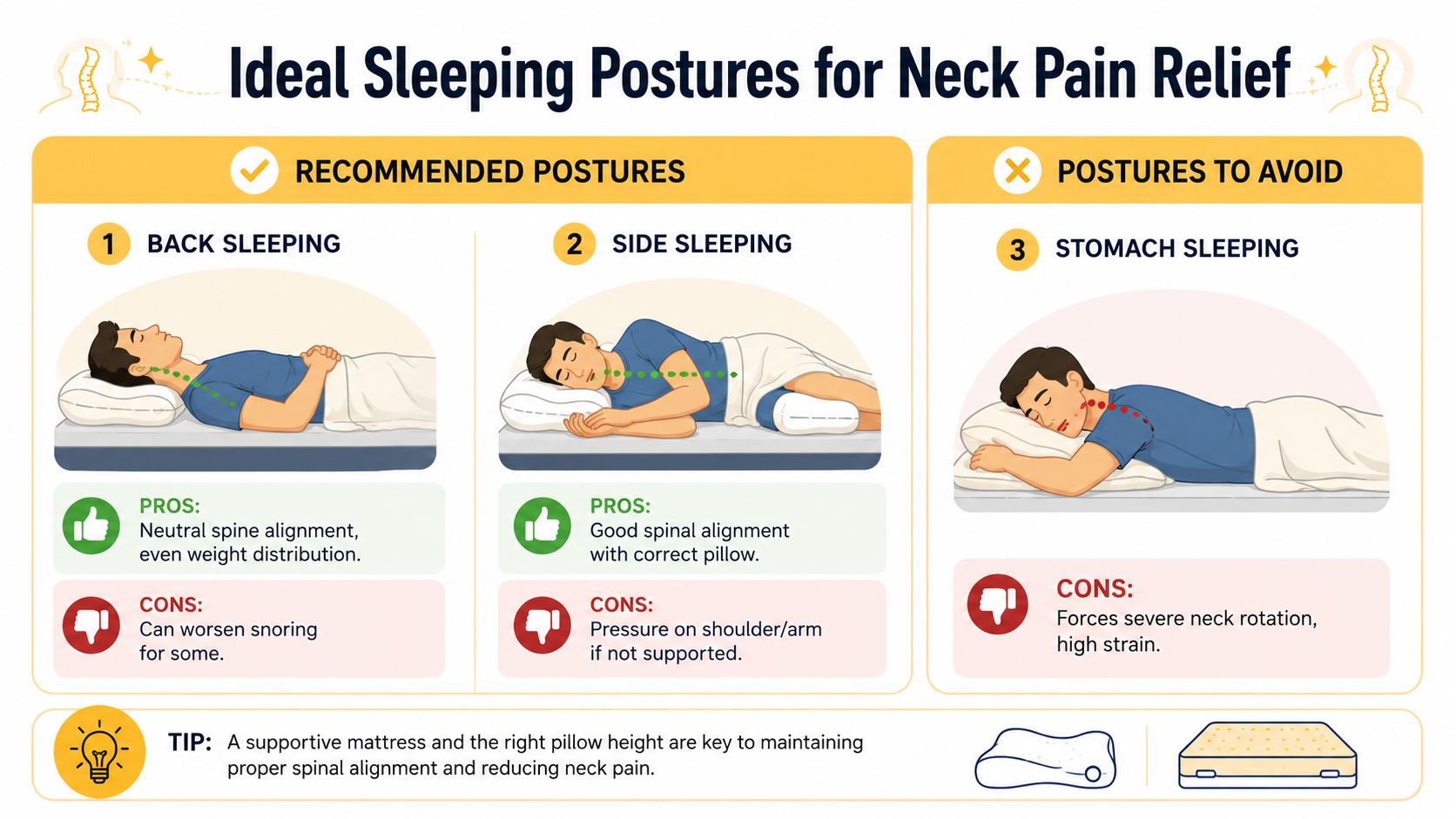
Expert guidance consistently identifies stomach sleeping as the worst option for cervicogenic headache because it forces the neck into rotation and extension, while side and back sleeping are preferred because they let the neck rest closer to neutral, as outlined in this clinical discussion of sleep posture and cervicogenic headaches.
Back sleeping that actually supports your neck
Back sleeping works well when your pillow supports the curve of your neck instead of merely lifting your head. Many people do best with a contoured pillow or a pillow shape that gently raises the neck and cradles the back of the head.
If you try back sleeping tonight, use this checklist:
- Support the neck curve: Your pillow should fill the space behind your neck without shoving your chin toward your chest.
- Keep the face looking up: If your head naturally turns to one side, your pillow may be uneven or too thick.
- Soften the pull through your spine: Place a pillow under your knees if your low back feels tight. That often helps the whole spine relax.
After you've set up the basics, this video offers a useful visual demonstration of supportive sleeping mechanics.
A good back-sleeping setup should feel quiet. If your chin is jammed down or your head feels like it's rolling, the setup still needs adjusting.
Side sleeping without collapsing into the pillow
Side sleeping can be excellent for cervicogenic headache if the pillow fills the space between your shoulder and head. If it doesn't, your neck hangs sideways all night.
A few changes usually help:
- Match pillow height to shoulder width. Broader shoulders usually need more loft than narrower frames.
- Keep your nose lined up with the center of your chest. If your face points down toward the mattress or up toward the ceiling, your neck is rotating.
- Use a pillow between your knees. This can reduce twisting through your pelvis and trunk, which often makes upper-body alignment easier to maintain.
- Hug a pillow if your top shoulder collapses forward. That small support can reduce tension across the upper back and neck.
Why stomach sleeping keeps the cycle going
Stomach sleeping is difficult to modify because the posture itself is the problem. To breathe, you have to turn your head. That means your neck stays rotated for a long stretch, often with some extension as well.
People sometimes say stomach sleeping feels comfortable because it helps them drift off. The problem is what happens after that. You may fall asleep quickly, then wake up with a neck that feels pinched, guarded, or oddly one-sided.
If you're a longtime stomach sleeper, don't try to force a total overnight change if that makes sleep impossible. Use a gradual shift instead:
- Start in side lying: Put a pillow behind your back to make rolling onto your stomach less automatic.
- Use a body pillow: This gives your arms and top leg somewhere to rest, which makes side sleeping feel more secure.
- Work on the first half of the night: If you can stay off your stomach for the first few hours, that's still progress.
Choosing the Right Pillow and Mattress
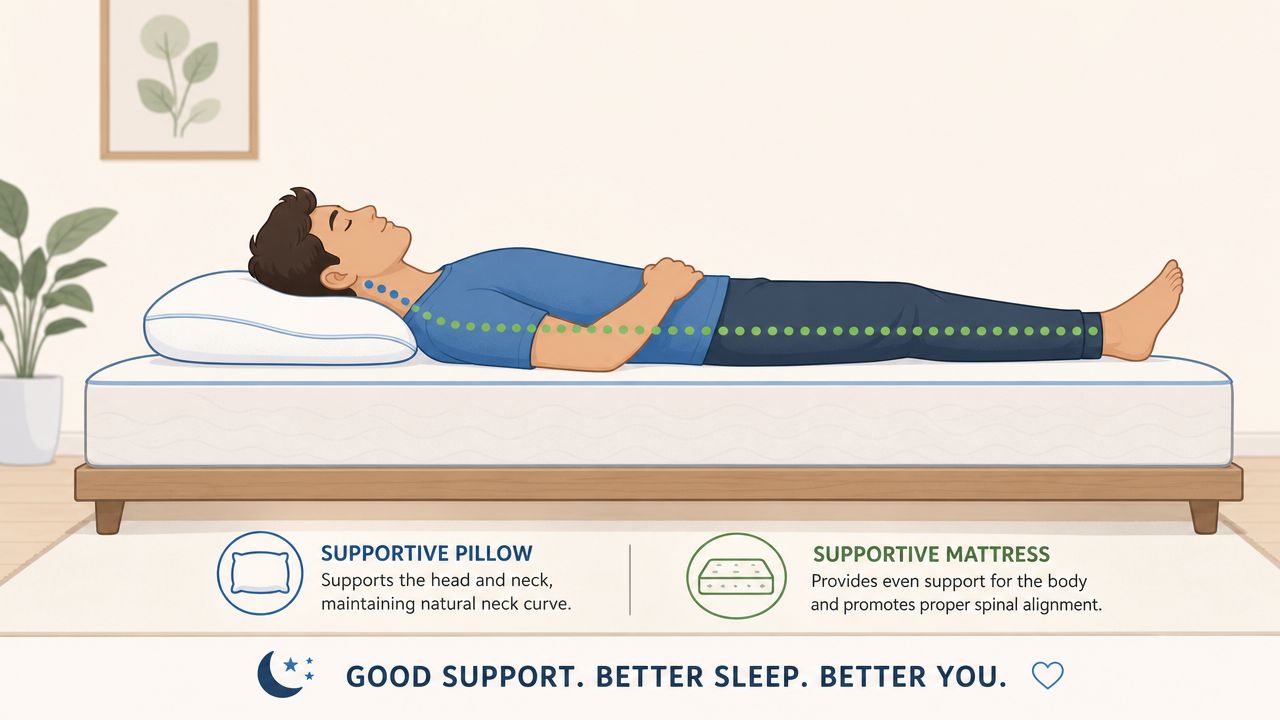
Good posture in bed depends on support. If your pillow and mattress don't match your body, even the “right” sleep position won't hold up through the night.
How to judge pillow height
Most pillow advice is too generic to be useful. “Low for back sleepers, higher for side sleepers” is directionally right, but you still need to test whether your head stays centered over your spine.
Use a mirror, a phone photo, or another person's eyes if possible. In back sleeping, your forehead and chin should stay level rather than tipping sharply up or down. In side sleeping, your nose should stay in line with your breastbone rather than dropping toward the bed.
A pillow is probably not helping if:
- You wake up folded forward: Your chin sits closer to your chest and the back of your neck feels stretched.
- You wake up with side bend stiffness: One side of your neck feels compressed and sore.
- You keep punching or folding the pillow: Your body is trying to create support the pillow isn't giving you.
Why your mattress may be the missing piece
The pillow gets most of the attention, but the mattress controls your foundation. If the mattress sags, your spine sags with it. If it feels like a board, pressure points can make you tense up all night.
Recent physical therapy literature has highlighted mattress firmness as an often-missed factor in cervicogenic headache. A mattress that's too soft allows spinal misalignment that directly worsens C2-C3 joint strain, and that joint area is a root cause in 70% of cervicogenic headache cases, as noted earlier in the linked clinical discussion.
That doesn't mean everyone needs the same firmness. It means your mattress should let your shoulders and hips settle without letting your trunk collapse.
If you've upgraded pillows three times and still wake up with the same neck pain, stop blaming only the pillow. Look underneath it.
Try this simple self-check for a week:
| What to track | What to notice |
|---|---|
| Morning neck stiffness | Is it worse after nights when the mattress feels saggy or overly hard? |
| Headache starting point | Does it begin at the base of the skull after sleeping in one spot too long? |
| Night movement | Are you tossing around because you can't get supported? |
A Simple Nightly Routine to Ease Neck Tension
The best cervicogenic headache sleeping posture works better when your neck isn't going to bed braced and irritated. A short routine before sleep can help your body settle into the position you're trying to maintain.
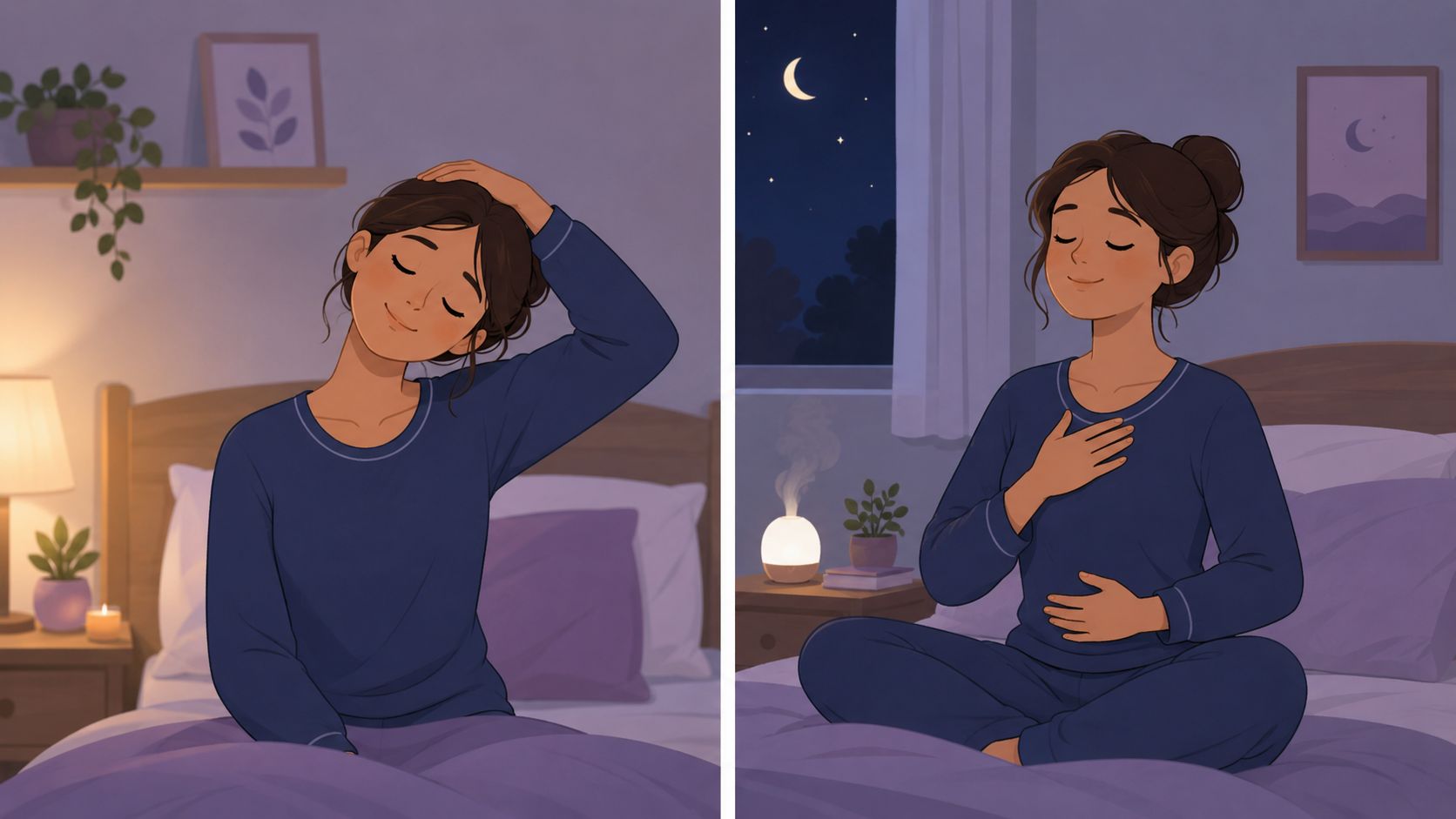
A five minute wind down for your neck
Keep this gentle. Bedtime isn't the place for aggressive stretching or “cracking” your neck.
Try this sequence:
Chin tuck
Sit tall and gently draw your chin straight back, as if you're making a small double chin. Hold briefly, then relax. The movement should feel subtle, not forceful.Small neck rotation
Turn your head a comfortable amount to one side, return to center, then repeat on the other side. Stay in an easy range. This is about reducing guarding, not chasing flexibility.Shoulder roll and exhale
Roll your shoulders up, back, and down, then take a slow breath out. A lot of neck tension is really neck-and-shoulder tension.Set your sleep position before you're drowsy
Arrange your pillow, knee pillow, or body pillow while you're still alert enough to notice alignment.
A simple routine works because it lowers the starting tension before your head hits the pillow. Done consistently, it can become a cue that tells your body it's time to unwind.
Gentle and repeatable beats intense and inconsistent.
If any movement sharply increases pain, stop and get guidance from a clinician.
When Lifestyle Changes Are Not Enough
Sometimes your setup improves and the pain still lingers. That doesn't mean you've failed. It usually means the problem needs a closer look.
Signs it is time to get checked
A probable cervicogenic headache may be diagnosed when there is a one-sided headache starting in the neck plus at least one additional feature, such as pain radiating to the shoulder or worsening with neck movement, according to ASRA's discussion of diagnosing cervicogenic headache. That doesn't mean you should diagnose yourself. It does mean those details are useful to track before an appointment.
Bring notes on patterns like:
- Where the pain starts: Neck first, then head, or head first with no neck trigger.
- What makes it worse: Looking up, turning your head, a specific sleep position, or time of day.
- What else comes with it: Light sensitivity, nausea, aura, dizziness, or shoulder pain.
This article is for informational purposes and is not medical advice. Consult a healthcare provider for personalized guidance.
Red flags that need urgent care
Seek immediate medical care for:
- A sudden severe headache: Especially if it feels explosive or unlike anything you've had before.
- Headache with fever or stiff neck: This needs urgent evaluation.
- Neurological changes: Weakness, numbness, confusion, vision loss, trouble speaking, or new balance problems.
- Headache after head injury: Even if the injury seemed minor at first.
If your symptoms don't fit a simple pattern, that's a good reason to get assessed rather than keep experimenting on your own. Consistent tracking can make that visit more productive because it helps separate neck-driven pain from migraine features, sleep triggers, and daily habits.
If you want a simple way to log headache timing, neck-related triggers, sleep changes, and symptom patterns over time, Relief can help you spot trends and bring clearer information to your next medical visit.


