You've probably had this moment: a bad migraine, a worried clinician, and a scan order that makes you wonder whether something is being missed. A CT scan for migraines is usually not the test that proves migraine, and for a typical migraine pattern with a normal neurologic exam it's usually unnecessary. What it can do is help rule out dangerous problems when your headache stops acting like your usual migraine.
This article is for informational purposes and is not medical advice. Consult a healthcare provider for personalized guidance.
Table of Contents
Do Migraine Sufferers Actually Need a CT Scan
The short answer is usually no. If your headaches still follow your usual migraine pattern, your neurologic exam is normal, and there are no red flags, major headache guidance says routine brain imaging isn't needed. The American Academy of Neurology guidance, later reaffirmed in Choosing Wisely summaries, says neither CT nor MRI is warranted in adults with recurrent migraine without recent substantial change, seizures, or focal neurologic symptoms, and the American Migraine Foundation notes that guidance dates back to 1994 and was reaffirmed in 2013. American Migraine Foundation summary of imaging guidance
That answer can feel unsatisfying when you are in pain. People usually ask about imaging because the headache has been severe, the pattern feels different, or a clinician is trying to rule out something dangerous and explain why a scan might help. A head CT is a test for structure, not for migraine itself.
Practical rule: if the headache still behaves like your established migraine, imaging is usually low yield. If it no longer does, that is where the conversation changes.
The low yield has been documented repeatedly. One study found close to 80% of patients with isolated chronic headache had a normal CT scan, and another reported normal CT findings in 61.5% of patients with migraine or tension-type headache.
That does not mean your pain is “nothing.” It means the scan is not built to diagnose the migraine process. It is mainly a rule-out tool when the clinical picture raises concern for a secondary cause.
What a Head CT Scan Can and Cannot Detect
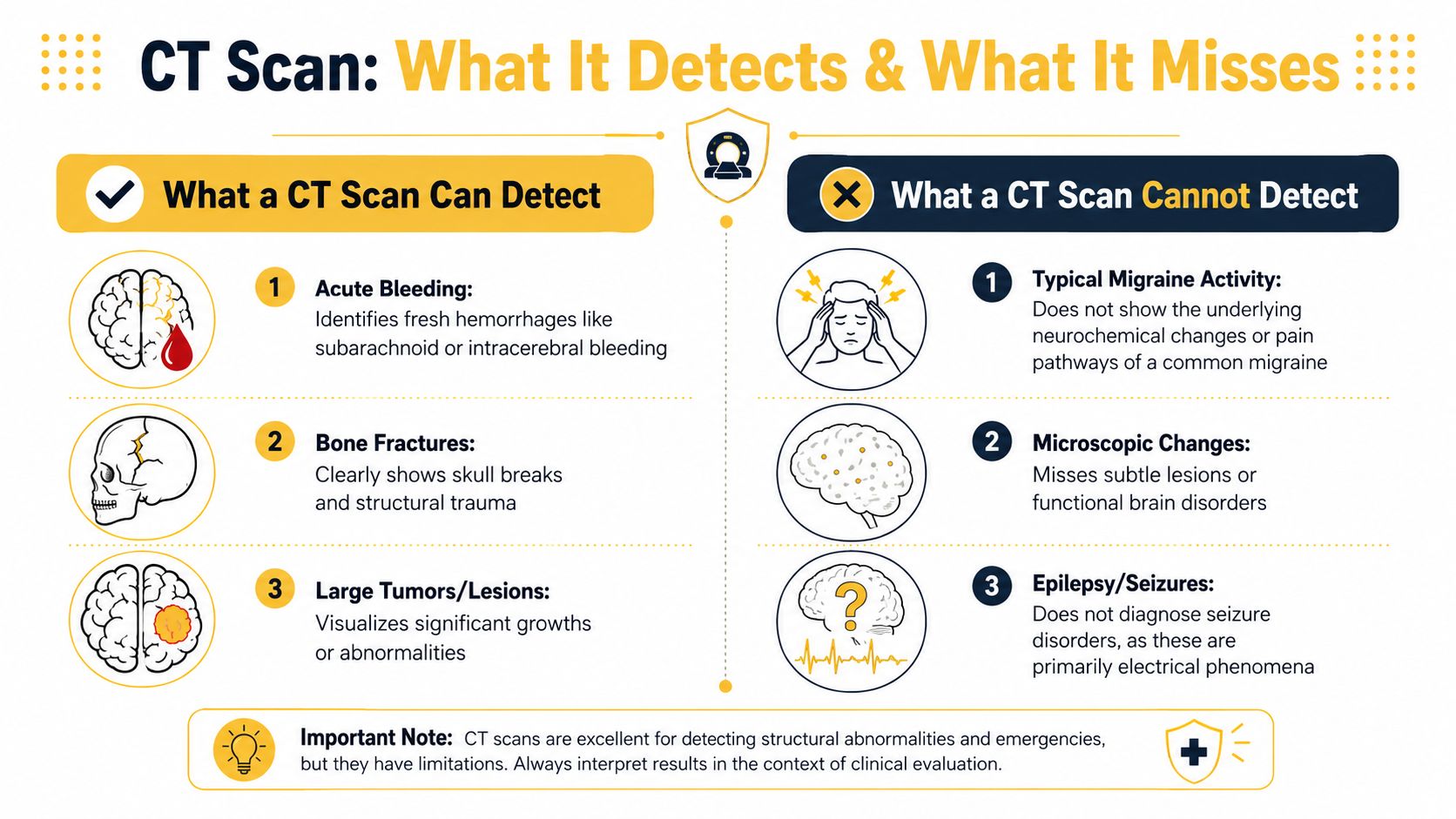
A CT scan uses X-rays to create fast cross-sectional pictures of the head. It functions as a flashlight, not a microscope. It's excellent for spotting big, urgent problems, but it isn't designed to show the biochemical and nerve-signaling changes that make migraine hurt.
What CT is good at
When clinicians worry about a dangerous cause, CT is often the first-line emergency test because it's fast. Radiology guidance says it can detect subarachnoid hemorrhage, intracranial bleeding, hydrocephalus, stroke, aneurysm, skull fracture, or tumor in urgent headache presentations. RadiologyInfo head CT overview
That speed matters. In an emergency, a test that quickly shows a bleed or a fracture can change the next step right away. If the CT suggests a problem, follow-up CTA or MRI may come next depending on what was seen.
What CT is not good at
A CT scan does not diagnose migraine itself. It also doesn't show the pain pathways, neurochemical shifts, or the aura process that many migraine patients experience. In routine migraine care, it often misses the thing you feel, because migraine is usually a functional problem rather than a large structural one. WebMD summary of migraine imaging guidance
It's also not the best tool for small or subtle findings. Mild abnormalities, tiny lesions, and many non-urgent brain changes are better seen on MRI when imaging is needed.
CT answers, “Is there a big emergency hiding here?” It doesn't answer, “Why do I get migraine?”
Red Flags That Change the Imaging Decision
The key question isn't just, “Do I need a scan?” It's, “Has your headache stopped behaving like your usual migraine?” When the answer is yes, imaging becomes more reasonable. When the answer is no, the default is usually to avoid scanning and focus on migraine care.
The red flags that matter most
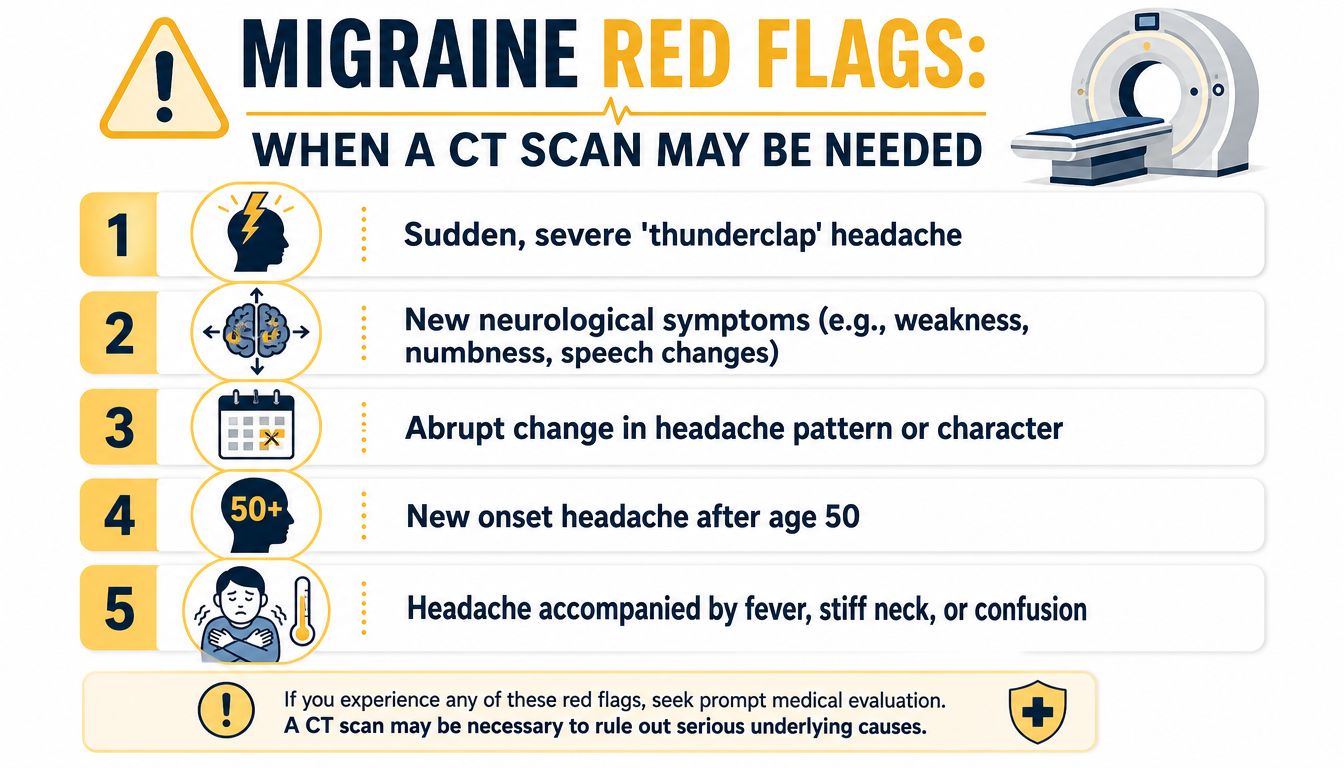
A Harvard Health review of imaging guidance lists red flags such as abnormal exam findings, thunderclap headache, optic disc swelling, new or progressive headache after head injury, cancer, immunosuppression, pregnancy, age over 50, and headaches worsened by exertion or position changes. Harvard Health red-flag review
A separate headache-imaging summary also highlights situations where imaging may be considered, including unusual or prolonged aura, increasing frequency or severity, first or worst migraine, brainstem aura, hemiplegic migraine, aura without headache, side-locked headache, and posttraumatic headache. American Headache Society review
What each red flag should prompt
- Sudden severe thunderclap onset. This can signal bleeding, so seek immediate medical care.
- Weakness, numbness, speech trouble, or confusion. New neurologic changes need urgent evaluation.
- Headache after head injury. Trauma changes the decision quickly, especially if symptoms are worsening.
- New headache after age 50. That pattern deserves prompt workup because it's not typical for longstanding migraine.
- Fever or stiff neck. These can point to infection, so don't wait it out at home.
If you're pregnant, immunocompromised, have cancer, or notice that headaches are worse with exertion or position changes, that also deserves a clinician's review. The point isn't that every one of these means something dangerous is definitely happening. The point is that these features break the usual migraine pattern enough to justify looking deeper.
CT Scan vs MRI for Migraine Evaluation
People often ask whether they should be asking for MRI instead of CT. The honest answer is that it depends on the situation. In emergency care, CT usually comes first because it's fast. In non-emergency settings where imaging is needed, MRI is often more useful for soft tissue detail.
The trade-off is simple. CT is quicker and better for fresh bleeding and bone. MRI takes longer, uses no ionizing radiation, and is better for subtle brain detail, white-matter changes, and structures that can be hard to see on CT. For migraine without red flags, neither test is usually indicated.
| Factor | CT scan | MRI |
|---|---|---|
| Speed | Fast, often preferred in emergencies | Slower |
| Radiation | Uses ionizing radiation | No ionizing radiation |
| Best at | Fresh bleeding, skull fracture, urgent structural problems | Soft tissue detail, subtle lesions, posterior fossa structures |
| Typical use in headache | Rule out dangerous acute causes | Better follow-up test when imaging is needed outside the emergency setting |
| Practical downside | Less detail for small or subtle issues | Longer exam, often less available |
That table is the patient question in plain language. If the concern is “Could I have a bleed or something urgent right now?”, CT is usually the first stop. If the concern is “My headache pattern is odd, but I'm stable and this isn't an ER situation,” MRI may be the more informative study when a scan is warranted at all.
What Happens During a Head CT Scan
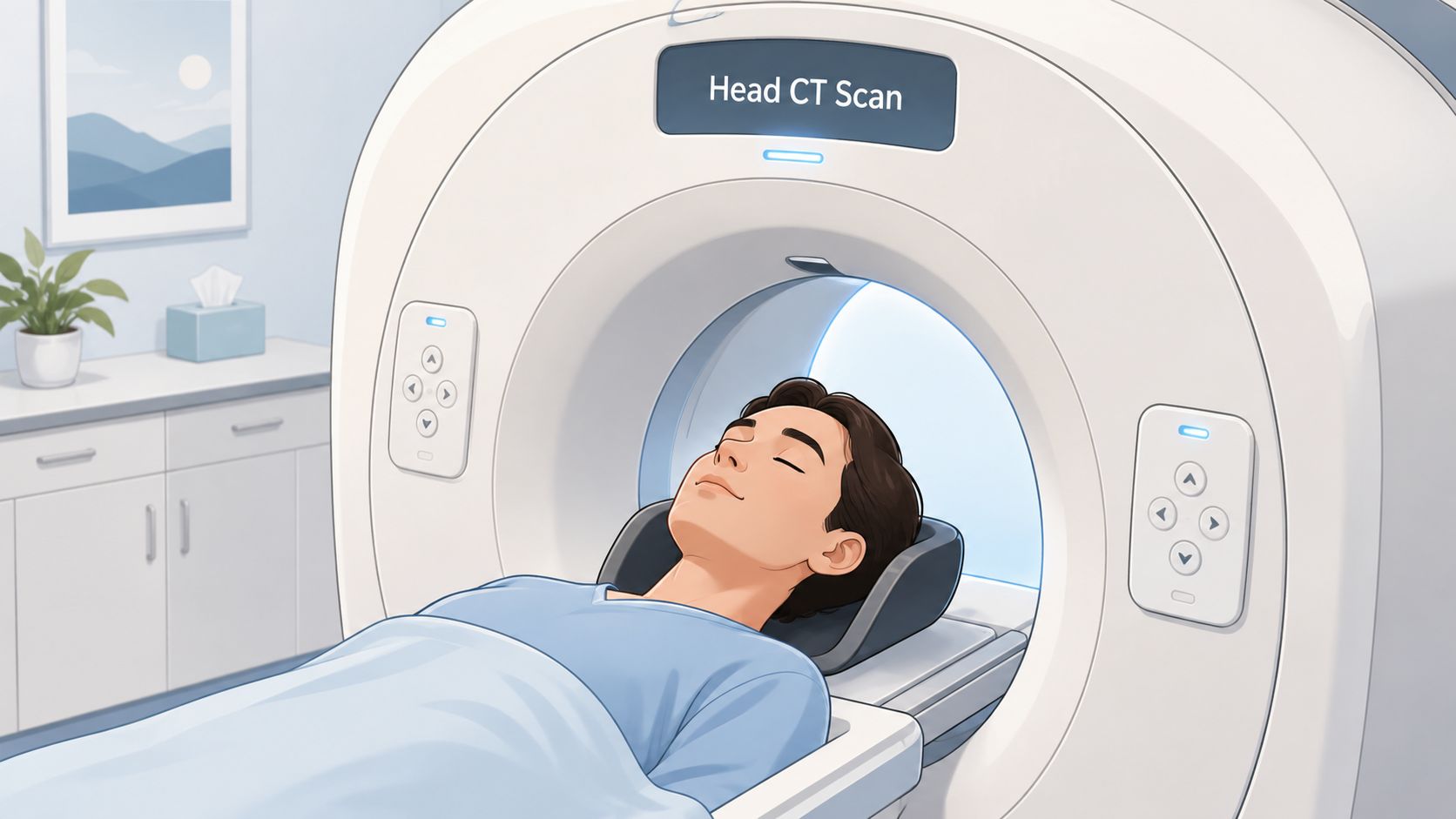
Most head CT appointments are shorter and less dramatic than people fear. You usually check in, change if needed, remove metal from your head and neck area, and lie down on a narrow table that slides into a donut-shaped scanner. The machine is open at both ends, and the actual imaging part is usually quick.
For people with migraine, the biggest issues are often light, noise, anxiety, and lying still. If bright lights bother you, bring sunglasses to the waiting area and ask whether you can keep your eyes covered before the scan starts. If pressure on your head worsens symptoms, tell the technologist early so they can help with positioning.
The scan itself can make some clicking or whirring sounds, but it doesn't usually feel painful. If contrast dye is used, it's typically given through an IV, and you may feel a brief warm sensation. Contrast isn't always needed for migraine evaluations.
Afterward, a radiologist reads the images and sends a report to the ordering clinician. A “normal” report usually means no concerning structural problem was seen on that scan, not that your pain was imaginary or unimportant.
A short video explanation can also help if you're visual and want to know what the room and machine feel like.
Understanding CT Radiation and Safety
Radiation is the part of CT that makes many people hesitate, and that concern is reasonable. A head CT uses ionizing radiation, unlike MRI. For a clinically indicated scan, though, the benefit of finding a dangerous cause almost always outweighs the small radiation cost.
The safety question becomes more important when scans are repeated, when the patient is a child, or when pregnancy is involved. That's where cumulative exposure matters more. For a one-time, clinically justified head CT in an adult, clinicians usually focus on whether the scan could rule out a serious problem that needs urgent treatment.
Contrast dye is a separate issue. It isn't always used for migraine workups, and when it is used, the team is usually looking for details that plain CT can't show as clearly. Some people are more likely to react to contrast than others, so your team should know about prior reactions or kidney concerns before the scan.
Pregnancy deserves special caution. If you're pregnant and a scan is being discussed, that's a conversation to have right away with the clinician ordering it, because the risk-benefit balance changes.
How to Talk to Your Doctor About Imaging
The easiest way to have a useful imaging conversation is to bring the story, not just the fear. Start with the facts that change the decision: when the headache started, how it differs from your usual migraine, whether you've had aura, and whether there are new symptoms like weakness, speech trouble, fever, or head injury. A short symptom log helps, especially if you can show pattern change over time.
You can say, “My migraines usually feel like this, but this episode is different because ___.” That sentence keeps the focus on the feature that matters clinically: change from baseline. If a scan is ordered, ask what red flag it's meant to rule out.
A few questions can make the visit more precise:
- Which red flags are you ruling out with this scan?
- Is MRI an option instead?
- If this comes back normal, what's our next step?
If your doctor orders a scan and you're unsure why, it's fair to ask whether imaging is likely to change management. That isn't being difficult. It's a respectful way to make sure the test is answering a real clinical question.
Reducing Unnecessary Scans Through Better Pattern Tracking
Good tracking makes the imaging decision easier. When you can show that your attacks have the same frequency, severity, prodrome symptoms, triggers, and medication response they've always had, clinicians have less reason to scan defensively. When the pattern changes, the record makes that change obvious.
That's where a simple log helps. Jot down date, start time, pain location, aura if present, nausea, light sensitivity, and anything unusual about the attack. Over time, that kind of record helps separate “my usual migraine” from “this is different,” which is exactly the boundary that matters in imaging decisions.
For ongoing tracking, Relief can help you notice patterns in weather, symptoms, and attack timing so your next appointment starts with better information. One calm step today is to save your last three attacks in a note or app, then compare them with this week's symptoms.
If you want a clearer migraine history before your next appointment, start tracking your attacks now with Relief. It can help you spot whether your headache is behaving like your usual migraine or crossing into red-flag territory. That kind of record can make the next imaging conversation faster, calmer, and more accurate.


