
Yes, for many people, exercise can help reduce headaches and migraines when you do the right amount consistently. Research includes a 40-minute session, three times per week that worked as well for migraine prevention as relaxation training or topiramate, and other evidence suggests 30 to 40 minutes at moderate-to-high intensity three or more times weekly can reduce monthly migraine days by about 2 days.
That answer can feel unfairly complicated when you're living it. You may have been told to “just exercise more,” then had a workout leave you with throbbing pain, nausea, light sensitivity, or that familiar sense that a migraine attack is building. If that's happened, you're not imagining it. Exercise can be both helpful and triggering, and the difference often comes down to type, intensity, timing, and your personal migraine pattern.
It also helps to separate headache from migraine. A headache is a symptom. Migraine is a neurological condition that can involve head pain, but also aura (temporary neurological symptoms such as visual changes), prodrome (early warning symptoms before the attack), photophobia (light sensitivity), nausea, dizziness, and postdrome (the drained, “migraine hangover” phase after the pain eases). So when people ask, “does exercise help headaches,” the answer often depends on whether you're dealing with tension-type headaches, exercise-triggered head pain, or migraine.
This article is for informational purposes and is not medical advice. Consult a healthcare provider for personalized guidance.
Table of Contents
- The Confusing Link Between Exercise and Migraines
- Why moderate movement often helps
- Why intensity changes the experience
- How much is enough to help
- When more stops helping
- A safe framework for finding your range
- How to tell helpful movement from a potential trigger
- Use a short experiment, not guesswork
The Confusing Link Between Exercise and Migraines
You finish a workout hoping it will help you feel better, then an hour later your head is pounding and you wonder whether exercise is helping or hurting. That uncertainty is exhausting, especially if you are already trying to manage sleep, stress, meals, hydration, and other triggers at the same time.
Both experiences can happen because exercise has a therapeutic window. Too little movement may leave stress, poor sleep, and physical tension unchecked. Too much intensity, too fast, or under the wrong conditions can push a sensitive nervous system past its limit.
Migraine works less like a simple on-off switch and more like a load meter. On a lower-load day, a walk, easy ride, or gentle strength session may feel settling. On a higher-load day, the same body might react badly to heat, dehydration, skipped food, hard intervals, heavy straining, or a sudden jump in effort.
That is why people with migraine often get mixed messages from their own experience. Someone with episodic migraine may tolerate moderate movement most of the time but get caught by a few bad workouts. Someone with chronic migraine may have a much narrower margin, so even a session that looks mild on paper feels like too much. Subtype matters too. Aura, vestibular symptoms, neck pain, and exercise intolerance can all change what “safe enough” looks like.
The goal is not to force yourself through workouts that clearly make you worse.
The goal is to find the amount and type of movement your nervous system can handle often enough to give you benefit without tipping into a trigger. For many people, that means starting below what they think they “should” be able to do, then building from there in small, repeatable steps.
Patterns matter more than single workouts. A brutal class once a week followed by a two-day crash usually teaches you less than several steady, manageable sessions that leave you feeling the same or slightly better afterward. If exercise is going to help your headaches, the helpful dose is often the one you can recover from.
If you are trying to sort out whether movement is protective, neutral, or provocative for you, tracking helps. A migraine tracking app for exercise and symptom patterns can make it easier to notice whether your threshold changes with intensity, duration, heat, meals, hydration, or the phase of a migraine attack.
How Movement Changes Your Brain and Body Chemistry
Movement affects migraine through more than one pathway. It can change pain signaling, stress response, sleep quality, mood, and even how reactive your body is to common triggers.

Why moderate movement often helps
One of the clearest mechanisms is endorphin release. Endorphins are part of your body's internal pain-control system. You can think of them as built-in chemical messengers that help turn the volume down on discomfort. Cardiovascular exercise also activates other endogenous neurotransmitter signals, including enkephalins, which may reduce migraine pain intensity, according to this review in PMC on exercise and migraine mechanisms.
Regular aerobic exercise can also lower migraine-related disability. A review summarized by News-Medical on exercise and migraine reports that moderate-intensity aerobic exercise for at least 30 minutes, three times per week stimulates endorphin release, lowers migraine-related problems such as sleep disturbances, depression, and anxiety, and leads to a mean reduction of 0.6 migraine days per month.
That matters because migraine rarely lives in isolation. Bad sleep raises stress. Stress changes how tense your neck and shoulders feel. Anxiety can make early symptoms harder to read. Exercise doesn't erase those factors, but it may make your system less reactive to them.
A practical way to picture it is this:
| Body system | What exercise may do | Why it matters for migraine |
|---|---|---|
| Pain signaling | Supports endorphins and related neurotransmitters | Pain can feel less intense |
| Stress response | Helps regulate stress hormones such as cortisol | Your trigger threshold may be less fragile |
| Sleep and mood | Improves sleep quality and mood for many people | Poor sleep and stress often stack triggers |
| Circulation and resilience | Supports healthier overall function | Some people feel fewer attacks with consistent routines |
Why intensity changes the experience
The catch is that exercise changes the body in both helpful and unhelpful ways depending on dose. A manageable walk or bike ride may calm your system. A sudden max-effort workout can spike breathing, blood pressure, heat load, and muscle tension all at once.
Practical rule: Aim for the kind of workout you can finish feeling better regulated, not wrung out.
Later research has also looked at more vigorous training. A review discussed by Migraine Disorders on aerobic exercise and the migraine paradox found that rigorous aerobic exercise alone can reduce migraine frequency, intensity, and duration, with greater benefits at higher intensity in the studies reviewed. That sounds encouraging, but “higher intensity helps” doesn't mean “go as hard as possible on day one.” Your body still needs time to adapt.
If it helps, watch this overview before you test a new routine:
The Best Types of Exercise for Headache Relief
Different workouts stress the body differently. For migraine, the best option is often the one that gives you cardiovascular benefits without a chaotic spike in symptoms.
Aerobic exercise for a steadier response
For many people, aerobic exercise is the most practical starting point. That includes:
- Brisk walking if you want low impact and easy pacing
- Cycling if outdoor walking means too much heat, glare, or impact
- Swimming if cool water helps you tolerate exertion
- Jogging if your attacks are stable and you already handle impact well
Aerobic routines are useful because they can be scaled. You can go from easy to moderate without the abrupt strain that some high-intensity formats create. That matters when your goal is consistency.
A Swedish clinical study in 91 patients found that exercising for 40 minutes, three times per week was statistically as effective as relaxation training or taking the preventive migraine drug topiramate for prevention, but topiramate caused significant side effects while exercise did not. The same research group later analyzed 46,648 people and found an inverse relationship between physical activity and headache frequency. Very high frequency and intensity did not add benefit beyond that moderate program, as described in this summary of the Swedish migraine exercise research.
Another patient-facing source, Migraine Canada on exercise and migraine, cites evidence that 30 to 40 minutes at moderate-to-high intensity, three or more times weekly, reduces monthly migraine days by an average of 2 days compared with no exercise.
Strength training and mind-body movement
Strength work deserves more attention than it usually gets. If your attacks come with neck tension, shoulder tightness, or poor posture after long desk hours, resistance training may help by improving muscular support and reducing strain during daily life.
Research also suggests that the combination matters. This study in PMC on aerobic plus muscle-strengthening activity found that a combined regimen of vigorous aerobic exercise and muscle-strengthening activities was associated with a 52% statistically significant decrease in the odds of severe headache or migraine compared to inactivity.
That doesn't mean everyone with migraine should jump into heavy lifting and bootcamp intervals. It means mixed training may be worth building toward if your body tolerates it.
Mind-body movement belongs in the conversation too. The evidence base in the material here emphasizes aerobic and strengthening work most strongly, but many clinicians include yoga or Tai Chi because they can support flexibility, breathing control, and stress regulation. Those forms may be especially useful if intensity itself is a trigger for you.
A simple comparison can help:
| Exercise type | Best for | Watch out for |
|---|---|---|
| Walking or cycling | Building consistency with less strain | Heat, hills, bright light |
| Swimming | Lower impact, steady cardio | Chlorine, strong smells, scheduling |
| Strength training | Neck, shoulders, posture, resilience | Breath-holding and sudden maximal effort |
| Yoga or Tai Chi | Stress regulation, flexibility, body awareness | Inversions or positions that aggravate symptoms |
| Interval training | Some people with stable patterns and conditioning | Too intense too soon can trigger pain |
A helpful workout is one you can repeat next week, not one that leaves you afraid to move again.
Finding Your Exercise Therapeutic Window
You finish a workout feeling proud, then two hours later your head starts to pound. The next week you skip exercise because you do not want to gamble. That push-pull is common with migraine, and it is exactly why the idea of a therapeutic window helps. Exercise works best in a middle range. Too little may not do enough to change migraine patterns. Too much, too fast, can act like another stressor on an already sensitive nervous system.
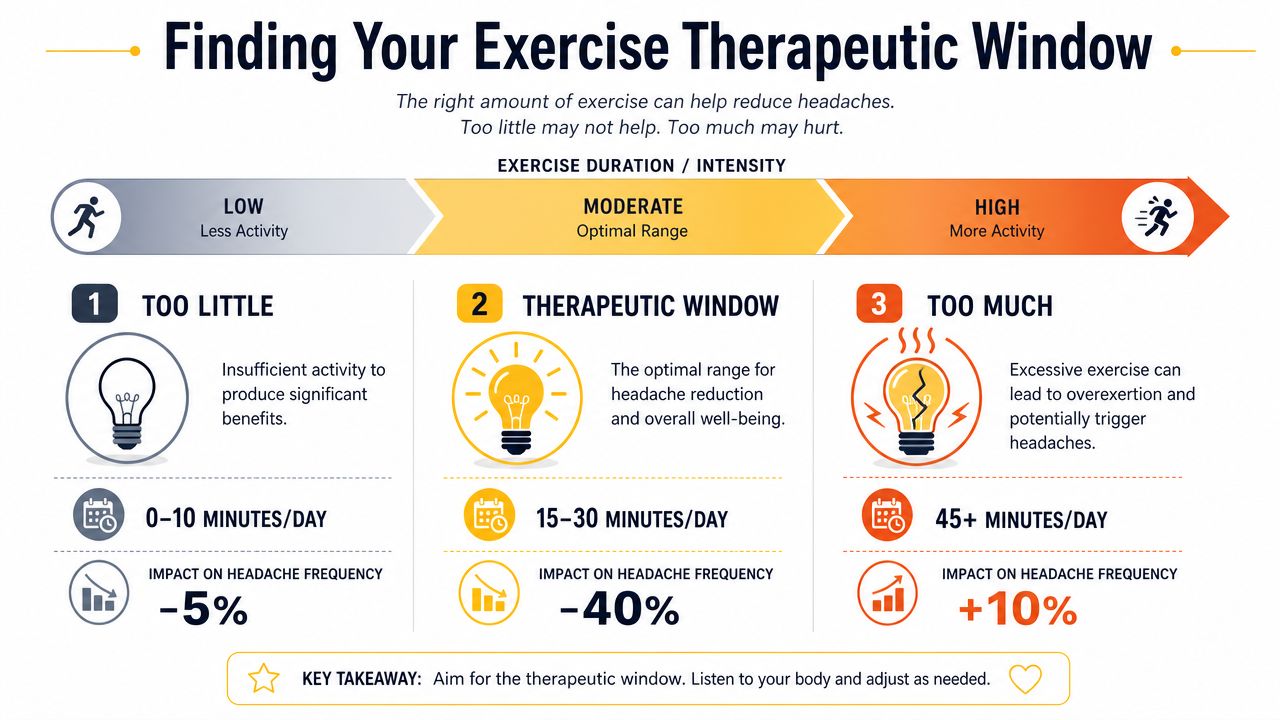
The infographic above is a visual aid, not a research summary. Your actual window depends on dose, intensity, and your personal trigger pattern.
How much is enough to help
A useful way to view exercise is like medication dosing. An occasional pill taken at random times rarely prevents anything. Exercise works similarly for migraine prevention. The body usually needs a repeatable dose before benefits show up.
A meta-analysis summarized by Migraine Collaborative on how much exercise is enough for migraine gives practical targets: about 200 total minutes of moderate aerobic exercise per week was linked with lower pain intensity, and about 300 minutes per week was linked with lower migraine frequency.
That helps explain a frustrating pattern many readers know well. One walk here, one bike ride there, and no clear payoff. The effort is real, but the dose may still be below the range where preventive effects become noticeable.
Consistency matters more than heroics.
When more stops helping
The same analysis noted that benefits plateaued around 900 to 950 minutes per week. After that, extra exercise did not appear to add more migraine benefit.
That ceiling matters because migraine is not only about fitness. Hard training can also bring heat exposure, missed meals, dehydration, poor sleep, and muscle soreness. If those stack up, it becomes harder to tell whether exercise is helping your brain or irritating it.
A better goal is a repeatable amount your body tolerates well enough to do again next week.
A safe framework for finding your range
Start low enough that your nervous system does not treat the workout like a threat, then increase one variable at a time. That is the safest way to spot your own therapeutic window.
Pick a steady weekly rhythm
Start with 3 sessions per week. Predictability helps you judge cause and effect.Keep effort in the moderate zone
You should be breathing harder but still able to talk in short sentences. If every session leaves you nauseated, overheated, or wiped out for the rest of the day, the intensity is probably above your current range.Use session length as your first dial
A reasonable early target is 20 to 40 minutes. If 40 feels like too much, begin shorter and build gradually.Change only one thing at a time
Increase either duration, intensity, or frequency. Do not raise all three in the same week. That makes your response much easier to read.Support the workout so it has a fair chance to help
Eat beforehand if fasting is a trigger. Hydrate. Warm up. Cool down. Choose a cooler time of day if heat or glare tends to set you off.
How to tell helpful movement from a potential trigger
This part confuses many people, so a simple rule helps. Helpful movement usually leaves you feeling worked, then settled. Triggering movement often leaves you feeling overloaded.
Signs you may be inside your therapeutic window:
- You recover within a few hours
- Headache frequency stays the same or improves over several weeks
- Sessions feel manageable enough to repeat
- You notice better sleep, mood, or stress tolerance
Signs you may be pushing past it:
- Head pain shows up during or shortly after most workouts
- You need days to recover from a single session
- You only flare after intense bursts, hills, heavy lifting, or hot conditions
- Your pattern gets worse when you increase volume quickly
That does not mean exercise is failing. It usually means the dose, pace, or setup needs adjustment.
Use a short experiment, not guesswork
Try one exercise plan for 2 to 4 weeks before judging it. Keep the type of exercise mostly the same. Keep notes on duration, effort, timing, and whether symptoms appeared during the workout, later that day, or the next morning. Migraine patterns can be delayed, so a same-day check is not always enough.
If you seem to tolerate moderate exercise well, you can test a small progression. Add 5 to 10 minutes to one session per week, or add a little intensity to one session, not every session. That approach helps you find the upper edge of your window without crashing through it.
Some people eventually tolerate vigorous training well. Others do best with steady, moderate work and careful pacing. Both are valid. The right dose is the one that improves your overall migraine pattern and still fits your life.
This article is for informational purposes and is not medical advice. Consult a healthcare provider for personalized guidance.
What to Do When Exercise Triggers a Headache
You finish a workout expecting that clear-headed, calmer feeling. Instead, your head starts pounding halfway through the session or an hour later. That can feel discouraging, especially if you are exercising to help your migraines in the first place.
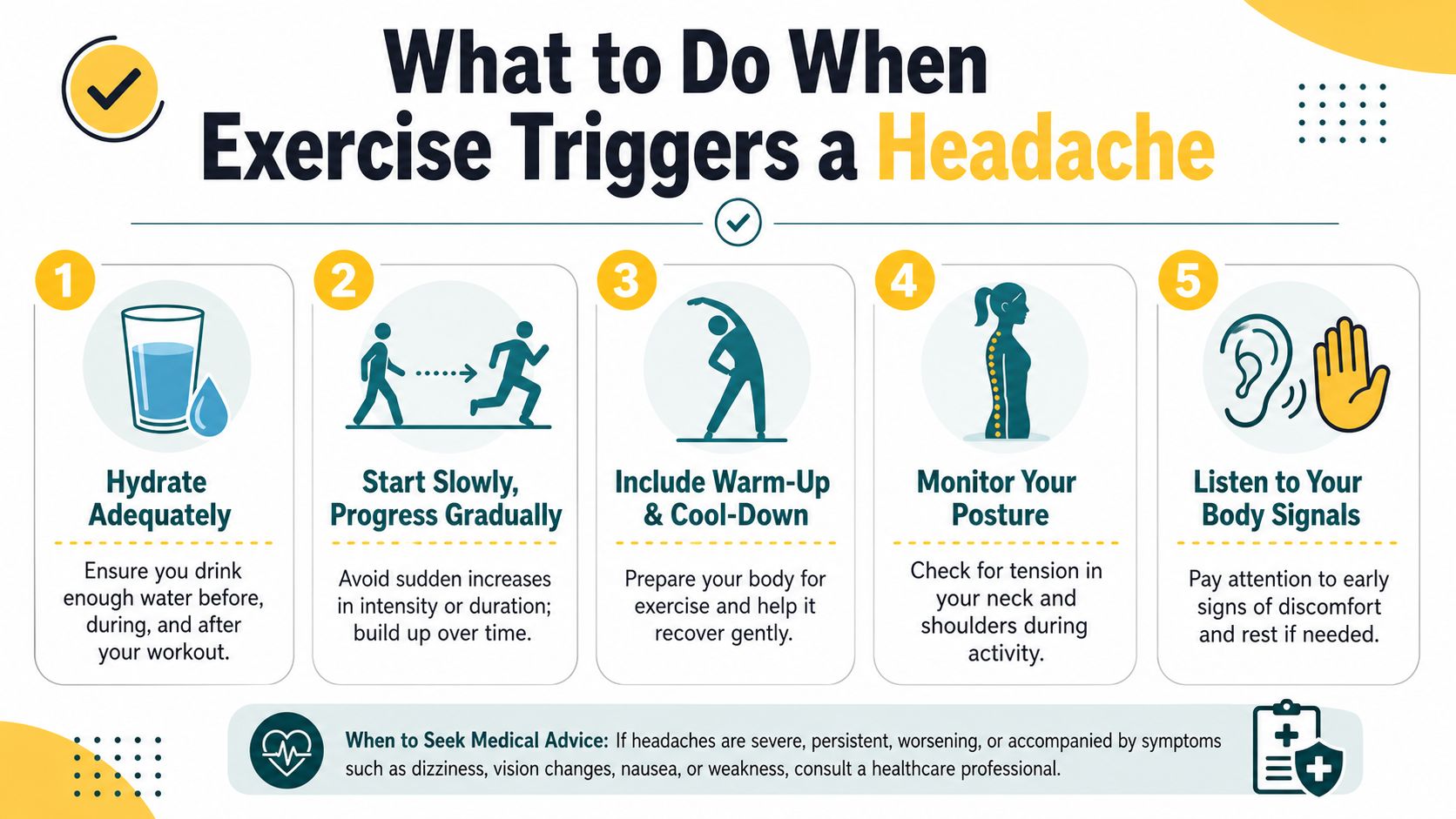
A flare after exercise usually means the workout landed outside your current therapeutic window. In plain terms, the dose was too much for that day, that setting, or that stage of your migraine cycle. The goal is not to quit movement. The goal is to change the conditions so your body reads exercise as steady input rather than a threat.
Common reasons a workout turns into pain
Exercise-triggered headache often comes from a mismatch between what your system can handle and what the workout asks of it. A few patterns show up often:
You started the session already depleted
Low fluids, missed meals, poor sleep, or a stressful day can lower your buffer before you even begin.The intensity rose too fast
Sudden jumps in pace, hills, heavy lifting, or all-out intervals can push the nervous system past its comfort zone.The environment added strain
Heat, bright sun, altitude, and stuffy rooms can make a tolerable workout feel much harder.Your muscles added mechanical stress
Jaw clenching, shrugged shoulders, neck strain, or poor form can feed headache pain during exercise.You exercised at a vulnerable time
Some people are more sensitive when fasting, during the early phase of a migraine, or after several trigger-filled days.
A helpful way to approach this is to troubleshoot like you would with a recipe. If one version goes badly, change one ingredient at a time so you can tell what mattered.
| If this happens | Try this adjustment |
|---|---|
| Head pain starts in the first 10 to 15 minutes | Add a longer warm-up and begin at an easier pace |
| Pain shows up after sprints, hills, or heavy sets | Use steady cardio or lighter resistance for 1 to 2 weeks |
| Outdoor sessions trigger symptoms | Exercise indoors or choose cooler, darker times of day |
| Headache comes with neck or shoulder tightness | Lower the load, relax your jaw, and check posture |
| You flare on workout days that also include poor sleep or missed meals | Fix the setup first, then test exercise again |
One point often causes confusion. A workout that is "healthy" in general can still be the wrong dose for your migraine system right now. Harder is not always better. Very light movement is not always enough. The useful question is: did this session leave you more stable over the next day or two, or did it push you into symptoms?
Ask whether the workout was helpful, too much, or mistimed. That question gives you something practical to adjust.
If a session triggers pain, return to a level you have handled before. Shorter duration, easier effort, more gradual warm-up, better hydration, and less heat are common first fixes. Keep the next few workouts boring on purpose. Consistency teaches you more than heroic effort.
When to get urgent medical care
Some exercise-related headaches need prompt medical evaluation. Seek urgent care if you have:
- A sudden, severe headache
- Headache with fever or a stiff neck
- Neurological changes, such as new weakness, confusion, trouble speaking, or unusual vision changes
- Headache after a head injury
These symptoms can signal something other than a typical migraine or exertional headache.
If the pattern is less urgent but still concerning, bring notes to a clinician. It helps to record whether the pain began during exercise or afterward, whether it matched your usual migraine pattern, whether aura appeared, and what else was happening that day, such as poor sleep, hunger, dehydration, or heat exposure.
This article is for informational purposes and is not medical advice. Consult a healthcare provider for personalized guidance.
Track Your Exercise to Find Your Personal Pattern
Two people can do the same workout and have very different migraine outcomes. One feels clearer and steadier later that day. The other gets head pain three hours later. That is why your own records matter more than generic advice.
The goal of tracking is simple: find your therapeutic window. You are looking for the dose of movement that helps your nervous system without pushing it past its limit. Exercise works a bit like sun exposure. Too little may do nothing. Too much can leave you paying for it later. The useful middle zone is personal.
A short note after each session is enough. You do not need a detailed spreadsheet unless you like data.
What to log after each workout
Record the details that are most likely to explain why one session helped and another did not:
Type of exercise
Walking, cycling, yoga, swimming, strength training, intervalsDuration and intensity
How long you exercised, and whether it felt easy, moderate, or hardTiming and conditions
Morning, afternoon, evening. Before food, after food, indoors, outdoors, hot room, humid weatherWarm-up and pacing
Gradual start or sudden effort, steady pace or stop-and-go, any sprinting or heavy liftingBody signals during or after
Neck tension, dizziness, nausea, aura, light sensitivity, pounding pain, unusual fatigueMigraine outcome over the next 24 to 48 hours
Better after, unchanged, mild symptoms, delayed attack, full migraine attack
How tracking changes your decisions
Tracking helps you spot patterns you would probably miss from memory alone. You might notice that a 20-minute walk after breakfast feels calming, while a harder session in the heat after a rushed morning leads to symptoms. You may learn that strength training is fine when you breathe steadily, but overhead presses or breath-holding bring on pressure.
That gives you something concrete to adjust. Instead of deciding that exercise is good or bad for migraines, you can test one variable at a time: intensity, duration, timing, temperature, meals, hydration, or sleep.
Try this framework for two to three weeks. Keep the type of exercise fairly consistent. Change only one factor at a time. Look for repeat patterns, not one-off bad days. A single headache after exercise does not always mean the workout caused it. Migraine often reflects the whole load on your system that day.
If you want a simple way to log exercise, symptoms, triggers, and changing migraine risk in one place, Relief can help you spot the patterns that are hard to see day to day.


