
You check the forecast before leaving home, notice a sharp temperature change or a storm moving in, and wonder whether your headache is about to become a migraine. You're not imagining that environmental factors can affect health. Research suggests that temperature, barometric pressure, and air pollution can shift migraine risk for some people, although the effect is usually modest and highly individual.
Migraine is more than a headache. An attack may include photophobia, meaning sensitivity to light, phonophobia, or sensitivity to sound, nausea, aura, and phases such as prodrome, the symptoms before pain, and postdrome, the recovery period afterward. Your experience may also differ depending on whether you have episodic, chronic, vestibular, or another migraine pattern.
The broader environmental health picture matters too. The World Health Organization describes ambient and household air pollution as major global health risks. It reports about 6.6 million deaths globally each year from air pollution and says more than 90% of people live in places where air quality is unhealthy to breathe (World Health Organization air pollution overview). That population-level burden doesn't prove that a particular polluted day caused your attack, but it shows why exposure deserves serious attention.
This article is for informational purposes and is not medical advice. Consult a healthcare provider for personalized guidance.
Table of Contents
- Why the Weather Can Feel Like a Migraine Trigger
- What Counts as an Environmental Factor for Migraine
- Weather variables and migraine risk
- Nerves respond to changing conditions
- Pollution can add inflammatory stress
- A sensitive brain may amplify normal input
Why the Weather Can Feel Like a Migraine Trigger
A pressure drop is forecast overnight. You sleep poorly, wake with pressure behind one eye, and notice that light and ordinary sounds feel harsher than usual. The weather may be part of the pattern, but the forecast alone cannot explain every attack.
Weather sensitivity is real, yet the same atmospheric change may affect you differently from one day to the next. A migraine often develops when several influences meet a susceptible nervous system. Poor sleep, hormonal changes, missed meals, or stress may increase the significance of a pressure shift, while the same shift may pass without symptoms on another day.
Researchers examine several connected atmospheric exposures:
- Temperature: A rapid rise, sharp drop, or sustained heat may coincide with attacks.
- Barometric pressure: Pressure can change before or after a storm, sometimes with a delay.
- Humidity: Moisture levels may matter more when they change quickly or reach an extreme.
- Wind and storms: These can combine temperature changes, pressure movement, glare, odors, and altered air quality.
A 2025 meta-analysis of environmental factors and migraine found significant associations between temperature and migraine attacks, with an odds ratio of 1.15, and between ambient pressure and migraine, with an odds ratio of 1.07. Humidity was not statistically significant in that analysis, so average humidity alone may provide a weaker signal than some weather apps suggest.
The useful forecasting question is not whether weather causes migraine. Ask which changes, at what time, tend to appear alongside your symptoms. For example, a pressure drop may be a manageable background exposure after restorative sleep, but a poor night of sleep can make that same forecast day more difficult. The weather, air quality, and your personal condition work like a combined exposure load, rather than separate switches.
Track those patterns without treating them as proof of causation. A simple record of forecast changes, sleep, meals, symptoms, and timing can help you compare days and give a clinician clearer information.
What Counts as an Environmental Factor for Migraine
A weather change, smoky afternoon, or burst of glare can arrive alongside other pressures on the body. In migraine research, an environmental factor is an external physical or atmospheric exposure that may influence symptoms. It differs from internal conditions such as hormones, sleep, stress, or fasting, although those conditions can combine with environmental exposure and change the overall load.
A practical framework groups these exposures into three connected categories:
- Meteorological variables include temperature, humidity, barometric pressure, wind, and storms.
- Ambient air pollution includes particulate matter, ozone, nitrogen oxides, sulfur compounds, and carbon monoxide.
- Sensory and local exposures include pollen, wildfire smoke, indoor air quality, bright sunlight, glare, flicker, strong odors, and loud noise.
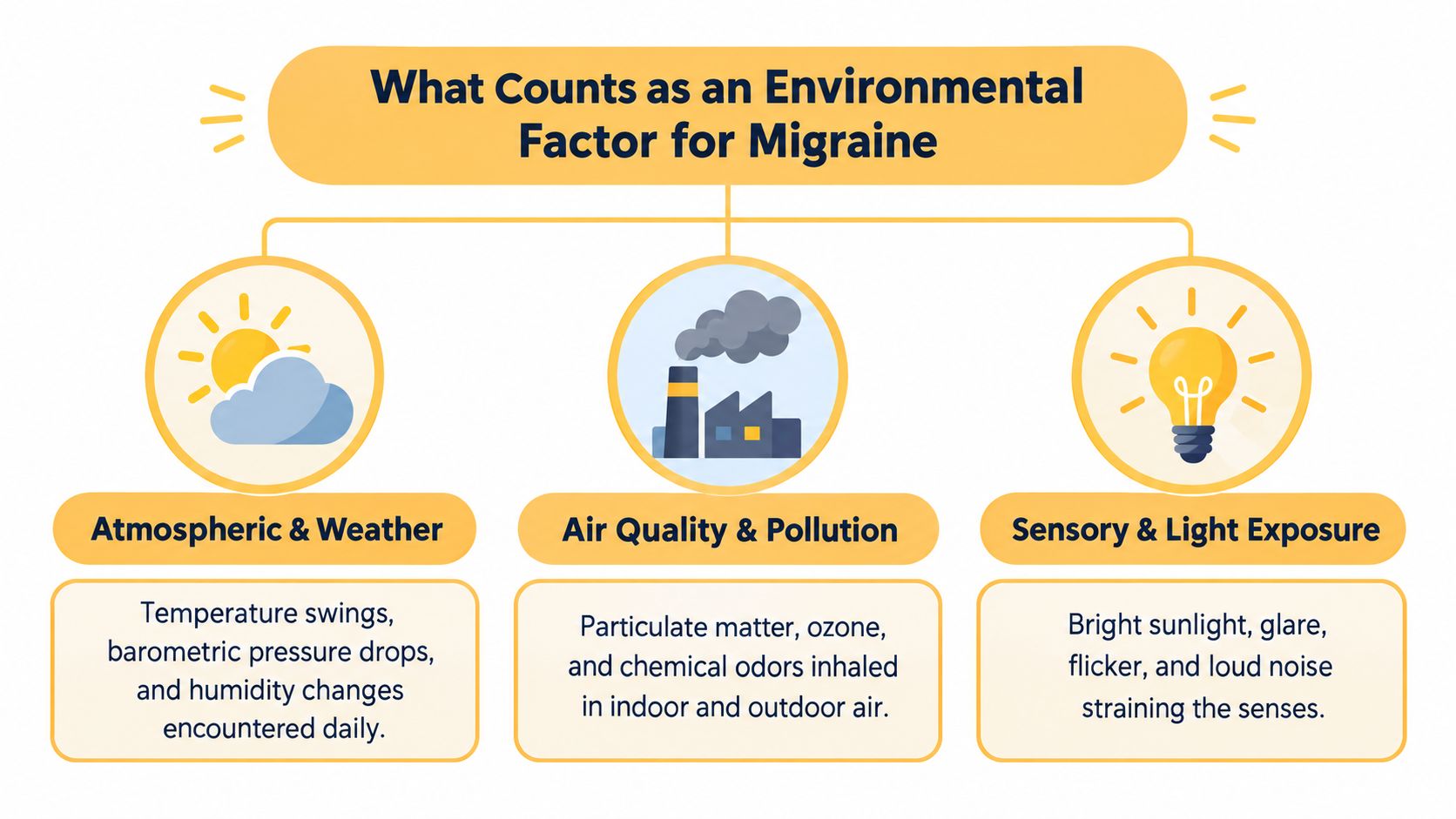
These categories often travel together. Hot weather can increase ozone, make indoor spaces uncomfortable, disrupt sleep, and contribute to dehydration. Wildfire smoke can combine particulate exposure, odors, reduced visibility, and concern about spending time outdoors. Viewing weather, air quality, and nearby sensory conditions as one exposure system can therefore be more useful than treating each factor as a separate switch.
Evidence also differs among pollutants. A systematic review found the clearest migraine signal for particulate matter, while findings for ozone and sulfur dioxide remained inconclusive (systematic review of ambient air pollution and migraine). That uncertainty does not rule out an individual response. It shows that research support is uneven across pollutants.
Together, meteorological, pollution-related, and sensory or local exposures form a three-category framework for understanding environmental influences on migraine.
Temperature, Humidity, and Barometric Pressure Explained
Weather conditions do not affect everyone in the same way, and the research is stronger for some signals than others. For personal forecasting, treat temperature, humidity, and pressure as connected parts of one exposure pattern, rather than as isolated switches.
Weather variables and migraine risk
| Variable | Direction of effect | Evidence strength | Typical lag time |
|---|---|---|---|
| Temperature | Higher temperatures and rapid changes may raise risk | Significant association in meta-analysis and hospital data | Same day to 24 hours |
| Humidity | Average humidity was not significant in one meta-analysis; rapid or extreme changes may still matter personally | Mixed | Variable |
| Barometric pressure | Pressure changes, particularly drops, may coincide with attacks | Significant association in meta-analysis and hospital data | Several hours to 72 hours |
Temperature is a useful signal for some people. Hospital-based data found that a 5°C increase in mean ambient temperature during the previous 24 hours was associated with a 7.5% increase in acute headache risk, with an odds ratio of 1.075 (hospital-based study of weather and headache risk). Because the study examined acute headache presentations, the result should not be treated as a precise forecast for every migraine attack.
Pressure may matter through its movement and timing. The same hospital study associated lower pressure during the prior 48 to 72 hours with nonmigraine headache presentations, reporting an odds ratio of 0.939 per 5 mm Hg. A falling pressure pattern before a storm may therefore be more relevant than the reading at the moment pain starts.
Humidity has a less consistent population-level signal. As noted earlier, research did not find a clear overall association, yet an individual may still notice symptoms during rapid or extreme changes. A single high reading is not proof of a trigger. Compare humidity's direction and speed of change with sleep, meals, illness, and medication changes. This guide to humidity and headaches can help you interpret those observations.
A practical forecast combines the variables. Hot, humid conditions may also encourage dehydration or poor sleep, while a pressure shift can occur alongside changes in temperature and air quality. Tracking the whole pattern gives you more useful context than assigning every attack to one weather reading. A pattern that precedes an attack for you may have no effect on someone else, and your own response may change from one day to another.
How Environmental Factors May Trigger a Migraine Attack
Scientists have proposed several biological pathways, but no single mechanism explains every weather-linked or pollution-linked migraine. Human studies often show associations rather than direct proof of cause, while laboratory and animal models can explain possible processes without fully reproducing a person's lived migraine experience.
Nerves respond to changing conditions
The trigeminal nerve network carries sensation from the face and head and plays a central role in migraine pain. Rapid temperature or pressure changes may irritate or activate this system in people who are susceptible. Researchers also study neurovascular coupling, the relationship between nerve activity and blood-vessel behavior, because changes in that system may make sensory responses more reactive.
Pollution can add inflammatory stress
Fine particles such as PM2.5 can reach deep into the lungs. Researchers propose that exposure may contribute to oxidative stress, which occurs when reactive molecules overwhelm the body's defenses, and may prime immune cells called microglia. Pollution may also stimulate inflammatory signaling through the nose and airways, although the exact route from exposure to migraine symptoms remains uncertain.
A sensitive brain may amplify normal input
During migraine, ordinary light, sound, smell, or movement can become difficult to tolerate. One proposed explanation is brain hyperexcitability, where sensory networks respond too strongly to signals that would usually feel neutral. Weather and pollution may act as additional inputs rather than isolated switches.
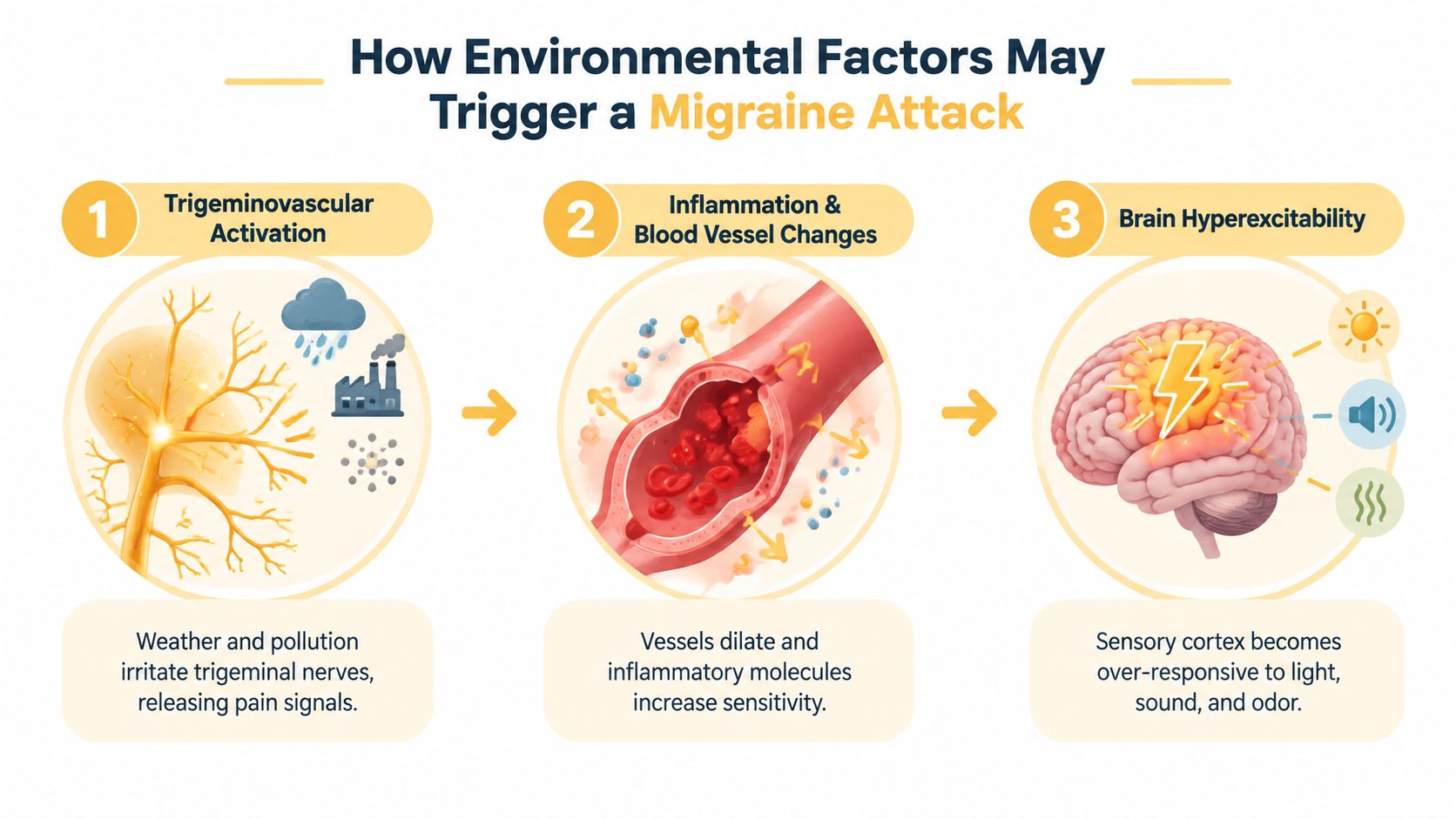
A pressure change, a PM2.5 increase, and a poor night's sleep can therefore create a more difficult day together than any one factor would create alone. This is why a diary should record exposure timing alongside prodrome symptoms, pain, nausea, aura, sleep, meals, stress, and menstrual or hormonal context when relevant to you.
The following video offers another visual explanation of the proposed connection between environmental exposure and migraine biology:
These mechanisms are plausible, not promises. If your headaches suddenly change, become more frequent, or feel different from your usual migraine, arrange medical evaluation rather than assuming the forecast explains them.
Air Pollution and Migraine Risk
Air pollution is a mixture, not a single exposure. Particles and gases behave differently in the air and in the body. Particulate matter has shown the clearest recurring migraine signal, but temperature, pressure, season, and other exposures can change how a reading relates to symptoms.
Air pollutants and migraine evidence at a glance
| Pollutant | Migraine evidence strength | Typical effect window | Likely mechanism |
|---|---|---|---|
| PM2.5 | Relatively consistent | Same day to two-day lag | Inflammatory and oxidative stress pathways |
| PM10 | Relatively consistent | Same day to short lag | Airway irritation and inflammatory signaling |
| Nitrogen dioxide | Association reported | Same day to short lag | Irritant and vascular-inflammatory effects |
| Sulfur dioxide | Mixed, with some location-specific findings | Short lag | Airway irritation and inflammatory response |
| Ozone | Inconclusive overall | Short lag | Oxidative irritation |
| Carbon monoxide | Association reported in meta-analysis | Short lag | Possible vascular and oxygen-related effects |
A 2025 meta-analysis found associations between higher pollution levels and more migraine visits for PM10, PM2.5, nitrogen dioxide, carbon monoxide, and ozone. The reported odds ratios ranged from 1.04 to 1.12 (2025 meta-analysis of pollution and migraine visits). These are modest population-level associations. They do not predict that a particular exposure will cause an individual attack.
The systematic review found the most repeated signal for particulate matter. PM10 showed detrimental relationships in 76.0% of reported findings, while PM2.5 did so in 61.3% (systematic review of air pollution and migraine). Nitrogen dioxide, carbon monoxide, PM10, and PM2.5 were associated with migraine, while findings for ozone and sulfur dioxide remained inconclusive.
Local research also shows why one air-quality number cannot explain every migraine day. In Edmonton, an interquartile-range increase of 6.2 µg/m³ in daily PM2.5 was associated with a 3.3% increase in migraine visits among females during the cold season, with a two-day lag. During the warm period, an interquartile-range increase of 2.3 ppb in sulfur dioxide was associated with a 2.5% increase in visits among females (Edmonton emergency department study). In Taipei, a warm-day interquartile-range rise in PM2.5 was associated with a 13% increase in migraine clinic visits, while no significant association appeared on cool days (Taipei study of PM2.5 and migraine visits).
For personal forecasting, start with PM2.5 and PM10, then compare those readings with temperature, pressure trends, and symptom timing. A consistent method for how to measure air quality makes the exposure record easier to interpret. The goal is pattern recognition, not treating pollution as a guaranteed trigger.
Practical Steps to Reduce Your Environmental Trigger Load
You don't need to reorganize your entire life around the forecast. The most useful approach is to run small experiments and keep enough information to decide whether a change helps.
Start with a manageable daily check
The night before, look at tomorrow's temperature change, pressure trend, and air-quality reading. If PM2.5 appears unusually high in your area, you might test shorter outdoor exposure, closed windows during the worst period, or an air purifier if you already have one. Don't treat a single reading as proof that an attack will happen.
Try one or two protective adjustments at a time:
- Buffer temperature changes: Layer clothing so you can adapt without overheating or becoming chilled.
- Reduce glare: Keep sunglasses available for bright outdoor conditions, especially when glare and a pressure shift occur together.
- Protect sleep and meals: An environmental exposure may be easier to tolerate when you aren't also sleep-deprived or skipping food.
- Record timing: Note the forecast, exposure, first prodrome symptom, pain onset, and recovery rather than writing only “weather bad.”
- Avoid over-avoidance: If avoiding every possible exposure makes work, movement, or social life smaller, the strategy needs recalibration.
Hydration can be a reasonable variable to track, but it isn't a universal solution and shouldn't replace medical care or an established treatment plan. The same applies to indoor filtration. Test whether it changes your symptoms in your setting instead of assuming that every device or routine will help.
Experiment, don't self-blame: A migraine after a weather change doesn't mean you failed to prevent it. It gives you another observation to place beside sleep, meals, stress, and exposure data.
This article is for informational purposes and is not medical advice. Consult a healthcare provider for personalized guidance.
Forecasting Your Migraine Risk Day by Day
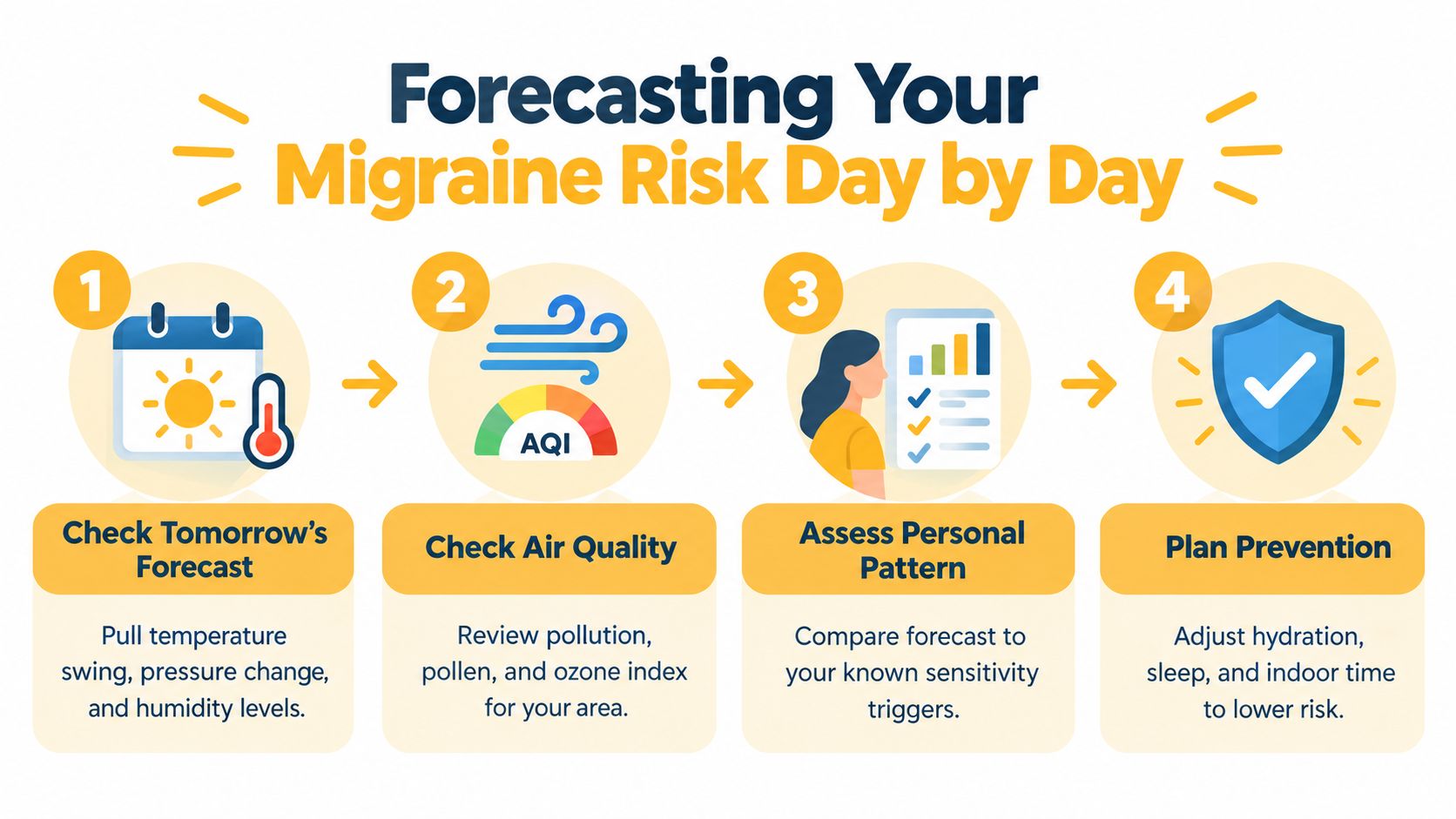
A useful forecast combines tomorrow's exposures with your recent pattern. Begin with four questions:
- What temperature swing, humidity change, and pressure movement are expected?
- What do the local AQI, PM2.5, pollen, and ozone readings show?
- Have your recent attacks followed similar exposure windows?
- Are sleep loss, missed meals, stress, illness, or hormonal changes adding load?
Then label the day low, moderate, or high risk based on your own observations. A high rating isn't a prediction that an attack must happen. It tells you to pre-load one practical behavior, such as protecting your wind-down routine, planning regular meals, or deciding when outdoor time is most comfortable.
Exposure timing matters. A pressure shift several hours earlier may deserve more attention than the current reading, while pollution may be relevant on the same day or after a delay. Your diary can reveal whether your pattern resembles one of these windows or differs from it.
Track predicted risk against actual symptoms for two to four weeks so you can calibrate your assumptions. Include the first sign of prodrome, aura if present, pain intensity, nausea, light or sound sensitivity, medication use, and recovery time. A simple record can expose false alarms as well as useful patterns.
For a more detailed planning approach, use an hour-by-hour migraine forecast alongside your own notes. The aim isn't perfect certainty. It's a clearer decision about when to pace yourself, reduce avoidable exposure, and contact your healthcare provider if your pattern is changing.
Seek immediate medical care for a sudden, severe headache, a headache with fever or stiff neck, new neurological changes, or a headache after a head injury. Also seek prompt medical evaluation for a first or rapidly changing headache pattern.
This article is for informational purposes and is not medical advice. Consult a healthcare provider for personalized guidance.
Relief combines local weather, air-quality, and pollen information with your health logs to provide an hour-by-hour migraine risk forecast and help you identify personal patterns. Visit Relief to track symptoms and environmental exposures in one place, so you can plan with more context and fewer surprises.


