Facial Migraine Symptoms: How to Tell Them Apart
Facial migraine symptoms can mimic sinus or dental pain. Learn the patterns that point to migraine and the red flags that need urgent care.
In this guide
- Why Facial Pain Can Be Migraine Pain
- Facial Migraine Compared With Sinus, Dental and Nerve Pain
- Symptom Clusters That Point Toward Migraine
- Nasal and Eye Signs That Migraine Can Cause
- Facial Numbness and Tingling During Aura
- When Facial Symptoms Need Urgent Medical Care
- Start a Symptom Log Before Your Next Visit
Could a throbbing cheek, aching upper teeth or blocked nose be migraine if your head doesn't hurt? Facial migraine symptoms can occur with headache or, more rarely, without it, which helps explain why they're sometimes mistaken for sinus or dental problems. If you've been dismissed or passed between appointments, your pain still deserves a careful explanation, not another assumption based only on where it hurts.
Why Facial Pain Can Be Migraine Pain
Say your upper teeth ache, but a dental examination finds no obvious cause. Your cheek throbs, ordinary movement makes things worse, and you want the lights turned down. That combination deserves assessment as a whole, rather than treating each symptom as an unrelated problem.
Facial involvement is a recognised but uncommon migraine presentation. A population-based study published in Cephalalgia examined 517 people with migraine, drawn from a random sample of 6,000 Essen residents, and identified facial involvement in 46 people, or 8.9%, most often affecting the upper jaw. Most participants with facial involvement also had head pain; only one had isolated facial pain without headache.
That distinction matters. The study supports recognising facial pain as part of migraine, but it doesn't suggest that unexplained toothache or cheek pressure is usually migraine.
Migraine is a condition, not simply a headache
Headache describes a symptom. Migraine is a neurological condition that can involve pain, sensory sensitivity, nausea and other changes. Your symptoms may extend beyond your head, and not every attack follows the same sequence.
The trigeminal nerve system carries sensation from your face, including areas around your eyes, sinuses, teeth and jaw. Migraine-related activity in these pathways can be perceived in those places, even when the painful area itself has no infection or dental disease.
Some people also experience aura, temporary, reversible neurological symptoms, or prodrome, early warning changes before an attack's more recognisable symptoms.
A useful starting point: Describe the location without deciding the cause. “Throbbing upper-left cheek with nausea” gives a clinician more information than “sinus headache.”
If you've previously been told it's just your sinuses, it's reasonable to ask what supports that explanation and what other possibilities need assessment. Today, note exactly where the pain sits and what happens alongside it.
This article is for informational purposes and is not medical advice. Consult a healthcare provider for personalized guidance.
Facial Migraine Compared With Sinus, Dental and Nerve Pain
Facial pain patterns compared by duration, location and signs
| Pattern | Typical duration | Where the pain sits | Associated signs | Common triggers |
|---|---|---|---|---|
| Facial migraine | Typically 4–72 hours | Cheek, upper jaw or lower face; one or both sides | Throbbing, nausea or vomiting, light or sound sensitivity, worse with activity | Individual patterns may include stress or sleep changes |
| Sinus pressure or infection | Days, sometimes longer than a migraine attack | Cheeks, forehead or under the eyes | Thick or discoloured nasal discharge, sometimes fever | Colds or allergies |
| Dental toothache | May persist or recur until the cause is treated | A tooth or localised jaw area, inside the mouth | Sensitivity to temperature or pressure; a dental problem may be present | Chewing, hot or cold foods, pressure |
| Trigeminal neuralgia | A fraction of a second to about 2 minutes per jolt | Along a trigeminal nerve branch, usually on one side | Electric-shock-like jolts | Light touch, chewing or washing the face |
| Cluster headache | Short, repeated attacks rather than a prolonged migraine-like episode | Around one eye or temple, on one side | Same-sided tearing and nasal congestion; restlessness during attacks | Alcohol during an active cluster period; sleep-related patterns |
These are patterns to describe, not diagnoses to select. The International Headache Society's headache classification describes trigeminal neuralgia attacks as lasting from a fraction of a second to two minutes, helping distinguish individual electric-shock jolts from sustained facial aching.
The table's most useful question is often: What exactly are you timing? Repeated jolts over an afternoon aren't the same as continuous pain throughout that afternoon. Record both the length of each burst and the period during which bursts recur.
Why duration doesn't settle the diagnosis
A clinical review of facial and sinus pain describes neurovascular orofacial pain, which can feel like a one-sided toothache inside the mouth, with attacks lasting about 1–4 hours, compared with 4–72 hours for orofacial migraine. That overlap means a timer helps, but it can't identify the condition by itself.
Location can mislead, too. Pain felt in a tooth doesn't automatically establish a dental cause, while a normal dental examination doesn't automatically establish migraine. People with these overlapping symptoms may first consult a dentist or an ear, nose and throat clinician before a headache-related explanation is considered.
Choosing an assessment route
- A localised tooth problem: Arrange a dental assessment when biting, temperature or pressure consistently reproduces pain around a particular tooth.
- Persistent nasal symptoms: A primary care or ear, nose and throat assessment can help evaluate discharge, congestion and possible sinus disease.
- Recurrent disabling attacks: Ask your healthcare provider whether neurological or headache-specialist assessment would help, particularly when nausea or sensory sensitivity accompanies facial pain.
Don't use a response to migraine medicine as proof of the diagnosis. Improvement is useful information for your clinician, but it doesn't replace an examination and history.
For your next appointment, prioritise duration, side and accompanying signs. Those details make the comparison more useful than circling the place that hurts.
Symptom Clusters That Point Toward Migraine
Migraine in the face is usually recognised from a group of features, not from the spot that hurts. A clinician weighs which signs arrive together, how the episode builds, and whether a similar cluster returns.
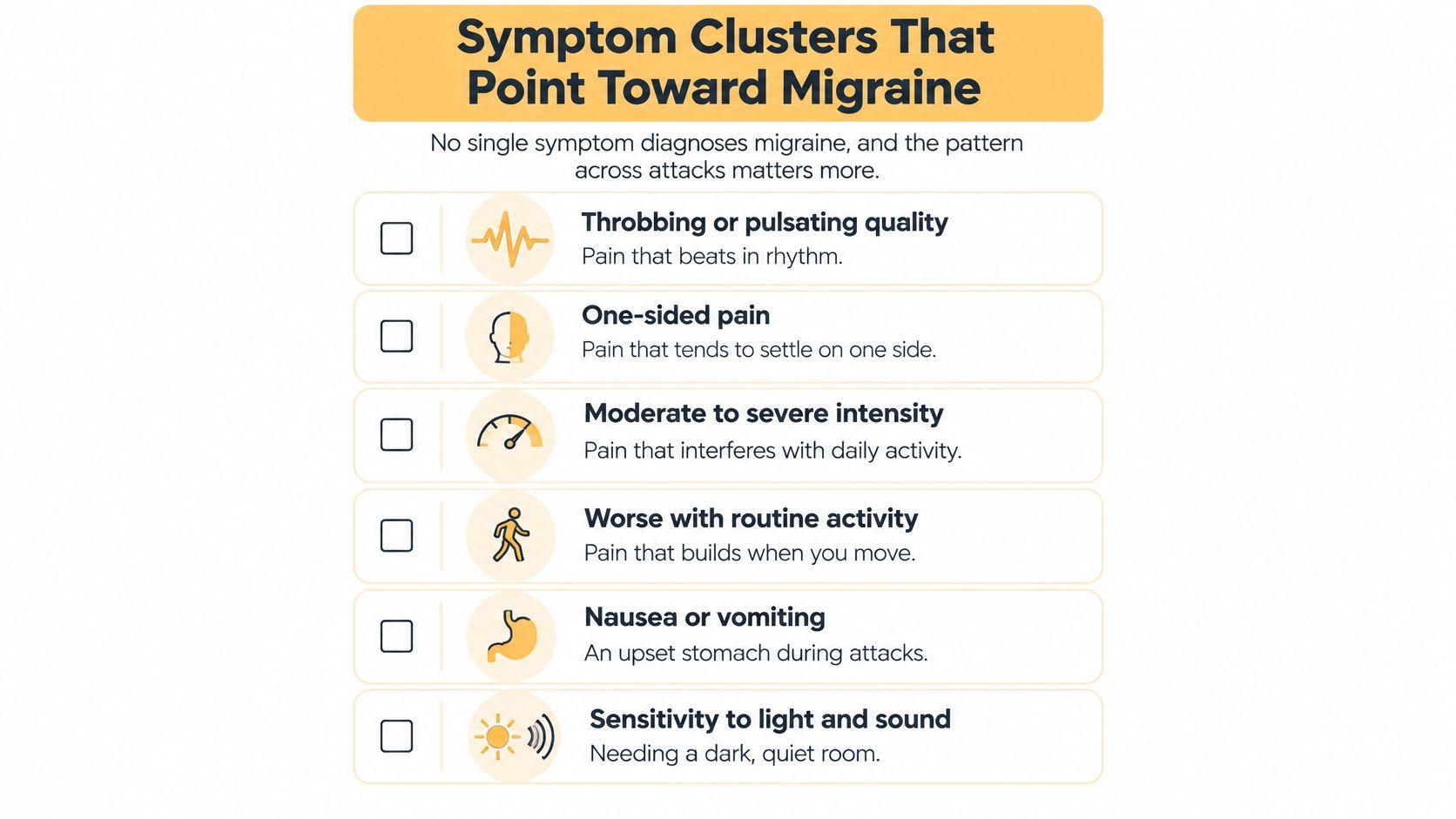
A symptom cluster works like a weather front. One cloud does not settle the forecast. Pulsating pain, moderate-to-severe intensity, and worsening with routine activity become more migraine-like when nausea or sensory sensitivity joins the same episode. Photophobia means sensitivity to light. Phonophobia means sensitivity to sound.
Record what ordinary activity already did. There is no need to climb stairs or sit under a bright lamp to test yourself.
A short checklist for your log
Use this list to describe what you notice, not to score yourself into a diagnosis.
- Pulsating or throbbing pain
- Moderate-to-severe intensity
- Worse with routine activity
- Nausea, or sensitivity to light or sound
- A similar pattern that returns, with or without a separate headache
- Face contact that hurts apart from the deeper ache
Pain over the upper jaw, or pain that stays on one side of the face, can still belong in that cluster. Location is a clue to write down. It is not a diagnosis on its own, and it is easy to file the same pattern as a sinus or dental problem.
Facial sensitivity is a separate symptom
Cutaneous allodynia means contact that ordinarily should not hurt becomes painful. Glasses against your cheek, your face on a pillow, brushing your hair, or a change in temperature may feel unexpectedly uncomfortable. The surface behaves a bit like sunburned skin: light contact is enough.
Log that contact sensitivity separately from the underlying ache. “My cheek throbbed” and “my glasses hurt against my cheek” describe different experiences, and both can help your clinician.
The figure below describes a study group, so it is not your personal probability.
Reported frequency of migraine facial features
| Feature | Reported frequency | Source |
|---|---|---|
| Cutaneous allodynia | 40% to 70% of people with migraine | American Migraine Foundation's symptom guidance |
Your pattern doesn't need to match someone else's
Migraine experiences differ across episodic and chronic migraine, with or without aura, and across forms such as vestibular migraine, involving balance symptoms, or hemiplegic migraine, involving motor weakness. New weakness must never be assumed to be migraine.
Illustrative example: You record a throbbing left cheek, nausea, and light sensitivity lasting through the day and overnight, before a separate headache is obvious. Bringing that combination to an appointment is more informative than recording only facial pain.
For an additional discussion of facial pain and headache, this video offers another format.
Nasal and Eye Signs That Migraine Can Cause
A nose that keeps blocking during painful episodes can make a sinus explanation feel obvious. If sinus treatments haven't explained the full pattern, it's understandable to feel frustrated.
Congestion and watery eyes don't automatically mean sinus disease. The American Migraine Foundation reports that 45% of people with migraine experience at least one congestion or watery-eye symptom, and research it cites found that 90% of self-diagnosed sinus headaches were migraine.
That finding concerns people who had labelled their symptoms themselves. It doesn't mean that most confirmed sinus infections are migraine, or that you should disregard a clinician's diagnosis of rhinosinusitis, inflammation affecting the nose and sinuses.
Automatic facial responses can look sinus-like
Cranial autonomic signs are automatic nerve-related changes involving the face and eyes. They can include tearing, eye redness, eyelid drooping, flushing and nasal congestion.
A study summarised in the American Migraine Foundation's discussion of cranial autonomic symptoms reported at least one such symptom in approximately 70% of people with chronic migraine and 56% with episodic migraine. These signs aren't exclusive to migraine; clinicians also consider other headache disorders when eye or nasal symptoms are especially prominent.
A blocked nose tells you what happened. Its timing, accompanying symptoms and examination help explain why.
Record the details that change the picture
Hypothetical example: You have cheek pressure and a blocked nose across a couple of days, with clear discharge and no fever. Rest makes you more comfortable, but those details alone don't establish whether the cause is migraine, allergy or another condition.
Thick, discoloured discharge and fever are more suggestive of rhinosinusitis and deserve professional assessment. Persistent congestion between painful episodes also deserves attention rather than being folded automatically into your migraine record.
For each episode, note:
- Side: Does the blocked nostril or watery eye match the painful side?
- Discharge: Is it clear and watery, or thick and discoloured?
- Sequence: Did congestion begin before, during or after pain?
- Other changes: Record temperature, eye redness, swelling and sensory sensitivity.
No single nasal sign decides the question. A consistent record across attacks gives your clinician a clearer basis for deciding what needs examination.
Facial Numbness and Tingling During Aura
A tingling cheek can feel very different from facial pain, and it can be unsettling when you don't know what it means. Sensory aura can involve temporary numbness or tingling in one side of the face, a hand or the fingers, sometimes alongside visual changes or difficulty finding words.
The American Migraine Foundation's symptom guidance describes typical aura as developing over time, lasting 5–60 minutes and resolving completely. Gradual development is important, but it isn't a reliable home test for excluding a neurological emergency.
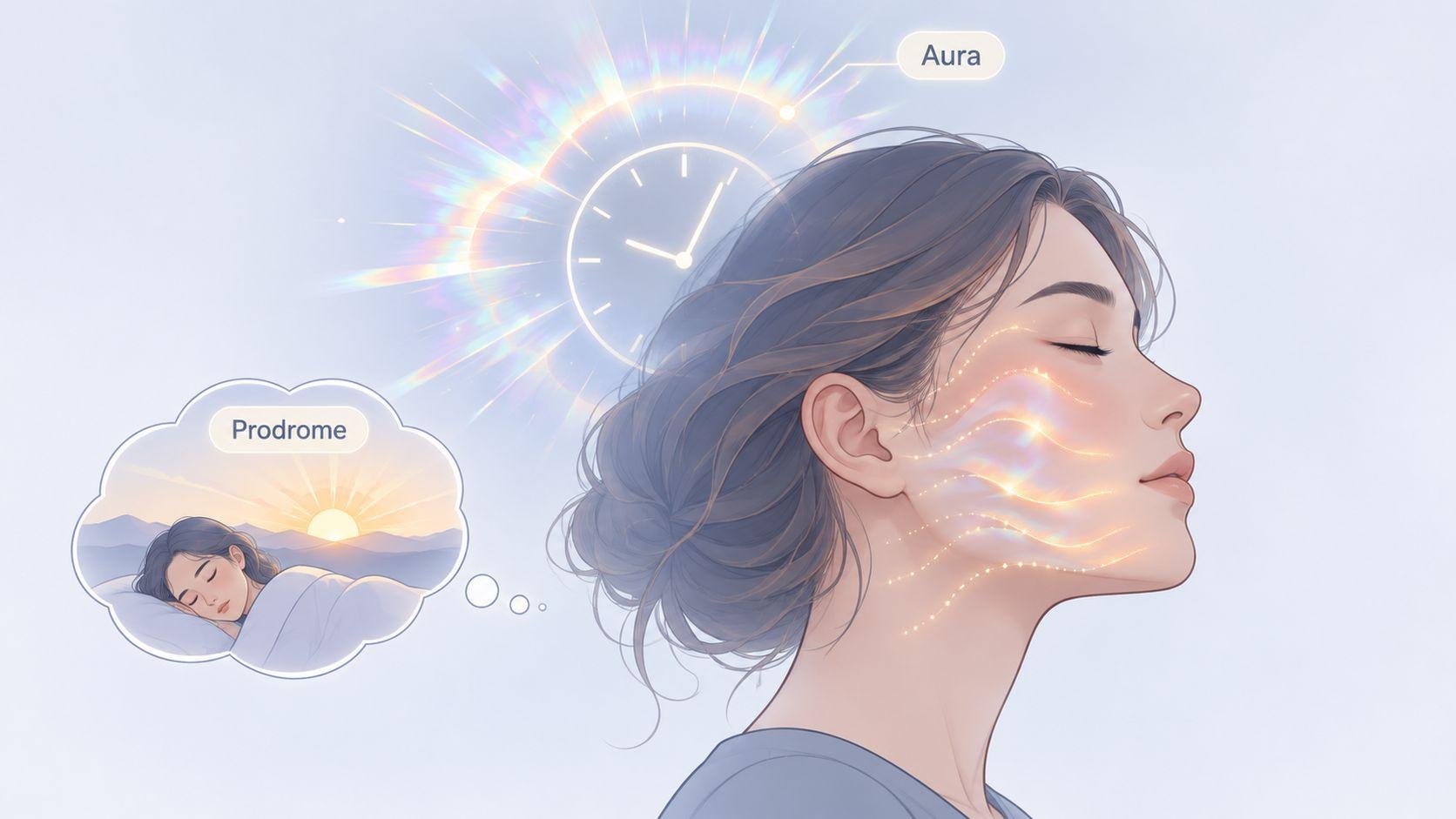
This illustration places sensory experiences alongside other possible phases of an attack.
Follow the sequence rather than guessing the label
In an illustrative sequence, tingling starts in the fingers, gradually involves part of the face, then fades completely. Another person may experience visual symptoms or speech-related changes instead.
Aura may precede or accompany headache, and some people experience it without headache. That doesn't mean a first episode of unexplained facial numbness should be labelled aura without assessment.
Prodrome is different from aura. Early tiredness or other warning changes don't describe the same process as a focal neurological symptom such as spreading tingling.
For a useful record, capture:
- Start: The exact time you first noticed the sensation.
- Location and progression: Where it began and whether it spread.
- Accompanying symptoms: Any visual change, speech difficulty or pain.
- Resolution: When it stopped and whether you returned fully to normal.
Our guide to migraine-related numbness and its warning signs offers more context for describing these sensations.
Don't wait for a familiar pattern when symptoms change
Sudden numbness, weakness, altered consciousness or speech difficulty requires immediate medical care, not observation in a symptom tracker. Symptoms that persist beyond the typical aura window or don't resolve also need urgent evaluation.
Even if you've previously had diagnosed aura, a new or substantially different neurological symptom deserves assessment. You don't need to determine the cause before asking for help.
When Facial Symptoms Need Urgent Medical Care
A sudden, severe or unusual headache needs immediate medical care. Call your local emergency number immediately. Our app doesn't monitor emergencies and cannot replace that step.
New facial pain shouldn't automatically be attributed to migraine, particularly when it comes with persistent neurological changes, fever, visual loss or an abrupt onset. The American Migraine Foundation's orofacial pain guidance emphasises medical evaluation for these warning signs.
Act on the symptom, not a presumed diagnosis
Facial symptoms that need medical attention
| Symptom | Why it matters | What to do |
|---|---|---|
| Sudden, severe or unusual headache | May signal a serious cause | Call your local emergency number immediately |
| Facial weakness, drooping or one-sided numbness with trouble speaking | May signal stroke or another neurological emergency | Call emergency services now |
| Aura lasting more than 60 minutes or not fully resolving | Prolonged or unresolved neurological symptoms need assessment | Seek urgent medical evaluation; call emergency services for ongoing or new neurological changes |
| Headache with fever and stiff neck | May signal a serious infection | Seek immediate medical care |
| New facial pain after a head injury | Injury needs assessment before attributing pain to migraine | Seek immediate medical care |
| Thick, discoloured nasal discharge with fever | More suggestive of rhinosinusitis than migraine | See a healthcare professional for assessment |
These are reference situations, not a checklist that can rule out danger. You don't need to have every listed symptom, and a history of migraine doesn't make a new emergency impossible.
If speech, strength, consciousness or vision changes suddenly, don't wait for head pain to appear. Seek immediate care even when the face is the only painful area.
Medical disclaimer
This article is for informational purposes and is not medical advice. Consult a healthcare provider for personalized guidance.
What to tell the clinician
Give the time symptoms began, whether they appeared suddenly or gradually, and whether they're new or different from your usual episodes. Describe which symptoms are still present rather than relying only on a label such as aura.
Mention any injury, fever, visual loss, weakness or difficulty speaking. If someone witnessed the onset, their description may also help.
For non-emergency preparation, our guide to headache with visual spots and warning signs can help you describe visual changes more clearly. It isn't a reason to delay care when a change is sudden, severe or unfamiliar.
Start a Symptom Log Before Your Next Visit
A generic headache entry can hide the detail you most need to explain. If your main symptom was an aching upper jaw, or tingling without pain, record that explicitly instead of forcing it into a description that doesn't fit.
A clinical review of orofacial migraine highlights why facial location, nasal symptoms, nausea, sensory sensitivity and recurrence belong together in the history. Your job isn't to diagnose yourself; it's to preserve an accurate description.
Capture the episode in a practical order
- Note the start time. Begin with the first symptom you noticed, even if pain came later.
- Pinpoint the area and side. Write upper-right teeth, left cheekbone or both sides of the jaw rather than face alone.
- Describe the quality. Use words such as throbbing, steady, burning, pressure or electric-shock-like.
- Mark activity sensitivity. Did walking, bending or an ordinary task make the pain worse?
- Add associated signs and their timing. Include nausea, light or sound sensitivity, congestion, tearing, redness or swelling.
- Record possible aura. Describe its progression and resolution, without assuming every neurological change is migraine.
- Separate contact pain. Note whether glasses, a pillow, washing or another normally harmless contact hurt.
- List medications taken. Record their names and whether they seemed to help, without using improvement as proof of a diagnosis.
- Record the end and recovery. Note when pain stopped and whether fatigue or other symptoms continued afterwards.
Keep the first entry manageable. A few accurate observations are more useful than a detailed form completed from uncertain memory much later.
Make the record useful at your appointment
Compare episodes without forcing them to match. If cheek pain occurred without nausea once but repeatedly came with light sensitivity on other occasions, keep both observations.
Note potentially relevant circumstances, such as sleep changes or stress, without declaring them triggers after a single coincidence. A pattern across several attacks is more informative than an isolated association, and association doesn't prove cause.
Our migraine log template can help you organise those observations for a visit.
Use tracking to support awareness and clinical conversations, not as a diagnostic test or replacement for care. Start your log today and bring it to your next visit.
Facial symptoms are easier to discuss when you can show where they occurred, how long they lasted and what happened alongside them.
This guide is general information, not medical advice, and it isn’t a diagnosis. Talk to your doctor about your own headaches.