Headache and Seeing Spots: Aura or Emergency
Headache and seeing spots is often migraine aura, but one-eye flashes can be urgent. Use this timing and laterality guide.
In this guide
The screen blurs in the middle of a meeting, small bright sparks slide sideways, and the ache behind your eye is already starting. Headache and seeing spots is often migraine visual aura, a temporary brain-based visual change, but sudden one-eye symptoms or vision that does not clear need urgent care rather than home management.
You are not imagining the scare. Sight that will not hold still makes the next decision harder, and plenty of people have been told to wait it out when they needed a clearer rule. The World Health Organization estimates that approximately 40% of the world's population, about 3.1 billion people in 2021, experienced a headache disorder. Migraine is one of the main neurological headache disorders and is more common in females than in males, though it affects every gender and doesn't look the same in every person. What you do in the next hour depends on which eye sees the spots, how fast they start, and whether they leave.
What Headache and Seeing Spots Usually Means
Say you cover your right eye and the sparks are still there, then cover the left and they remain. That both-eye shimmer with a building headache is often migraine with visual aura: fully reversible neurological symptoms from a temporary change in visual processing, not automatically an eye disease.
Migraine is a neurological disorder. A headache is the pain symptom, and the two aren't the same thing. Aura means those reversible symptoms, which can include blind spots, sparks, bright dots, flashes, stars, and zigzag patterns. The American Migraine Foundation reports that only about 25% to 30% of people with migraine experience aura, and visual symptoms are the most common form. Fewer than 20% of people who experience migraine visual aura have it during every migraine attack.
An aura symptom generally develops gradually, and no individual symptom should last longer than 60 minutes. Headache commonly follows after a symptom-free interval of less than one hour, though pain can begin before or with the visual change.
This article is for informational purposes and is not medical advice. Consult a healthcare provider for personalized guidance.
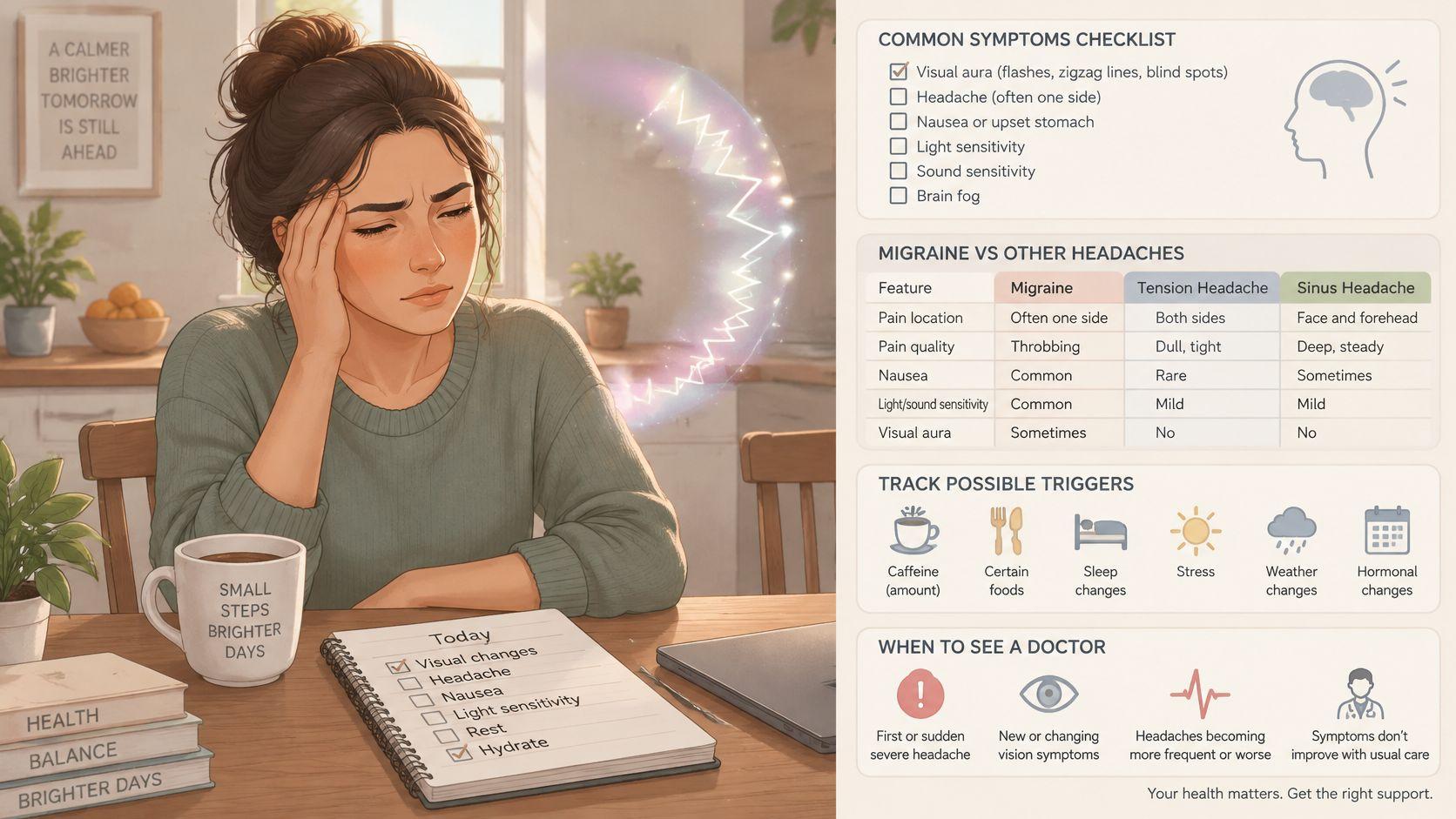
Being dismissed, or trying to judge your sight while it is unreliable, is exhausting. One episode can't prove a diagnosis. A same-day sort by eye, speed, and whether the change clears is the practical next step.
One Eye or Both and When to Get Care
Cover one eye, then the other, without delaying emergency care. Note whether the spots stay in both eyes or only one. A past migraine diagnosis doesn't make a new episode safe to manage at home.
The cover test
Typical migraine aura usually produces visual symptoms in both eyes, even when it feels as if it is coming from one side. The pattern often spreads or shimmers across the field. A published review of aura features notes that this disturbance typically lasts 5 to 60 minutes, and the practical self-check is that cover test (PMC review of visual aura).
A one-eye change is different. Sudden vision loss, a curtain-like shadow, or flashing that persists raises concern for retinal or vascular eye disease rather than ordinary cortical aura. Acute angle-closure glaucoma can pair a one-eye visual change with severe eye pain, headache, nausea, and halos. New one-eye symptoms, sudden lasting loss, or eye pain need urgent medical or eye assessment. Sudden vision loss with neurological deficits needs emergency care.
Practical rule: If you can't safely do the cover test, or the loss is sudden and still there, skip the experiment and get emergency care.
Spots with headache sorted by eye and urgency
| What you notice | More often fits | What to do |
|---|---|---|
| Gradual bright spots, zigzags, or a blind patch in both eyes for about 5 to 60 minutes, then headache | Migraine visual aura | Record onset, duration, and sequence; contact a clinician if this is the first time or the pattern changed |
| Sudden new flashes plus a rapid increase in floaters, especially in one eye | Possible vitreoretinal traction, retinal tear, or detachment | Urgent eye assessment, typically within 24 hours, with acuity, fields, and a dilated exam |
| Dark peripheral shadow, gray curtain, or a lasting visual-field defect | Retinal emergency | Emergency eye care now; untreated detachment can cause permanent vision loss |
| One-eye visual change with severe eye pain, halos, headache, and nausea | Possible acute angle-closure glaucoma | Emergency care now |
| Sudden vision loss with weakness, numbness, speech trouble, confusion, or poor balance | Possible stroke or transient ischemic attack | Call your local emergency number immediately |
| Familiar bilateral shimmer that fully clears and follows the usual migraine sequence | Recurring migraine aura pattern | Track it; seek urgent care if it lasts beyond 60 minutes, is sudden, or comes with new neurological symptoms |
When a familiar look isn't safe at home
Typical aura develops gradually over about five minutes and resolves within an hour. Sudden, non-progressive loss of vision, weakness, numbness, or speech difficulty can resemble a transient ischemic attack (a brief stroke-like episode) or a stroke. A clinical summary of atypical aura lists the exceptions that need urgent assessment rather than routine trigger notes: a first-ever visual episode, a major change in your established pattern, any symptom past an hour, a sudden worst headache, confusion, a seizure, fever with neck stiffness, or one-sided weakness (headache red-flag table). Headache after a head injury belongs on that same urgent list.
NHS guidance on migraine in adults treats one-eye visual symptoms, double vision, motor weakness, poor balance, and reduced consciousness as atypical features that need urgent assessment, because another neurological or eye condition may need to be considered.
Spots without head pain still need the same review. Missing pain doesn't clear the symptom. When visual aura occurs without headache, a clinician may need to exclude a TIA and other causes. A closer look at ocular migraine in one eye helps separate a brain-based field change from a problem inside one eye.
Use five checks before you decide this is a usual attack:
- First versus familiar. A brand-new visual episode isn't a home-management day.
- Gradual versus sudden. A slow build fits the usual clock. A snap onset doesn't.
- Cleared versus still present. Full clearing within about an hour is the expected end. A leftover patch isn't.
- One eye versus both. Both eyes, including with either eye covered, fits cortical aura more often. One eye doesn't.
- Any neurological companion. Weakness, numbness, speech trouble, confusion, seizure, fever with a stiff neck, poor balance, or reduced consciousness means emergency care.
How Migraine Visual Aura Builds and Fades
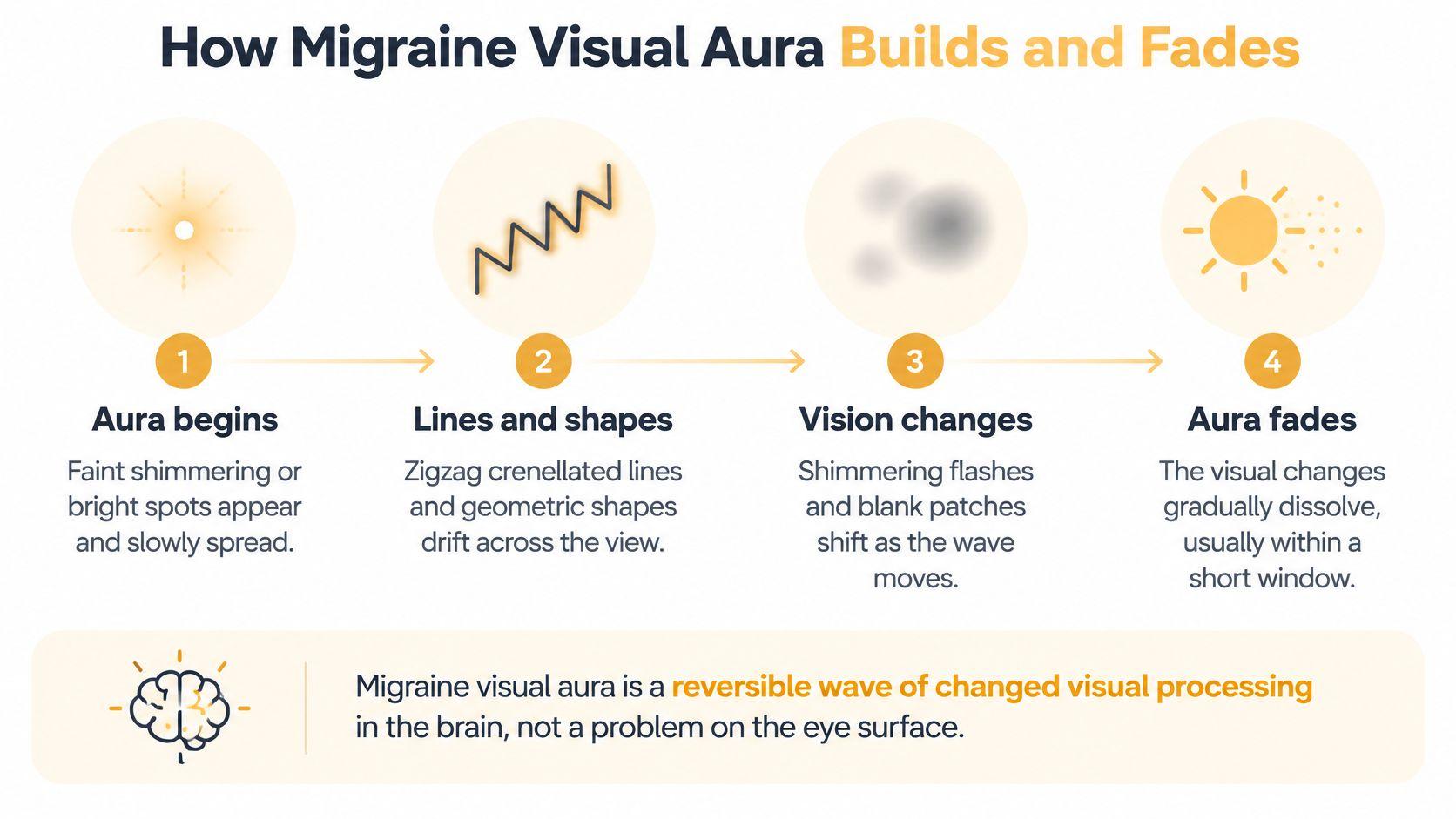
Think of the visual change as weather moving across a field, not a speck stuck on the eye surface. A front arrives near the center, crosses the view, and lifts. The eye itself isn't the thing that is "dirty." The disturbance is a reversible wave of changed visual processing in the brain.
The common picture includes shimmering or bright spots, flashes of light, zigzag lines, geometric patterns, or blind areas called scotomas. Symptoms often begin near the center of the visual field and spread outward. The American Migraine Foundation's headache guide describes aura as generally developing over at least 5 minutes and lasting 5 to 60 minutes. It may come before the head pain, during the headache, or occasionally without head pain.
How common the visual phase is
Visual symptoms dominate aura, but they aren't the whole story of migraine. The American Migraine Foundation's ocular migraine overview notes that approximately 90% of people who experience migraine aura report visual symptoms. In 2024, visual aura was reported by 215 of 227 participants with migraine with aura (94.7%) in the REFORM study, published in the Journal of Headache and Pain.
Positive symptoms add something to the view, such as sparks, bright dots, or zigzags. Negative symptoms take something away, such as a missing patch. In 2024, a multicenter study of 272 people with migraine with aura found that 224 participants (82.4%) experienced positive scotomas, while 39 (14.3%) experienced negative scotomas (Cephalalgia multicenter aura study).
Aura can skip attacks. A missing visual phase doesn't erase a migraine history, and a matching clock isn't a diagnosis. A new or changing pattern should be assessed by a healthcare professional.
What to write down while it is fresh
If the change is clearing and you are safe to look at a screen, note four things: the clock time it started, whether each eye saw it, whether it spread, and whether pain followed. Those details are more useful than the word "spots" alone.
The phases around the pain have names worth using once. Prodrome is the early shift in energy, mood, or appetite. Aura is the reversible neurological wave. The headache phase is the pain. Postdrome is the drained, foggy stretch after pain eases. A plain walk-through of what happens in a migraine attack keeps those stages separate so a visual wave isn't treated as the whole disorder.
Spots That Are Not Ordinary Aura
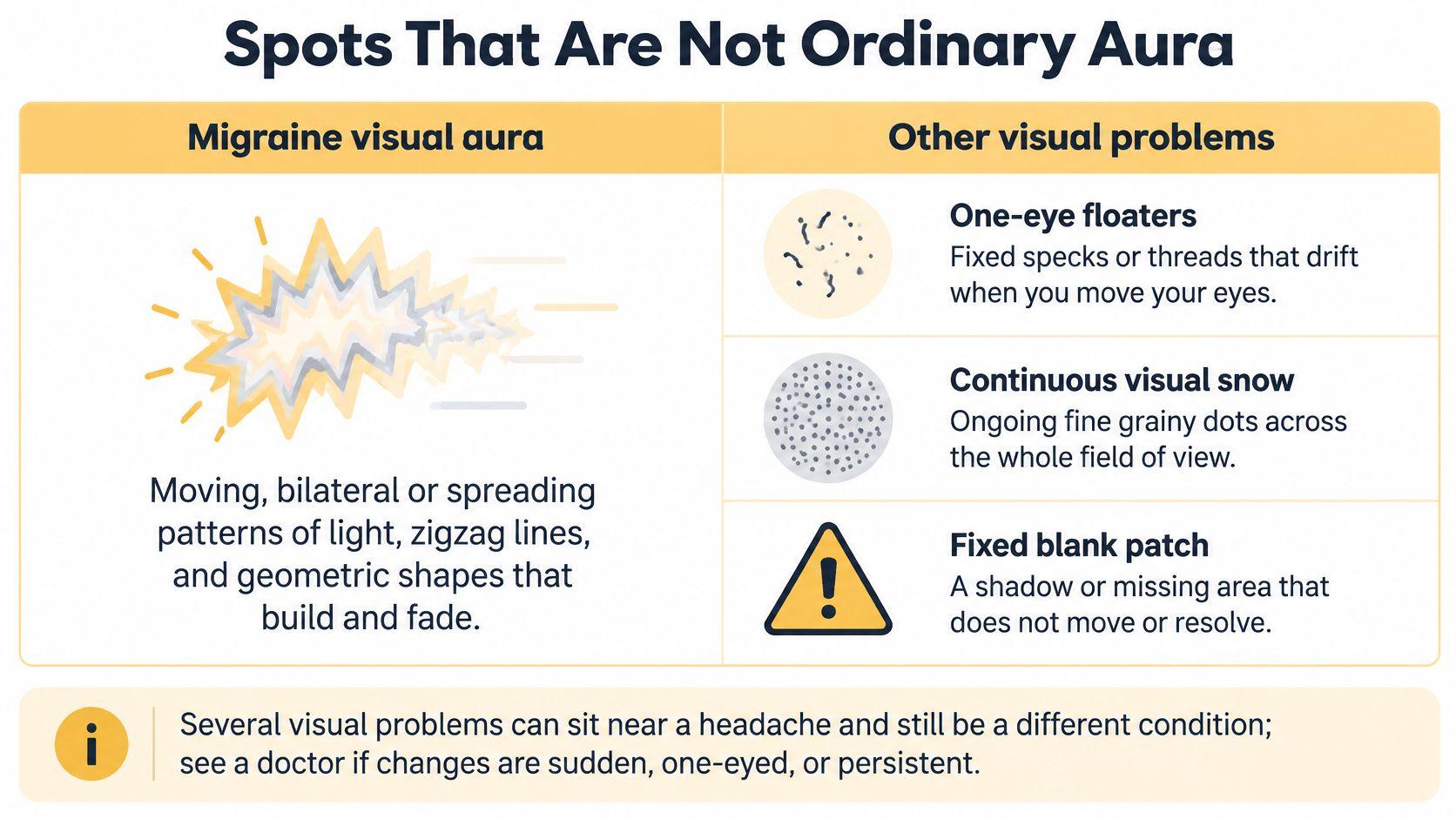
Several visual problems can sit near a headache and still be a different condition. The split that matters here is duration and laterality: minutes and both eyes, versus constant, one eye, or a curtain.
Aura compared with other spot-like vision changes
| Pattern | Usual field | How long it lasts | Clue it may be something else |
|---|---|---|---|
| Migraine visual aura | Usually both eyes, often spreading from the center | About 5 to 60 minutes, then it clears | Sudden onset, lasting past an hour, or a brand-new pattern |
| Visual snow | Both eyes, like static across the view | Ongoing or episodic, not a brief spreading wave | The grain remains between headaches |
| Alice in Wonderland syndrome symptoms | Not a simple blind spot; size or distance looks wrong | Episodes vary | Distortions of size or distance rather than zigzags or flashes |
| Photophobia | Light feels uncomfortable, not a spot or zigzag | Often through the headache | Light discomfort is a separate migraine feature, not visual aura |
One-eye floaters and flashes don't behave like a moving bilateral shimmer. New flashes with a shower of floaters, a shadow, or reduced acuity can point to vitreoretinal traction, a retinal tear, or retinal detachment. The Mayo Clinic's overview of eye floaters says high-risk signs include a dark peripheral shadow, a gray curtain, reduced visual acuity, or a visual-field defect, because untreated retinal detachment can cause permanent vision loss. Clinical guidance recommends ophthalmologic referral within 24 hours for new symptomatic floaters, flashes, and a field defect, typically with acuity testing, confrontation fields, and a dilated fundus exam. That pathway is eye care, not a migraine plan.
Visual snow is a persistent grain or static across vision, unlike an aura that ends within an hour. In a 2024 study of 217 people with migraine, 17 participants (7.8%) met criteria for visual snow syndrome, and 58 (26.7%) had episodic visual snow and associated features (Neurological Sciences visual snow study).
Alice in Wonderland syndrome is a temporary change in how big, far, or distorted things look, not a zigzag or a blind patch. A 2024 study of 808 adults with migraine found that 133 participants (16.5%) had experienced these symptoms during their lifetime, and prevalence was 19.5% among those with aura (PubMed report on Alice in Wonderland symptoms).
Photophobia, discomfort from light, is a separate migraine feature. It can run through the headache without any spots at all.
None of these labels should be self-applied. A clinician sorts them with history and, when needed, an eye or neurological exam. Visual symptoms that outlast the headache are a reason to book that review rather than assume the wave will lift on the usual clock.
A short clinical walk-through of warning vision changes can make the curtain-versus-shimmer difference easier to picture while you are calm.
What Different Spot Episodes Can Look Like
These sketches are illustrations, not diagnoses and not statistics. Experiences vary widely, including episodic and chronic migraine, attacks with aura and without it, and less common forms such as vestibular or hemiplegic migraine. A sketch can't say which one applies to you.
A widening zigzag, then pain. Someone notices a small bright zigzag near the center of both eyes. It widens over about 20 minutes, fades by 45 minutes, and a one-sided throbbing headache follows, with photophobia and nausea. That sequence matches the usual aura clock and a both-eye field. If the pattern is new, the useful next step is a timed note and routine clinical follow-up, not a self-label.
Floaters in one eye, then a gray edge. Someone sees a sudden burst of floaters and flashes in the left eye only, then a gray edge at the side. Head pain is there, and so is a long migraine history. The sketch still matches the retinal warning row. Emergency eye care comes first.
Static that has already lasted weeks. Dots like television static have been present for weeks in both eyes, including between headaches. That story is closer to visual snow than to a 20-minute spreading wave. It belongs with a clinician, not a same-day migraine assumption.
Spots and no headache at all. Missing pain doesn't retire the checks. Sudden versus gradual, and one eye versus both, still decide whether this is an emergency. Headache warning signs that need emergency care stay in force when the head doesn't hurt.
A familiar migraine history is context for a clinician. It isn't permission to ignore a one-eye curtain or a change that won't clear.
Call for Care or Log the Cleared Episode
Use the urgency table as the fork. If a higher-risk row applies, call your local emergency number or get emergency care now. Don't log first.
The app doesn't monitor emergencies, so for a sudden, severe, or unusual headache you should call your local emergency number immediately.
If the spots were gradual, in both eyes, fully cleared within about an hour, and match a known migraine pattern, write a note a clinician can read later. Repeated logs may help show whether spots reliably precede pain, which a single attack can't show.
- Start time. The clock time the spots began.
- Each eye. Whether the right eye, the left eye, or both saw them.
- Spread. Whether the pattern moved outward or stayed fixed.
- End time. When the visual change fully stopped.
- Pain. When pain started, or that pain never came.
- Companions. Nausea, photophobia (discomfort from light), or other symptoms.
- What eased the day. Rest, a dark room, food, or whatever you tried. Don't record doses here as a plan for next time.
Relief starts a migraine record when you tap "I feel something," and it then follows early signs, aura, headache, and recovery, each with its own timer. The doctor report is a PDF of your attacks, their stages, your medicines, and what helped, created from Settings, then Export / Reports. A migraine symptom checklist can sit beside that timeline so a cleared episode isn't only a memory.
This guide is general information, not medical advice, and it isn’t a diagnosis. Talk to your doctor about your own headaches.