A useful migraine symptom checklist records what happens before, during, and after head pain, including timing, duration, severity, functional impact, and urgent warning signs. It can help you organize observations for self-management and clinical conversations, but it can't diagnose migraine.
What should you record during a migraine? If you've tried to explain an attack after the pain has faded, you already know how difficult it can be. Severe pain, nausea, sensory overload, fatigue, and brain fog can leave you exhausted, while other people may dismiss symptoms they can't see.
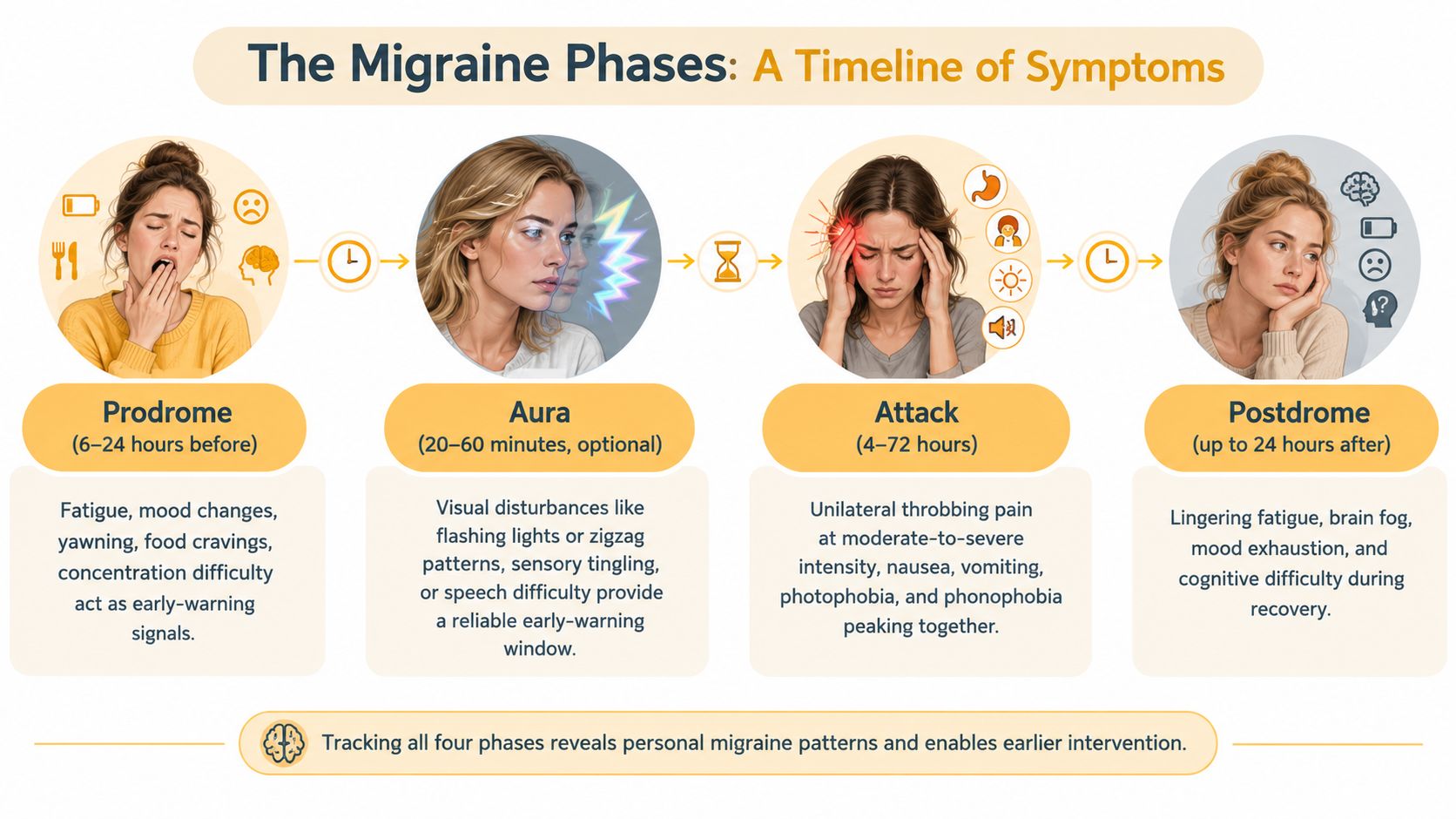
Migraine isn't an ordinary headache. The clinical pattern includes repeated attacks, specific pain features, and associated symptoms such as nausea, vomiting, or sensitivity to light and sound. A complete record also recognizes prodrome, the early phase before pain; aura, reversible neurological symptoms that may precede or accompany pain; the headache or attack phase; and postdrome, the recovery period afterward.
Symptoms vary widely. Some people experience visual changes, dizziness, neck stiffness, smell sensitivity, or speech difficulty. Others have little or no head pain during part of an attack. The International Classification of Headache Disorders, or ICHD-3, provides the structured clinical reference for migraine diagnosis, including migraine without aura and migraine with aura (ICHD-3 criteria for migraine without aura).
This article is for informational purposes and is not medical advice. Consult a healthcare provider for personalized guidance.
Use the eight entries below as a print-friendly migraine symptom checklist. You'll find practical ways to record symptoms, compare migraine features with other headaches, recognize red flags, and use Relief to turn scattered notes into a more usable record.
Table of Contents
1. Pain Severity and Location
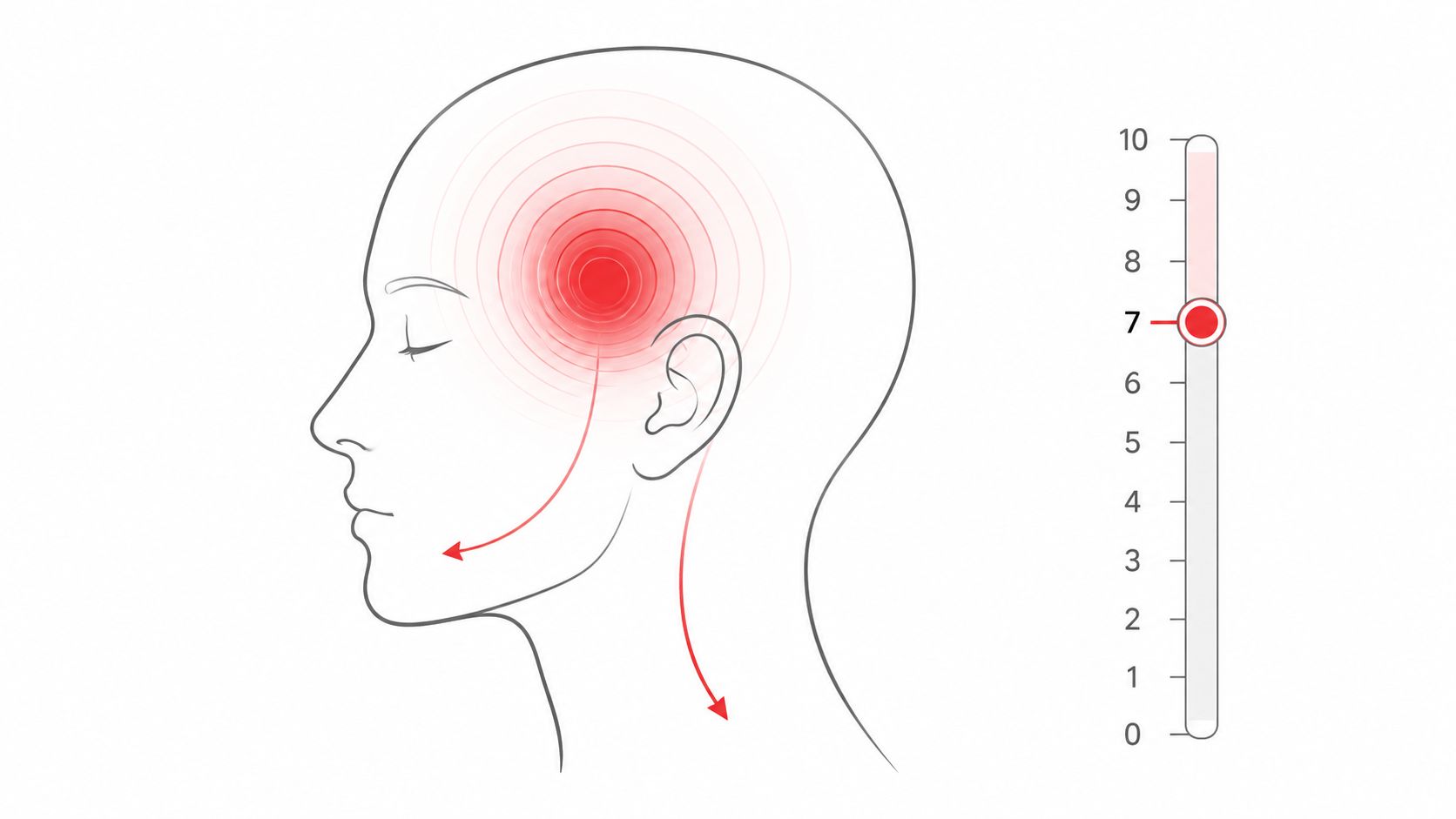
Where does the pain begin, how does it change, and what can you still do while it is present? “Bad headache” is difficult to compare later. Record location, movement, quality, intensity, and effect on function so this entry captures the attack's pain phase rather than only its strongest moment.
Migraine pain is commonly one-sided, pulsating, and moderate to severe, and routine activity may worsen it. The clinical pattern also includes symptoms such as nausea, vomiting, or sensitivity to both light and sound, as described in the ICHD-3 migraine definition. A checklist helps you observe patterns across the timeline, but it cannot determine the cause of an individual headache.
Record location and intensity consistently
Use a 0–10 scale each time and create personal anchors. For instance, 3 might be noticeable but manageable, 7 might require rest, and 9 might prevent normal activity. The point is consistent comparison, not matching another person's scale.
Describe the anatomy in plain language:
- Temporal: At one or both temples.
- Frontal: Across the forehead or behind it.
- Occipital: Near the back of the head.
- Vertex: Toward the top of the head.
- Diffuse: Spread across much of the head.
Add the quality, such as throbbing, pressure, stabbing, or pulsing. If pain starts in the right temple, then moves behind one eye or across the forehead, record the sequence. A moving pain map can be more informative than selecting one fixed location.
Practical rule: Pair intensity with function. “7/10 and worked slowly” describes a different experience from “7/10 and had to lie in a dark room.”
Write the pain level within about 30 minutes of noticing it, or once it stabilizes. Record whether it followed an earlier prodrome or aura, then note recovery later. A repeated pattern, such as right-temporal pain, followed by a new pattern of severe pain across both sides of the forehead, deserves discussion with a healthcare provider rather than personal interpretation.
2. Photophobia and Light Sensitivity
Could light sensitivity be part of the attack before head pain appears? Photophobia means discomfort or pain caused by light. During migraine, daylight, a phone screen, fluorescent bulbs, or flickering light may feel unusually intense. Squinting, covering your eyes, avoiding screens, or needing a dark room are practical details to record.
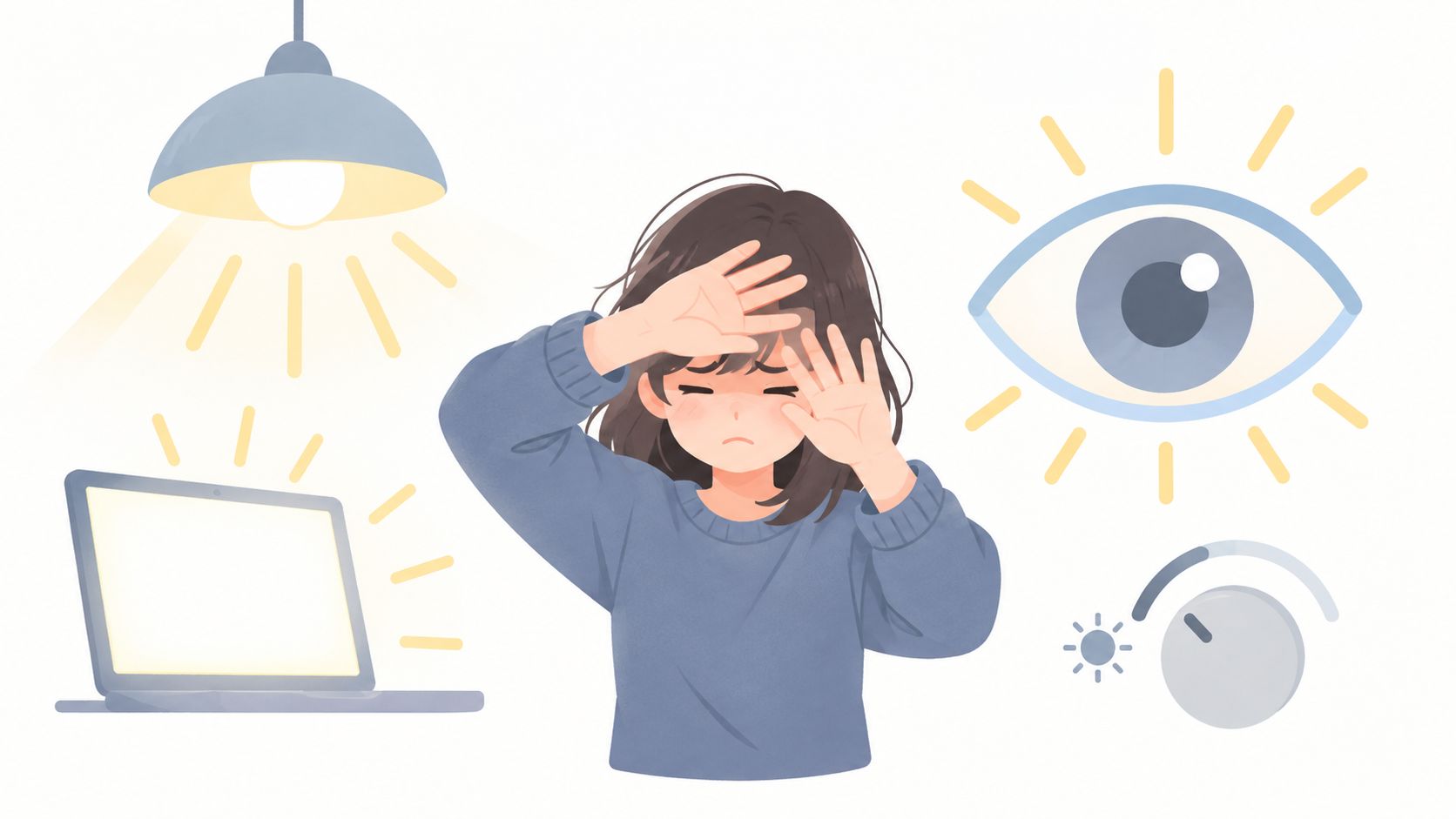
Treat the symptom like a signal with three parts: what triggered discomfort, when it appeared, and what it changed. Note whether sensitivity began during prodrome, the early phase before pain, during the headache, or after pain eased. Then identify the source and effect:
- Source: Sunlight, office lighting, television, phone, laptop, or flashing light.
- Severity: Unpleasant, painful, or impossible to tolerate.
- Function: Could you read, work, drive, or use a screen?
- Response: Did dimming the room, taking a screen break, or resting in darkness help?
A useful entry might read, “Laptop light became painful before head pain, and reading stopped.” If sensitivity starts early, reducing exposure may make the setting more tolerable. It does not prove that light caused the attack, so record the pattern without treating it as a diagnosis.
Try one environmental change at a time, such as closing curtains, lowering screen brightness, using warmer-toned bulbs, or taking short screen breaks. Blue-light-blocking glasses may feel helpful for some people, but they are not a guaranteed preventive measure.
Finally, record recovery. How long did dark-room rest take before light felt manageable? Note whether light remained difficult after the pain improved. This distinction can help separate pain relief from full symptom recovery and support planning for work, travel, or caregiving.
3. Nausea and Vomiting
Could nausea be part of the attack even when head pain seems dominant? Yes. Nausea and vomiting belong on a migraine symptom checklist because they may appear before pain, during the headache, or during recovery. Record them as separate signals. Nausea can be intense without vomiting, while vomiting may occur once or repeatedly.
Start with the timeline, almost like marking checkpoints on a route. Write when nausea began, when it peaked, and when it eased. Rate nausea from 0 to 10, then record vomiting as yes or no. For example: “Nausea 4/10 soon after pain began, rising to 8/10, vomiting once, then improving with rest.”
Add details that explain how the symptom affected the attack:
- Food status: Had you eaten recently, or were you fasting?
- Medication timing: Did you take an oral medicine before or after nausea started?
- Practical relief: Did cool air, ginger, lying still, or a quiet room help?
- Hydration: Could you keep fluids down?
- Recovery: Did nausea continue after head pain improved?
These notes do not identify the right treatment by themselves. Do not change medication forms or timing without professional guidance. They can show a healthcare provider whether nausea interfered with oral medicine, eating, drinking, work, or ordinary activity.
Include one plain-language impact note, such as “could sip water but could not eat” or “nausea remained after pain eased.” That distinction helps separate improvement in head pain from recovery of the whole attack.
Seek prompt medical advice if vomiting is frequent, fluids will not stay down, or signs of dehydration appear. Severe or unusual symptoms need assessment rather than being assumed to match a familiar migraine.
4. Phonophobia and Sound Sensitivity
Sound can become part of the attack timeline, not merely a background inconvenience. Phonophobia means intolerance of sound during an attack. Conversation, traffic, television, keyboard clicks, or household noise may feel painfully sharp or overwhelming. For some people, this sensitivity appears early, like an alarm that signals the attack is building.
Record the specific sound and your response. “Mouse clicks felt painful” shows more than “sound sensitivity present.” Note whether the sound hurt, increased pain, caused distress, or made concentration difficult.
Use function to describe severity
Rate sound sensitivity on the same 0–10 scale you use for pain, then describe what you could still do:
- Mild: Background noise is irritating, but conversation remains possible.
- Moderate: You need lower voices, headphones, or a quieter room.
- Severe: Conversation, work, or routine household activity is not tolerable.
The practical impact can guide planning. If keyboard sounds become unbearable, voice-to-text, distance from a shared workspace, or a request to lower the volume may help you continue fewer activities with less strain. White noise or gentle ambient sound helps some people. Others tolerate only silence.
“Quiet” is an environmental observation, not a diagnosis or treatment plan.
Add the timing: Did phonophobia begin before head pain, during it, or afterward? How long did it remain once the pain eased? Include what reduced the burden, such as a quieter room, headphones, or leaving a noisy setting. A short message prepared in advance can reduce explanations during an attack: “I'm having sound sensitivity and need a quieter space.”
This record can show whether recovery involved more than head pain. Seek urgent care for neurological changes or other red flags described later. Sound sensitivity may occur with migraine, but a new or dramatically different pattern should be assessed rather than self-diagnosed.
5. Migraine Aura and Neurological Disturbance
Could a symptom that feels unfamiliar still fit the migraine timeline? Migraine aura is a fully reversible neurological disturbance. It can affect vision, sensation, speech or language, movement, the brainstem, or the retina. Visual aura may look like shimmering patterns, zigzags, flashing lights, or blind areas, yet aura is not limited to eyesight.
The sequence often provides more useful information than the label alone. ICHD-3 describes migraine with aura using at least two attacks with reversible aura symptoms, along with timing features such as symptoms lasting 5–60 minutes and headache beginning during or within 60 minutes after aura (ICHD-3 migraine with aura criteria). These criteria support clinical classification, not personal diagnosis. For a checklist, record the order as if you were marking stages on a timeline.
Record what changed and when:
- Visual changes: Describe what you saw and where it appeared in your visual field.
- Sensory changes: Note tingling or numbness, including whether it began in a finger, hand, face, or another area.
- Speech or language: Record difficulty finding words, understanding speech, or speaking clearly.
- Spread: Note whether the symptom gradually moved or expanded.
- Headache timing: Mark whether pain began during the aura or afterward.
- Resolution: Record whether the symptom disappeared completely.
“Shimmering area in the right visual field, began before pain, resolved completely” gives a clearer record than “aura.” If vision or speech is affected, do not force yourself to take photos or write. Add details later when doing so is safer.
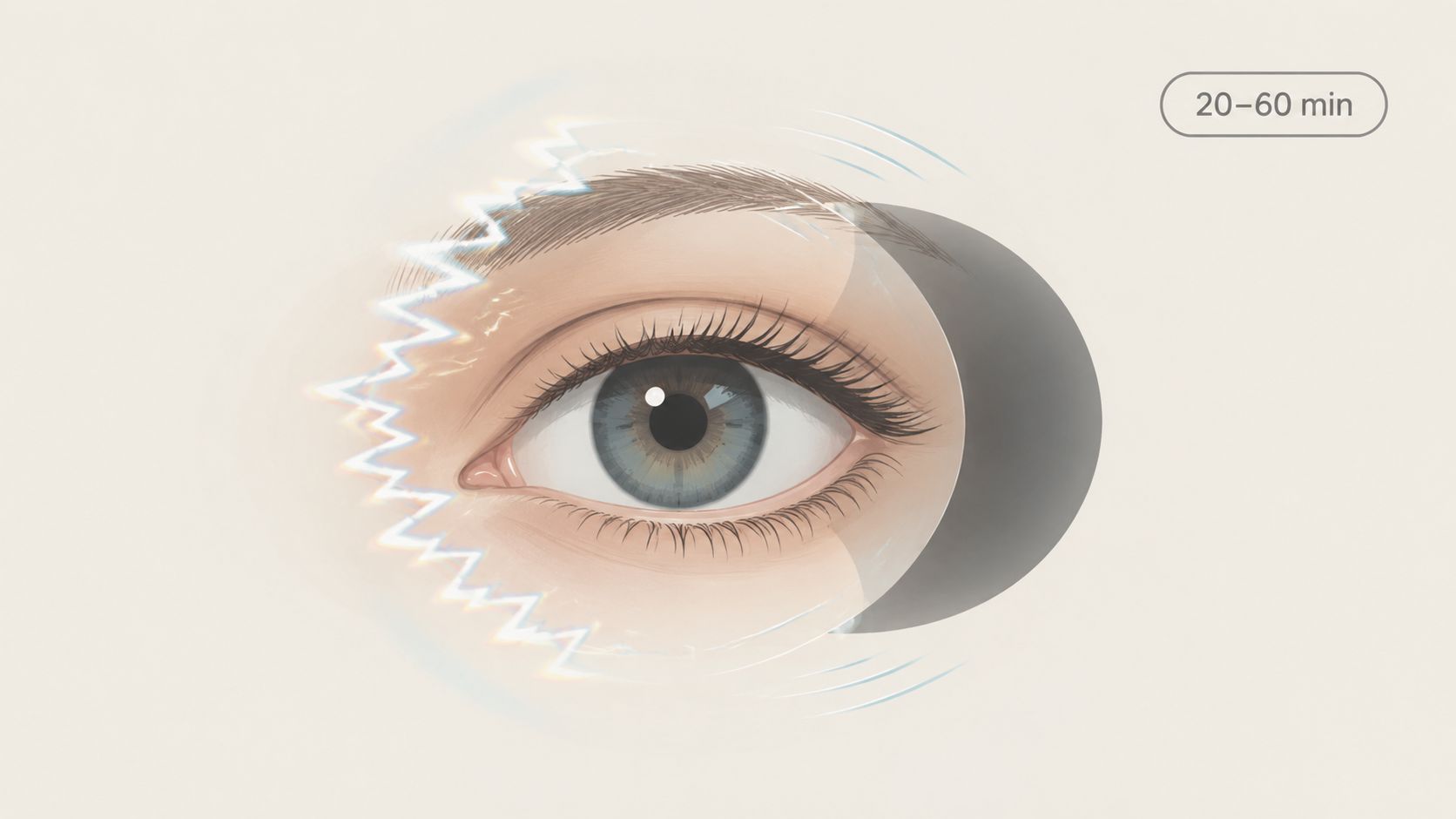
A brief explanation of aura mechanics can clarify why timing belongs in the record.
Seek immediate medical care for new weakness, paralysis, severe speech difficulty, confusion, or a new aura type. A sudden neurological symptom, or one that differs from previous attacks, should not be assumed to be migraine.
6. Attack Duration and Frequency Patterns
A migraine record becomes more useful when it captures the whole timeline, not only the period of strongest pain. Duration and frequency show the broader burden, including attacks that last longer, return sooner, or leave little time for recovery.
For migraine without aura, untreated headache may last 4–72 hours. This range describes a diagnostic pattern, not a personal diagnosis. Record when the episode begins, when pain changes, and when you return to your usual baseline.
Mark the timeline clearly
Use the same boundaries each time:
- Start: Note the first clear head pain. If you are recording the full attack, also mark the earliest related symptom.
- End: Use the time you feel back to baseline, rather than the moment pain merely decreases.
- Frequency: Count migraine days, because one day can include one prolonged episode or several separate periods of pain.
- Treatment status: Record whether treatment was used and whether the episode continued afterward.
A monthly count can hide important patterns. An attack may overlap with prodrome or postdrome, and functioning may remain limited after pain improves. Real-time notes preserve these details better than trying to reconstruct them later.
Chronic migraine refers to headache on at least 15 days per month for more than 3 months, with at least 8 days per month showing migraine features or responding to migraine-specific medication (ICHD-3 chronic migraine criteria). This pattern requires clinical interpretation, so use your record to support a conversation with a healthcare professional.
A structured tool such as Relief's migraine tracking app can keep start times, end times, treatment status, and recovery notes together, reducing reliance on memory.
7. Associated Symptoms and Recovery Effects
Migraine is a sequence, not only a period of head pain. Early changes may begin before the pain, and recovery can continue after the pain fades. Recording that sequence helps separate related symptoms from unrelated complaints and turns scattered experiences into a clearer timeline.
Before pain, prodrome may include yawning, mood changes, food cravings, gastrointestinal symptoms, increased sensitivity, or neck stiffness. The American Migraine Foundation describes prodrome as a distinct phase that can begin up to 24–48 hours before pain (the migraine attack timeline). Mark the first noticeable change, then note when head pain begins.
After the attack, postdrome may involve fatigue, cognitive difficulty, residual sensitivity, or trouble returning to usual tasks. The Migraine Trust recommends tracking symptoms across the stages of an attack, including nausea, vomiting, light and sound sensitivity, aura, dizziness, neck pain, fatigue, and concentration difficulty (the stages of a migraine attack).
Read symptoms in sequence
Timing provides context. Unusual yawning and irritability before pain may fit prodrome, while brain fog and exhaustion after pain eases may fit postdrome. A symptom such as light sensitivity can occur in more than one phase, so record its start and end rather than assigning it to a phase automatically.
Use a brief recovery note:
- Fatigue: Rate it from 0–10 and state whether work or routine tasks were possible.
- Mood: Record irritability, low mood, restlessness, or other changes without assuming they caused the attack.
- Cognition: Note word-finding difficulty, slowed thinking, or poor concentration.
- Body symptoms: Include neck stiffness, dizziness, appetite changes, smell sensitivity, or increased urination when relevant.
- Recovery: Mark when you returned to your usual level of function.
For example: “Unusual yawning and food craving before pain, then concentration difficulty after pain resolved.” This shows the order of events, not just a collection of symptoms.
Avoid calling every pre-attack change a trigger. It may be an early migraine signal instead. Discuss recurring or changing patterns with a healthcare provider, particularly when they interfere with daily life. Before using app-based logging, review Relief's privacy information to understand how tracking data is handled.
Relief App Tracking & Integration (synthesis)
A useful migraine record should capture the full timeline without becoming another burden during an attack. Start with phase, symptom, intensity, start time, duration, effect on daily function, surrounding context, and what helped. Add detail later if your symptoms make that possible.
Relief supports quick logging for aura, nausea, vomiting, dizziness, light sensitivity, sound sensitivity, smell sensitivity, neck pain, and brain fog. The app also combines symptom tracking with local weather, air quality, and pollen information, allowing you to compare your records with environmental conditions instead of relying on memory.
Build a phase-based record
Organize entries like a timeline:
- Prodrome: Note early changes before pain, such as yawning, cravings, mood shifts, or neck stiffness.
- Aura: Record reversible visual, sensory, speech, or other neurological symptoms, including when each begins and ends.
- Attack: Log pain location, quality, severity, nausea, vomiting, light sensitivity, sound sensitivity, and effects on function.
- Postdrome: Record fatigue, brain fog, lingering sensitivity, and the time needed to return to your usual baseline.
Keep treated and untreated duration separate when possible. Record nausea and vomiting as different items, since they can affect eating, hydration, and discussions about treatment with a healthcare provider.
Use environmental information to examine patterns, not to assign a definite cause. Repeated symptoms alongside particular weather conditions, disrupted sleep, or demanding days may give you useful questions to discuss with a provider. You can visit Relief to explore a workflow that combines symptom logging with pattern awareness.
8-Point Migraine Symptom Checklist Comparison
| Item | 🔄 Implementation Complexity | ⚡ Resource Requirements | ⭐ Expected Outcomes | 📊 Ideal Use Cases | 💡 Key Advantages / Tips |
|---|---|---|---|---|---|
| Pain Severity and Location | Low, quick to record but subjective | Minimal, numeric scale and simple location map | ⭐⭐⭐⭐, strong for distinguishing headache types and tracking trends | Differentiating migraine vs. tension; monitoring treatment response | 💡 Use consistent 0–10 scale; log within 30 min and note radiation |
| Photophobia (Light Sensitivity) | Low, simple observation; note timing relative to pain | Minimal, note light sources; consider filters/sunglasses | ⭐⭐⭐⭐, highly specific and actionable when present | Early-warning detection; environmental modifications (work/home) | 💡 Log timing and worst light types; try blue-light filters/dimmers |
| Nausea and Vomiting | Moderate, separate nausea severity and vomiting events | Moderate, may prompt antiemetics or non‑oral meds | ⭐⭐⭐, strong for management decisions (med route/effectiveness) | Determining med absorption strategy; timing antiemetics | 💡 Record nausea (0–10) and vomiting yes/no; note food/med timing |
| Phonophobia (Sound Sensitivity) | Low, simple to note but context-dependent | Minimal, earplugs/quiet space; log sound types | ⭐⭐⭐, specific corroborating symptom; aids functional planning | Workplace/home noise adjustments; early-warning when it precedes pain | 💡 Rate severity and list triggering sounds; try white noise or ear protection |
| Migraine Aura (Visual/Sensory/Speech) | Moderate, requires precise description and timing | Moderate, capture descriptions/photos; urgent eval for atypical signs | ⭐⭐⭐⭐, very reliable early-warning and diagnostic marker | Timing preemptive meds; distinguishing migraine with aura | 💡 Log onset/duration (20–60 min); seek urgent care for motor/speech changes |
| Attack Duration & Frequency Patterns | Moderate, needs disciplined, longitudinal logging | Low, diary or app tracking, calendar review | ⭐⭐⭐⭐, critical for treatment choice and assessing burden | Deciding preventive therapy; evaluating treatment response over months | 💡 Define attack start/end, count migraine days, review 3‑month trends |
| Associated Symptoms (Fatigue, Mood, Cognition) | Low, broad and subjective; timing important | Low, simple scales but repeated entries helpful | ⭐⭐, useful as prodrome for some but non‑specific | Early-warning planning (6–24 hrs prodrome); postdrome scheduling | 💡 Distinguish prodrome vs. postdrome; rate mood/fatigue on same scale |
| Relief App Tracking & Integration (synthesis) | Moderate–High, initial setup and consistent use required | Moderate, smartphone, time to log, optional sensor data | ⭐⭐⭐⭐, high value from aggregated trends, forecasts, clinician reports | Longitudinal management, clinician sharing, personalized risk forecasting | 💡 Log in real time, use separate fields (treated vs. untreated), review 3‑month dashboards |
Turn Your Checklist Into a Safer Tracking Habit
A migraine symptom checklist should make your experience easier to describe, not turn every difficult day into a data-entry project. If you can record only a few details during an attack, choose the phase, main symptom, severity, start time, and effect on your ability to function. Add context and recovery notes later, when you're able.
A complete record can include:
- Phase: Prodrome, aura, attack, postdrome, or symptom-free interval.
- Symptom: Pain, nausea, vomiting, light sensitivity, sound sensitivity, aura, dizziness, fatigue, or cognitive difficulty.
- Severity: A consistent 0–10 rating, with your own reference points.
- Timing: When the symptom began, changed, and ended.
- Duration: How long the attack lasted and when normal function returned.
- Functional impact: Whether you worked, modified activity, rested, or needed help.
- Context: Sleep, meals, stress, weather, air quality, pollen, screens, or other observations.
- Response: What you tried and what changed afterward.
Keep observations separate from assumptions. “Headache began after a hot commute” is an observation. “Heat caused the migraine” is an interpretation. A pattern becomes more credible when it recurs across your own records, but even then, discuss major changes with a healthcare provider rather than making a firm conclusion from an app or diary.
Red flags need immediate attention
Seek immediate medical care for a sudden severe headache, a headache with fever or stiff neck, neurological changes, or a headache after a head injury. New weakness, paralysis, severe speech difficulty, confusion, or a new type of aura also warrants immediate care.
Don't wait for a tracking trend when a symptom feels urgent or dramatically different. A familiar migraine history doesn't automatically explain a new neurological event, a sudden change in intensity, or a headache after trauma.
When to discuss the pattern with a clinician
Arrange clinical advice when your pattern changes, vomiting becomes frequent, you struggle to stay hydrated, or migraine days are increasing. A diary can help you explain what changed, how often it happens, how long recovery takes, and whether current strategies are helping.
Relief can make logging faster and place symptoms beside personal environmental and lifestyle observations. It can help surface summaries for a provider conversation, but it's a tracking and awareness tool, not a medical treatment and not a substitute for professional care.
This article is for informational purposes and is not medical advice. Consult a healthcare provider for personalized guidance.
Use Relief to log pain, aura, nausea, sensory symptoms, timing, and recovery in one place, then review the patterns that may help you prepare for future attacks. Start with the symptoms you can capture today, and bring the resulting record to a healthcare provider when you need personalized guidance.


