Migraine aura is a fully reversible wave of neurological symptoms lasting 5 to 60 minutes that occurs in about 20% to 30% of people with migraine, most often affecting vision and typically appearing before headache. It can also involve tingling, numbness, speech changes, or other neurological symptoms, and sometimes occurs without head pain.
You may be reading this while bright zigzags are moving across your vision, one hand is tingling, or words feel briefly difficult to find. That experience can be disorienting, especially when someone else can't see anything unusual and you're left wondering whether it's “just” a migraine.
Aura is real. It's a temporary neurological phase, distinct from the headache phase, and it doesn't happen to everyone with migraine. A major clinical reference estimates that nearly 25% of people with migraine experience aura, while migraine affects about 12% of the population overall, as described in this clinical reference on migraine aura and migraine.
This guide explains what migraine aura feels like, how long it usually lasts, why it can spread across your vision or body, and how to distinguish a familiar pattern from symptoms that need urgent medical attention. You'll also find practical ways to record aura symptoms so you can describe them more clearly to a healthcare provider. For additional background on Relief's approach to migraine awareness and tracking, visit the ReliefMigraine about page.
This article is for informational purposes and is not medical advice. Consult a healthcare provider for personalized guidance.
Table of Contents
- What Migraine Aura Feels Like and Why It Matters
- The four phases in simple terms
- What gradual onset can look like
What Migraine Aura Feels Like and Why It Matters
You may be reading this while a shimmering line crosses your vision, a blind spot expands, or tingling travels from your fingers up your arm. Words might briefly feel difficult to find. These sensations can be frightening, especially when no one else can see them, but your experience is real.
Migraine aura is a recognized neurological phase, not an imagined reaction or merely a visual distraction. It usually involves fully reversible focal neurological symptoms. In other words, a temporary change affects a specific function, such as vision, sensation, or language, and then resolves.
Visual symptoms are the most common, but zigzags are only one possibility. You might see flashing lights, shimmering areas, or changes in what you can see. Sensory aura can bring tingling or numbness, while language symptoms can affect speaking or understanding. The peer-reviewed REFORM study on migraine aura symptoms reported visual symptoms in 94.7% of participants, somatosensory symptoms in 35.7%, and speech or language symptoms in 13.7%.
A useful distinction: Migraine is a neurological condition. A headache is one possible phase of migraine, not a synonym for the whole condition.
Aura may appear before head pain, during an attack, or without a later headache. That last pattern often causes confusion because aura is commonly treated as a warning that pain will follow.
Your usual aura may develop gradually, spread in a familiar direction, and disappear completely. A first episode, a major change in your pattern, or sudden weakness and other new neurological deficits should be assessed by a healthcare professional rather than assumed to be migraine. Recording symptoms in Relief's migraine tracking approach can help you describe their timing, progression, and recovery clearly.
Understanding Migraine Aura and Its Typical Timeline
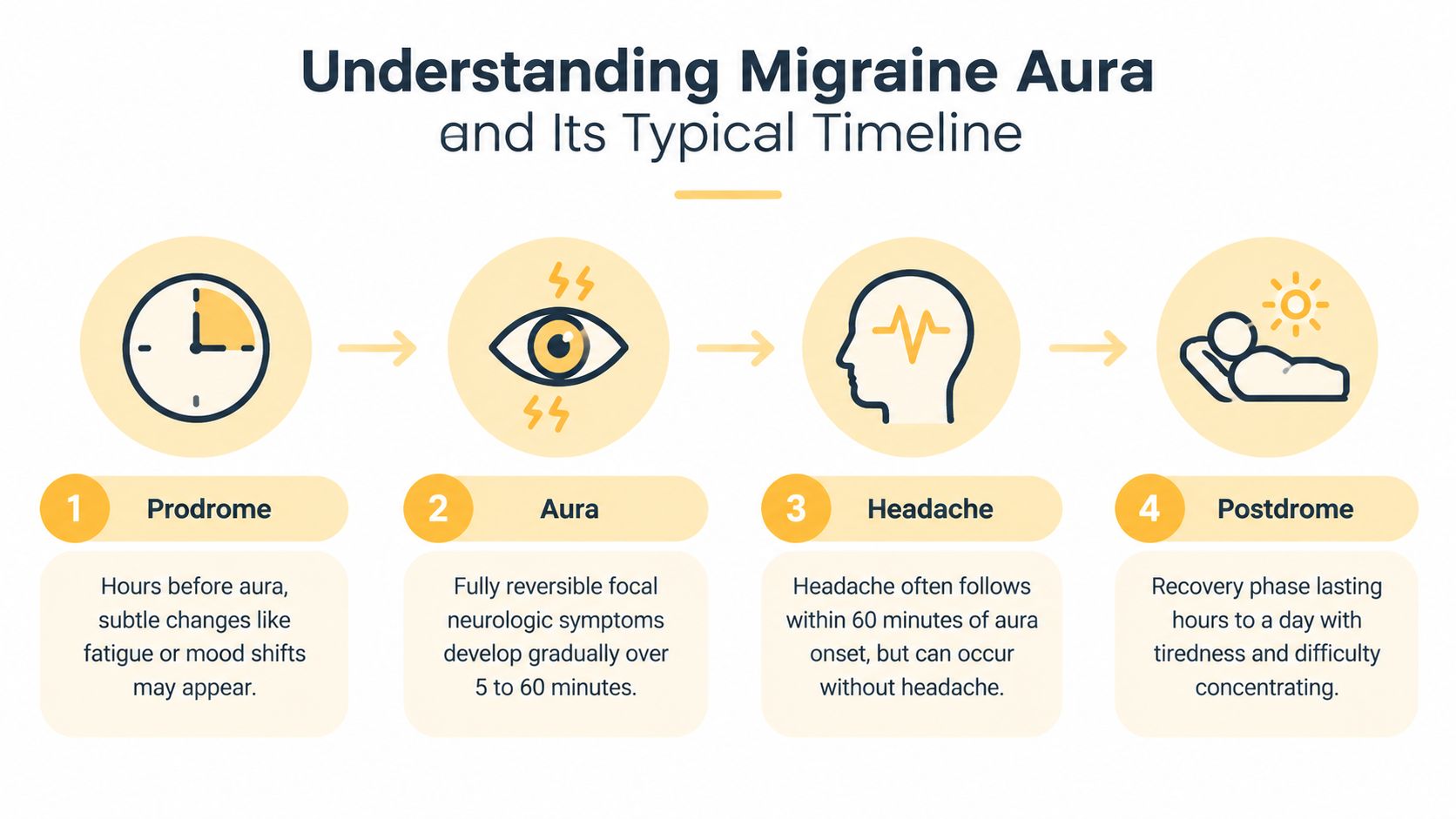
A migraine attack may unfold in stages, like a sequence rather than one sudden event. You might notice a tired, unsettled feeling first, then neurological symptoms, head pain, and a period of recovery. These phases can overlap, and some people experience only a few of them.
The four phases in simple terms
Prodrome comes before aura or head pain. Fatigue, mood changes, trouble concentrating, or other subtle changes may signal that an attack is developing. These symptoms are part of the broader migraine pattern, not the aura itself.
Aura involves fully reversible neurological symptoms. Typical aura usually develops gradually over at least 5 minutes, lasts 5 to 60 minutes, and may occur before headache. Aura can involve vision, sensation, speech, movement, brainstem functions, or the retina. The REFORM clinical study of aura characteristics examined how these symptoms appear and progress.
Headache is one possible phase of migraine, not the definition of migraine itself. Aura can come before head pain, overlap with it, or occur without a later headache.
Postdrome is the recovery period. After the more noticeable symptoms fade, you may feel tired, mentally slowed, emotionally flat, or less able to concentrate.
A clinical study of aura timing and migraine sequence reported that aura lasted an average of 27.3 minutes, with headache following it by an average of 10.4 minutes, in 952 migraine patients. These are clinical benchmarks, not a schedule your body must follow. Episodes can vary from one attack to another.
What gradual onset can look like
A visual aura might start as a small flicker and expand into zigzags or a shimmering blind spot. Sensory symptoms may begin in the fingertips and gradually move through the hand, arm, or face. This spreading pattern can help clinicians compare a familiar aura with other neurological conditions.
Track the start and end time when you can do so safely. Record whether symptoms spread, whether one symptom followed another, and whether head pain appeared afterward. Relief's migraine tracking approach can help organize these details for a healthcare visit. A first episode, a major pattern change, sudden weakness, or another new neurological deficit should be assessed promptly rather than assumed to be aura.
The Main Types of Migraine Aura You Might Experience
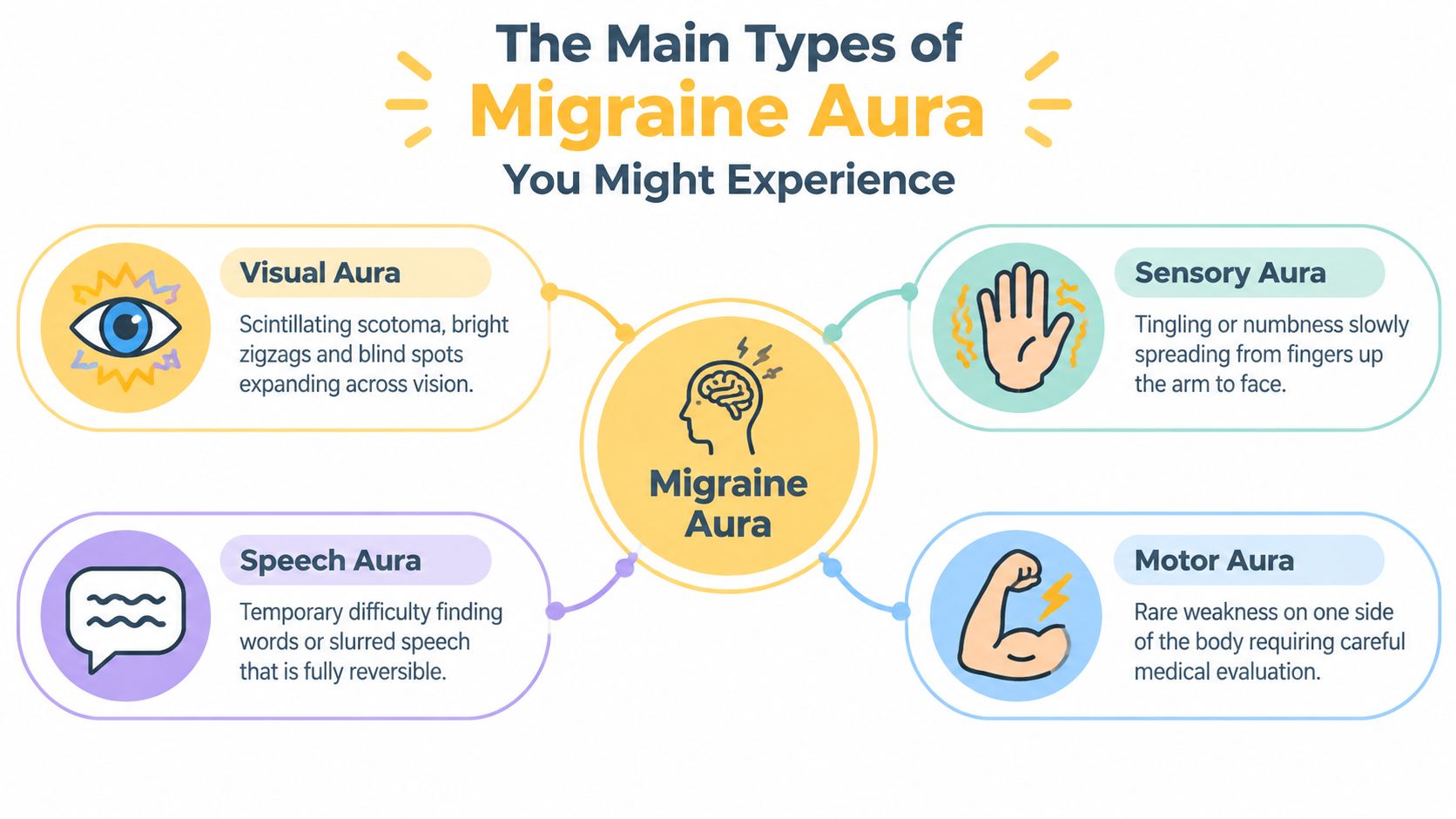
Aura doesn't always mean flashing lights. Vision is the dominant form, but migraine aura can affect sensation, language, movement, balance, or sight in one eye.
Visual aura
Visual aura can include scintillating scotoma, a term for a shimmering or flashing area that may include a blind spot. You might see bright zigzags, flickering lights, wavy lines, or a shape that gradually expands across part of your field of vision.
Because visual aura can involve both eyes even when it seems to occupy one side of your view, it may help to record what you noticed rather than trying to label it as an eye problem yourself. Sudden vision loss in only one eye needs prompt assessment.
Sensory aura
Sensory aura often feels like tingling, pins and needles, or numbness. It may begin in the fingers and slowly spread up the arm toward the face, or it may affect another area.
The direction and progression can be more informative than the sensation alone. Note where it began, how it moved, and whether it resolved fully.
Speech and language aura
You may know what you want to say but struggle to retrieve the word. Speech can feel slowed, unusual, or temporarily unclear. These symptoms are fully reversible in typical aura, but sudden speech difficulty can also signal an emergency, particularly when it doesn't follow your familiar pattern.
Motor aura
Motor aura involves weakness, often on one side of the body. It's uncommon and can resemble stroke, so it requires careful medical evaluation rather than home interpretation.
Brainstem and retinal symptoms
Brainstem-related aura can involve symptoms such as vertigo, imbalance, or changes in coordination. Retinal symptoms affect vision in one eye and may include flashing or shimmering lights, blind spots, or temporary loss of vision.
The 2025 systematic review of migraine aura phenotypes describes aura as broader than the familiar visual-only picture, including sensory, speech or language, motor, and brainstem symptoms. Track the categories you experience, even if they occur together or during head pain.
What Happens in Your Brain During an Aura
The leading biological explanation for migraine aura is cortical spreading depression, often abbreviated as CSD. It's a slowly moving wave of altered electrical activity across the outer layer of the brain, called the cortex.
The wave travels about 3 to 5 millimeters per minute, and it's associated with reduced blood flow and temporary suppression of neural activity, according to this review of cortical spreading depression and migraine aura.
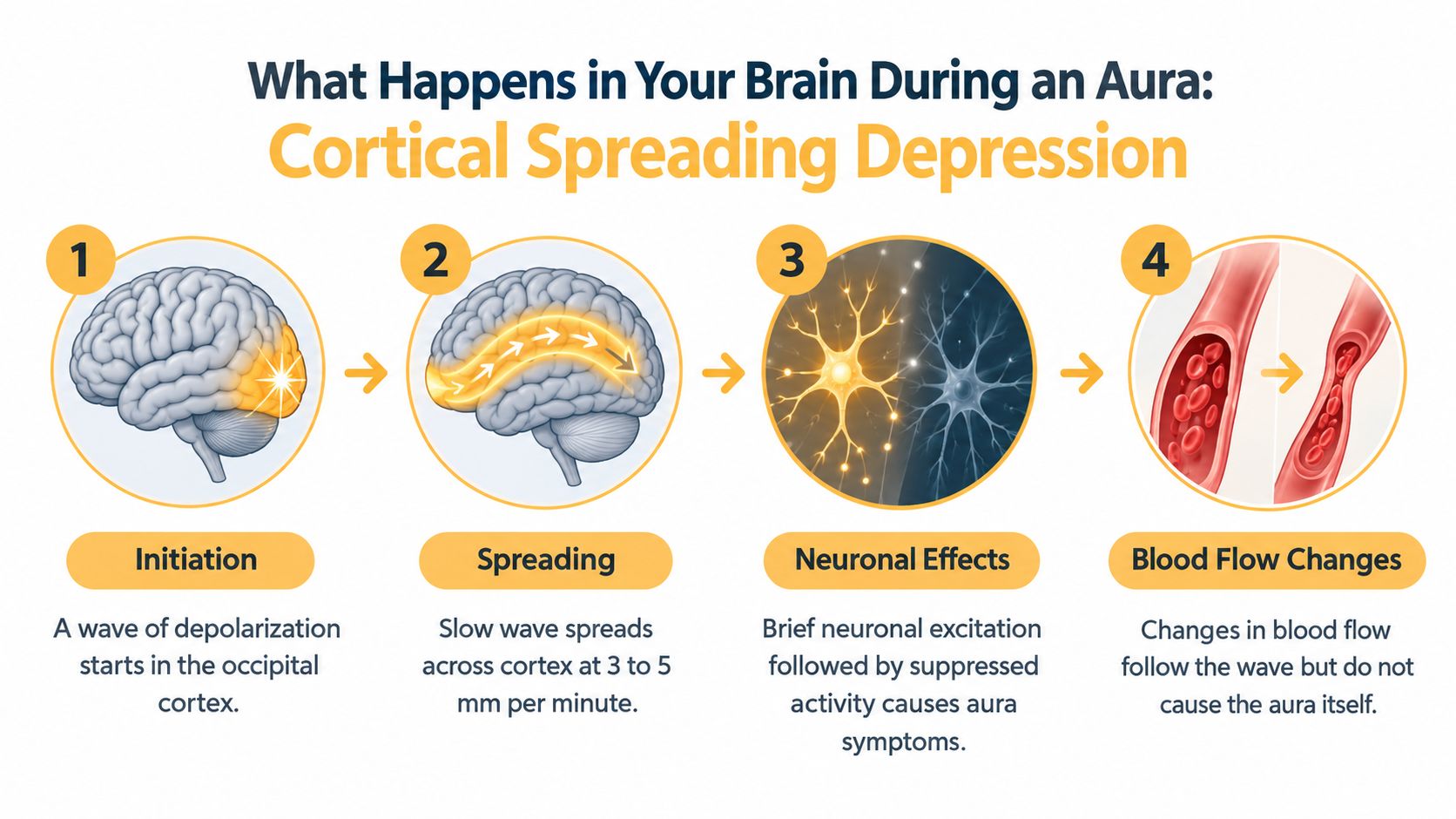
A simple analogy is a wave moving across a field of lights. As the wave passes, one area briefly becomes overactive and then quieter. If it moves through brain regions involved in vision, you may see zigzags or shimmering shapes. If it affects sensory or language regions, tingling or word-finding difficulty may follow.
This model helps explain why aura often spreads gradually instead of appearing all at once. It also helps explain why symptoms typically resolve, although cortical spreading depression isn't a complete explanation for every person's experience and doesn't replace clinical evaluation.
Changes in blood flow accompany the wave, but current explanations don't treat reduced blood flow alone as the cause of aura. The gradual electrical process is the key concept.
Why this matters: A symptom that moves and resolves can fit the biology of aura. A sudden, fixed, or persistent deficit needs a different level of caution.
How Migraine Aura Differs From Stroke and Other Conditions
Aura and neurological emergencies can share symptoms, which is why comparison alone can't safely diagnose you. A familiar pattern that builds gradually and resolves completely may be consistent with aura, but a first or changed pattern should still be discussed with a clinician.
| Feature | Migraine Aura | TIA / Stroke or Seizure |
|---|---|---|
| Onset | Often develops gradually over at least 5 minutes | May begin suddenly, especially with a fixed deficit |
| Symptom pattern | Can spread or move from one area to another | May cause abrupt weakness, numbness, speech difficulty, or vision loss |
| Duration | Typically resolves within 5 to 60 minutes | Symptoms may persist, recur, or require urgent evaluation |
| Vision | Often affects the visual field with shimmering, zigzags, or expanding patterns | Sudden loss of vision, particularly in one eye, is concerning |
| Repetition | May follow a recognizable pattern across attacks | A new or substantially different pattern shouldn't be assumed to be aura |
| Headache | May precede, accompany, or follow symptoms | A severe headache can occur with serious neurological conditions too |
Questions to ask about the pattern
Ask yourself whether symptoms began gradually or all at once. Did they spread in a sequence, and did they completely resolve? Did you experience weakness, confusion, loss of consciousness, or vision loss in one eye?
These questions can help you communicate clearly with a healthcare provider, but they don't rule out emergencies. Aura without the classic severe headache can occur, and a Cleveland Clinic overview of migraine aura notes that visual, sensory, speech, motor, brainstem, and retinal symptoms can all be part of the broader clinical picture.
In middle-aged and older adults, a new aura without a typical headache deserves careful assessment. The American Academy of Neurology report on aura without headache highlights this important nuance for people whose symptoms emerge or change later in life.
When to Seek Immediate Medical Care for Aura Symptoms
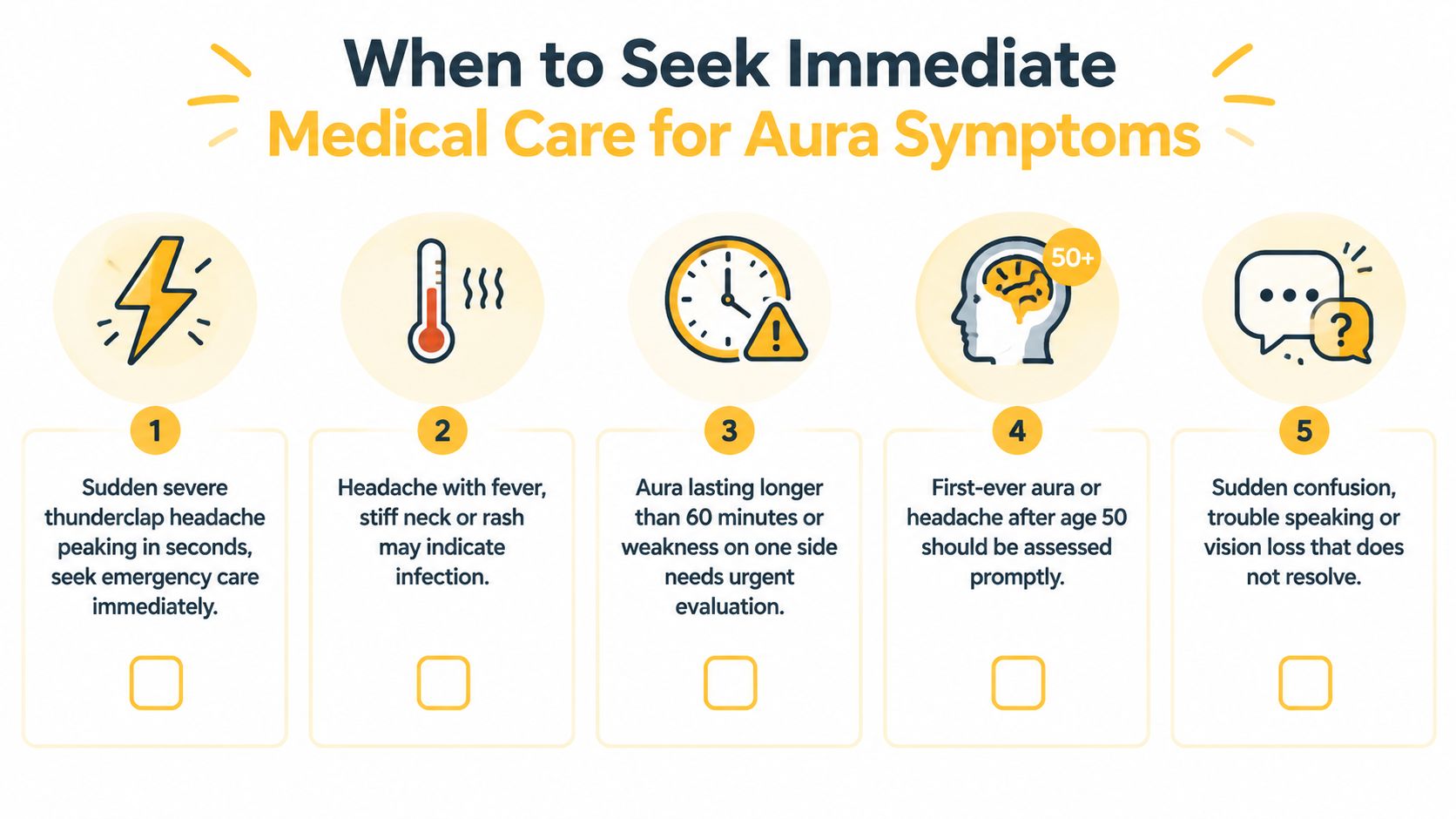
Don't try to track a symptom at home when it could represent a neurological emergency. Seek immediate medical care, call emergency services, or go to an emergency department for any of the following:
- Sudden severe headache: A thunderclap headache that peaks in seconds requires emergency evaluation.
- Fever or stiff neck: Headache with fever, stiff neck, or a rash may indicate a serious infection.
- Persistent symptoms: Aura-like symptoms lasting longer than the usual 60-minute window need urgent assessment.
- One-sided weakness: Sudden weakness, especially on one side of the body, should be treated as an emergency.
- Sudden confusion or speech trouble: New confusion, difficulty speaking, or vision loss that doesn't resolve needs immediate care.
- Head injury: A headache or neurological change after a head injury requires prompt medical evaluation.
- First or changed aura: A first-ever aura, a substantially different episode, or a new pattern later in adulthood should be assessed promptly.
Safety rule: If you're unsure whether symptoms are migraine aura or an emergency, choose urgent medical evaluation. Don't drive yourself if your vision, speech, strength, or awareness is impaired.
This article is for informational purposes and is not medical advice. Consult a healthcare provider for personalized guidance.
Managing Aura and Tracking Patterns Over Time
Aura tracking works best when it captures the experience without requiring a long journal entry. Record the start time, end time, symptom type, whether symptoms spread, whether headache followed, and anything unusual about the episode.
A short entry might read: “Shimmering arc in left visual field, expanded gradually, resolved fully, head pain followed.” If you had tingling or language changes, add where the symptom began and whether it moved.
Separate management options clearly
Lifestyle approaches can include protecting regular sleep, eating consistently, staying hydrated, and reducing avoidable sensory strain. Triggers vary widely, so don't treat a list of foods, weather conditions, hormones, smells, or stressors as universal explanations.
Over-the-counter options may help some people with migraine pain when used safely and according to guidance from a healthcare professional or product labeling. A pharmacist or clinician can help you consider interactions, health conditions, and whether an option is appropriate.
Prescription treatments may be used during attacks or as preventive treatment when migraine substantially affects daily life. The right choice depends on your symptoms, medical history, other medicines, and migraine subtype, so discuss options with a healthcare provider rather than selecting a treatment based on an online ranking.
Emerging research is examining aura subtypes, brain activity, and neuroimaging. This may eventually support more individualized understanding, but research attention doesn't make an investigational approach a proven treatment.
Relief can support symptom and trigger logging alongside environmental information such as weather, air quality, and pollen. Use any app as a record-keeping tool, not as a substitute for clinical care.
Review your entries with a clinician. Patterns are more useful when they show what happened before, during, and after aura instead of only recording the day a headache occurred.
Planning Ahead With Confidence After an Aura
An aura may arrive while you are working, driving, or trying to speak, making the moment feel frightening and unpredictable. Recognizing your usual pattern can give you time to pause, reduce stimulation, record symptoms, and follow the plan you made with your healthcare provider.
Aura affects a substantial minority of people with migraine, roughly one-third of migraine patients in many settings, according to population findings summarized in the NCBI clinical reference on migraine aura. A familiar pattern still does not make every episode predictable. New, unusually severe, or different neurological symptoms need medical assessment.
Record the aura's type, timing, spread, and recovery, along with what happened before and after it. These details can help your clinician identify changes and ask more focused questions. If privacy matters, read the Relief privacy information before choosing a tracking tool.
You do not need a perfect explanation. A brief, consistent record can turn a frightening episode into useful information for future planning.
Relief lets you log aura symptoms, migraine severity, triggers, and medications beside environmental signals such as weather, air quality, and pollen. Visit Relief to build a clearer record of your migraine experience and plan with fewer surprises.


