Episodic migraine means fewer than 15 headache days per month. Chronic migraine means 15 or more headache days per month for more than 3 months, with at least 8 of those days meeting migraine criteria (clinical review of migraine classification).
If you're reading this because your migraines used to show up once in a while and now seem to be creeping into more of your month, you're not overthinking it. The frequency of migraine attacks is one of the most important parts of understanding what kind of migraine pattern you're dealing with, when prevention starts to matter, and what your tracking should capture.
This article is for informational purposes and is not medical advice. Consult a healthcare provider for personalized guidance.
Table of Contents
- Frequency is one signal, not the whole story
- What a rising count can mean
- What your tracker should surface
- A practical daily logging routine
- What consistency looks like
- Review your month, not just individual bad days
- Triggers are better understood as risk exposures
- Common drivers to review when frequency starts climbing
- What your app or diary should surface
- Start with foundations you can repeat
- Add non-prescription and clinician-guided options thoughtfully
- Use tracking to find hit rates, not just counts
- Keep treatment lanes separate in your mind
What Migraine Attack Frequency Really Means
You wake up with head pain on Tuesday, feel almost normal by Wednesday night, then lose Friday to light sensitivity, nausea, and that familiar migraine fog. By the end of the month, the hardest part is not only what happened. It is figuring out what to count.
That confusion is common because migraine attack frequency and migraine burden are related, but they are not the same thing.
Migraine attack frequency means how often you have separate migraine episodes during a set period, usually a month. An attack is a single migraine episode that may last hours or, for some people, stretch across more than one day. Burden is broader. It includes how many days migraine affects you, how intense the symptoms are, how long they last, and how much normal life gets pushed aside.
A simple way to picture it is weather versus time indoors. Frequency asks, "How many storms rolled through?" Burden asks, "How many days did the storm keep you from living normally?" Those numbers can move together, but they do not always.
That difference matters.
Someone with two long attacks in a month might have many impaired days. Someone else might have four shorter attacks with less disruption per attack, but a pattern that raises questions about prevention. Counting attacks helps identify recurrence. Counting migraine days shows the month-level load. You need both to understand the pattern clearly.
Frequency is one signal, not the whole story
Frequency does not tell you:
- Severity, meaning how strong the pain or other symptoms feel
- Duration, meaning how long one attack lasts
- Disability, meaning how much migraine interferes with work, childcare, driving, sleep, exercise, or basic tasks
Two people can report "three attacks this month" and be describing very different lives.
That is why a bare attack count can be misleading if it sits alone in a tracker. A useful record should show what happened around those attacks too. Did poor sleep show up before two of them? Did missed meals appear before three? Did a rescue medicine stop one attack quickly but fail on another? The helpful question is not only how many attacks occurred. It is how often a suspected trigger or condition was followed by an attack.
What a rising count can mean
More frequent attacks can be an early pattern change, not just a run of bad luck. For some people, frequency increases after a period of stress, schedule disruption, hormonal change, medication overuse, or untreated sleep problems. For others, the shift is gradual enough that it hides in plain sight until the month starts feeling crowded.
Population research summarized by Practical Neurology shows that migraine is often a recurring condition rather than an occasional event, with many people experiencing multiple attacks or multiple headache days in a month (Practical Neurology review of clinical features of migraine).
That recurring pattern is one reason clinicians pay attention to frequency early. Prevention decisions are often tied to thresholds, but those decisions also depend on how much of your month migraine is taking over. A person with "only" a few attacks may still need a prevention discussion if each attack is long, hard to treat, or linked to repeated lost days.
What your tracker should surface
A good migraine log should do more than total up attacks.
It should help you see exposure-hit-rate patterns. In plain language, that means noticing how often a possible driver is followed by an attack, not just how often the driver happened. If you drank coffee late five times and had an attack after one of those times, that pattern looks different from sleeping poorly four times and getting an attack after three.
Counts tell you volume. Hit rates tell you which exposures are earning your attention.
That is the practical meaning of migraine attack frequency. It is not just a number for your chart. It is one part of a pattern that helps you decide when prevention may be worth discussing, what burden your month is really carrying, and what your tracking app should bring to the surface.
Episodic vs Chronic Migraine and the 15-Day Threshold
You log a miserable month and count four clear attacks. That does not sound "chronic." Then you look closer and realize those attacks spilled across more than half the month as headache days. That is the gap between attack frequency and migraine-day burden, and it is exactly why the 15-day threshold exists.
The 15-day rule
Episodic migraine and chronic migraine are separated by monthly headache-day count, not by how intense the worst attack felt.
Under accepted diagnostic criteria, chronic migraine means headache on 15 or more days a month for more than 3 months, with at least 8 of those days having migraine features. Fewer than 15 headache days falls under episodic migraine (American Migraine Foundation overview of chronic migraine diagnosis).
That definition catches many people off guard. A person with 14 headache days can be heavily limited and still remain on the episodic side of the line.
Frequency diagnosis, burden decision
Chronic migraine is a frequency-based diagnosis. It does not rank one person's suffering above another's.
What it does do is signal that migraine is occupying a larger share of the month. Clinicians use that pattern, along with disability and treatment response, to decide when preventive treatment deserves a real conversation. The American Headache Society notes that prevention is commonly considered for people with four or more monthly headache days, depending on disability and other factors (American Headache Society guidance on preventive treatment for migraine).
That threshold matters because treatment decisions usually start before someone crosses into chronic migraine. In other words, "not chronic" does not mean "too early to talk prevention."
| Criterion | Episodic Migraine | Chronic Migraine |
|---|---|---|
| Monthly headache-day count | Fewer than 15 | 15 or more |
| Time requirement | Not applicable | More than 3 months |
| Migraine-feature requirement | Can still have migraine attacks | At least 8 days per month meet migraine criteria |
| What defines it | Headache-day burden stays below the chronic cutoff | Headache-day burden stays at or above the chronic cutoff |
Why this cutoff changes what you should track
A bare attack count can miss the reason a clinician changes course. Four long attacks may create many more affected days than four short ones.
That is why a tracking app should surface more than totals. It should show headache-day count, probable migraine-day count, and which exposures have the highest hit rate, meaning how often a given exposure is followed by a migraine episode. That helps with two different questions at once: "Am I approaching a prevention threshold?" and "Which patterns are showing up before these bad stretches?"
If you want a closer look at the diagnosis itself, ReliefMigraine has a clear explainer on the definition of chronic migraine and how doctors apply it.
Episodic and chronic migraine are not fixed labels. Many people move between them over time as sleep, hormones, stress, treatment response, and medication use change.
Attacks vs Migraine Days and Why Counting Matters
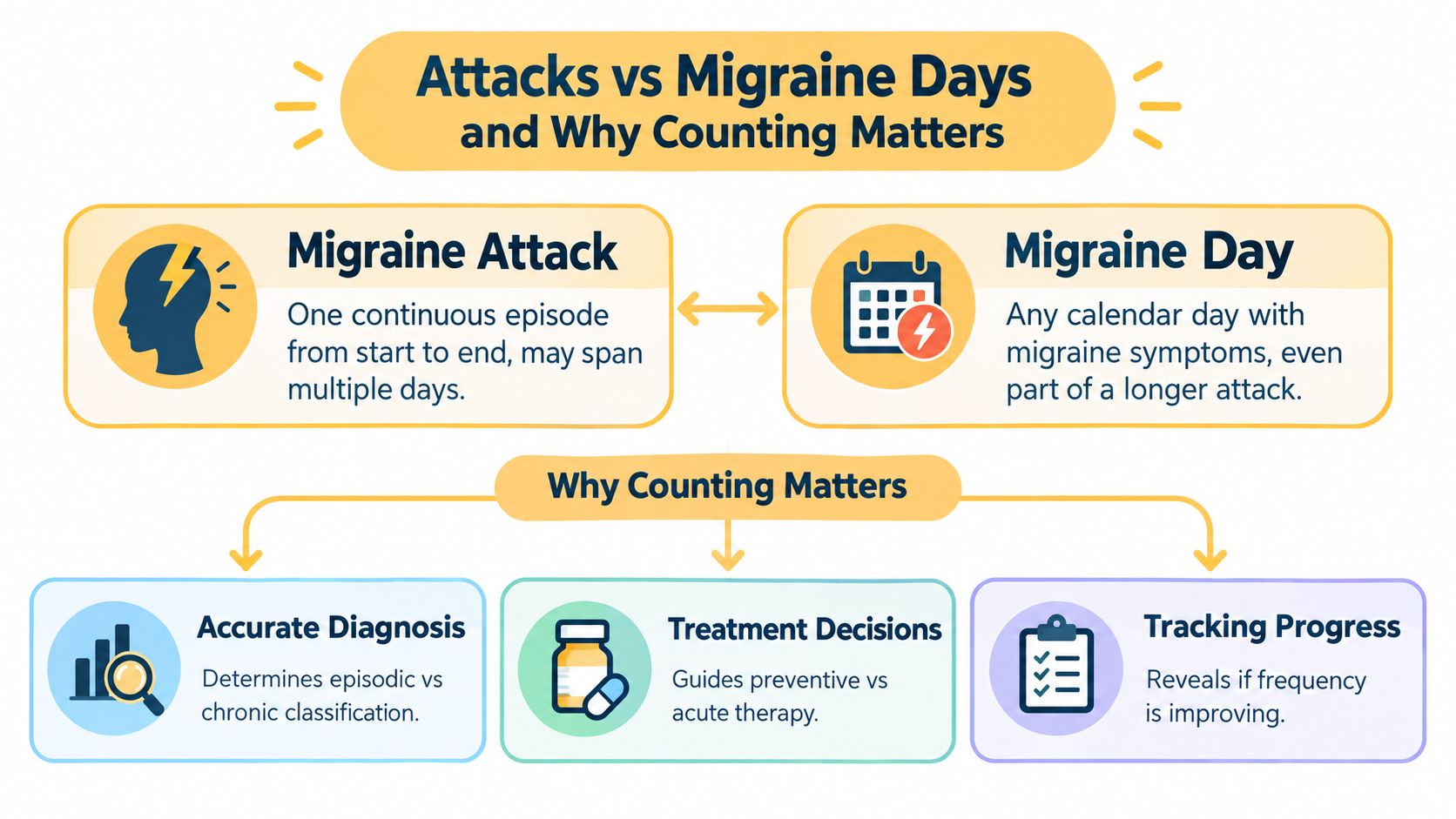
A migraine attack is one continuous episode with a beginning and an end. A migraine day is any calendar day when migraine symptoms are present.
Those are not the same thing.
One attack can create several migraine days
A typical migraine attack can move through prodrome (early warning symptoms), aura (temporary neurologic symptoms such as visual or sensory changes), headache, and postdrome (the drained after-effect). The headache phase usually lasts 4 to 72 hours without treatment, and aura usually lasts 5 to 60 minutes when it happens (overview of the four migraine phases, NCBI Bookshelf review of migraine aura).
So if one attack starts Monday night and fades Wednesday afternoon, that's one attack but three migraine days.
Why this mix-up matters
The most common mistake is counting only attacks and ignoring how many calendar days they occupy. A clinic-focused review found that clinicians asked about frequency in 63% of visits, but it also warned that focusing on attacks can underestimate monthly migraine days (review on migraine burden assessment in clinic visits).
That matters because prevention decisions and chronic migraine definitions use headache-day burden. If you only report, "I had two migraines this month," you might accidentally hide the fact that those two attacks swallowed six or seven days.
What to log each time
Keep it simple enough that you'll do it.
- Date and day label. Note whether it was a migraine day, possible migraine day, or pain-free day.
- Start and stop times. This helps separate one long attack from multiple short ones.
- Symptoms. Include nausea, photophobia (light sensitivity), phonophobia (sound sensitivity), aura, neck pain, or dizziness.
- Impact. Did you function, slow down, or have to lie down?
How to Measure and Record Migraine Frequency
Perfect tracking isn't the goal. Useful tracking is.
A short, consistent daily record gives you a better picture than trying to reconstruct the month from memory during an appointment. That's especially true because preventive decisions are often tied to frequency thresholds, and one peer-reviewed review noted that many guidelines consider prevention when attacks average two or more per month, while some use three or more per month (peer-reviewed discussion of prevention thresholds and diary use).
A practical daily logging routine
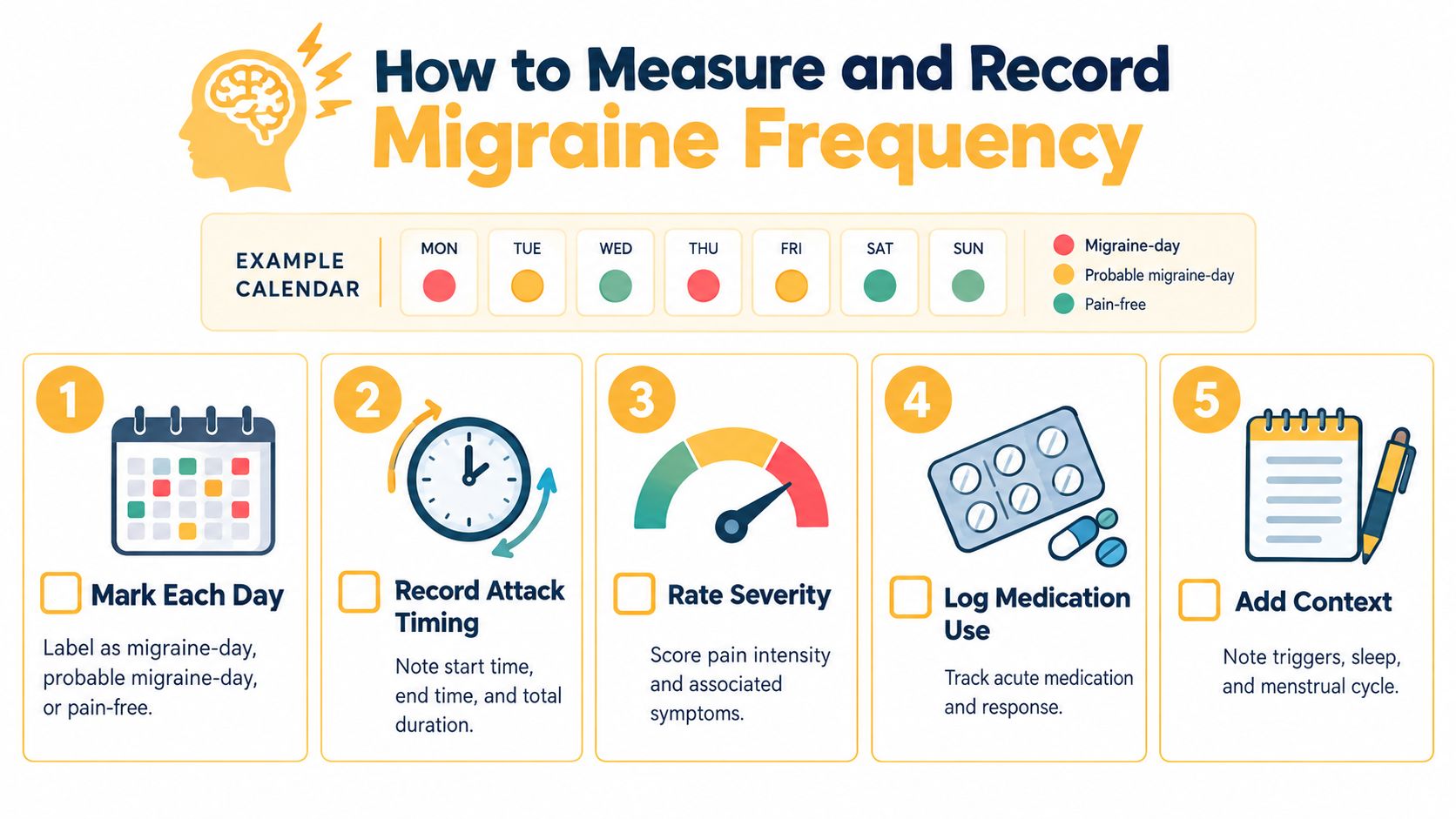
Use one line per day if that's all you can manage.
- Mark the day. Label it migraine day, probable migraine day, or pain-free.
- Record timing. Add start time, end time, and total duration if you know it.
- Rate severity. A simple 0 to 10 scale works if it helps you stay consistent.
- Capture symptoms. Aura, nausea, photophobia, phonophobia, dizziness, and postdrome are all useful.
- Log treatment use. Note over-the-counter medicine, prescription acute treatment, supplements, and whether they helped.
- Add context. Sleep, stress, skipped meals, menstrual cycle timing, weather shifts, and unusual exposures can all matter.
For a practical walkthrough of diary habits, ReliefMigraine also has a guide to tracking migraine headaches in a way you'll actually keep up with.
What consistency looks like
Some entries will be detailed. Some will just say "woke with migraine, light sensitive, took meds."
That's fine. A diary is a pattern tool, not a moral report card.
Review your month, not just individual bad days
Look back at the end of each month and ask:
- How many headache days did I have?
- How many distinct attacks did those days represent?
- Is the pattern stable, rising, or clustering around certain conditions?
A sparse diary you keep is more valuable than a detailed diary you abandon after four days.
Common Drivers of Increasing Migraine Frequency
You have a month where the attacks seem to start showing up everywhere. One after poor sleep, another after a skipped lunch, then two more during a stressful week. It can feel random. More often, it is a pileup.
Rising attack frequency usually comes from repeated pressure on a migraine-prone nervous system, not from one mistake. A single late night may pass without much consequence. The pattern often changes when several exposures keep landing close together, especially if your recovery time between attacks gets shorter.
Triggers are better understood as risk exposures
A trigger is an exposure linked to a higher chance of an attack. It is not a guarantee. In a review of migraine precipitants, 75.9% of patients reported triggers at least sometimes, with stress, hormonal shifts, skipped meals, weather, and sleep disturbance among the commonly reported exposures (review of migraine triggers and precipitants).
That distinction matters.
If perfume gives you an attack once and not the next three times, that does not mean your log is useless. It usually means the exposure has a hit rate, not a one-to-one rule. Migraine works more like a threshold problem. The bucket slowly fills with poor sleep, stress, hormonal change, dehydration, sensory load, or frequent rescue medication use. One more exposure can tip it over.
This is also why bare counts can miss the story. Two people can each have four attacks in a month. One has four isolated events. The other has four attacks after the same repeatable exposure pattern. For prevention decisions, the second pattern is often more actionable.
Common drivers to review when frequency starts climbing
| Driver Category | What it can look like | Why it matters |
|---|---|---|
| Sleep and routine disruption | Irregular sleep, sleeping in, shift work, skipped meals, dehydration | The brain tends to like regular timing. Repeated disruption can lower the threshold for attacks. |
| Stress and post-stress let-down | Work deadlines, caregiving strain, travel, then the crash after pressure eases | Some people get attacks during stress. Others get them when the body relaxes after it. |
| Hormonal change | Menstrual cycle shifts, perimenopause, changes in hormonal contraception | Timing patterns can be strong here, which makes tracking especially useful. |
| Sensory and environmental load | Bright or flickering light, heat, humidity, strong odors, noise, weather changes | These exposures vary a lot by person, so your own pattern matters more than population averages. |
| Acute medication overuse | Treating headaches more and more often, needing repeat doses, shorter relief windows | Frequent use of acute medicines can help in the moment but also contribute to more frequent headache over time in some people. |
Hormones deserve special attention because the pattern is often cyclical rather than random. Menstrual migraine, meaning attacks that occur around menstruation, can cluster so consistently that the timing itself becomes a prevention clue, not just a diary detail.
Medication pattern matters too. If attack frequency rises and your acute treatment days are rising with it, that is worth bringing to a clinician early. The issue is not "using medicine wrong." It is that more attacks and more acute treatment can start feeding each other.
What your app or diary should surface
A useful tracker should do more than total up attacks. It should show which exposures are followed by attacks often enough to matter.
For example:
- poor sleep followed by an attack 4 out of 6 times
- skipped meals followed by an attack 2 out of 9 times
- menstruation followed by an attack 3 cycles in a row
- weather shifts noted often, but with no clear increase in attack hit rate
That kind of exposure-to-attack pattern is more helpful than a flat monthly count alone. Frequency tells you how often attacks happen. Burden tells you how many days they take from you. Exposure hit rate helps explain why the frequency may be rising, and what is most worth targeting in prevention.
Population patterns can add context, but they do not replace your own record. A trigger that is common in studies may not matter much for you. A trigger that looks minor at first may turn out to hit hard when it stacks with poor sleep or cycle timing.
If your headaches change suddenly, become abruptly severe, happen after a head injury, come with fever or a stiff neck, or bring new neurologic symptoms, seek immediate medical care.
Strategies That May Help Reduce Attack Frequency
Reducing migraine frequency usually works best when you think in layers. One tool may help, but combining routines, symptom management, and medical review when needed tends to be more effective.
Start with foundations you can repeat
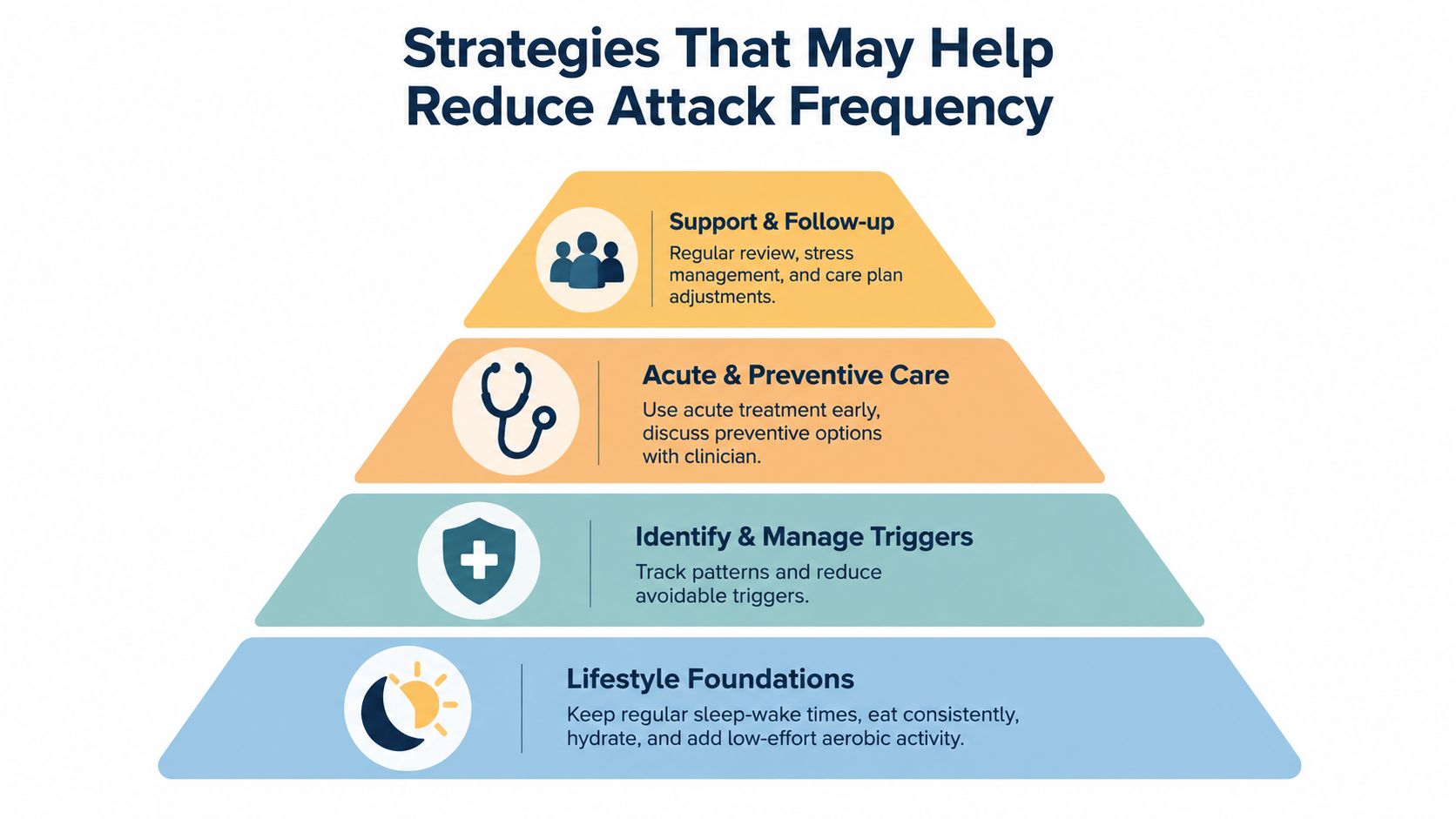
Lifestyle changes won't "cure" migraine, but they may reduce frequency for some people.
- Regular sleep. Try to keep sleep and wake times steady, even on weekends.
- Consistent meals and hydration. Long gaps without food and dehydration are common problems some people identify.
- Gentle aerobic movement. Walking or another low-effort routine can help some people support stress regulation and sleep.
- Stress buffering. Short breathing exercises, mindfulness, or a calmer transition after intense work can be more realistic than trying to eliminate stress.
Add non-prescription and clinician-guided options thoughtfully
Some people discuss supplements such as magnesium, riboflavin, or CoQ10 with a healthcare professional. Over-the-counter options may help some attacks, but they need to be used carefully, especially if you're treating headaches often.
Prescription prevention belongs in a separate conversation from rescue treatment. Depending on your pattern, a clinician may discuss broad preventive categories such as beta-blockers, certain anticonvulsants, tricyclic antidepressants, onabotulinumtoxinA, or anti-CGRP therapies.
Prevention decisions make more sense when they're based on a documented pattern across weeks or months, not just the memory of one terrible stretch.
Use tracking to find hit rates, not just counts
Many migraine diaries stop too early. Counting attacks matters, but it doesn't tell you which exposures are repeatedly present before attacks.
A more useful question is: when sleep drops, meals are delayed, or weather changes, how often do migraine days follow? That's the kind of pattern that can support real decisions.
Relief is one example of a tracking tool built around that idea. It combines logged symptoms with environmental data and shows patterns such as trigger correlations, trend lines, migraine-free streaks, and hour-by-hour risk forecasts, which can be more actionable than a raw monthly total alone.
Keep treatment lanes separate in your mind
A clear migraine plan often has four lanes:
- Lifestyle support for baseline stability
- Over-the-counter treatment for selected attacks
- Prescription acute or preventive treatment when frequency or disability justifies it
- Emerging or adjunctive options such as neuromodulation devices, cognitive behavioral therapy for migraine, or diary-guided dietary changes
None of these is a universal answer. The right mix depends on your pattern, your triggers, and how much of your month migraine is taking from you.
How Relief Reveals Patterns in Your Migraine Frequency
If you're tracking only a monthly total, you can miss the part that helps. The better question isn't just "How many migraines did I have?" It's "What changed before them, and am I drifting toward a higher-frequency pattern?"
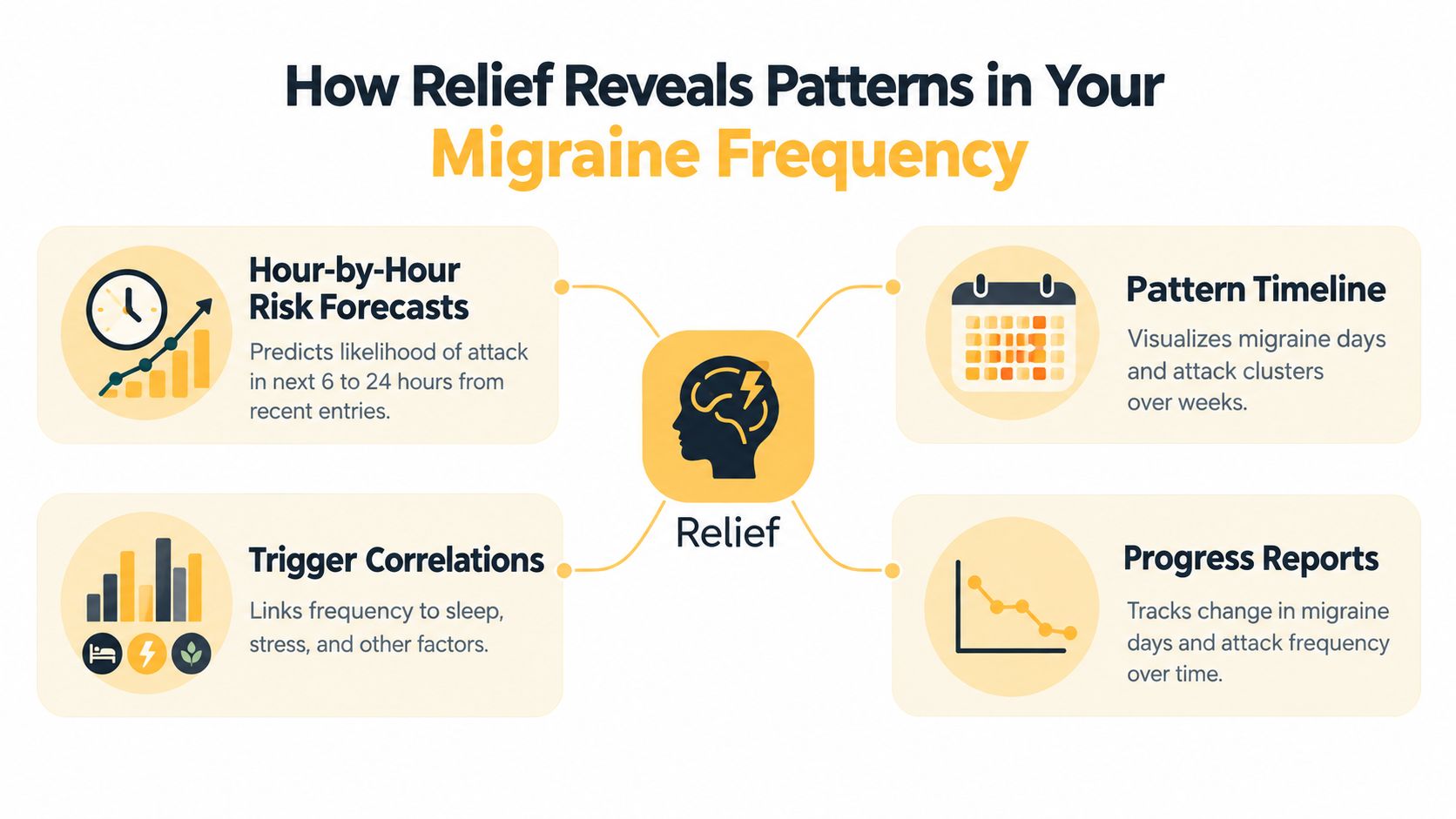
What pattern tracking should surface
A useful migraine app should help you see at least four things:
- Risk windows. When your recent entries suggest an attack may be more likely in the next several hours.
- Exposure hit rates. Which tracked exposures show up more often before migraine days than before pain-free days.
- Streaks and clusters. Whether you're getting longer breaks between attacks or slipping into a dense run of migraine days.
- Trend lines against care thresholds. Whether your monthly burden is staying low, moving toward prevention territory, or approaching chronic migraine range.
That last part matters if you're also watching for frequent acute medication use. If that applies to you, it's worth learning how medication-overuse headaches can complicate a rising migraine pattern.
Your next step
You don't need a perfect record to get useful insight. You need a month of honest, consistent entries that distinguish attacks from migraine days and give you something more reliable than memory.
If you ever get a sudden severe headache, headache with fever or stiff neck, new neurologic changes, or headache after a head injury, seek immediate medical care.
This article is for informational purposes and is not medical advice. Consult a healthcare provider for personalized guidance.
If you want help turning migraine logs into something easier to act on, Relief lets you track migraine days, symptoms, medications, and likely triggers in one place while showing trend lines and hour-by-hour risk forecasts. It's a practical way to see whether your frequency of migraine attacks is staying steady, clustering around certain exposures, or moving toward a pattern worth discussing with your clinician.


