
You're lying in a dark room with a pounding head, but your legs ache as if you've walked for hours. Headache and achy legs can appear together because migraine phases, dehydration, infection, inflammation, and other whole-body processes can affect both the nervous system and muscles. The combination doesn't automatically mean something dangerous, but it deserves more attention than being told to “just rest.”
Headache and migraine aren't interchangeable terms. A headache describes pain in the head, while migraine is a neurological disorder that can involve nausea, light sensitivity, aura, fatigue, cognitive changes, and body symptoms before, during, or after head pain. This guide explains how the symptoms can connect, what patterns may point elsewhere, which warning signs need urgent care, and how tracking can make your next healthcare conversation more useful.
This article is for informational purposes and is not medical advice. Consult a healthcare provider for personalized guidance.
Table of Contents
- Can dehydration cause both symptoms?
- How long is too long?
- Can achy legs be part of migraine?
- Should you track symptoms or see a doctor?
Why Headache and Achy Legs Often Show Up Together
Dragging legs and a pounding head can feel like two unrelated problems arriving at once. In practice, headache and achy legs frequently co-occur because the nervous, immune, and circulatory systems share signaling pathways, so dehydration, infection, inflammation, poor sleep, and physical strain can affect several parts of the body together.
Think of your body as a connected network rather than a collection of separate compartments. A change in fluid balance can influence blood circulation and muscle function while also making a primary headache more likely. An immune response can produce general muscle soreness while pain-sensitive pathways in the head become more reactive.
Headache disorders already represent a major global burden. The World Health Organization and recent global burden analysis describe headache disorders affecting about 40% of the global population, or 3.1 billion people, in 2021. The same analysis estimates that 2.9 billion people still had a headache disorder in 2023, with migraine remaining a particularly disabling subtype.
Why the combination feels confusing
Leg aching may be dull, heavy, cramp-like, restless, or tender to touch. Head pain may throb, press, burn, or intensify with movement. Because the symptoms feel so different, it's easy to assume they must have separate causes, even when one trigger is affecting the whole body.
The useful questions are:
- Did the leg symptoms begin before, during, or after the head pain?
- Do they appear with fever, vomiting, diarrhea, weakness, swelling, or shortness of breath?
- Do they recur with your usual migraine pattern?
- Do fluids, food, sleep, or reduced activity change them?
Those details help separate a migraine-associated pattern from dehydration, infection, exertional soreness, vascular symptoms, or another medical condition.
The Most Common Causes Linking Head Pain and Leg Aches
A headache and aching legs can share one trigger. Fluid loss, immune activity, and inflammation may affect circulation, pain pathways, and muscles together, like a drop in water pressure that weakens several faucets at once.
Dehydration is one common connection. Vomiting, diarrhea, fever, heavy sweating, or drinking too little can reduce circulating fluid and contribute to head pain. Muscles may then feel tired, tight, crampy, or sore, while dehydration can also aggravate an existing migraine disorder. In mild cases, symptoms may improve within 1–2 hours after rehydration with roughly 16–32 ounces of water, according to this review of dehydration and headache mechanisms. That response is not universal, and severe symptoms need medical assessment.
An infection follows a different route. Immune signals can produce fatigue, widespread aches, and headache at the same time. The CDC's seasonal influenza estimates associate influenza with 34 million illnesses, 15 million medical visits, 470,000 hospitalizations, and 28,000 deaths during the 2023–2024 U.S. season. Those symptoms can feel especially intense when fever, poor sleep, reduced appetite, and low fluid intake occur together.
Dengue provides another example. The World Health Organization's dengue information describes an estimated 100–400 million infections each year worldwide, with headache and severe muscle or joint pain among recognizable symptoms.
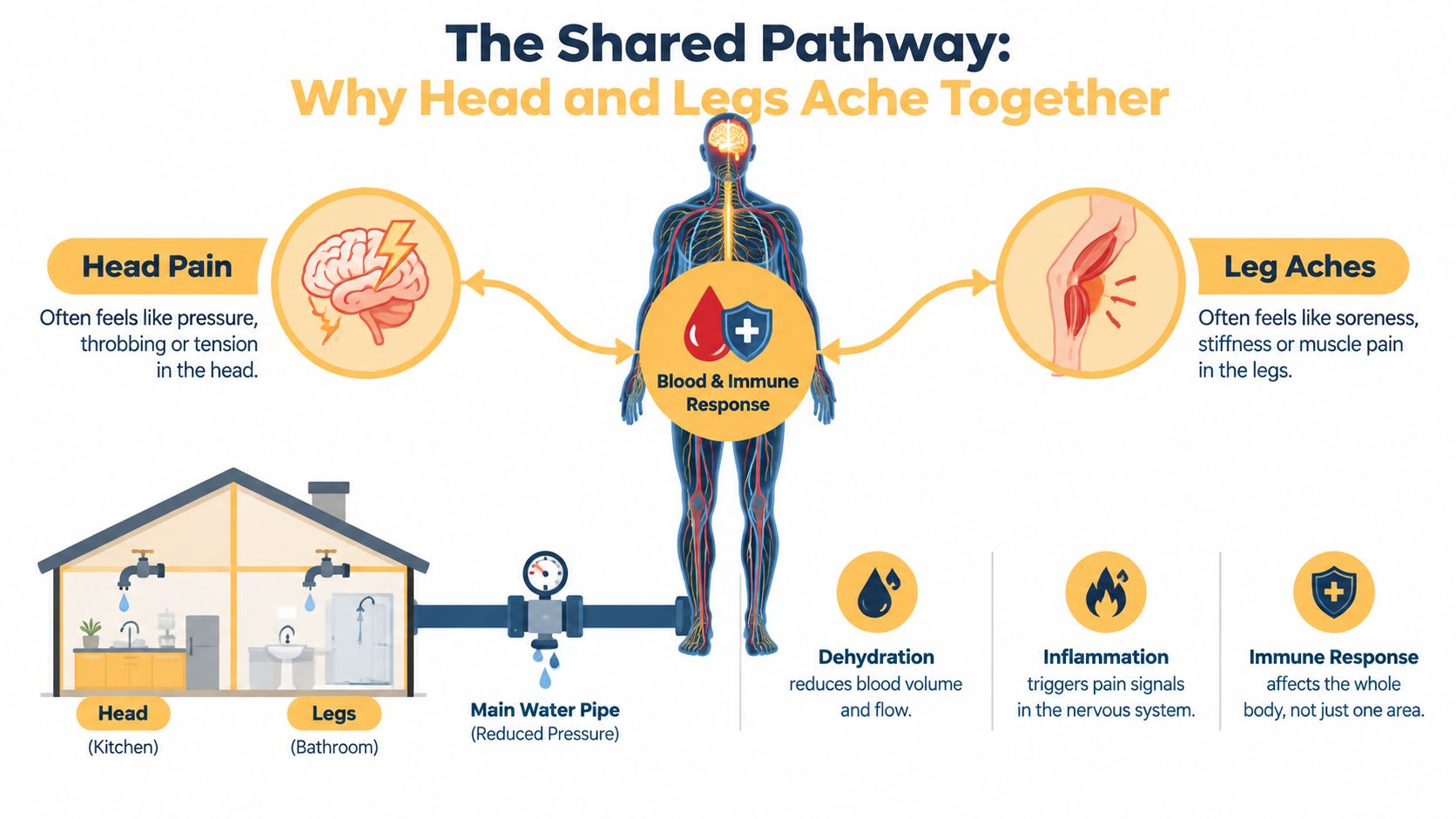
Several factors may stack together. A mild viral illness can lower appetite and fluid intake, while poor sleep makes the nervous system more sensitive to pain. Menstrual cycle changes, exertion, and shifts in hydration or electrolytes may amplify the same process. In other cases, leg discomfort may reflect restless sensations or venous symptoms rather than the headache itself, so timing, swelling, movement, and recurrence with migraine patterns deserve attention.
How Migraine Phases Can Bring Leg and Body Symptoms
Migraine can affect your body before the head pain begins and after it ends. Recognizing the phases can help you see why leg heaviness or aching may recur around attacks instead of appearing randomly.
Prodrome
Prodrome is the warning phase that can start hours to 1–2 days before migraine pain. The Mayo Clinic's migraine overview lists signs such as constipation, mood changes, food cravings, neck stiffness, increased urination, fluid retention, and frequent yawning.
You might also notice fatigue, heaviness, reduced motivation, or a vague sense that your legs feel different. These symptoms don't prove that a migraine is coming, but a repeated timing pattern can be informative. A brief explanation of this early phase appears in what prodrome means.
Attack
During the attack, migraine-related pain processing becomes more sensitive. Light, sound, movement, touch, and smells may feel unusually intense. Some people also experience muscle tension, neck pain, limb heaviness, or aching that becomes more noticeable because ordinary sensations are harder to ignore.
That doesn't mean every leg symptom during a migraine comes from migraine. One-sided weakness, new numbness, trouble walking, or a sudden change from your usual symptoms requires urgent evaluation rather than self-labeling it as an attack.
Postdrome
Postdrome is the recovery phase after head pain improves. The American Migraine Foundation's postdrome guidance describes fatigue, mental fog, dizziness, nausea, light sensitivity, difficulty concentrating, and body aches. A PubMed-indexed study also reported weak or clumsy limbs, tiredness, reduced activity, impaired concentration, head tenderness, and neck ache or stiffness after attacks in research on migraine postdrome.
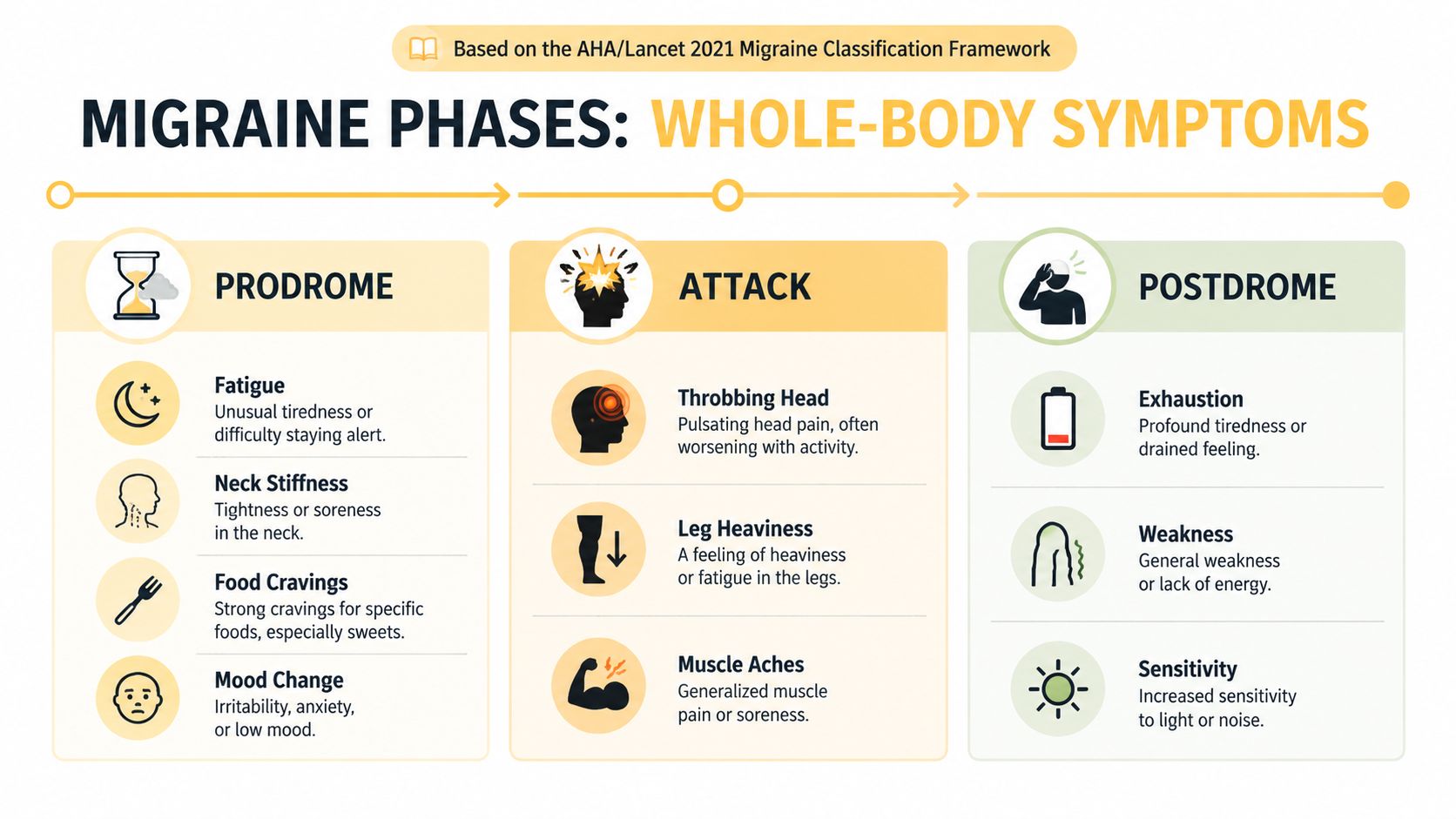
If your headache consistently fades before your legs feel normal, that timing may fit a postdrome pattern. If fever, a new cough, gastrointestinal symptoms, or worsening weakness appear, infection or another condition becomes more important to consider.
A Differential Look at What Else Could Be Going On
A clinician usually compares several possibilities instead of assigning one explanation from one symptom. Headache and leg aching can overlap across infections, migraine, inflammatory conditions, circulation-related symptoms, and medication effects.
| Cause | Onset and Trigger | Headache Pattern | Leg Ache Character | Distinguishing Clue |
|---|---|---|---|---|
| Migraine | May follow familiar personal triggers or phases | Throbbing, pressure, nausea, light or sound sensitivity, or aura | Heaviness, soreness, or postdrome aching | Repeats around recognizable migraine phases |
| Influenza or another viral illness | Often develops with an acute illness | Head pain with fatigue and generalized sickness | Diffuse muscle aches | Fever, cough, sore throat, chills, or feeling unwell overall |
| Dengue or another vector-borne infection | Depends on exposure and infection | Headache may occur with systemic illness | Prominent muscle and joint pain | Travel or mosquito exposure, fever, rash, or severe illness |
| Autoimmune or inflammatory condition | May persist or fluctuate over time | Variable, sometimes alongside fatigue | Stiffness, tenderness, or joint-related pain | Swelling, prolonged morning stiffness, or other systemic symptoms |
| Medication or substance effect | May follow a medication change, withdrawal, or caffeine pattern | May be new, recurrent, or difficult to control | Muscle discomfort or generalized aching | Clear timing after starting, stopping, or changing a substance |
Influenza commonly produces fever, cough, sore throat, and muscle aching. Dengue can cause headache with severe muscle and joint pain. COVID-19 and other infections may also produce body aches, but symptoms vary widely. A fever changes the interpretation because migraine itself doesn't cause fever, as explained in this discussion of migraine and fever.
Inflammatory and pain-sensitization conditions can create a more persistent pattern. Medication effects may be relevant after changes involving withdrawal, statins, triptans, or caffeine, but you shouldn't stop a prescribed treatment without discussing it with your prescriber.
A neurological symptom that is new, one-sided, or unusually severe deserves particular care. Learn the warning features of hemiplegic migraine, but don't assume a new weakness or speech change is migraine without prompt medical evaluation.
Red Flags That Mean Seek Care Now and Safer Self-Care Steps
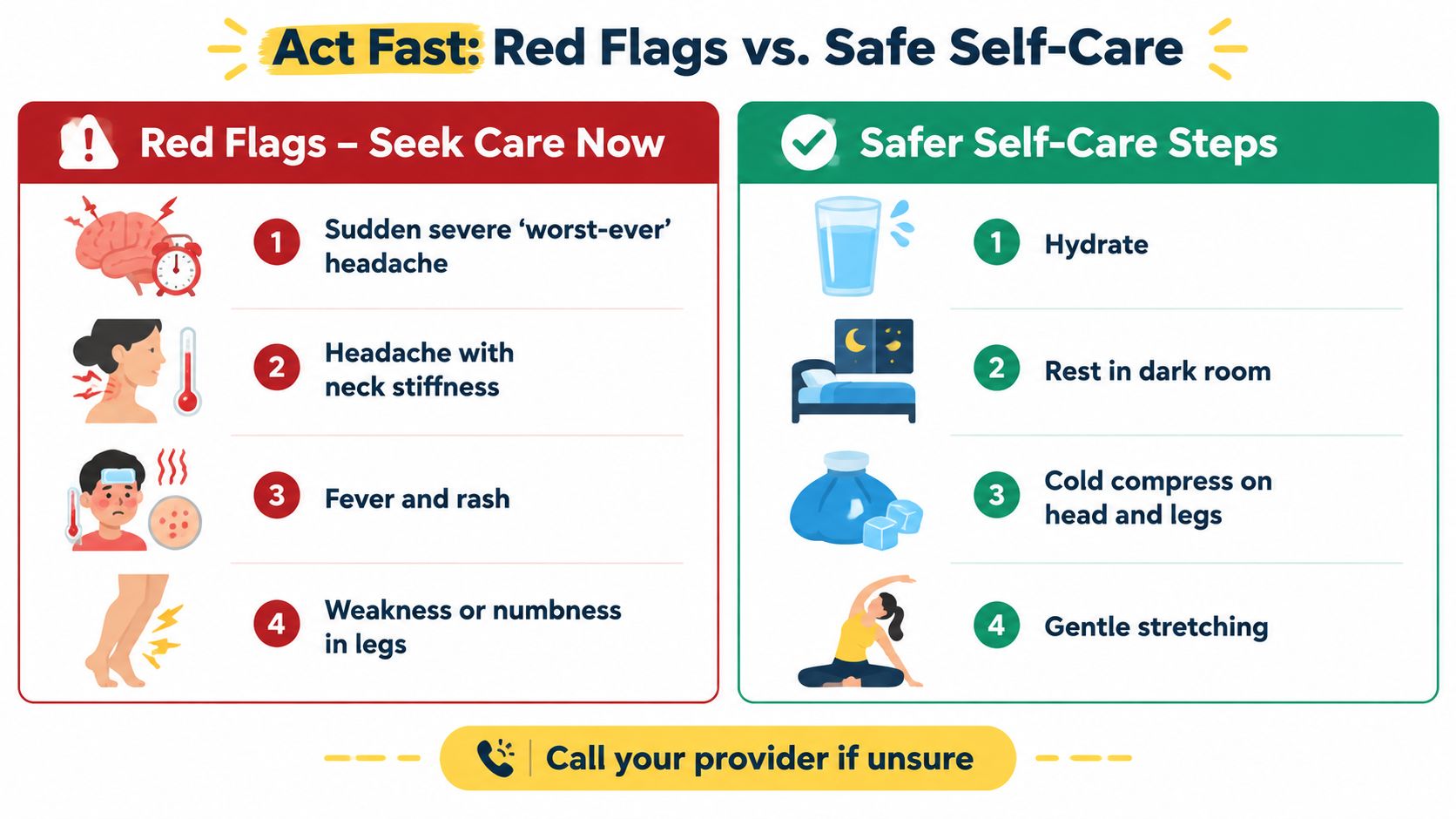
Some combinations shouldn't be managed at home while you wait to see what happens. Seek immediate medical care for a sudden severe or “worst-ever” headache, a headache with fever and stiff neck, new weakness or numbness, confusion, trouble speaking, a fever with rash, or a headache after head injury.
Urgent evaluation also matters for severe calf pain or swelling, chest pain, shortness of breath, or a new headache after age 50 with no prior history. These signs don't identify one diagnosis by themselves, but they can signal infection, neurological problems, vascular issues, or another condition that needs examination.
When no red flags are present
If the symptoms resemble your usual pattern and you have no warning signs, use self-care as a bridge while you observe the course:
- Reduce stimulation: Rest in a dark, quiet room if light and sound intensify the headache.
- Rehydrate gradually: Sip water or an electrolyte-containing drink, particularly after sweating, vomiting, diarrhea, or fever.
- Ease the legs: Try gentle stretching and warmth for tense muscles, but stop if movement increases pain.
- Pause intense exercise: Give your body time to recover rather than pushing through a worsening attack.
- Use OTC medicines carefully: If you use an over-the-counter analgesic, follow the product label and check with a healthcare professional if you have medical conditions, take other medicines, or need frequent pain relief.
Safety rule: If symptoms worsen, persist, or stop resembling your usual attacks, home care is no longer enough. Contact a healthcare provider.
This article is for informational purposes and is not medical advice. Consult a healthcare provider for personalized guidance.
Tracking Symptoms to Find Your Personal Pattern
A symptom log can turn “my head and legs hurt” into a timeline a clinician can interpret. Record the information close to the time it happens, because migraine fog makes reconstruction difficult later.
Track these six areas:
- Head symptoms: Note intensity, location, quality, aura, nausea, light sensitivity, and movement sensitivity.
- Leg symptoms: Describe heaviness, cramping, burning, restless sensations, tenderness, swelling, or weakness.
- Fluids and output: Record unusually low intake, heavy sweating, vomiting, diarrhea, or urination changes.
- Sleep: Include approximate duration and whether sleep felt restorative.
- Context: Add weather changes, temperature shifts, menstrual cycle notes when relevant, and unusual stress.
- Possible triggers: Log meals, skipped meals, prolonged screen use, exercise, alcohol, caffeine changes, and medications.
You don't need a complicated spreadsheet. A few words and a consistent rating can reveal whether the leg discomfort appears before head pain, peaks during it, or lingers afterward.
What to look for
Review the log after two to four weeks if your symptoms remain safe to monitor. Look for timing relationships, such as leg heaviness appearing after poor sleep, or head pressure following a day with low fluid intake. Notice whether eating, resting, or drinking changes the symptoms, but treat those observations as clues rather than proof of cause.
For example, you might notice head pressure and heavy legs the day after poor sleep and skipped water. That pattern gives your provider a clearer starting point than a general statement that the symptoms “come together.”
A structured headache diary app can reduce the effort of recording attacks. The purpose isn't to diagnose yourself. It's to show patterns that a single appointment may not capture.
Misconceptions and When to See a Provider
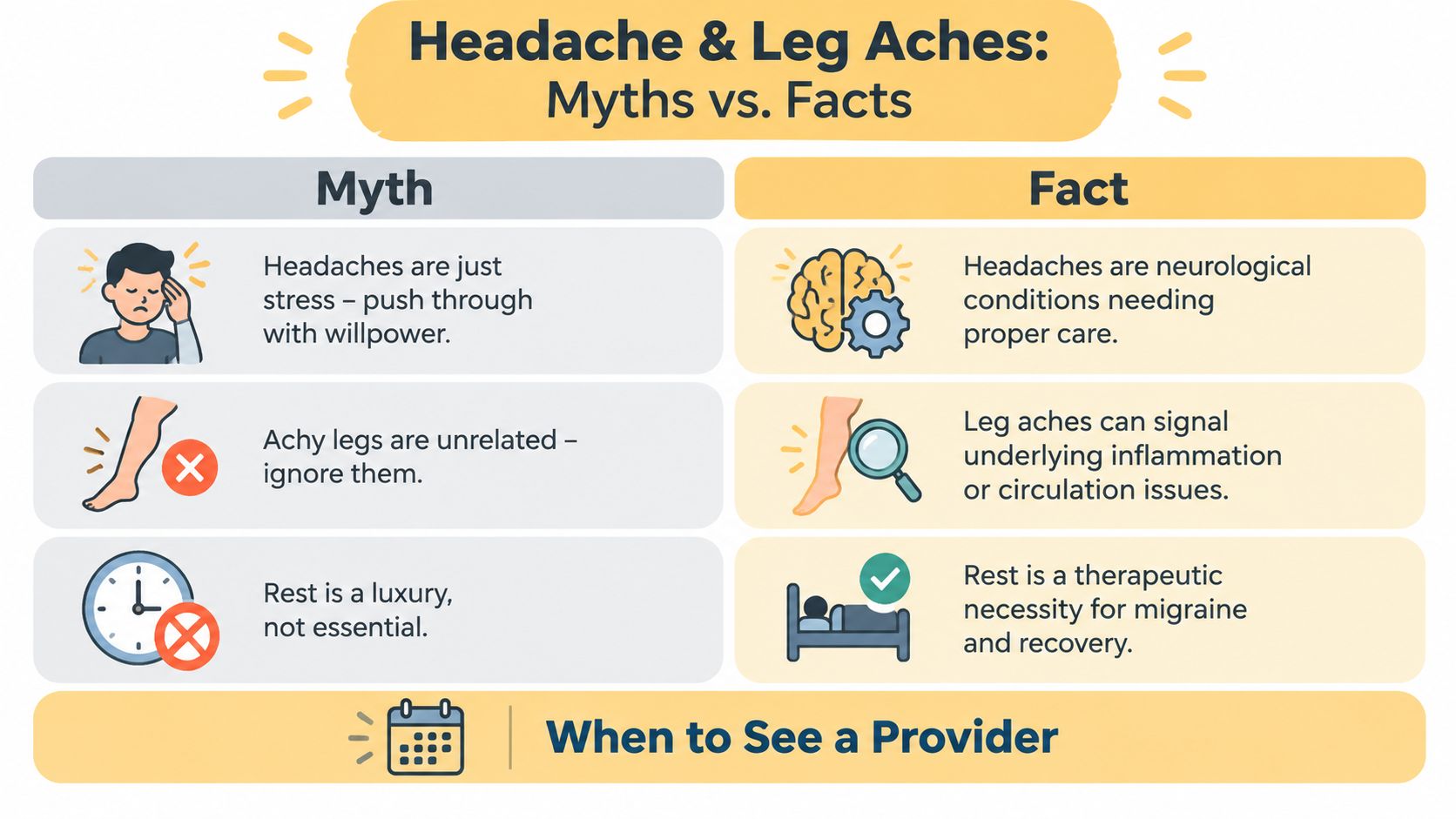
Myth one: headaches are just stress, so you should push through. Stress can trigger or amplify migraine, but it doesn't reduce migraine to a character test. Migraine is a neurological condition, and forcing yourself through light sensitivity, nausea, or escalating pain can leave you less able to recover.
Myth two: leg aches have nothing to do with head pain. Sometimes they are unrelated, but not always. Research has found that restless legs syndrome occurs in about 20% of people with migraine, with stronger associations reported in migraine with aura and chronic migraine, according to this 2026 meta-analysis on restless legs and migraine. A separate study found aching legs and other venous symptoms were more common among people with migraine than controls.
Myth three: rest is a luxury. Rest can be a practical part of migraine recovery, especially when your nervous system is sensitive to light, sound, movement, and cognitive effort. It doesn't replace evaluation, but it can prevent an ordinary activity from adding more strain while you assess what's happening.
When to make an appointment
Arrange medical care for a new daily headache pattern, recurring leg symptoms that don't fit your usual migraine, neurological symptoms, fever with neck stiffness, one-sided leg swelling, or pain that persists beyond a week. Also seek help when symptoms interfere with work, relationships, sleep, walking, or ordinary activities.
Recent population research connects pain beyond the head with higher headache intensity, more monthly headache days, greater disability, and poorer sleep and mood outcomes, as reported in this study of body pain in migraine and tension-type headache. You don't need to wait until symptoms become unbearable to ask for support.
Frequent Questions and What to Do Next
Can dehydration cause both symptoms?
Yes, dehydration can contribute to headache and leg aching through fluid loss and changes in the body's fluid and electrolyte balance. It's more likely after sweating, fever, vomiting, diarrhea, or poor intake, but severe dehydration symptoms need medical assessment rather than aggressive self-treatment.
How long is too long?
A familiar, mild pattern may settle as the underlying trigger improves. Pain lasting beyond a week, worsening symptoms, weakness that limits normal activity, or repeated episodes without a clear pattern deserves a provider's review. Sudden severe headache, fever with stiff neck, neurological changes, chest pain, shortness of breath, or severe one-sided leg swelling require urgent care instead of waiting.
Can achy legs be part of migraine?
They can be. Limb weakness or clumsiness may occur during postdrome, and leg discomfort can overlap with restless legs and venous symptoms in people with migraine. New weakness, especially on one side, is different from familiar aching and needs immediate evaluation.
Should you track symptoms or see a doctor?
You can do both. Tracking helps reveal timing around sleep, hydration, weather, hormonal changes, meals, medications, and migraine phases, while a clinician can assess symptoms that a diary can't explain. Consistent logging turns vague experiences into patterns that support more productive conversations with healthcare providers.
Relief lets you log headache severity, symptoms, triggers, and medications while viewing those entries alongside local weather, air quality, pollen, and other environmental signals. If you want a practical way to track whether leg aching follows migraine phases or changing conditions, visit Relief.


