
You're probably trying to plan your day around a migraine that might not even have shown up yet, which makes “normal” productivity advice feel useless. The most practical way to plan your day with migraine is to build around your hourly risk, your energy, and your warning signs, not around a perfect calendar that assumes you'll feel the same all day. This article is for informational purposes and is not medical advice. Consult a healthcare provider for personalized guidance.
Table of Contents
- Why Migraine Changes How You Plan Your Day
- Reading Your Hourly Migraine Risk Forecast
- Put hard work where your brain is most available
- Keep the plan flexible enough to survive symptoms
Why Migraine Changes How You Plan Your Day
The morning can feel fine, and then your brain changes the rules by lunch. That's why a migraine day needs a different plan than a standard workday, especially if you've already noticed that sleep loss, weather shifts, or prodrome can turn a manageable morning into a rough afternoon. The word prodrome means the warning phase before the attack, and it matters because it can lower your usable capacity before pain starts.
Traditional time-blocking assumes your energy stays steady. Migraine doesn't work like that. Aura is a neurologic symptom that can involve visual changes or other sensory shifts, the attack is the migraine phase itself, and postdrome is the recovery period that can leave you foggy or wiped out afterward.
Practical rule: don't plan the day you wish you had, plan the day your brain can actually handle.
That's where risk-aware planning helps. If your forecast says the afternoon looks unstable, your job isn't to force a heroic schedule. Your job is to move demanding work into safer hours and keep lighter tasks ready for the times when your capacity drops.
For readers who want a fuller overview of how Relief frames migraine management, the About page gives the broader context without assuming every day will look the same.
Reading Your Hourly Migraine Risk Forecast
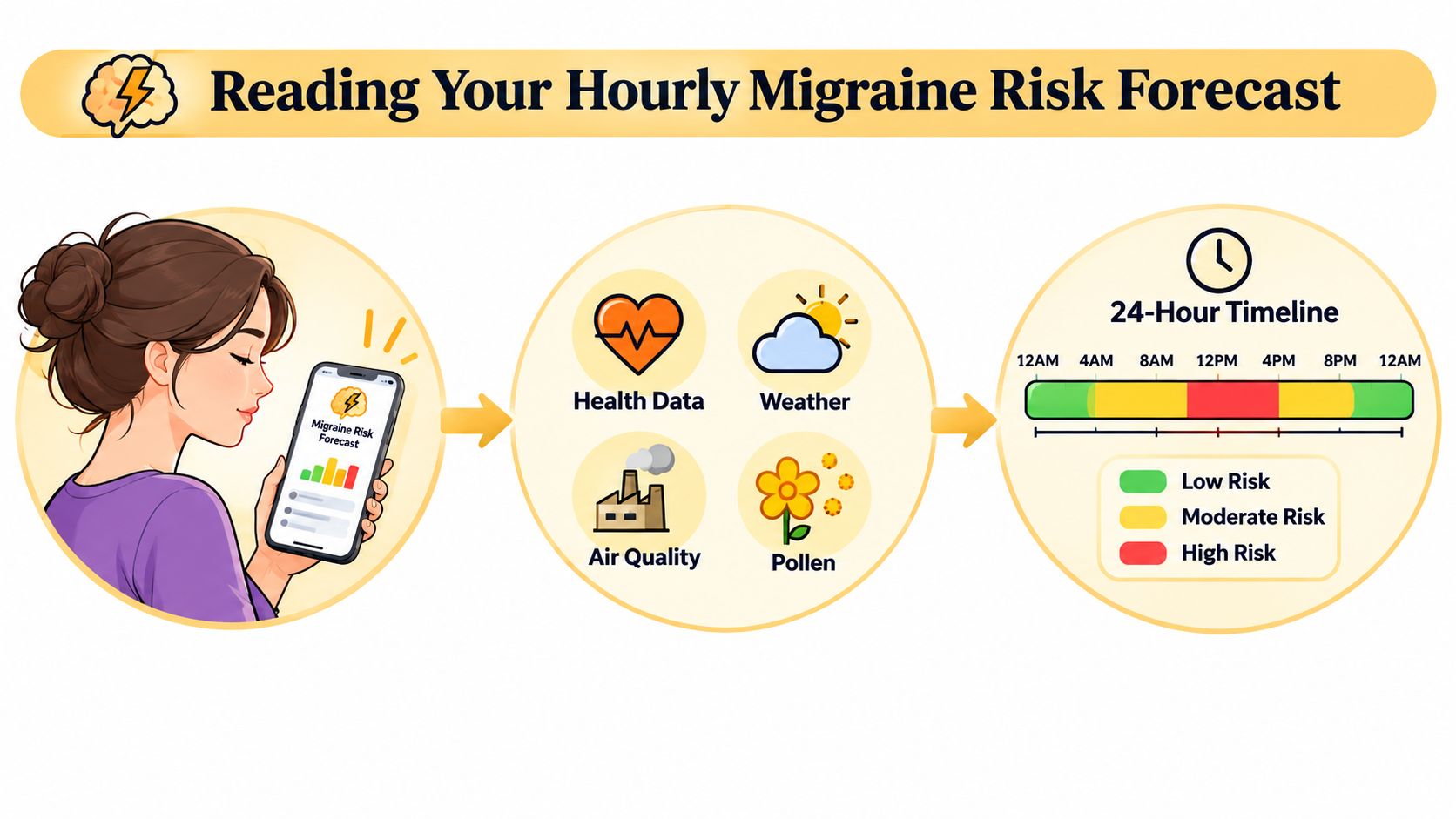
An hourly forecast only helps if you treat it like a decision tool, not a score to stare at. Relief blends your health data with local weather, air quality, and pollen so you can see when risk is likely to rise and when your day has a little more room. The point isn't certainty. It's better timing.
Start with the hours that look safest. That's where your hardest task belongs, whether it's writing, calls, studying, or anything that needs attention you can't easily spare later. If the forecast shows a high-risk window at 2 PM, move the work that requires clear thinking into the morning and leave the afternoon for tasks that are easier to pause.
A sudden barometric pressure shift can matter too, especially if you already know that weather is one of your recurring patterns. You don't need to understand every environmental variable to use the forecast well. You just need to notice which hours line up with prior bad days and which ones tend to stay more stable.
Read the forecast as a map of capacity, not as a prediction that you're about to fail.
If one hour looks shaky and the next two look worse, that's a signal to front-load the day. If the morning is unstable but the late morning settles, push your most important work to that better window and keep the early hours simple. You're matching task difficulty to the hours that are most likely to cooperate.
For the app view itself, the home screen shows the hour-by-hour pattern in a way that's easier to use when you're already tired.
Scheduling Tasks Around Low-Risk Windows
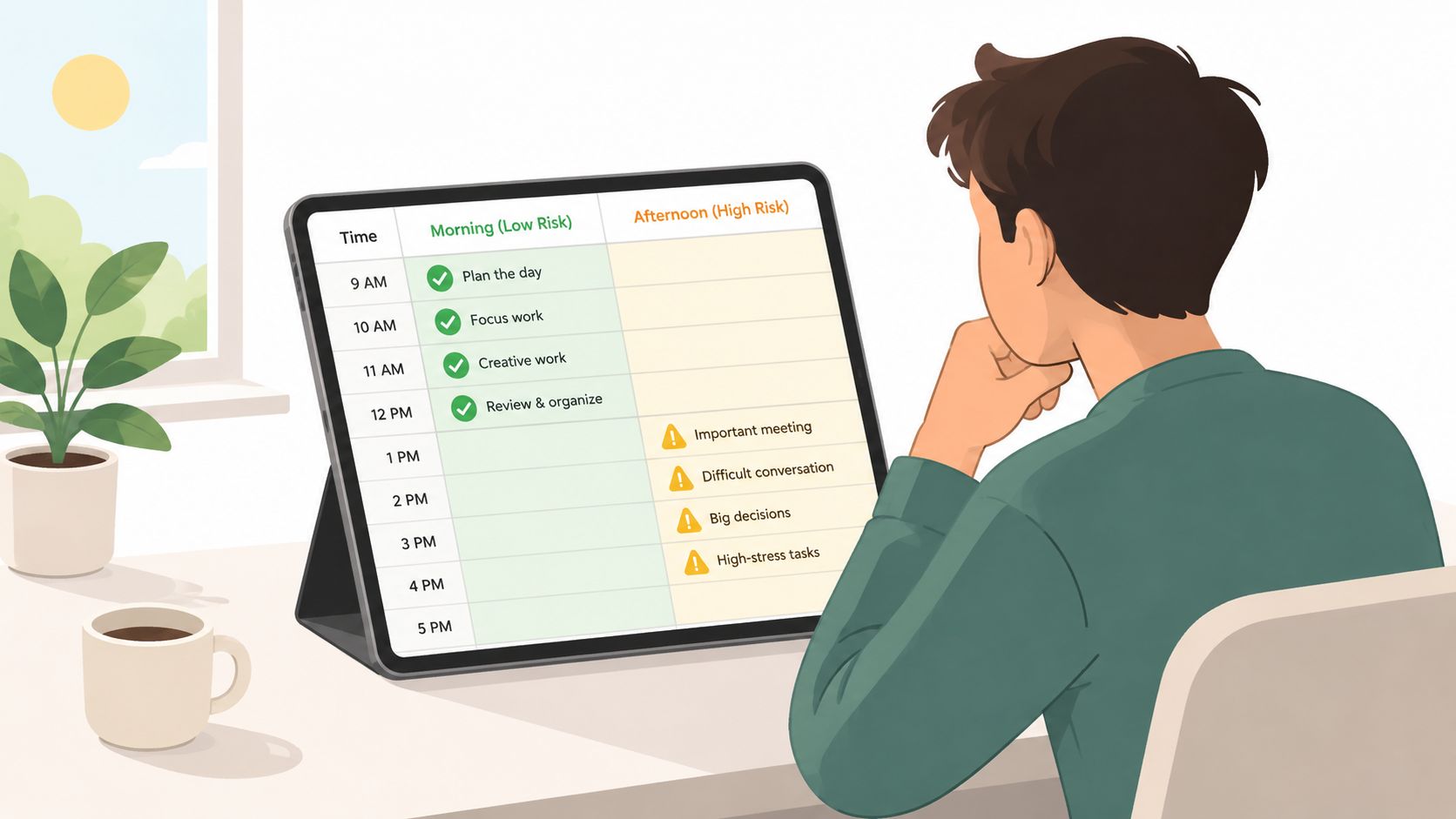
A useful migraine schedule starts with three priorities, not twelve. Choose the few things that would make the day feel successful if everything else went sideways, then place them in your lowest-risk hours. This is the opposite of overstuffing a calendar. It's a way of protecting your best thinking for the limited time you're most likely to have it.
Put hard work where your brain is most available
If mornings are steadier, use them for deep work, complex emails, or appointments that take more concentration. If your forecast shows an afternoon dip, move administrative work, routine messages, or anything you can do on autopilot into that window. A student might save the hardest reading for the morning and use the lower-energy stretch for flashcards or proofreading.
When the whole day looks daunting, shrink the plan instead of abandoning it. A low-capacity day still needs structure, just less of it. Pick one essential task, one maintenance task, and one recovery-friendly task so the day doesn't collapse into guilt.
Keep the plan flexible enough to survive symptoms
A schedule that only works on perfect days isn't a migraine plan. It's a fantasy. If your symptoms often shift midday, keep the most delicate work early and leave room to swap in easier tasks without losing the whole day.
A good test is simple. If your afternoon got cut short, could you still finish something meaningful? If the answer is no, the schedule is too brittle.
Building Buffers and Contingency Plans
The safest migraine plan leaves space on purpose. A practical benchmark is to cap the day at about 80% of available time and leave 15-minute buffers between activities, which helps stop one delay from wrecking everything else University of Pennsylvania guidance on effective time management. That matters more on migraine days, because one surprise, a phone call, traffic, or a symptom flare can consume the margin you thought you had.
Make the schedule absorb mistakes
Buffers are not wasted time. They're the part of the day that keeps you from spiraling when a task runs long or your head starts to feel off. They also give you a place to stop, reassess, and decide whether to continue or switch gears.
Buffer blocks are part of the work, not a reward after it.
If you already know your body tends to wobble after lunch, put the buffer before the vulnerable period, not after it. That way the schedule has a chance to absorb the change instead of forcing you to power through it.
Decide what gets dropped first
A contingency plan works best when it's written before you need it. If prodrome symptoms show up mid-morning, the first things to drop are the least essential tasks, then anything that can be rescheduled, then anything that requires high concentration. Keep a low-demand backup list ready, such as sorting receipts, sending one important email, or resting in a quiet room.
This is also where communication helps. If you need to shift capacity with colleagues or family, say it early and plainly. A short message beats disappearing from the day because you tried to hold onto a plan that no longer fits.
The privacy page matters here because logging and planning only help if you feel comfortable keeping your health data in one place.
Planning Trigger Mitigation Throughout the Day
Migraine planning works better when you time your protection, not just your tasks. If you know your risk rises when the day gets brighter, louder, or more demanding, you can set up small defenses before the spike hits. That's more realistic than waiting until symptoms are already in motion.
Match controls to the hour
Some triggers are partly in your control. Meal timing, hydration, screen exposure, lighting, and room temperature can all be adjusted as the day unfolds. Others, like barometric pressure, pollen, or humidity, can't be stopped, but you can prepare for them.
A simple approach is to build a check-in around the forecast. If the next few hours look rough, hydrate before the window opens, not after you start feeling unwell. If bright light tends to bother you, reduce screen brightness and plan screen breaks before the most exposed part of the day. If strong scents are a problem, think ahead about where you'll be and how to avoid unnecessary exposure.
Use the day as a mitigation timeline
Morning can be the time to set up the environment. Afternoon may need lower stimulation and fewer transitions. Evening often benefits from softer light and less screen time, especially if you've already used up most of your tolerance for the day.
- Before a higher-risk window: drink water, check your next meal, and clear the schedule of avoidable demands.
- During a risky stretch: shorten screen time, reduce noise, and keep hard decisions to a minimum.
- After the spike passes: log what changed so the next forecast has a better reference point.
A short check-in routine helps without turning your day into homework. Note what you were doing, what the weather looked like, and whether symptoms started before, during, or after the risk window. That's enough to make the next day's plan more precise.
Logging Check-Ins and Recognizing Patterns Over Time
The best plans get better when you keep a lightweight record. A quick log of severity, symptoms, triggers, and medications takes seconds, but it turns a rough day into usable information for the next one. Relief uses those check-ins to sharpen future predictions, and that matters because migraine patterns are personal, not generic.
Look for your real patterns, not your guesses
It's easy to assume a trigger is obvious when it only seemed obvious once. Over time, logging shows which exposures line up with your migraines and which ones just happened to be present in the same week. That's where exposure hit rates and trend views become useful, because they separate repeated patterns from one-off hunches.
The visual summaries help too. A run of migraine-free days can be encouraging, and a change in severity can show you whether your current routine is helping even if attacks haven't disappeared. If frequency starts climbing, the data gives you an earlier warning than memory usually does.
If you want the plan to improve, don't rely on how the day felt in the moment. Log it while it's still fresh.
Keep the logging fast enough to actually use
The log should support your life, not become another source of friction. Write down the basics, move on, and let the pattern emerge over time. For many people, the biggest benefit is emotional as much as practical. Seeing your own history in one place can make the condition feel less random and less personal.
If you use Relief, the forecast and tracking stay in one place, so you can connect an hourly risk window with what happened later. That combination is what turns daily planning into a long-term migraine tool instead of a one-day experiment.
If you want a calmer way to plan around migraine risk, Relief brings hourly forecasts and quick logging into one place so you can schedule smarter and spot your patterns faster. It's a practical way to connect today's risk window with what happened, so tomorrow's plan has a better chance of working.


