
When considering ketorolac for migraines during an attack, you're likely seeking practical solutions, not theoretical discussions. You want to know if it can help when a migraine just won't stop, and the short answer is yes. Ketorolac can be a useful rescue treatment for a severe migraine attack, especially in urgent care or emergency settings, but it isn't an everyday go-to and it comes with important risks.
Migraine is not the same thing as a routine headache. A migraine attack can involve throbbing head pain, photophobia (light sensitivity), phonophobia (sound sensitivity), nausea, vomiting, dizziness, aura in some people, and the wiped-out postdrome phase that can linger after the worst pain fades. When an attack keeps going despite your usual plan, ketorolac may come up as part of a more urgent treatment approach.
This article is for informational purposes and is not medical advice. Consult a healthcare provider for personalized guidance.
Table of Contents
- That Migraine That Just Wont Break
- Why blocking inflammation matters
- Why it can feel different from a typical pain reliever
That Migraine That Just Wont Break
You may know this moment well. You've already tried your usual routine. Maybe you used your prescribed rescue medication, drank water, lay in a dark room, put an ice pack on your head, skipped screens, and still the migraine keeps grinding on.
Hours later, the attack can feel less like pain and more like collapse. Light hurts. Sound hurts. Your stomach may be turning. If you're reading this from a waiting room, urgent care, or your bed while deciding whether you need help, you're exactly the kind of person who needs clear information without fluff.
Ketorolac, often recognized by the brand name Toradol, is a prescription non-steroidal anti-inflammatory drug, or NSAID. Doctors use it for severe short-term pain, including some migraine attacks that haven't responded to earlier treatment. In migraine care, it usually shows up as a rescue medication, meaning a treatment used when an attack is intense, prolonged, or resistant to your first-line options.
That niche matters. Ketorolac is not meant to replace a full migraine plan. It doesn't prevent future attacks, and it isn't something to keep reaching for repeatedly whenever a migraine is difficult.
Practical rule: Ketorolac makes the most sense when the goal is to stop a severe active migraine attack, not to manage day-to-day migraine patterns.
People often get confused because migraine treatment has layers. There are lifestyle supports, over-the-counter options, prescription abortive treatments used during an attack, and preventive treatments meant to reduce future frequency. Ketorolac sits in a narrow part of that picture. It's a strong short-term tool for the right situation.
If you're trying to make sense of your treatment history over time, keeping your symptoms, medications, and attack patterns in one place can make those conversations with your clinician easier. A tracker like Relief migraine tracking tools can help you notice whether severe attacks follow certain triggers or whether they tend to escalate after missed sleep, weather changes, or delayed treatment.
How Ketorolac Fights a Migraine Attack
A severe migraine is not just "bad head pain." By the time an attack has escalated, your nervous system is often amplifying pain signals and inflammatory chemicals at the same time. Ketorolac is used in that moment because it can interrupt one important part of that process.
Why blocking inflammation matters
During a migraine attack, the body produces chemicals called prostaglandins. These chemicals can intensify pain signaling and contribute to the inflamed, aggravated feeling many people notice during a hard-to-stop attack.
Ketorolac blocks the enzymes COX-1 and COX-2, which are involved in making prostaglandins. A practical way to understand that is this: if prostaglandins act like fuel on an already active pain system, ketorolac helps reduce some of that fuel. It does not erase every part of migraine biology, but it can lower one of the drivers that keeps the attack going.
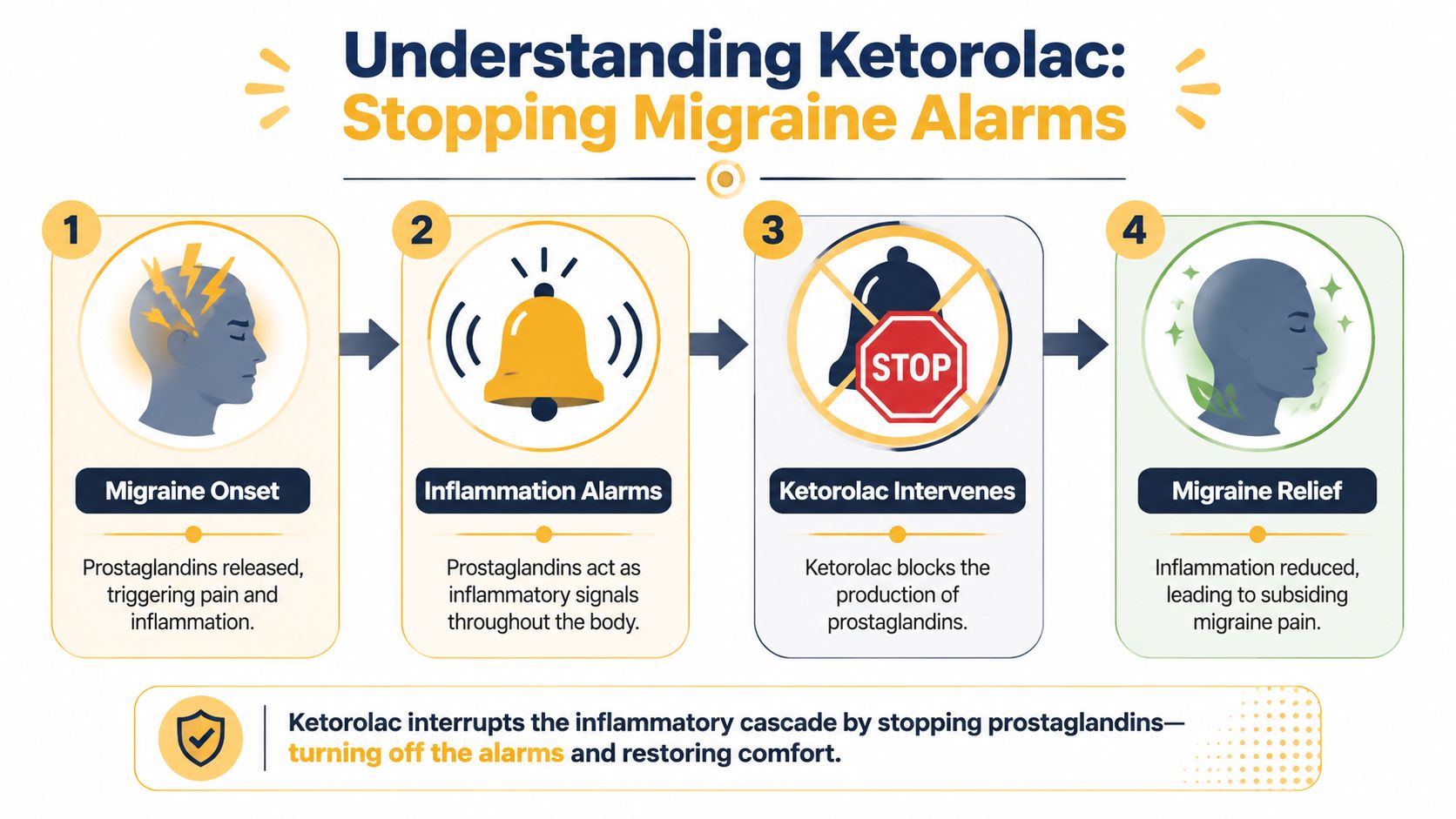
That is one reason ketorolac has a specific place in a migraine plan. It is often chosen as a rescue treatment for a severe attack, especially when the usual early-step treatment has failed or when nausea and vomiting make the whole situation harder to control.
Why it can feel different from a typical pain reliever
Many patients hear "NSAID" and assume ketorolac is basically a stronger version of ibuprofen. That's an oversimplification. It is in the same medication family, but in migraine care doctors usually reserve it for more serious situations and use it with more caution because the safety limits are stricter.
Its role is narrow but important.
Ketorolac is not meant to be the medication you keep repeating through the week whenever a migraine breaks through. It is better understood as a powerful short-term tool for a specific kind of problem: the migraine that is escalating, lingering, or resisting your usual plan.
That distinction matters because people often ask the right next question. If ketorolac works, what then? Usually the next step is not to rely on it over and over, but to review why that attack got so far and whether your broader migraine plan needs adjustment.
If ketorolac does not work, that is also meaningful. A failed response can be a sign that the attack needs a different rescue strategy, a combination treatment, or medical reassessment, especially if the pain is unusually severe, lasts longer than expected, or comes with symptoms that feel different from your normal pattern.
The key point is not just whether ketorolac can reduce pain. It is where it fits in the plan, and what your doctor wants you to do next if the attack does not turn around.
Ways Ketorolac is Administered for Migraines
How ketorolac is given changes how useful it is during an attack. A person who is vomiting in the emergency department needs a different route than someone at home who can still use a nasal spray and keep fluids down. That is why doctors do not just choose the drug. They choose the delivery method that fits the moment.
In the emergency department
In urgent care or the emergency department, ketorolac is often given by IV or IM injection. IV means it goes into a vein. IM means it goes into a muscle. Both routes avoid the stomach, which matters during a migraine that brings heavy nausea, vomiting, or slowed stomach emptying.
An older clinical study of IM ketorolac reported onset in about 15 minutes and found that many patients had meaningful relief within an hour that lasted for several hours afterward (PubMed report on IM ketorolac for acute migraine).
Doctors usually choose these routes when the attack is severe, fast relief matters, or swallowing medicine is unrealistic.
The nasal spray option
A nasal spray version can be useful for selected patients. That often catches people off guard, because ketorolac is usually associated with injections. The practical appeal is simple. It offers a non-needle rescue option when a migraine is building and a pill may not be reliable.
Research has found that intranasal ketorolac was non-inferior to IV ketorolac at 60 minutes for reducing headache pain intensity in acute migraine treatment. The same review also described a separate trial in which 35.3% of patients using ketorolac nasal spray achieved 24-hour sustained pain freedom compared with 12.2% with placebo, while sumatriptan nasal spray reached 22.4%, which was not statistically significant versus placebo (randomized trial of intranasal versus IV ketorolac and related trial summary).
That does not make nasal ketorolac a standard first choice for every migraine. It shows that, for the right person and the right situation, it may fill an important gap between a pill that may not absorb well and an injection that requires medical care.
Why pills are a different conversation
Oral ketorolac exists, but migraine attacks often interfere with how well pills work. During a severe migraine, the stomach can slow down, much like traffic backing up after a crash. Medicine may sit there longer than expected instead of moving through and being absorbed predictably.
That is one reason oral ketorolac usually plays a smaller role in migraine rescue care, especially when nausea, vomiting, or stomach irritation are already part of the attack.
| Form | Typical setting | Why a doctor might choose it |
|---|---|---|
| IV ketorolac | Emergency department or urgent care | Fast access, useful when symptoms are severe or vomiting is present |
| IM ketorolac | Emergency department, urgent care, clinic | Does not require swallowing and can work quickly |
| Intranasal ketorolac | Selected outpatient or urgent settings | Non-injectable rescue option with evidence for acute migraine relief |
| Oral ketorolac | More limited use in migraine care | Less reliable during attacks with nausea, vomiting, or stomach upset |
The main question is not only whether ketorolac can help. It is which form fits your real-world migraine pattern, and what your doctor wants you to do if that rescue option does not turn the attack around.
Ketorolac Effectiveness Compared to Other Migraine Treatments
A useful way to compare migraine treatments is to ask two questions. How quickly can this treatment calm the attack, and what is its job in the larger plan?
Ketorolac can be very good at the first job. It is much less reliable for the second. That distinction matters because a medication can blunt the worst part of an attack without being the best choice for every migraine, or for keeping the pain from returning later.
What the evidence suggests
Research reviews of acute migraine treatment place ketorolac in the same general range as several medications commonly used in urgent care, especially anti-nausea drugs that also help migraine pain. One systematic review and updated analysis found ketorolac had similar efficacy to phenothiazines and metoclopramide, and in some studies it showed stronger early pain relief than treatments such as sumatriptan, dexamethasone, and sodium valproate at about the 1-hour mark (systematic review and updated analysis on ketorolac in acute migraine).
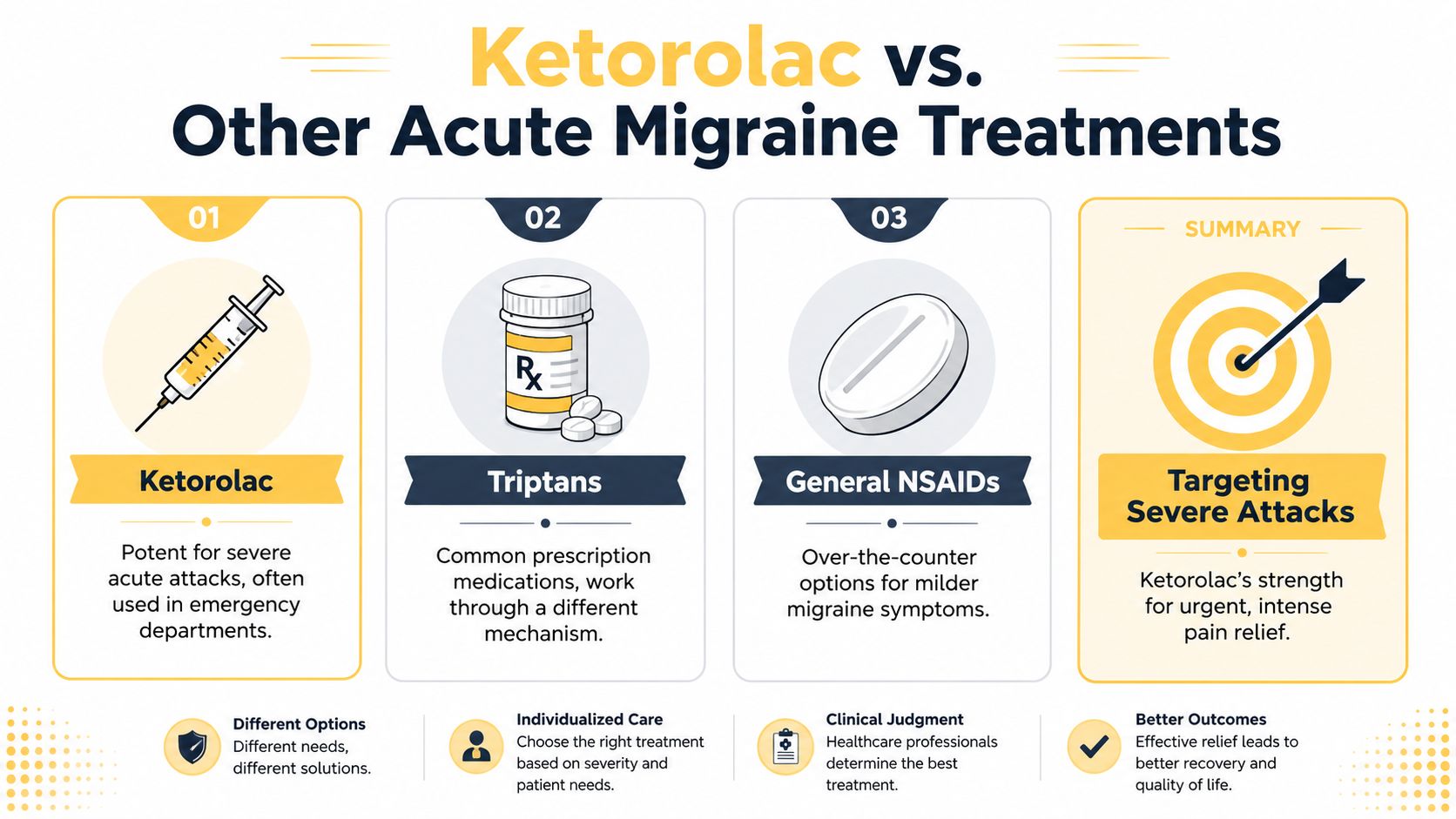
That does not mean ketorolac is the "strongest" migraine medicine. Migraine drugs are not lined up on one simple power scale. Triptans target migraine-specific pathways. Anti-nausea medicines can reduce both nausea and head pain. Preventive treatments aim to reduce future attacks, which ketorolac does not do.
Ketorolac's role is narrower and very practical. It is often a rescue option for a hard attack that needs quick relief, especially in a clinic, urgent care, or emergency setting.
A simple comparison table
| Treatment category | Main role in migraine care | Where ketorolac fits |
|---|---|---|
| General NSAIDs | Often used earlier in an attack, depending on your plan | Ketorolac is a higher-intensity rescue option within the NSAID family |
| Triptans | Prescription abortive therapy for many people | Works through a different mechanism and may be preferred earlier in a personalized plan |
| Anti-nausea medications used in acute care | Can help nausea and may also help pain | Ketorolac often performs similarly for short-term relief in emergency settings |
| Preventive treatments | Lower future attack frequency or severity | Ketorolac does not replace them |
One point patients rarely hear clearly is what happens if ketorolac helps only halfway. Short-term relief and staying better are different outcomes. Earlier emergency department research suggested ketorolac may relieve pain early but may not provide the same lasting relief as some other rescue approaches later in the day, as noted earlier.
That is why ketorolac should usually be viewed as a specific tool, not the whole toolbox.
If it works, good. Your doctor may still want a plan for recurrence, hydration, nausea control, or follow-up treatment at home. If it does not work, that is also useful information. The next step is not to keep repeating it casually. The next step is to contact the clinician who prescribed the plan, or seek urgent care if the attack is severe, because treatment may need to shift to a different class such as a triptan, an anti-nausea medication used as a migraine abortive, IV therapy, or a reassessment to make sure this really is migraine and not something more dangerous.
Ketorolac is best understood as a strong rescue medication for selected attacks. It is not usually the default choice, and if it fails, your migraine plan should already spell out what comes next.
Critical Safety Information and Side Effects
Ketorolac can help. It can also cause serious harm if used casually or in the wrong person. That's the balance you need to understand before you ever think of it as just another pain medication.
The benefits are real and so are the risks
The biggest safety issue is that ketorolac is a powerful NSAID with major warnings. It can raise the risk of gastrointestinal bleeding, ulcers, and perforation. It can also increase the risk of kidney damage and cardiovascular events such as heart attack and stroke, especially in people who already have risk factors or who use it inappropriately over time.
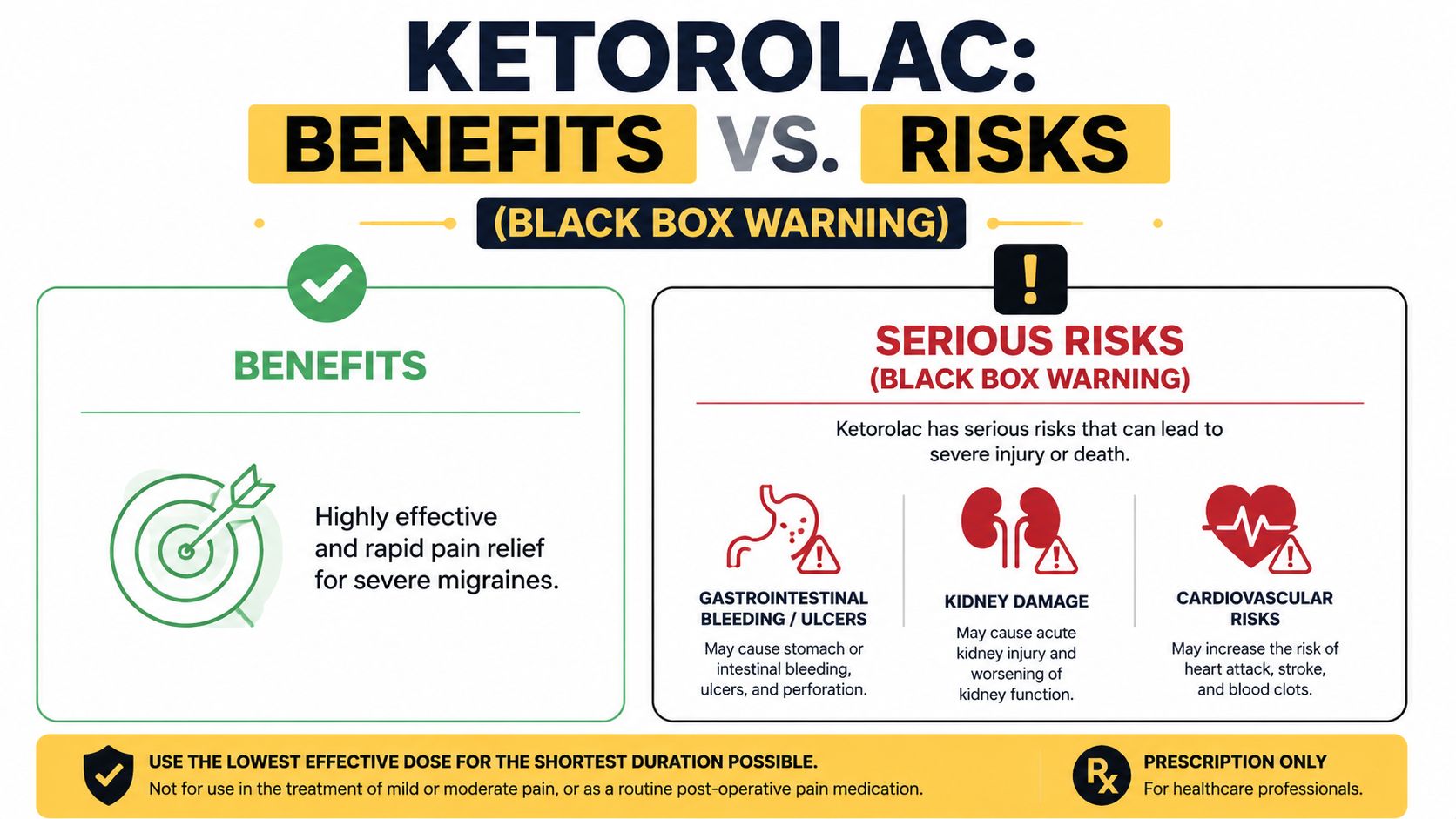
For that reason, ketorolac is generally treated as a short-term medication rather than a recurring self-management tool. Clinicians also need to consider what other NSAIDs you're already taking, whether you're dehydrated, and whether vomiting has already strained your kidneys.
Who needs extra caution
Be especially careful to tell a clinician if any of these apply to you:
- Kidney concerns: Any history of kidney disease, reduced kidney function, or dehydration matters.
- Stomach or intestinal problems: Active ulcers, prior GI bleeding, or strong stomach sensitivity are important.
- Cardiovascular history: A personal history of heart disease or stroke risk changes the conversation.
- Pregnancy: Ketorolac may not be appropriate, especially later in pregnancy.
- Other NSAID use: Combining or stacking NSAIDs can increase risk.
Common side effects can include nausea, dizziness, and drowsiness. Those are not the main reason doctors are cautious. The serious risks above are the reason.
Here are symptoms that need urgent medical attention, whether ketorolac is involved or not:
- Sudden severe headache: Especially if it feels abrupt or unlike your usual migraine pattern
- Fever or stiff neck: This can point to a medical emergency, not a routine migraine attack
- Neurological changes: New weakness, confusion, fainting, vision loss, or trouble speaking needs immediate care
- Headache after head injury: This should not be managed as a standard migraine at home
This article is for informational purposes and is not medical advice. Consult a healthcare provider for personalized guidance.
When Doctors Choose Ketorolac for Migraine Attacks
Ketorolac usually enters the picture when a migraine has moved beyond your usual playbook. Not every severe attack needs it, and many people will never receive it. But for the right patient, at the right moment, it fills an important gap.
Where ketorolac fits
Doctors are more likely to consider ketorolac when the attack is refractory, meaning it hasn't responded to earlier treatment and is still active. That might happen in urgent care, an infusion setting, or the emergency department.
This is often the situation:
- Your regular acute treatment didn't stop the attack
- The migraine kept escalating or lasting
- Nausea or vomiting made oral medication less useful
- A clinician needed a short-term rescue option
Ketorolac is especially useful to think about as a specific-situation medication. It isn't a marker that your migraine care is failing overall. It may mean this attack needs a different level of intervention.
What happens if it fails
This is the point many articles skip. If ketorolac doesn't work, the answer usually isn't to keep repeating it or to assume you just didn't take enough.
A discussion of treatment failure notes a key point that mainstream coverage often misses. Ketorolac should not be repeated after failure, and a first-line emergency protocol may combine ketorolac 30 mg IV with metoclopramide 10 mg IV because the combination can improve gastric absorption and analgesia (discussion of ketorolac treatment failure and ED protocol).
That matters for two reasons. First, repeating an ineffective NSAID can push risk upward without solving the attack. Second, frequent use of acute medication can contribute to medication-overuse headache, often called MOH, where the treatment pattern itself starts worsening headache frequency.
If a rescue medication doesn't work, that often means the next conversation should be about changing mechanisms or strengthening prevention, not simply trying more of the same.
So if ketorolac fails, your doctor may need to reassess the diagnosis, switch treatment strategy, or step back and ask whether your overall migraine plan needs updating.
How to Discuss and Track Ketorolac Treatment
When you're in pain, it's hard to think clearly. That's normal. A short mental checklist can help you ask useful questions and capture details you'll want later, especially if ketorolac becomes part of your rescue plan.
Questions worth asking in the moment
You don't need to sound medical. Plain language is enough.
Try questions like these:
- How does this fit my current migraine plan? You want to know whether this is rescue care, a one-time urgent measure, or part of a broader strategy.
- What risks matter most for me? Ask based on your stomach history, kidney history, pregnancy status, heart history, and current medications.
- What should I watch for after I leave? This helps you know which side effects are expected and which require attention.
- If this doesn't work, what's the next step? That question is especially important because repeating ketorolac after failure may not be the right move.
- Do I need to revisit preventive treatment? If your attacks are escalating, that's often the more important long-term discussion.
What to log after treatment
Tracking makes the next appointment more useful. Instead of saying, "I think it helped a little," you can show the pattern clearly.
A simple log should include:
| What to track | Why it helps |
|---|---|
| Time ketorolac was given | Lets you compare relief against the treatment window |
| Pain level before treatment | Creates a baseline |
| Pain level later that day | Shows whether relief was partial, strong, or short-lived |
| Nausea, light sensitivity, aura, dizziness | Migraine is more than head pain |
| Side effects | Helps your clinician judge tolerability |
| What happened in the next day | Useful if pain returned or symptoms shifted |
If video is easier to process than reading during recovery, this walkthrough may help:
You can also jot down context that often gets forgotten later. Did the attack start with aura? Did you delay treatment because you were at work? Were you also vomiting? Did weather, missed sleep, or a menstrual cycle shift seem relevant? Those details help separate a one-off severe attack from a bigger pattern.
This article is for informational purposes and is not medical advice. Consult a healthcare provider for personalized guidance.
If you want a simpler way to track attack timing, symptoms, triggers, and medications after a rescue treatment like ketorolac, Relief can help you log the details quickly and spot patterns that are hard to see on your own.


