
You start a new migraine treatment, set a reminder, miss a few doses during a rough week, and then a month later you're left wondering whether the medication failed, the side effects are settling, or your routine just got in the way. Medication adherence tracking helps answer that question by showing what occurred, not just what you remember during a tired appointment or in the middle of a migraine attack.
For migraine, that matters more than many people realize. Preventive treatment only makes sense if you can connect three things clearly: when you took it, how consistently you took it, and what happened to your migraine pattern afterward. The part most guides miss is the next layer. Your medication data becomes much more useful when you compare it with attack timing, symptoms, and outside triggers like weather, air quality, or pollen.
This article is for informational purposes and is not medical advice. Consult a healthcare provider for personalized guidance.
If you have a sudden severe headache, a headache with fever or stiff neck, new neurological changes such as weakness, confusion, trouble speaking, or vision loss, or a headache after a head injury, seek immediate medical care.
Table of Contents
- The simplest methods still have value
- Digital and objective methods give clearer evidence
- Comparison of Medication Adherence Tracking Methods
- Forgetfulness and routine friction
- Side effects, doubt, and emotional fatigue
- Cost, access, and complicated schedules
Starting a New Migraine Treatment Can Feel Like Guesswork
You start a preventive medication because you want fewer attacks, less lost time, and a little predictability. Then the waiting begins. One week you have milder pain but more nausea. The next week you miss a dose, sleep badly, the weather changes, and you can't tell whether the throbbing pain, photophobia, and brain fog came from migraine itself or from a medication adjustment.
When every day feels slightly different
Migraine is not the same as a general headache. It can include prodrome (early warning symptoms before the attack), aura (neurological symptoms such as visual changes, in some people), the attack itself, and postdrome (the drained, hungover feeling afterward). When all of that overlaps with a new medication, memory gets messy fast.
That confusion is common, and it's one reason adherence is such a problem. Research on preventive migraine treatment found that as few as 20.4% of patients are adherent, and adherence may drop to 17% to 20% after 12 months according to a PubMed review of preventive migraine adherence. If you're unsure whether a treatment is helping, inconsistent use can make the answer even harder to see.
You don't need perfect behavior to learn something useful. You need a record that's honest enough to show patterns.
What adherence tracking actually means
Medication adherence tracking is a structured way to record whether you took your treatment as prescribed, when you took it, and what was happening around that time. For migraine, that can include your symptoms, possible triggers, and the severity or duration of attacks.
It isn't about proving that you're disciplined. It's about reducing guesswork.
A basic tracking note might include:
- Medication event: Did you take the dose, skip it, or take it late?
- Migraine context: Did you have aura, nausea, photophobia, dizziness, or postdrome that day?
- Trigger context: Did your sleep change, stress rise, meals get delayed, or weather shift?
- Outcome: Did attack frequency, severity, or recovery time change over the week or month?
When you track this consistently, even in a simple format, you create something many people with migraine rarely get: a clearer view of cause and effect.
Why Adherence Tracking Is Crucial for Migraine Care
A medication can't get a fair trial if the pattern of use is unclear. That's true for many chronic conditions, but it's especially important in migraine, where symptoms fluctuate naturally and triggers can pile up in ways that mimic treatment failure.
Migraine treatment needs a fair test
The World Health Organization report on adherence to long-term therapies found that average adherence for chronic illnesses in developed countries is only 50%, and it noted that non-adherence has a greater impact on population health than improvements in specific treatments. The same report states that non-adherence is linked to an estimated 125,000 deaths annually in the United States.
Migraine care has its own version of that problem. If you're taking a preventive medication off and on, you may conclude it “doesn't work” when what you really have is an unclear test. Or you may blame the medication for symptoms that were part of a prodrome, the early phase that can include fatigue, mood changes, food cravings, neck pain, or trouble concentrating before the head pain starts.
Practical rule: If you're judging a treatment by memory alone, you're usually comparing feelings, not facts.
Tracking makes the experiment fairer. It helps separate at least three possibilities:
- The medication was used consistently and didn't help enough.
- The medication may help, but timing or missed doses interfered with the result.
- The pattern of attacks seems more connected to triggers than to the medication change.
Better records lead to better conversations
This matters in appointments too. “I think it's maybe helping” is understandable, but it doesn't give your clinician much to work with. A simple record does.
Useful notes might show that:
- attacks clustered on days after missed doses
- dizziness started before the headache, suggesting prodrome rather than a side effect
- morning dosing worked better for your routine than evening dosing
- a high-risk weather day lined up with symptoms despite taking your medication on time
That kind of information supports self-advocacy. It doesn't make you responsible for fixing migraine alone. It helps you bring evidence into the room.
If you want more practical support around recording symptoms and attack patterns, related ReliefMigraine articles on migraine triggers, weather-related migraine patterns, and migraine symptom logging can help you build a fuller picture alongside adherence tracking.
Different Methods to Measure Medication Adherence
Not every tracking method fits every life. Some people want a paper calendar on the fridge. Others want a phone notification, a refill record, or an electronic device that logs openings automatically. The best method is the one you'll keep using when work is busy, sleep is off, and your head hurts.
The simplest methods still have value
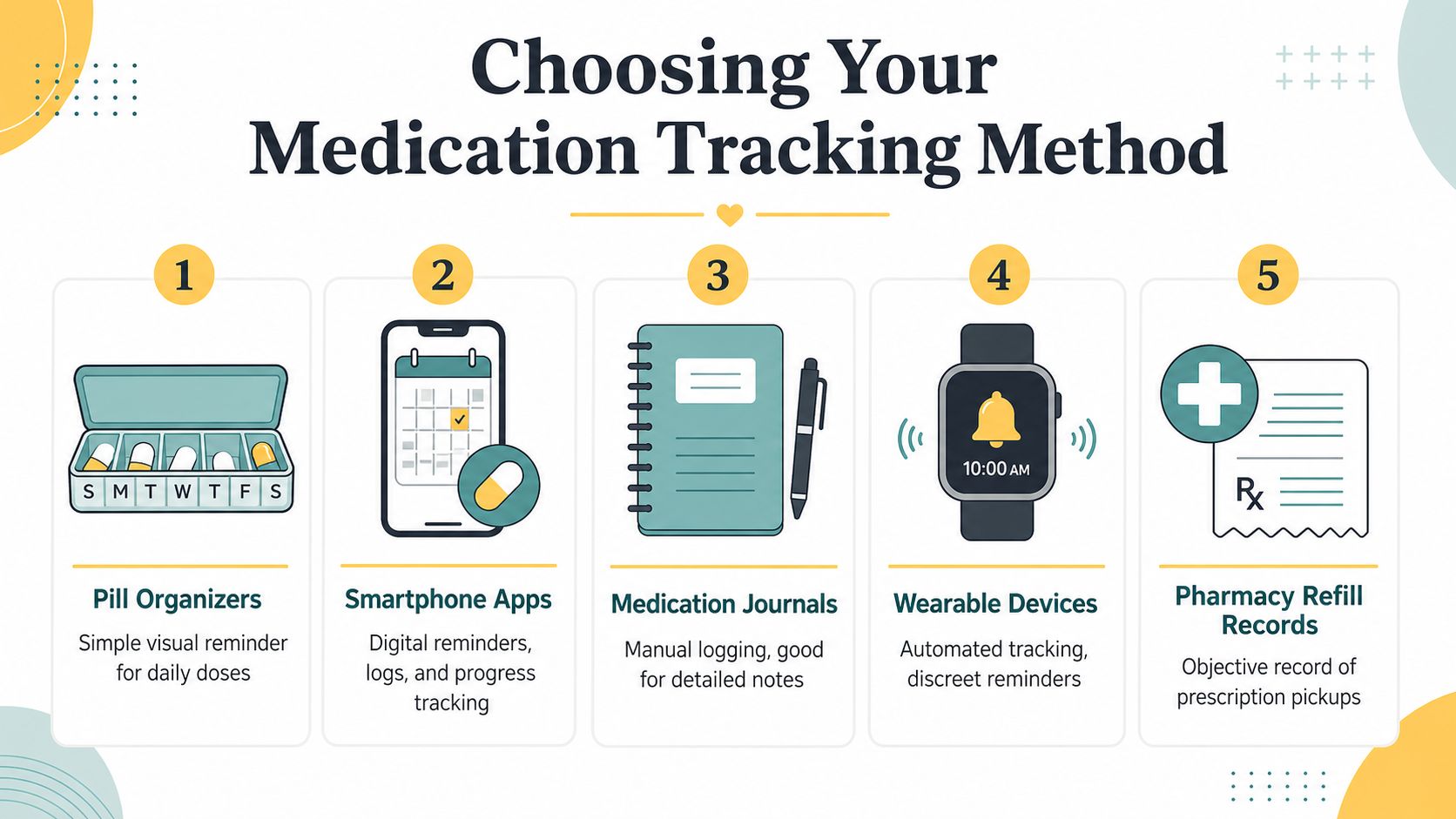
Self-report is the most common starting point. That includes diaries, checklists, paper planners, phone notes, or app logs where you mark doses yourself. It's cheap, flexible, and easy to start today. The downside is that memory can distort the record, especially when a migraine week blurs together.
Pill counts are another low-tech option. You compare the number of pills left with the number you expected to have left. This can reveal patterns over time, but it doesn't show whether you took a dose at the right time, took it late, or removed a pill without consuming it.
Digital and objective methods give clearer evidence
Digital reminders and apps add structure. You can log a dose in real time, attach symptoms, and connect your medication history with migraine attacks, aura, nausea, light sensitivity, or environmental changes. This doesn't automatically make the data perfect, but it usually makes it easier to keep the record current.
Smart packaging such as electronic pill bottles or blister packs goes a step further. According to AARDEX on measuring and managing patient adherence, smart packaging reaches 97% accuracy, compared with 60% for pill counts and 27% for patient self-reporting. That doesn't mean everyone needs high-tech packaging. It means objective methods can reduce the bias that comes from trying to remember yesterday while dealing with pain today.
Some people also use pharmacy refill records as an extra check. These records can't prove that a dose was swallowed, but they can show whether prescriptions are being refilled on time. For long-term migraine prevention, that can be a useful reality check.
The more your system relies on memory after the fact, the less reliable it becomes.
Comparison of Medication Adherence Tracking Methods
| Method | How It Works | Pros | Cons |
|---|---|---|---|
| Self-report diaries or journals | You manually write down each dose and any symptoms or notes | Very accessible, flexible, good for detailed context | Easy to forget, memory bias, hard to review over long periods |
| Pill counts | You compare remaining pills with your expected supply | Simple, no special technology, useful as a rough check | Doesn't confirm timing or actual ingestion |
| Digital reminders and apps | Your phone prompts you, and you log doses when taken | Convenient, searchable, can combine meds with symptoms and triggers | Still depends on you entering data honestly and consistently |
| Smart packaging | Electronic bottle or blister pack records opening events | More objective, precise timing data, less recall bias | Cost, setup, and availability may limit use |
| Pharmacy refill records | Refill dates show whether prescriptions are picked up regularly | Objective for pickup history, useful in long-term review | Doesn't show whether the medication was taken as prescribed |
If you want one practical rule for choosing, use this: pick the least burdensome method that still gives you trustworthy information.
Key Metrics to Understand Your Progress
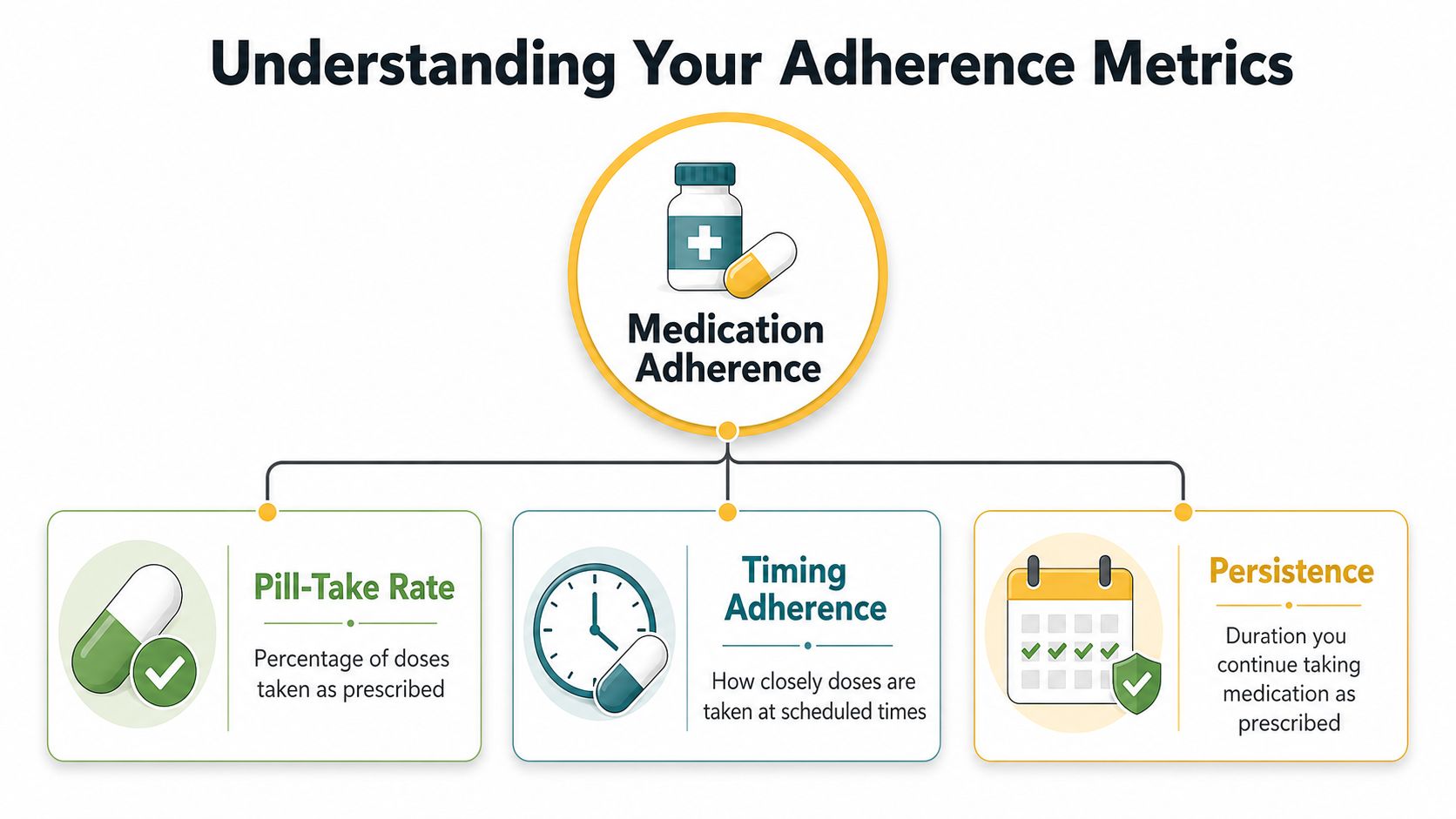
Once you start tracking, the next challenge is knowing what the record means. A useful way to think about it is as a report card with three different grades. One grade asks whether you took the doses. Another asks whether you took them at roughly the right times. The third asks whether you stayed on the treatment long enough to evaluate it.
Dose adherence
Dose adherence is the share of prescribed doses you took.
If you were supposed to take a preventive medication daily and missed several days, your dose adherence would drop. This is usually the first thing people mean when they say they've been “consistent,” but it's only one piece of the picture.
Timing adherence
Timing adherence asks whether you took the medication close to the intended time of day.
For some treatments, timing matters because more regular timing helps maintain a steadier pattern. You might have decent dose adherence overall but poor timing adherence because you took the medication in the morning on some days, late at night on others, and skipped logging exact timing altogether.
Good tracking doesn't just answer “Did I take it?” It answers “When did I take it, and what happened after?”
Persistence
Persistence means how long you continue the treatment from start to stop.
This matters a lot in migraine prevention because many people stop before there's a clear picture. Another problem is that self-report can make all three metrics look better than they are. A study discussed in this PubMed review of adherence measurement in headache found a 65% adherence rate using a simple self-report scale, but only 20.4% for the same patient group when a more rigorous validated scale was used. That gap is a good reminder that your memory, especially during recurrent migraine, may not be enough.
A simple way to interpret your own record is:
- Low dose adherence: you may be missing enough doses to blur the result
- Good dose adherence, poor timing: routine may be interfering even if motivation is strong
- Good dose and timing, low persistence: you may be stopping too early to judge the plan clearly
These metrics don't judge you. They explain the shape of your treatment experience.
Common Barriers to Adherence and How to Solve Them
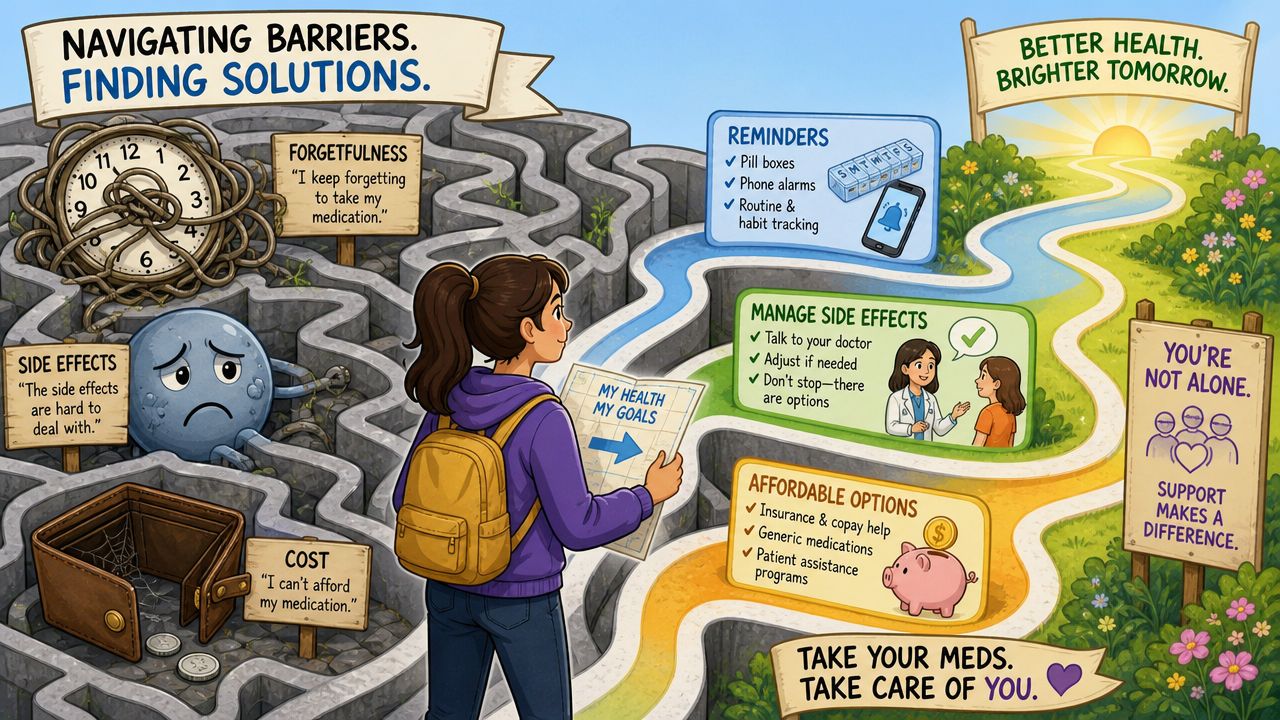
Most missed doses don't happen because someone “doesn't care.” They happen because migraine is disruptive, treatments can be hard to live with, and daily life keeps moving. If your system ignores that reality, it probably won't last.
Forgetfulness and routine friction
Sometimes the problem is plain friction. You wake up late, rush out, and realize at lunch that you can't remember whether you took your medication. Or you meant to take it after brushing your teeth, then your phone rang, and the whole routine broke.
Try reducing the number of decisions involved:
- Attach it to an existing habit: Pair your medication with something stable, like brushing your teeth or making coffee.
- Keep the cue visible: Store it in a safe place you'll reliably see, if your clinician or pharmacist says that storage location is appropriate.
- Use a one-tap record: The easier it is to log a dose, the more likely you are to do it in the moment.
Side effects, doubt, and emotional fatigue
This barrier is quieter and often heavier. If you feel off, it's easy to wonder whether the medication is worth it. If attacks are still happening, doubt can build fast.
That emotional layer matters. A study in migraine patients found that a patient's beliefs and perceptions about medication are highly influential, and that trust in the doctor and treatment concept plus effective coping strategies were significantly associated with adherence in a PubMed study on adherence and patient perceptions in migraine.
That means practical tracking should include your reactions to the treatment, not just whether you swallowed a pill.
Consider logging:
- Confidence level: Do you feel the plan makes sense to you?
- Side effect notes: What happened, when did it start, and did it overlap with prodrome or postdrome?
- Questions for your clinician: Write them down before you forget them during a busy or stressful day.
If you're tempted to stop a medication because of side effects or worry, record what's happening and contact your clinician rather than making abrupt changes on your own.
Cost, access, and complicated schedules
Other barriers are structural. Refill delays, insurance issues, travel, or a complicated schedule can throw off even the most motivated person. If your plan involves multiple medications, or both acute and preventive treatment, confusion can creep in quickly.
A few ways to lower that burden:
- Check refill timing early: Don't wait until the last dose to look at what you have left.
- Separate preventive and acute medications clearly: Migraine prevention and acute relief have different purposes, and mixing them up can make your log harder to interpret.
- Ask for simplification: If your schedule feels unrealistic, tell your clinician. Sometimes the barrier isn't motivation. It's the plan itself.
A Practical Workflow for Tracking Your Medications
You don't need a perfect system. You need a system that still works on a workday, a travel day, and a migraine day.
Set up a system you can actually live with
Start with one method from the options above and commit to using it for a defined period. If you prefer paper, use paper. If you rely on your phone for everything, use a digital option.
A good setup usually includes:
- One home for your medication log. Don't split it across three apps and a sticky note.
- A reminder you won't ignore automatically. Choose a time connected to a real routine.
- A few fields only. Dose taken, time taken, migraine symptoms, and brief trigger notes are enough to start.
This kind of screen can help you see meds and migraine context in one place:
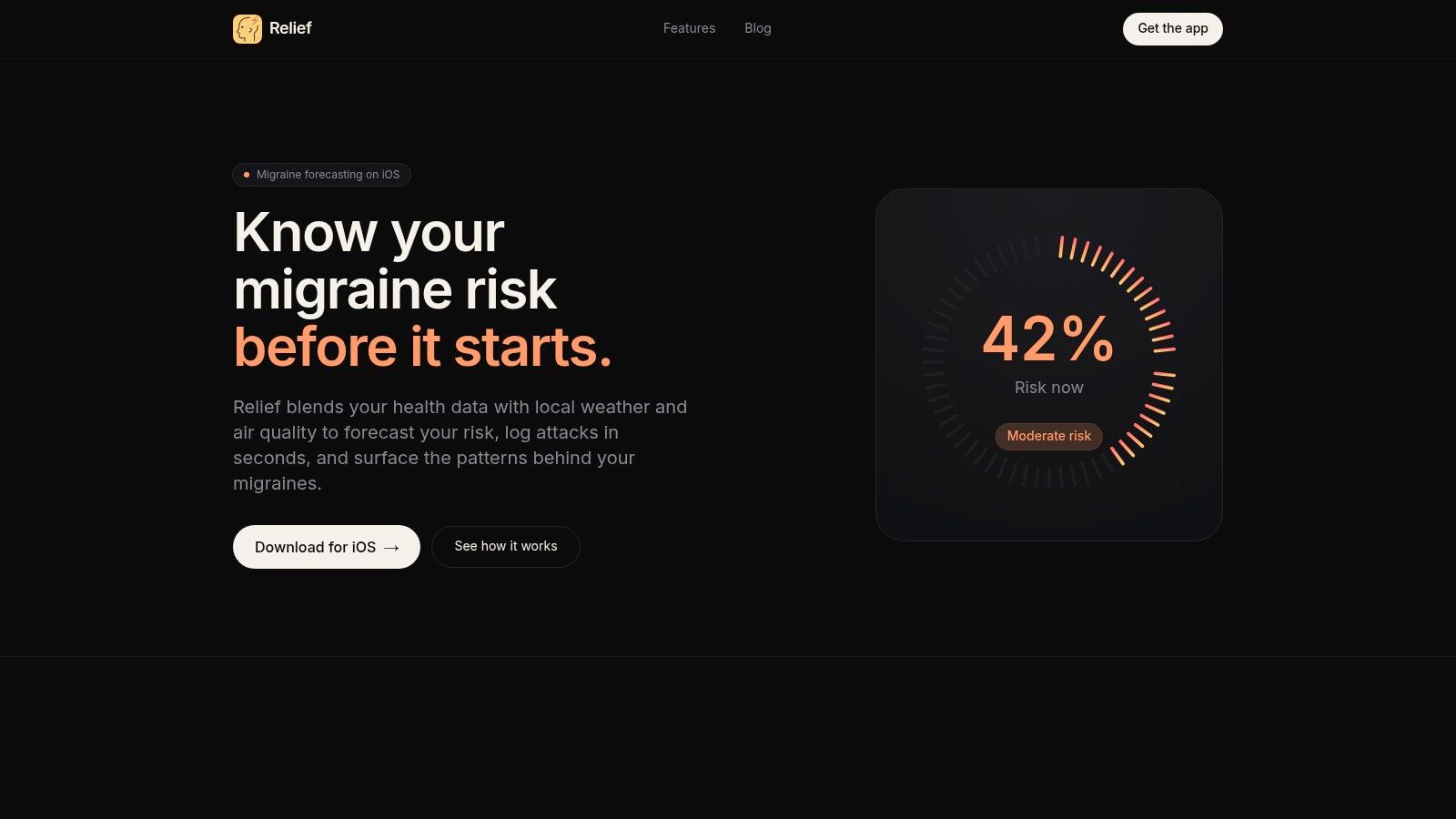
If you want a tool that combines symptom logs with environmental context, Relief for migraine tracking on iOS is designed around that kind of day-to-day use.
Review your log before it becomes a blur
The tracking itself takes seconds. The meaning shows up when you review it regularly.
Try this short routine once a week:
- Look for missed or late doses: Were they random, or did they cluster around stressful days or bad sleep?
- Compare with migraine activity: Did attacks happen after skipped doses, or despite consistent use?
- Notice trigger overlap: Weather shifts, air quality changes, pollen, stress, and sleep disruption may help explain why a bad week happened even when adherence was solid.
A short walkthrough can make that review process easier to picture:
If your log feels overwhelming, scale down. A smaller log you keep is more valuable than an elaborate system you abandon after a week.
Making Sense of Your Adherence Data to Improve Care
The goal isn't to collect data for its own sake. It's to spot patterns that help you and your clinician make better decisions.
Look for patterns, not perfection
Start by comparing your adherence record with your migraine record over time. You're looking for relationships, not certainty.
Questions worth asking include:
- When I took my preventive medication consistently, did attack frequency change?
- Were attacks less intense, shorter, or easier to recover from?
- Did missed doses line up with worse weeks, or was the bigger factor weather, sleep, stress, or another trigger?
- Did I have symptoms that looked like side effects but appeared before the migraine attack, suggesting prodrome?
Migraine tracking offers greater power than simple pill logging. Many tools tell you whether you took a dose. Fewer help you compare that history with changing conditions around you, such as humidity, temperature shifts, air quality, or pollen. For some people, those patterns may explain why a medication seemed unreliable when it was actually a mix of adherence and trigger exposure.
A useful log can show not only whether you took the medication, but also why a bad day may have happened anyway.
Bring useful evidence to appointments
Good adherence data changes the quality of a medical conversation. Instead of saying, “I don't think this is working,” you can say that you took the medication consistently for a meaningful stretch, logged your symptoms, and noticed either improvement, no change, or a pattern tied to specific triggers.
That doesn't replace medical judgment. It gives your clinician clearer evidence.
It's also reasonable to think about privacy when you use any health app. Before storing sensitive information, review the app's privacy practices, what data it keeps, and how you control your records. You deserve tools that are practical and respectful of your health information.
If you want a simpler way to connect medication logs with symptoms, triggers, and local environmental conditions, Relief can help you track those patterns in one place so your next appointment starts with clearer evidence, not guesswork.


