
You're staring at yesterday's medication entry, trying to remember whether you took the rescue medicine before the pain peaked, after the nausea began, or not at all. A medication log book can answer that question by recording what you took, when you took it, and how it affected your migraine. It turns medication use into dated, structured information that you and your clinician can review without relying on exhausted recall.
Migraine isn't a bad headache. It can involve photophobia, meaning sensitivity to light, prodrome, the early phase before the main symptoms, aura, temporary neurological symptoms such as visual changes, and postdrome, the drained or foggy period after the attack. This article is for informational purposes and is not medical advice. Consult a healthcare provider for personalized guidance.
Table of Contents
What a Medication Log Book Actually Does for Migraine
A migraine can make memory unreliable. During pain, nausea, dizziness, or light sensitivity, writing down a dose may feel less important than finding a dark room. Later, your clinician may ask what you took and whether it worked, and you may only remember that you felt awful.
A medication log book is a dated record of medication use and response. It can include the medicine name, dose, time taken, whether it was scheduled or as needed, missed doses, and the effect on symptoms. The aim isn't to create more paperwork. It's to capture information while it's still available.
Why a written record can support adherence
Medication diaries have been used as structured adherence tools for a long time. In a 2019 study of 123 people with chronic myeloid leukaemia, 44 participants, or 35.8%, completed the diary. Among diary users, overall adherence was 93.6%, compared with 86.5% during the period without a diary, a statistically significant difference of p<0.0001. The study reported diary-use adherence of 94.9% for imatinib, 91.1% for nilotinib, and 95.8% for dasatinib in the relevant groups, as described in the PubMed study on medication diaries and adherence.
For migraine, that matters because a time-stamped entry can help distinguish a missed dose from a medicine that was taken correctly but didn't provide enough relief. It also gives you a more dependable memory aid when attacks blur together.
The log shouldn't diagnose you or prove that a treatment has failed. It gives you a clearer record to discuss with a healthcare professional. That's especially useful when your migraine pattern changes, whether you experience episodic migraine, chronic migraine, migraine with aura, vestibular migraine, or another presentation that needs individual assessment.
What to Record So Your Log Is Clinically Useful
A useful medication log book works more like a small data system than a blank diary. Each entry should answer four practical questions: what was taken, how much, when, and what happened afterward.
Start with one record for every medication. For each drug, record the exact start date and stop date using day-month-year, the dose, the unit, the frequency, and whether it's used continuously or as needed. “Two tablets” is incomplete if the strength or unit isn't clear. If a medicine is taken only for a particular migraine, label it as acute treatment, rather than grouping it with daily preventive therapy.
The migraine log template from ReliefMigraine can help you organize these fields in a consistent format.
Separate acute and preventive use
An as-needed medicine is used for a specific headache or migraine episode. A continuous preventive medicine is taken on a regular schedule to reduce the likelihood or severity of future attacks. Keep them separate, because the same entry, “took medication,” doesn't tell a clinician whether you used rescue treatment or followed a routine preventive plan.
For each migraine day, also record the headache or migraine day itself, pain severity, the dose and time used, and the medicine's effect. The American Migraine Foundation recommends tracking headache days, pain severity, medications, dosage, timing, and effect in its medication-overuse guidance.
| Field | As-Needed Acute Medicine | Continuous Preventive Medicine |
|---|---|---|
| Medicine name | Record each rescue medicine separately | Record the scheduled medicine separately |
| Dose and unit | Include the amount and unit used during the attack | Include the prescribed amount and unit |
| Time | Record the time each dose was taken | Record the scheduled or actual administration time |
| Frequency | Record how many times it was taken that day | Record the planned frequency |
| Start and stop dates | Note when this treatment was started or stopped | Note each change to the ongoing regimen |
| Symptoms and effect | Record severity, symptoms, and whether relief was complete, partial, or absent | Record changes in migraine frequency, severity, or tolerability for discussion |
| Status | Mark as as needed | Mark as continuous |
For acute medicines, record the number of times each medicine was taken that day, not just the total number of medicines. Mayo Clinic Health System's headache diary separates as-needed treatment for a specific headache from daily preventive medication. That distinction helps your clinician assess treatment timing and exposure patterns.
How to Keep Your Medication Log Accurate Day to Day
The strongest log is recorded continuously, close to the time of use. Back-filling several days later creates gaps, uncertain timing, and entries based on memory rather than observation.
A simple routine can reduce that burden. Keep the paper log beside your medicines, or keep the digital entry screen easy to reach. When you take an as-needed medicine, record it at the time if you can. If you're too unwell, make the smallest possible mark and complete the detail when you're able, rather than trying to reconstruct an entire week.
Use a short daily quality check
A 30-second check-in can catch errors without turning tracking into a second job. Ask:
- Dates: Is the start or stop date possible, and is it written as day-month-year?
- Active entries: Do two records incorrectly show the same medication as active at once?
- Units: Does every dose include a clear unit?
- Duplicates: Did you accidentally create a second record for the same medicine?
- Missed doses: Did you mark a dose as skipped or leave it blank instead of pretending it was taken?
- Changes: Did you record a prescription or dosage change when it happened?
- Reasons: If you skipped a dose, did you note why, such as nausea, sleep, access, or a change in instructions?
These checks reflect recommendations for reliable concomitant-medication data, including validation of impossible dates, overlapping entries, vague units, and duplicate medication records in the methodology paper on structured medication logs.
Practical rule: An honest blank or “skipped” entry is more useful than a polished guess.
As-needed frequency deserves particular care. Record how often you used the medicine at entry time, because dispensing records alone can't reliably show when or how frequently an as-needed treatment was taken. Update your medication list whenever a prescription changes, consistent with FDA guidance on keeping a medication list current.
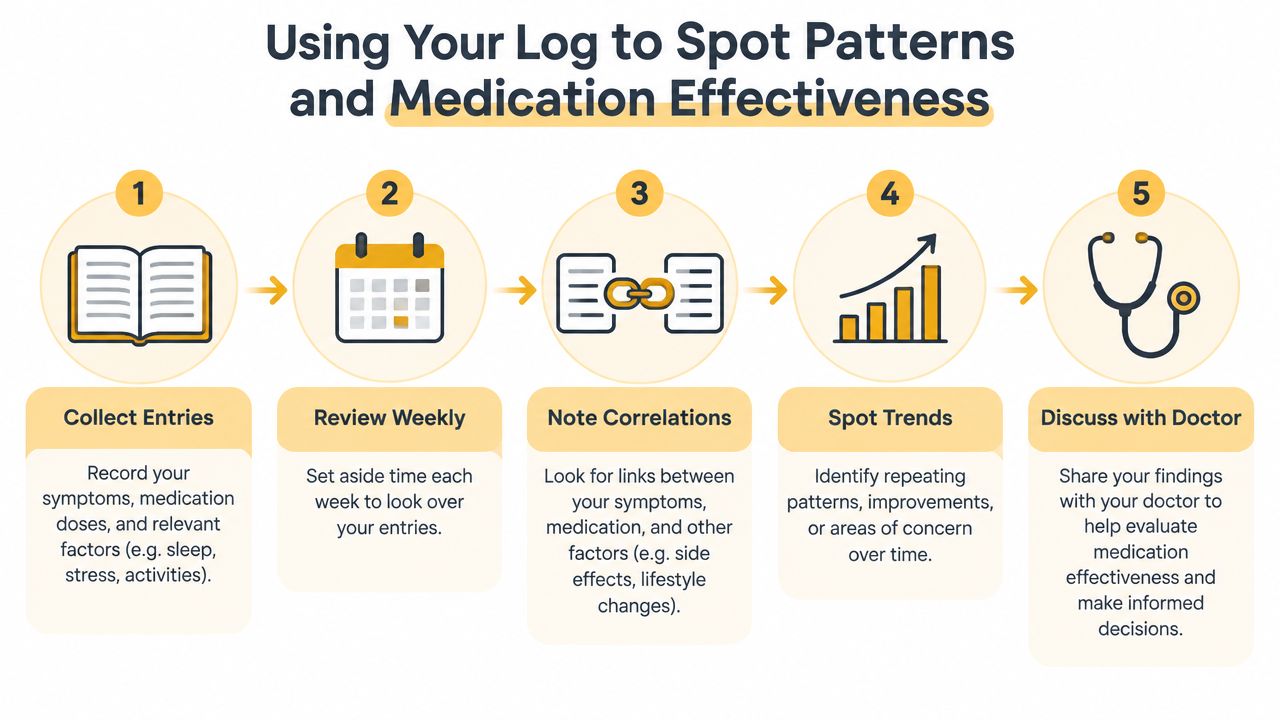
Using Your Log to Spot Patterns and Medication Effectiveness
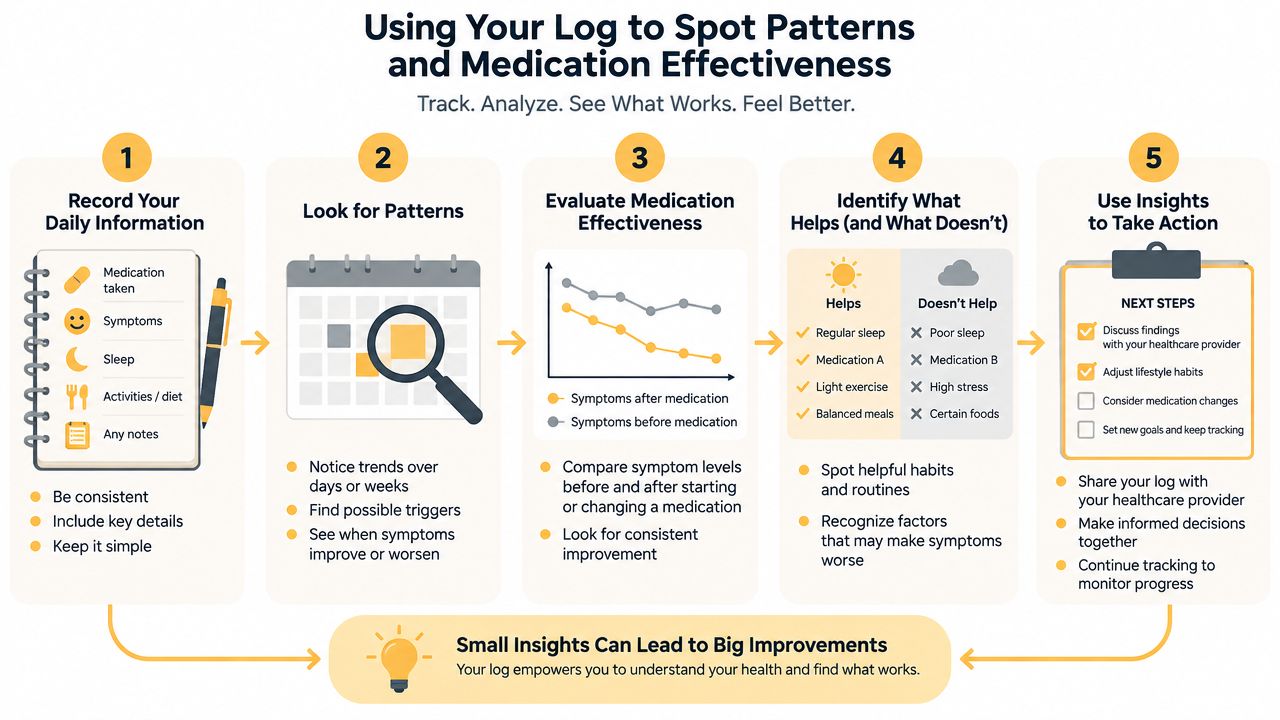
After a tiring migraine day, one entry can feel like all you can manage. Its value grows when you compare records across time. Treat the log as a structured data system: connect dose timing, symptoms, and response, while separating as-needed use from preventive use. For example, record whether an acute medicine was taken early or late, then mark the result as complete, partial, or absent relief. This observation cannot diagnose the cause, but it gives your clinician a clearer question.
A medication log can also show whether worsening symptoms occur alongside missed or delayed doses. The NCBI Bookshelf review on medicines adherence describes diary cards as a way to measure adherence over time and examine relationships between exacerbations and medicine-taking behavior. For practical guidance on recording whether medicines were taken as planned, see this guide to medication adherence tracking.
Review dates, not just stories
Count migraine and headache days by month, then review the same measures after 12 weeks. NHS Scotland guidance recommends keeping a headache diary so treatment response can be assessed over that period. Date-based counts can show whether a treatment change occurred alongside fewer migraine days, without relying on a general memory that the month felt “better” or “worse.”
Track total days of acute medication use separately from headache days. Scottish NHS migraine guidance advises recording painkiller use and frequency, and notes a long-term limit of not taking painkillers on more than 10 days each month. Reaching that pattern calls for a conversation with a healthcare provider, not a self-diagnosis or an independent treatment change. Repeated acute use may also make overuse patterns easier to discuss during a review.
Your log still has limits. A review found an average 30% surplus of diary entries compared with electronic monitoring, while another source reported that 67% of patients overestimated compliance with self-recording tools, as summarized in this review of medication-adherence measurement. A diary can show that you recorded a dose, but it cannot always confirm ingestion or prove that the timing was exact.
A comparison of electronic monitoring and diary-based measurement in cancer pain found 79% used the electronic monitor for the full four weeks, compared with 70% completing the diary. The diary showed 87% taking adherence but 53% timing adherence. That difference separates taking a medicine from taking it on schedule. Bring the full record to appointments, including skipped doses and uncertainty, so your clinician can interpret the pattern in context.
Seek immediate medical care for a sudden severe headache, a headache with fever and stiff neck, new neurological changes, or a headache after a head injury. These symptoms need urgent assessment rather than diary analysis.
Privacy Paper Logs and App Check Ins That Sharpen Forecasting
Paper and digital logs can serve the same purpose, but they create different practical trade-offs. A paper medication log book is available without a device or account, and you can keep it at home with your medicines. A digital check-in can make timestamps easier to review, search entries quickly, and connect medication timing with other information.
Privacy depends on your habits and the tool you choose. Store paper pages somewhere visitors won't casually see them, and avoid writing unnecessary identifying details. For an app, review its privacy information, use device security features, and choose only the health details you're comfortable recording.
A unified digital timeline can place medication entries alongside symptoms, weather, humidity, barometric pressure, temperature, wind, air quality, and pollen. That doesn't establish that an environmental factor caused a migraine. It can, however, help you notice whether a specific exposure repeatedly appears near your own attacks rather than treating every commonly mentioned trigger as universal.
Relief is an iOS tracking option that lets you log migraine timing, severity, symptoms, triggers, and medications, then view those check-ins with local environmental data and an hour-by-hour risk forecast. Its trend views include exposure hit rates, migraine-free streaks, total migraine hours, average attack time, and changing severity. Relief supports awareness and pattern tracking, but it isn't a medical treatment or a replacement for clinical care. The broader principle of combining information across sources is described in health data integration for migraine tracking.

Timestamped entries can also reduce some problems linked with retrospective self-report, although no log should be treated as perfect evidence. Choose the format you'll use during a migraine. A simple paper mark may be better than an elaborate digital system you avoid, while an app may suit you if searching and trend review reduce your workload.
Your Next Steps and When to Seek Care
Start small. For the next week, record each medication separately, note the time, mark whether it was acute or preventive, and write a short description of the effect. Add the number of migraine and headache days, pain severity, and any missed dose or treatment change.
Before an appointment, bring:
- Your medication list: Include current medicines, start and stop dates, dose, unit, and frequency.
- Your timeline: Show when acute medicines were used and how many times each was taken.
- Your response notes: Record whether symptoms improved, stayed the same, or returned.
- Your questions: Mark entries that are unclear so you can discuss them rather than guess.
Triggers vary widely. A food, weather condition, sleep pattern, or remedy that appears in another person's log may not matter in yours, so use your record to identify personal patterns instead of applying universal rules.
This article is for informational purposes and is not medical advice. Consult a healthcare provider for personalized guidance. Seek immediate care for a sudden severe headache, fever with a stiff neck, neurological changes, or a headache after head injury.
Relief can make it easier to log symptoms, medications, triggers, and timing in one place while you look for patterns in your own migraine history.
If you want a lower-effort way to build a consistent medication log book, visit Relief to record migraine details in seconds and review personal patterns alongside environmental signals. Use those insights to prepare clearer questions for your healthcare provider, not to replace their guidance.


