Migraine Attack Duration: How Long Attacks Really Last
Migraine attack duration is 4-72 hours for untreated attacks. Learn typical timing, each phase, why it varies and when to seek medical care.
In this guide
In adults, an untreated or unsuccessfully treated migraine without aura typically has a headache phase lasting 4-72 hours; for children under 15, the recognized range is 2-48 hours. Those headache hours don't necessarily include the early warning symptoms or the recovery time afterward.
You might be lying in a dark room wondering whether you'll manage tomorrow's meeting, or your pain may have stopped while your concentration still hasn't returned. That uncertainty is exhausting, especially when someone assumes you're fine because the headache has eased. Understanding migraine attack duration means looking at both the pain and the time it takes to feel functional again.
Typical Migraine Attack Duration at a Glance
The 4-72-hour headache window for untreated or unsuccessfully treated migraine without aura comes from the International Classification of Headache Disorders, 3rd edition diagnostic criteria. It's a diagnostic boundary, not a countdown that predicts when your next attack will finish.
Migraine is more than a headache. Headache describes pain in the head; migraine is a disorder that can also involve nausea, sensory sensitivity, aura, and changes in energy or thinking. Duration helps clinicians understand the pattern, but it can't establish a diagnosis by itself.
Typical migraine attack duration by group
| Group | Typical duration | What it represents |
|---|---|---|
| Untreated migraine without aura, adults | 4-72 hours | ICHD-3 diagnostic window for the headache |
| Untreated migraine, children under 15 | 2-48 hours | Recognized headache-duration range for this age group |
| Episodic migraine under 50, non-perimenstrual women | 16 hours | 2024 International Headache Society average |
| Episodic migraine under 50, perimenstrual women | 23 hours | 2024 International Headache Society average |
| Episodic migraine under 50, men | 14 hours | 2024 International Headache Society average |
| Global study, all respondents (n=11,086) | 18.15 hours | 2023 mean attack duration |
| Global study, females | 19.16 hours | 2023 mean attack duration |
| Global study, males | 14.69 hours | 2023 mean attack duration |
| Unremitting attack in adults | Over 72 hours | Status migrainosus, a medical concern category |
The pediatric range and sleep-counting rules are described in the ICHD-3 migraine-without-aura reference, which gives a 2-48-hour range for children under 15. The 2023 global study of 11,086 respondents reported a mean of 18.15 hours overall, 19.16 hours among females, and 14.69 hours among males.
Averages hide a wide spread. An attack can be longer than a study average and still fit the usual diagnostic window; an attack within that window can still be disabling.
Practical rule: Compare like with like. Headache hours and total recovery hours answer different questions.
If your headache durations generally fall within the diagnostic window, their length is consistent with that aspect of migraine. Repeatedly crossing its upper boundary deserves medical review, rather than becoming your new normal.
This article is for informational purposes and is not medical advice. Consult a healthcare provider for personalized guidance.
The Four Phases That Make Up One Attack
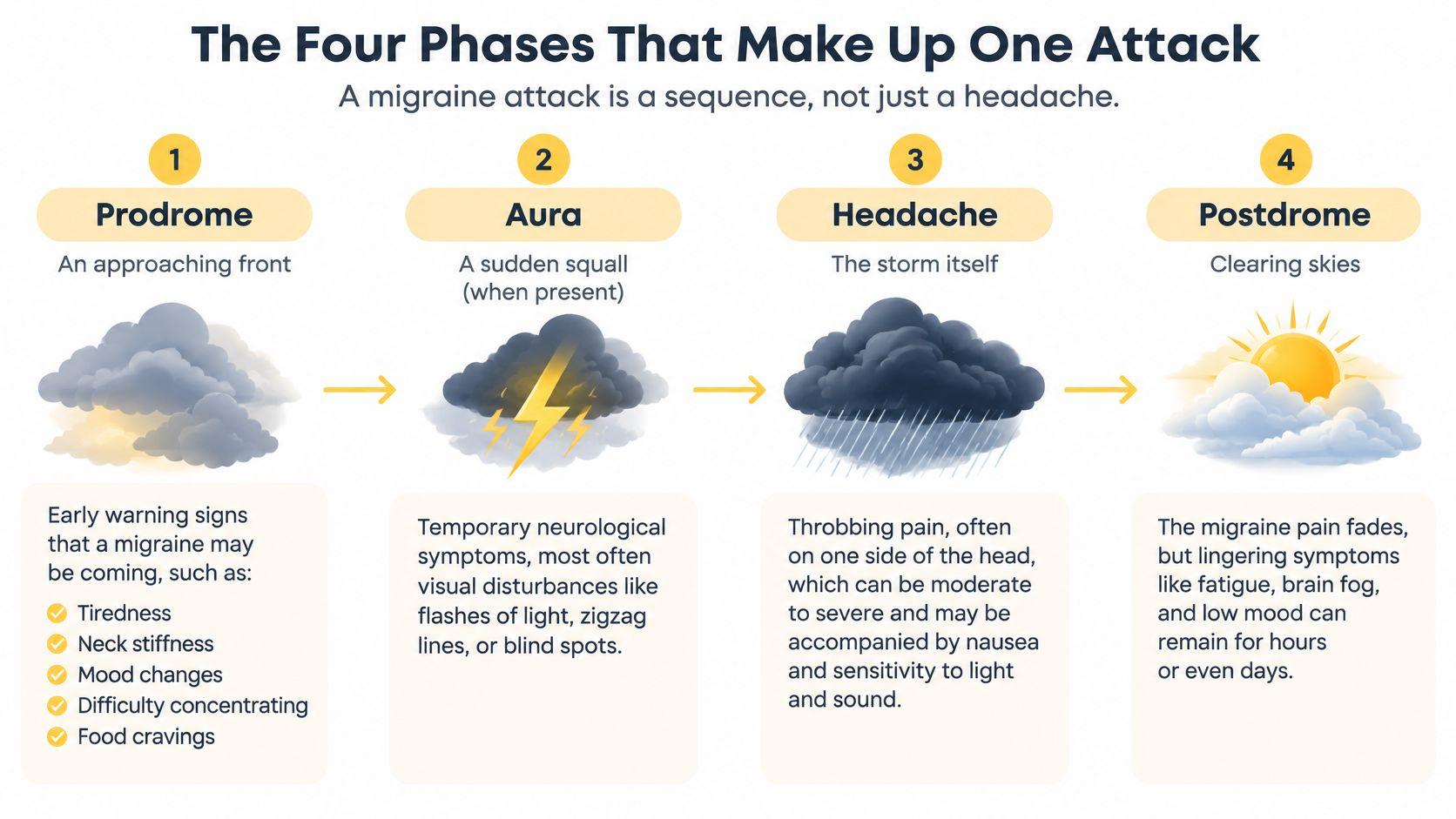
A migraine attack can resemble a changing weather system: an approaching front, a sudden squall when aura occurs, the storm itself, and clearing skies with disruption left behind. The analogy helps explain why pain is only part of the experience.
The American Migraine Foundation's guide to migraine signs and symptoms describes four phases and notes that aura typically develops over at least 5 minutes and lasts 5-60 minutes. Not everyone experiences every phase, and your sequence can change between attacks.
This timeline shows how the phases fit together.
Phases of a migraine attack and typical timing
| Phase | Typical timing | What you may notice |
|---|---|---|
| Prodrome, the pre-headache phase | Several hours to days before pain | Fatigue, mood changes, food cravings, neck stiffness, light or sound sensitivity |
| Aura, temporary sensory symptoms in some attacks | Builds over at least 5 minutes, lasts 5-60 minutes | Visual changes, tingling, numbness, speech difficulty |
| Headache | Commonly several hours to 3 days | Moderate-to-severe pain, often throbbing, nausea, light or sound sensitivity |
| Postdrome, the recovery phase sometimes called a migraine hangover | Can continue after pain ends, often up to about a day | Fatigue, dizziness, body aches, poor concentration |
Prodrome is the approaching front. Unusual tiredness or a stiff neck might become recognizable as an early sign only after you've logged a repeating pattern.
Aura is the temporary squall, not another word for all warning symptoms. Our explanation of what migraine aura can look and feel like can help you distinguish it from less specific changes in energy or mood.
During the headache phase, photophobia, meaning sensitivity to light, may make ordinary surroundings difficult to tolerate. Postdrome can then leave you unable to concentrate even when head pain has stopped.
Record the boundaries you can identify, rather than forcing every symptom into a perfect sequence. If there's no aura, leave that field empty; if you're unsure when recovery began, mark the time as approximate.
A Worked Example From First Sign to Recovery
This is a hypothetical illustration, not patient data: an attack begins with unusual tiredness and neck stiffness at 8:00 a.m. on day one. You continue with your day, but you don't feel quite like yourself.
The visual below separates the stages so the pain interval doesn't get confused with the whole episode.
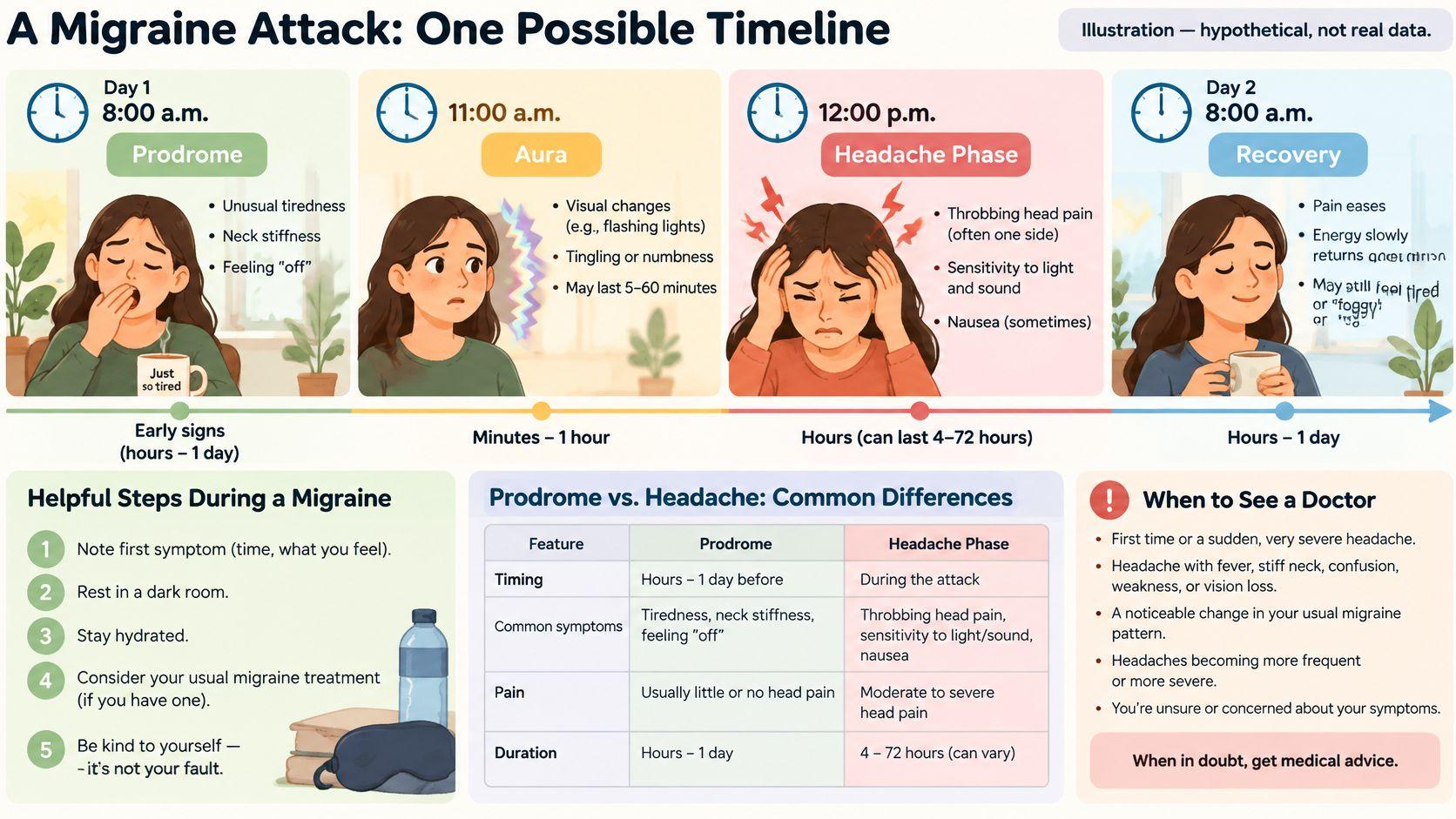
Following the clock
At 2:00 p.m. on day two, a shimmering visual change appears and lasts about 20 minutes. Headache begins at 2:30 p.m., peaks that evening, and resolves around 1:00 a.m. on day three.
Your concentration and energy remain low until 3:00 p.m. on day three. That leaves a substantial recovery period after the pain has ended.
| Measurement in this hypothetical example | Calculation | Total |
|---|---|---|
| Headache duration | Day two, 2:30 p.m., to day three, 1:00 a.m. | 10.5 hours |
| Postdrome recovery | Day three, 1:00 a.m., to 3:00 p.m. | 14 hours |
| Total affected time | Day one, 8:00 a.m., to day three, 3:00 p.m. | 55 hours |
The headache total answers how long the pain lasted. The longer total describes the span from first recognizable symptoms to recovery, though it doesn't mean you were equally impaired throughout.
For another way to follow the sequence, this video provides a visual companion.
The important transitions were the first early sign, aura, headache onset, pain resolution, and return to baseline. Bring both totals to a healthcare appointment, along with a note about which activities each phase prevented.
Why Attack Length Varies From Person to Person
Group averages describe patterns, not your diagnosis or your next attack. In a 2024 International Headache Society review, people under 50 with episodic migraine had average durations of 16 hours for non-perimenstrual women, 23 hours for perimenstrual women, and 14 hours for men.
That comparison suggests menstrual timing matters for some people, but it doesn't tell any individual how long an attack should last. Migraine affects people of all genders, and experiences within each group differ.
What changes the measurement
- Age and hormonal timing: Children's attacks can be shorter than adults' attacks. For people who menstruate, recording whether symptoms occur around a period may reveal a useful personal pattern.
- Attack frequency: Episodic and chronic migraine describe different frequency patterns. Closely spaced attacks can make it harder to identify where one episode ended and another began.
- Treatment response: The diagnostic window concerns untreated or unsuccessfully treated headache. A successfully treated attack may end sooner, so record what you used and whether relief lasted.
- Sleep: If you fall asleep during an attack and wake without migraine, the diagnostic counting convention includes the time through awakening. Note sleep rather than guessing exactly when pain stopped.
Migraine type also affects what deserves a separate timestamp. Migraine with aura includes sensory symptoms, while vestibular migraine can involve prominent dizziness or balance symptoms; a head-pain-only record may miss what disrupted your day.
You don't need to classify every symptom yourself. Describe what happened in plain language and let your healthcare provider interpret the pattern.
Your usual duration is a useful comparison point, but it isn't proof that a changed attack is safe.
A habitually brief attack makes an unusually long one stand out. Compare each episode with your own baseline, including its symptoms, response to your care plan, and recovery, rather than judging it against a published average alone.
When Long Attacks Need Medical Attention
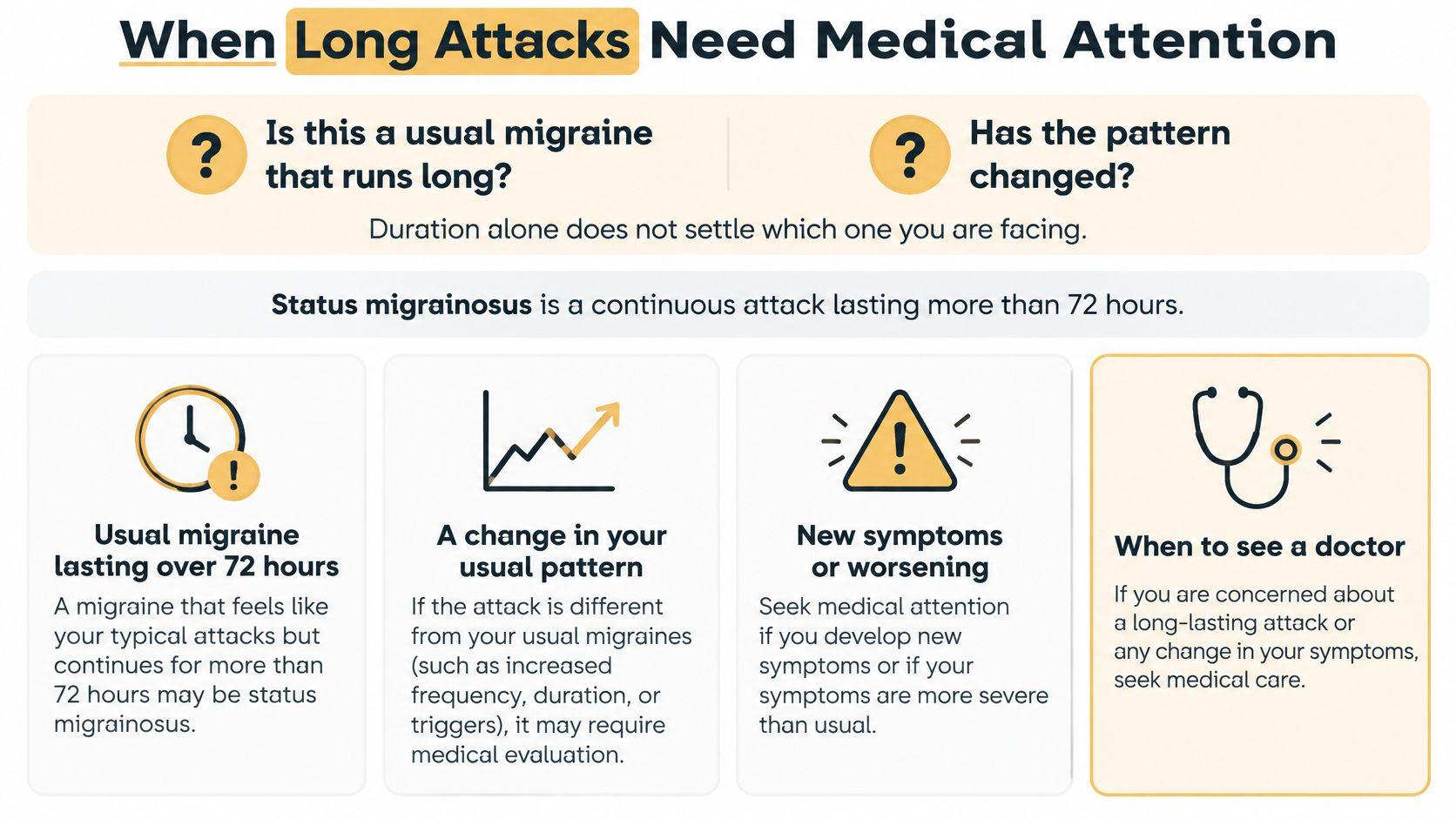
A familiar migraine lasting longer and a headache with a changed pattern aren't the same problem. Duration alone can't tell you whether an attack is safe to manage at home.
Seek immediate medical care for the emergency symptoms below. Don't wait for a duration threshold, and don't assume a new neurological symptom is your usual aura.
When to get medical care right away
| Situation | What to do |
|---|---|
| Sudden, severe or unusual headache | Call your local emergency number immediately |
| Headache with fever and stiff neck | Call your local emergency number immediately |
| New neurological changes such as weakness, numbness, confusion or trouble speaking | Call your local emergency number immediately |
| Headache after a head injury | Call your local emergency number immediately |
| Continuous headache beyond 72 hours with no pain-free interval | Seek medical care or follow your established headache-care plan, especially if usual treatment has not helped |
| Usual migraine pattern lasting within 4-72 hours | Log it and review the pattern with your healthcare provider |
The American Migraine Foundation's status migrainosus guidance describes a continuous migraine headache lasting longer than 72 hours and advises medical care or an established care plan, especially when usual treatment hasn't helped; this differs from chronic migraine, a frequency pattern involving 15 or more headache days per month.
Formal ICHD-3 status migrainosus criteria also account for brief remissions of up to 12 hours due to sleep or medication. A short break therefore doesn't automatically remove the need for assessment.
This checklist highlights the distinction between elapsed time and a changed pattern.
Our app doesn't monitor emergencies. For a sudden, severe or unusual headache, call your local emergency number immediately rather than relying on a log or forecast.
Use a migraine symptom checklist to organize non-emergency observations. Record any pain-free interval and tell your provider when a prolonged attack crossed the escalation threshold.
This article is for informational purposes and is not medical advice. Consult a healthcare provider for personalized guidance.
Logging Phase Times and Sharing Your Pattern
A useful record doesn't need a long narrative. It needs enough timestamps to distinguish when pain stopped from when you felt like yourself again.
The prospective electronic-diary study of postdrome found that 93% of 120 patients returned to normal within 24 hours after spontaneous pain resolution. For the minority with symptoms beyond that period, a pain-only log would miss part of the recovery.
Record the transitions you can recognize
Use a notes app, a paper diary, or a migraine log template. Enter dates as well as clock times, especially when symptoms continue overnight.
- First early sign: Record when a recognizable change began, such as unusual fatigue or neck stiffness. Note uncertainty if you only identified it afterward.
- Aura start and end: If present, describe the sensory symptom and when it appeared and resolved.
- Headache onset: Record when head pain began, not just when it became severe. Add peak pain as a separate event if helpful.
- Pain relief: Distinguish partial improvement from complete pain resolution, and record whether pain returned.
- Return to baseline: Note when your usual concentration, energy, and ability to function returned.
- Sleep interruption: Record when you slept, whether symptoms woke you, and how you felt on awakening.
During an attack, accuracy matters more than completeness. A short entry such as “pain gone, still foggy” can be more useful than a detailed description written much later.
Don't force a precise time if you don't know it. An approximate timestamp, clearly labeled, is better than false precision.
Keep recovery visible: End the headache timer when pain resolves, but don't erase lingering symptoms by calling the whole episode finished.
Calculate and compare the right totals
Headache hours run from headache onset to pain resolution. Total affected hours run from the first recognizable attack-related symptom to your meaningful return to baseline.
Keep any pain-free or symptom-free intervals visible. If you clearly returned to baseline before another attack began, record separate episodes rather than adding everything into one continuous attack; if you're unsure, describe the gap for your provider.
After several entries, look for practical differences:
- Your usual range: Do headache durations cluster toward the shorter or longer end of the diagnostic window?
- Your recovery burden: Does fatigue or difficulty thinking last longer than the pain itself?
- Your direction of change: Are attacks becoming shorter, longer, or harder to recover from?
- Your sustained relief: Does improvement last, or do symptoms repeatedly return after a brief break?
Knowing your total affected time can help you leave room for work, school, caregiving, and recovery. Don't use a predicted end time as clearance to drive if vision, concentration, or balance remains affected.
Take a summary of your recorded attacks, including headache hours and total affected hours, to your next healthcare appointment.
This guide is general information, not medical advice, and it isn’t a diagnosis. Talk to your doctor about your own headaches.