
You're staring at the clock, you skipped breakfast, and now that familiar one-sided throb is starting behind your eyes. If that sounds like you, migraine blood sugar may be part of the story. Blood sugar swings can trigger migraine for some people, and migraine attacks can also change glucose levels while they're happening, so the relationship goes both ways.
This article is for informational purposes and is not medical advice. Consult a healthcare provider for personalized guidance.
Table of Contents
Why Your Blood Sugar Might Be Triggering Migraines
You skip breakfast because the morning ran long. By early afternoon, your head starts to pulse, your light sensitivity ramps up, and even your usual coffee feels off. That pattern is common enough that people often blame stress or “just needing food,” but for some migraine sufferers, the issue is bigger than hunger.
The brain runs on a steady energy supply, and glucose is one of its main fuels. When you go too long without eating, or when you eat in a way that sends blood sugar up fast and then down again, your nervous system can become more reactive. That can matter for migraine, which is a neurologic disorder, not a simple headache.
Low blood sugar and high blood sugar can both matter
Low blood sugar, or hypoglycemia, is the version many people notice first. A classic clue is the attack that starts after missed meals, a long commute, or a workday where lunch never happened. High blood sugar and fast rises followed by a drop can also be a problem, especially when a meal is mostly refined carbohydrate and doesn't have much protein or fiber to slow absorption.
That's why migraine blood sugar discussions are rarely just about “eating less sugar.” They're really about stability. Your system may be sensitive to the swing itself, not only to the starting number.
Practical rule: if an attack shows up after a skipped meal, a very sugary snack, or a long gap between meals, log the timing first. The pattern matters more than guessing the culprit on day one.
This is also where migraine gets confused with a plain hunger headache. Hunger can make you uncomfortable and irritable, but migraine usually brings more than pain, things like photophobia (light sensitivity), nausea, or a need to lie still. If your “food-related headache” also comes with those neurologic symptoms, it's worth treating it as a migraine pattern, not a generic headache.
What the Research Shows About Glucose and Migraine
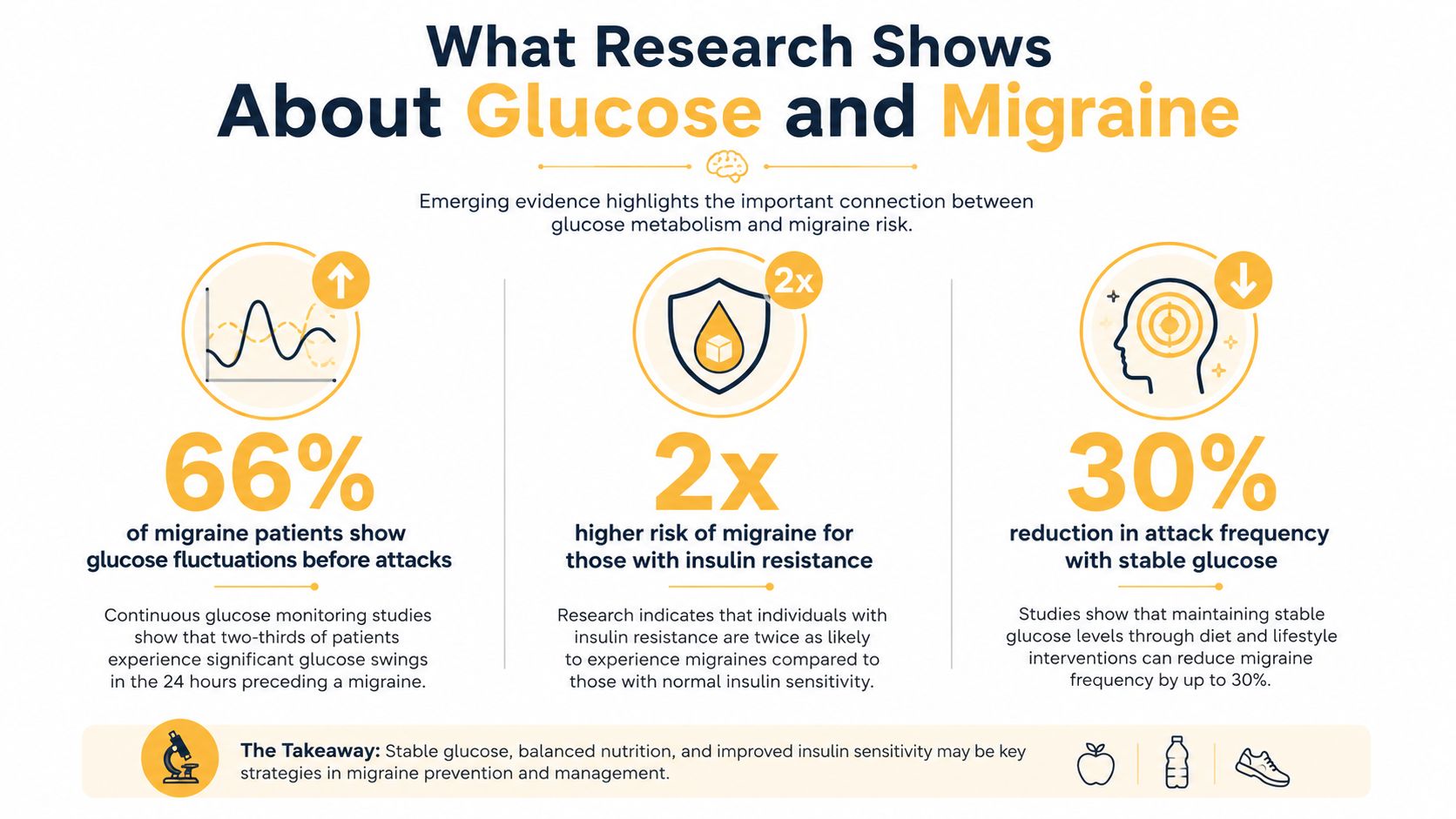
The research doesn't say every migraine is caused by blood sugar. It does show the relationship is real, measurable, and more complicated than a simple cause-and-effect story. A major U.S. population study found that people who had migraine in the previous year were more likely to have type 2 diabetes than headache-free controls, with 12.6% versus 9.4% prevalence and an odds ratio of 1.4 (PMCID: PMC9141901). That doesn't prove one causes the other, but it does show the two conditions cluster at the population level.
A later prospective cohort of women followed for a mean of 14.6 years and 564,508 person-years recorded 3,032 incident type 2 diabetes cases and did not find a significant increase in diabetes risk for migraine overall, with an HR of 1.06 (same study review). The association is meaningful, but it isn't one-directional or identical in every group.
Glucose can change during an actual attack
A newer physiologic study found that glucose levels shifted during migraine itself. Average plasma glucose was 89.30 ± 13.71 mg/dL during the ictal phase, meaning the active attack phase, versus 99.52 ± 11.07 mg/dL in the interictal phase, about a 10.20 mg/dL difference, with P = .001 (Neurology Advisor summary of the study). After adjusting for diurnal variation, the difference stayed the same, and the rise was strongest early in the attack, then declined by 1.57 mg/dL per hour from onset (same source).
That matters because it means blood sugar isn't only a background risk factor. It may shift as part of the attack process itself.
Genetics points to shared biology, not a single switch
A 2024 cross-trait genetic study found significant genetic correlations between migraine and several glycemic traits, including fasting insulin, glycated hemoglobin, and 2-hour glucose, with pleiotropic signals across 1,703 linkage-disequilibrium-independent genomic regions (Springer link). The same study reported inconsistent causal evidence overall, but it did find evidence that higher fasting proinsulin may decrease headache risk (same source).
That's a good reminder not to treat every glucose marker as interchangeable. Blood sugar, insulin, HbA1c, and insulin resistance are related, but they aren't the same thing. The science suggests shared biology, not one neat answer.
Recognizing Your Personal Blood Sugar Warning Signs
Some people can eat irregularly for years and never notice a clear migraine link. Others can name the pattern almost immediately. The hard part is that blood sugar-related clues often show up before the head pain does, so you may dismiss them as “just being tired” or “having a rough morning.”
Look for the lead-up, not just the attack
A useful question is whether your migraine usually follows a timing pattern. Did you go too long without eating? Did the attack start a few hours after a meal that was mostly quick carbs? Did you feel shaky, irritable, foggy, or oddly weak before the pain arrived?
Those lead-up symptoms can be easy to miss because they overlap with stress, poor sleep, and dehydration. The difference is in the repeatability. If the same meal timing or snack pattern keeps showing up before attacks, that's useful data even if the exact food isn't the same every time.
“Notice the gap before the migraine, not just the migraine itself.”
Track the window that seems to matter
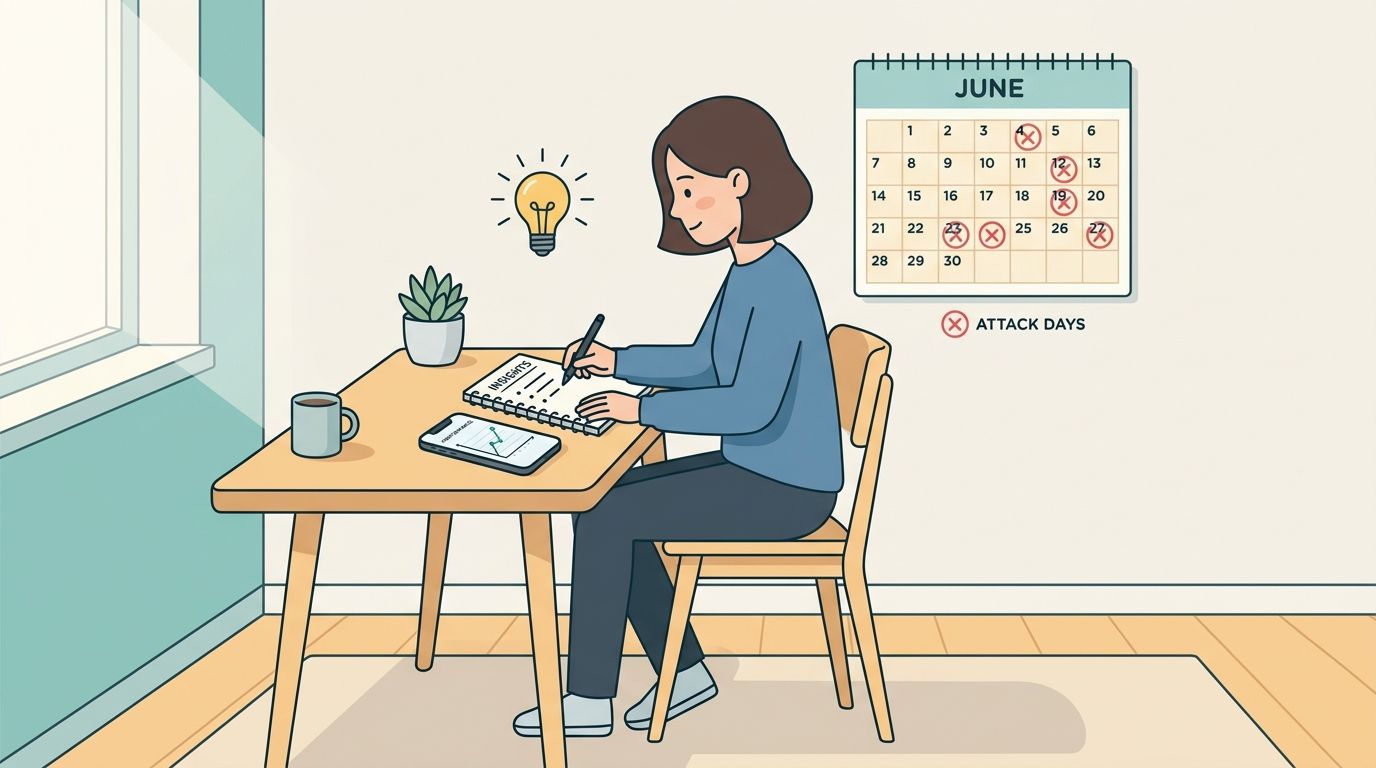
Write down three things for each attack. First, when you last ate. Second, what the meal or snack looked like. Third, when the migraine began. You're looking for a window, not perfection. For some people, the pattern is a missed breakfast. For others, it's a big lunch followed by a long stretch with no food.
A simple comparison can help:
| Pattern you notice | Possible clue |
|---|---|
| Head pain after a skipped meal | Possible low glucose or long fasting gap |
| Head pain after a very sweet snack | Possible spike-and-drop response |
| Head pain after a balanced meal | Blood sugar may not be the main trigger |
| Shaky, foggy, irritable before pain | Possible glucose-related warning sign |
Not everyone with migraine has blood sugar sensitivity, and that's okay. This isn't about forcing every attack into one explanation. It's about finding whether your attacks cluster around eating patterns that can be adjusted.
Practical Strategies for Stable Blood Sugar and Fewer Migraines
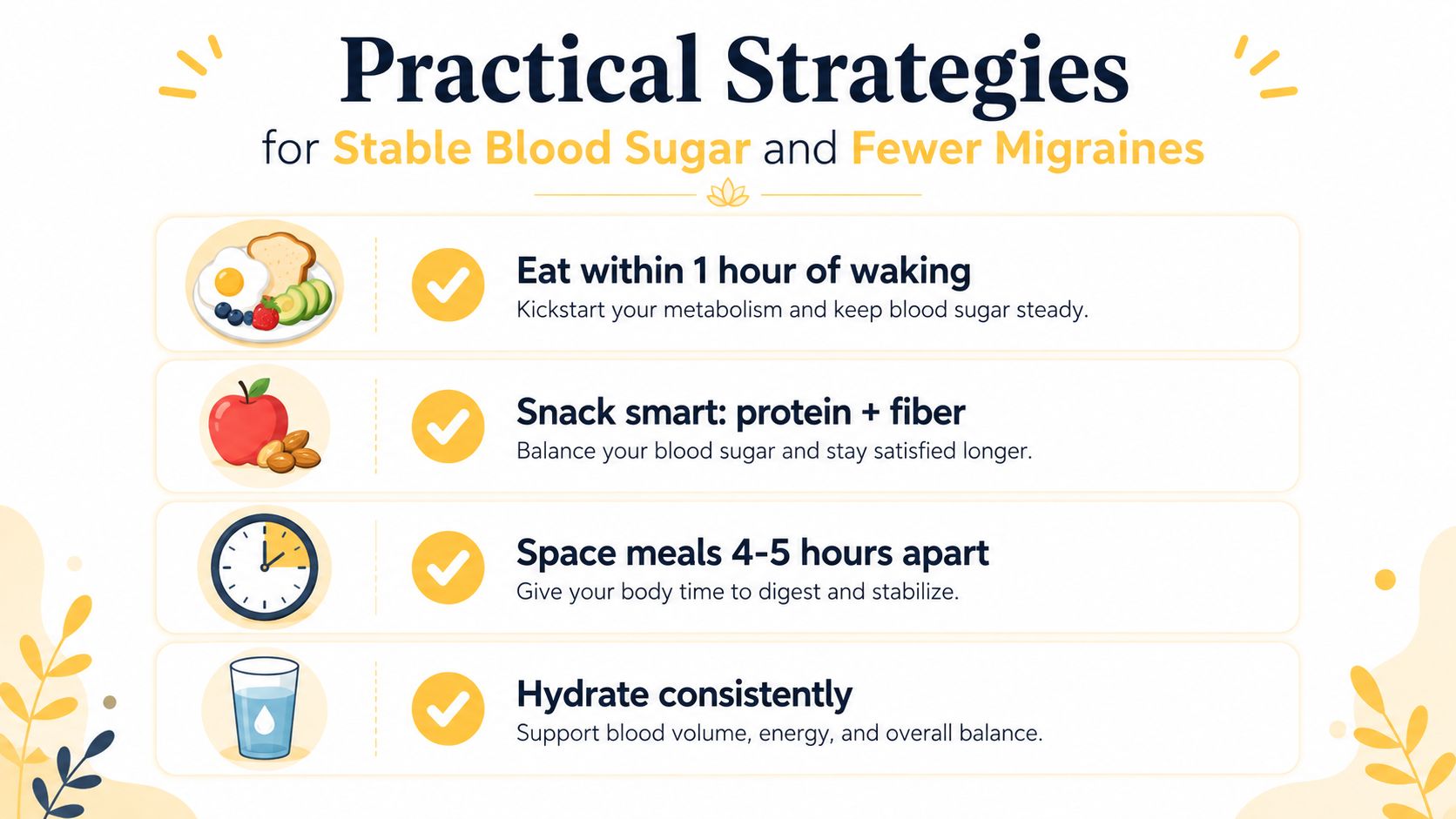
The simplest place to start is meal rhythm. If you're someone who wakes up and doesn't eat for hours, your body may be spending part of the day trying to catch up. A steadier rhythm often feels better than trying to “fix” the problem with one perfect food.
The National Headache Foundation conversation in the research notes points to balanced meals, protein with carbs, and consistent timing as practical migraine-friendly habits, especially when blood sugar swings seem to matter. That lines up with what many people find in real life, fewer long gaps and fewer energy crashes usually mean fewer surprises.
Build meals that slow the swing
A balanced plate usually works better than a solo carb. Fruit by itself may be fine for one person and a problem for another, which is why pairing matters. If you eat fruit with protein or healthy fat, you slow digestion and blunt the spike-and-crash pattern that can leave you shaky later.
A few practical moves:
- Start with something small if breakfast feels hard. Toast with nut butter, yogurt, or a protein shake is often easier than a large meal.
- Pair carbs with protein or fat. That could mean beans with rice, yogurt with berries, or crackers with cheese.
- Keep emergency snacks available. Think shelf-stable, portable options you can eat in a car, at work, or between meetings.
Hydration matters too, because dehydration can stack on top of missed meals and make you feel worse. Sipping water consistently is a small move, but it helps the whole pattern feel less jagged.
Make real-life planning easier
Travel, long meetings, childcare, and late workouts can all push meals out of rhythm. Instead of aiming for a perfect schedule, choose a backup plan. Keep a snack in your bag, decide what you'll eat before a long drive, and don't wait until you're already shaky to think about food.
If you use migraine medication that changes appetite or makes eating less appealing, coordinate meals with your routine so you don't accidentally stretch too long between them. Some people on GLP-1 medications also need to pay closer attention to regular fueling because appetite can drop sharply, which can matter if migraine is already sensitive to fasting.
Learn how Relief organizes migraine tracking and risk patterns if you want one place to log attacks, symptoms, and the meal timing around them.
Monitoring Options From Fingersticks to Continuous Glucose Monitors
Not everyone with migraine needs to monitor glucose. If your pattern is obvious, like skipping meals and then getting an attack, tracking food timing may be enough. If the pattern is murky, a short monitoring period can help you see whether your blood sugar swings the way you suspect.
Fingersticks and CGMs do different jobs
A fingerstick meter gives you a snapshot. It's relatively inexpensive, quick, and useful if you want to check a number when you feel a symptom coming on. The limitation is obvious, you only see one moment, not the trend before and after.
A continuous glucose monitor, or CGM, gives you a moving picture. It can show whether your glucose rises sharply after certain meals, drops later, or varies more on stressful days. The tradeoff is cost, wearability, and the fact that it can be more data than you need if your attacks are infrequent.
| Option | What it helps with | Main limitation |
|---|---|---|
| Fingerstick meter | Spot checks during suspected trigger windows | Misses the full pattern |
| CGM | Trend detection across meals and days | More expensive and more data-heavy |
Practical rule: use the simplest tool that answers your question. If a meal log already shows the pattern, you may not need a sensor at all.
What to look for in the numbers
You don't need to obsess over every reading. A meaningful pattern is usually a personal pattern, not a universal threshold. For one person, the important clue may be a fast rise after breakfast followed by a later drop. For another, it may be a flat number on paper but a lot of variability across the day.
If you try monitoring, use it for a short window and look for links between meals, stress, sleep, and attack timing. The point is not to become your own lab technician. It's to answer one question, whether glucose behavior seems to move with migraine behavior.
Using Your Data to Predict and Prevent Attacks
Data only helps if it changes what you do next. A meal log, a glucose reading, and a migraine note can feel disconnected on their own. Put them together, and you start to see whether there's a pattern you can plan around.
Build a personal threshold
Your threshold might be time-based, not number-based. Maybe you learn that a migraine often starts after a long gap between meals, or after a breakfast that's mostly refined carbs. Maybe you notice that the attack doesn't happen immediately, but a few hours later, which is why the connection felt invisible before.
That's where tracking apps can help. Relief, for example, combines attack logging with pattern detection so you can review how symptoms, triggers, and timing line up over time. It's not a substitute for medical care, but it can make hidden patterns easier to spot.
Use the pattern before the pain starts
Once you know your usual warning sign, act earlier. Eat sooner. Pack a backup snack. Don't wait until the headache phase is already in motion, because by then the window for prevention may be smaller.
The most useful habit is consistency, not perfection. You're not trying to control every glucose fluctuation. You're trying to learn which swings seem to matter for your migraine pattern, and which ones don't.
When to Talk to Your Doctor About Blood Sugar and Migraine
Get medical help right away for a sudden severe headache, headache with fever or a stiff neck, neurological changes like weakness, trouble speaking, or confusion, or headache after a head injury. Those are not the moments to self-track and wait.
Talk with a healthcare provider if you're having repeated symptoms that could point to blood sugar problems, like frequent shakiness, excessive thirst, frequent urination, or attacks that keep happening despite better meal timing. Bring your notes with meal times, attack times, and any glucose readings if you have them. That makes the conversation much more concrete.
A clinician may consider fasting glucose, HbA1c, or other testing if your history suggests it. Don't start glucose-lowering supplements or change diabetes medication on your own. If a provider dismisses the link, keep the focus on your pattern, the timing, and the impact on daily life.
If you want a simpler way to see whether migraine blood sugar patterns are showing up in your day, Relief can help you log attacks, meals, and symptoms in one place so the connections are easier to spot. Visit Relief and start tracking the patterns that matter most to you.


