Migraine is a complex neurological disease that can include phases before, during, and after the head pain, along with symptoms like nausea, light sensitivity, and sound sensitivity. A tension headache is usually muscular, pressure-like pain that feels steady rather than pulsating, and it usually happens without those associated symptoms.
If you're reading this with a hand over your eyes, wondering whether this is “just a bad headache” or something more, that confusion makes sense. The overlap is real. Migraine gets mislabeled all the time, especially when the pain shows up on both sides of the head, and tension headaches are so common that people often assume every non-dramatic attack must be one. The difference matters because the relief strategies that help a tight, strained, pressure-type headache often don't do enough for a migraine attack that involves the nervous system.
This article is for informational purposes and is not medical advice. Consult a healthcare provider for personalized guidance.
Table of Contents
- Migraine has phases, not just pain
- Tension headache is usually more physically localized
- Where overlap causes trouble
Is This a Migraine or a Tension Headache
It often starts at the worst possible time. You are trying to finish a shift, sit through a meeting, or get your kids out the door, and the pain begins. Then comes the second problem. Do you stretch your neck and keep going, or cancel your plans and find a dark room?
That confusion is common because migraine and tension headache can overlap more than people expect. Migraine is a neurological attack. Tension headache is usually a steady pressure pain, often tied to muscle tension, posture, stress, or jaw clenching. They can feel similar at first, especially if your migraine is on both sides of the head instead of one.
That last point matters. Bilateral pain does not rule out migraine. I see people dismiss attacks as "just tension" because the pain is not one-sided or dramatically throbbing. The result is years of using the wrong label and the wrong relief strategy.
A practical starting point is to look beyond the pain itself. Migraine is more likely when the headache comes with nausea, light sensitivity, sound sensitivity, brain fog, or a strong need to stop normal activity. It is also more likely when routine movement makes the pain worse, or when triggers include barometric pressure shifts, hormonal changes, poor sleep, or sensory overload. Tension headache can be miserable, but it usually stays more localized and does not bring the same whole-body shutdown.
Practical rule: If the pain is paired with sensory sensitivity, stomach symptoms, or a clear drop in your ability to function, treat migraine as a serious possibility, even if the pain is on both sides.
This distinction affects what helps. A tension headache may ease with food, hydration, posture changes, stress reduction, or gentle muscle work. A migraine attack often needs reduced stimulation, early treatment, and a different prevention plan altogether. Mislabeling the attack can leave you stuck in a cycle where the headache keeps returning and nothing seems to fit.
Key Differences at a Glance
Distinguishing between migraine and tension headache often requires a quick assessment. Do you need darkness and stillness, or do you need to stretch your neck, hydrate, and step away from the screen? The chart below gives you the most useful distinctions first.
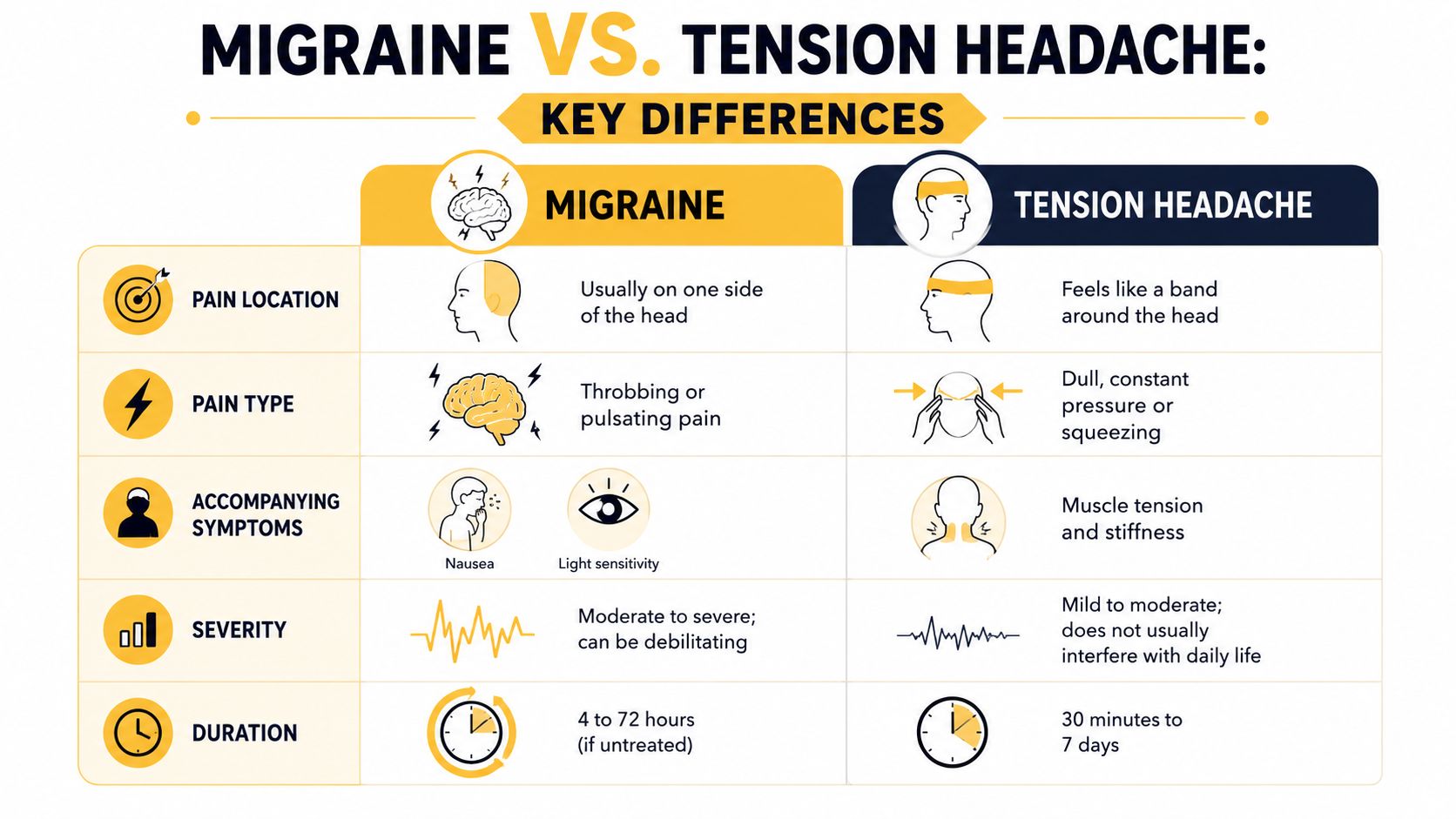
| Feature | Migraine | Tension headache |
|---|---|---|
| Pain type | Often pulsating or throbbing | Usually steady, pressing, or tightening |
| Pain intensity | Often moderate to severe | Usually mild to moderate |
| Location | Can be one-sided or both sides | Often both sides, like a band or pressure |
| Movement effect | Often worsens with routine physical activity | Usually not aggravated by movement |
| Associated symptoms | Nausea, photophobia (light sensitivity), phonophobia (sound sensitivity) may occur | Usually lacks those symptoms |
| Typical duration | 4 to 72 hours if untreated | 30 minutes to 7 days |
That time window matters. A migraine attack typically lasts 4 to 72 hours if untreated, while episodic tension-type headaches can last 30 minutes up to 7 days (Kaiser Permanente overview of headache and migraine duration differences).
Why this comparison matters in real life
The label isn't just academic. It changes what you do next.
If your pain is pressure-like, both sides, and tied to neck or shoulder tightness, your first moves might center on posture, rest, hydration, and muscle relief. If you're dealing with nausea, light sensitivity, or pain that flares when you climb stairs or even walk around, a migraine plan is usually more appropriate.
A useful checkpoint is function. Tension headache is often annoying but workable. Migraine often makes normal life feel physically expensive.
If your symptoms don't fit cleanly into either column, that's not unusual. Headache disorders overlap. The point isn't to diagnose yourself with certainty. It's to notice patterns that make a medical visit more productive and your self-care less random.
For more context on symptom patterns, ReliefMigraine readers often also benefit from articles on migraine warning signs and early symptoms and how to build a useful migraine diary.
Beyond the Pain What Each Attack Feels Like
A checklist helps, but it doesn't capture the lived experience. Migraine often feels like an event. Tension headache usually feels like strain that has spread and settled in.
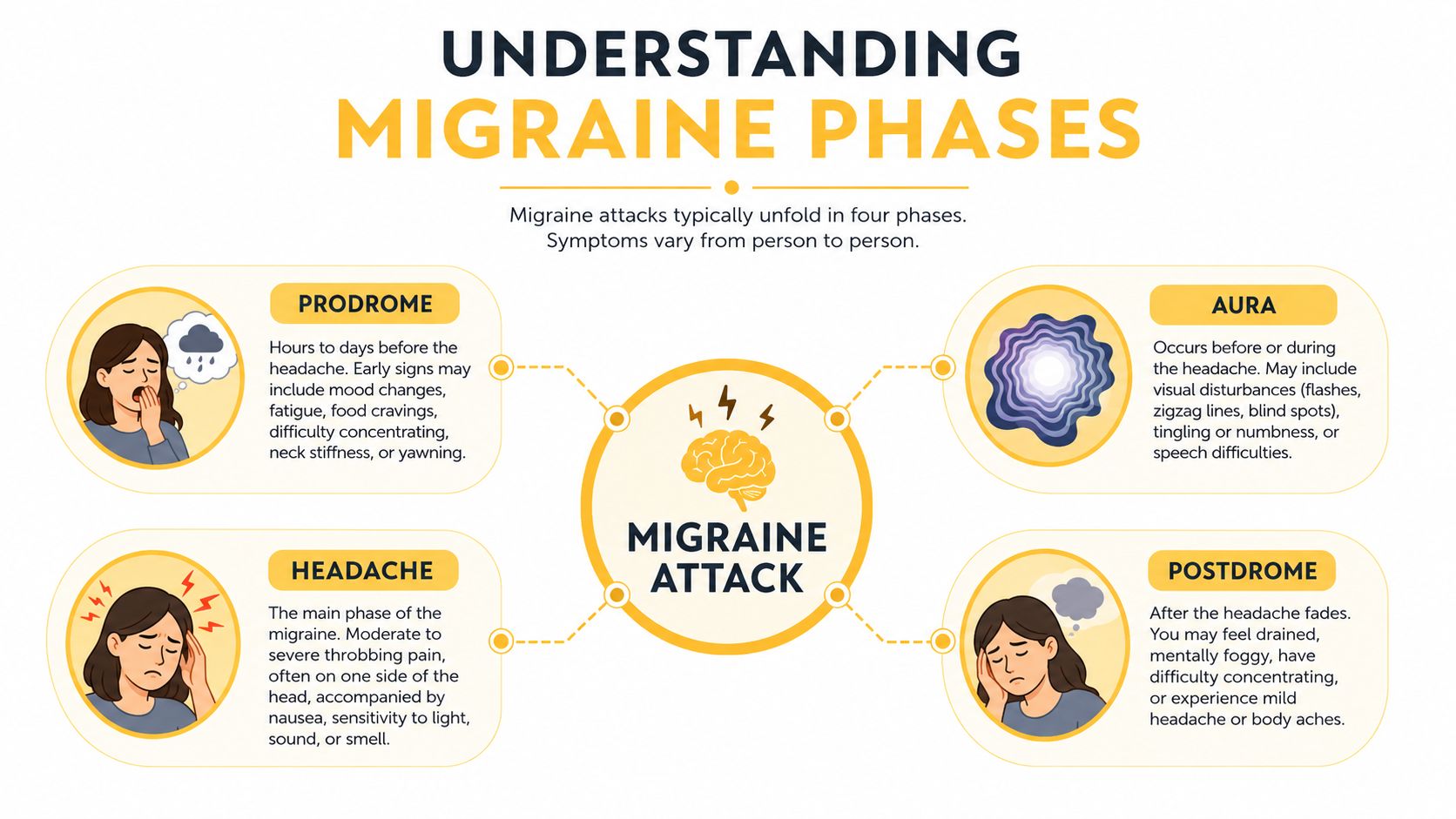
Migraine has phases, not just pain
For many people, migraine starts before the head pain.
- Prodrome means early warning symptoms that can happen before the main attack. You might feel unusually tired, foggy, irritable, or “off.”
- Aura refers to temporary neurological symptoms that happen in some migraine attacks, often visual changes such as flashes, zigzags, or blind spots.
- Headache phase is the main pain period, often with nausea, photophobia, or phonophobia.
- Postdrome is the after-effect. The pain may ease, but you can still feel drained, mentally slow, or unusually sensitive.
People often miss these phases because they only count the hours when the head hurts. That can make migraine seem unpredictable when, in reality, your body may be sending signals earlier than you realize.
Tension headache is usually more physically localized
Tension headache tends to be easier to describe. It's often a band-like, vise-like, or helmet-like pressure. The pain is commonly felt across the forehead, temples, back of the head, neck, or shoulders. It may come after a long workday, poor posture, jaw clenching, or stress that has your muscles staying “on” for hours.
The feeling is usually steadier than migraine. Less wave-like. Less sensory. People often say they can still function, but everything feels harder and more irritating.
A short self-check can help:
- Muscle clue: Does your scalp, neck, or upper shoulders feel tight or tender?
- Sensory clue: Do light and sound feel harder to tolerate than usual?
- Activity clue: Does walking around make the pain noticeably worse?
- System clue: Are you also nauseated, mentally foggy, or wiped out afterward?
Where overlap causes trouble
One of the biggest reasons migraine gets misread as tension headache is pain location. Many people still think migraine must be one-sided. That's not reliable. About 40% of migraine patients report bilateral pain, which can make migraine look deceptively similar to tension headache and contribute to delayed treatment (discussion of bilateral migraine pain and overlap with tension headache).
A common point of confusion arises. If your pain is on both sides, but you also feel nauseated, light-sensitive, wiped out, or worse with movement, the “both sides means tension” rule can lead you in the wrong direction.
Bilateral pain does not rule out migraine.
Another source of confusion is that tension-type headaches and migraine can coexist in the same person. You might have a pressure headache from shoulder tension one day and a migraine attack the next. You might also have overlapping triggers, especially stress and poor sleep, which makes the distinction feel messier than online checklists suggest.
If your symptoms keep getting dismissed because the pain doesn't fit a stereotype, bring the full picture to your clinician. Not just where it hurts, but how it behaves, what comes with it, and what happens after.
Uncovering Your Personal Triggers
Trigger advice is often too broad to be useful. “Avoid stress” isn't a plan. “Watch the weather” isn't much better if nobody explains what to watch for.
Triggers can overlap, but not in the same way
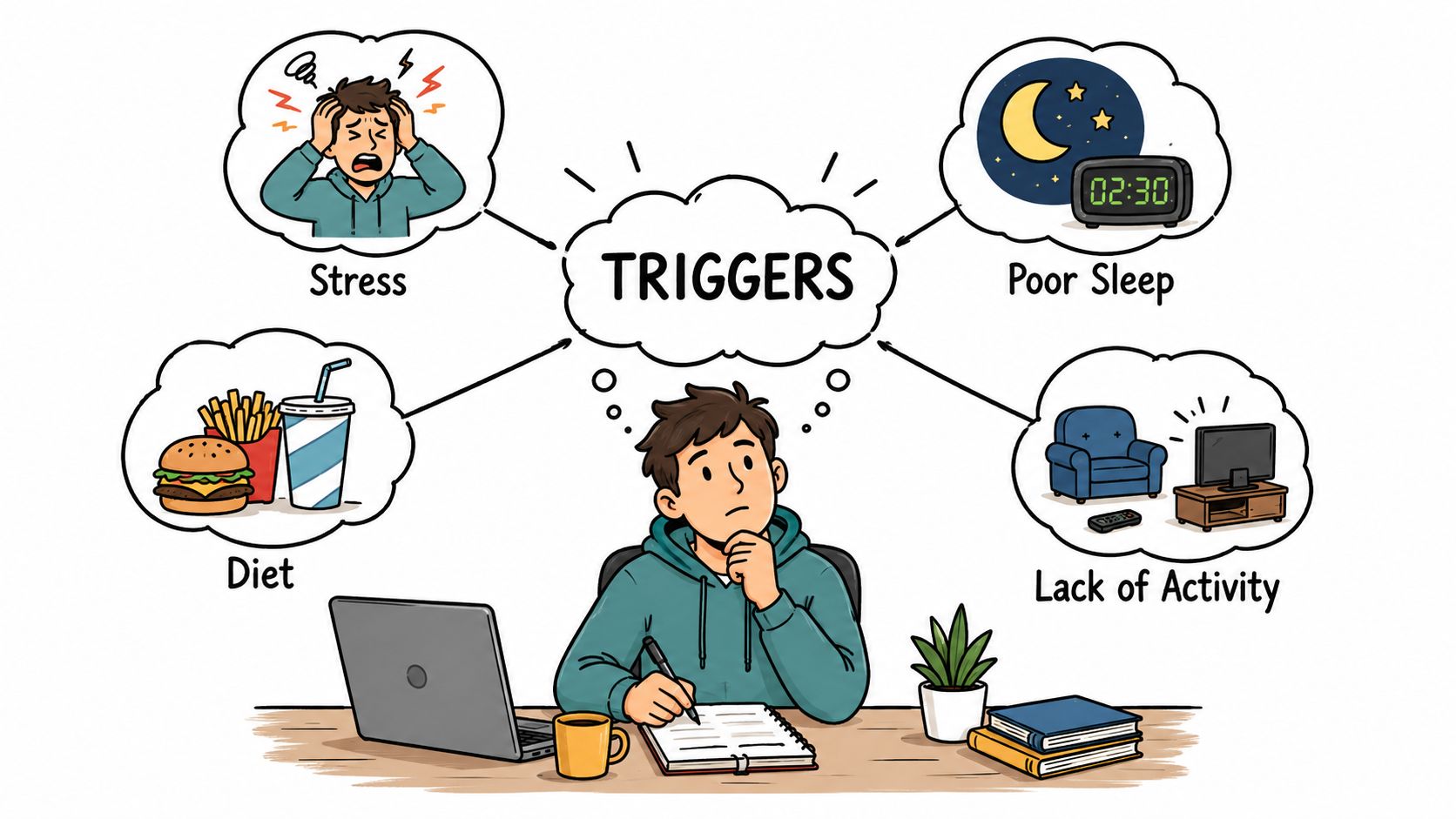
Both migraine and tension headache may flare around stress, poor sleep, dehydration, and long days of screen time. But they don't always react to those inputs through the same body systems.
A key difference is the environment. General “weather” gets blamed for both, but migraine is more specifically linked to barometric pressure shifts and is also aggravated by physical activity, while tension-type headache is more strongly tied to posture, neck strain, and peripheral muscle tension (clinical discussion of barometric pressure, activity, and muscular factors in migraine versus tension headache).
That distinction matters. If a walk makes your pain spike, or if certain weather changes seem to line up with attacks, that pattern may point more toward migraine physiology than simple muscular tension.
How to track triggers without guessing
A common mistake is tracking too much too vaguely. “Stress” written ten days in a row won't help you much later.
Track a few concrete variables instead:
- Timing: What time did symptoms begin, and what were you doing in the hours before?
- Environment: Did weather shift noticeably, especially pressure, heat, wind, or air quality?
- Body state: How was your sleep, hydration, meals, and menstrual or hormonal context if relevant?
- Physical load: Were you at a desk all day, clenching your jaw, lifting, traveling, or exercising?
- Attack features: Was the pain pressure-like or pulsating? Did movement worsen it? Any nausea, photophobia, or phonophobia?
A short video overview can help if you're trying to build a trigger-tracking habit that feels realistic.
What tends to work: Track the same handful of variables every time.
What usually doesn't: Trying to remember patterns from memory after a rough month.
It also helps to think in terms of trigger stacks instead of single causes. Maybe weather alone isn't enough. But weather plus poor sleep plus a skipped meal is. That kind of threshold pattern is common, and you usually won't spot it until you log several attacks the same way.
If you're exploring related patterns, ReliefMigraine readers may also want guides on weather-triggered migraine patterns and sleep disruptions that can set up an attack.
How Doctors Diagnose and When to Seek Care
You describe a headache on both sides of your head, pressure across the forehead, maybe some neck tightness. It gets labeled a tension headache. Then you mention that light feels harsh, weather swings seem to set it off, and walking upstairs makes the pain flare. That is where misdiagnosis happens.
Clinicians do not sort migraine from tension-type headache by location alone. Bilateral pain can happen in migraine, and that overlap is one reason people get brushed off for years. The diagnosis comes from the full pattern across attacks, especially what happens before, during, and after the pain.
This article is for informational purposes and is not medical advice. Consult a healthcare provider for personalized guidance.
What clinicians look for
The history usually matters more than any single exam finding. A clinician will ask how the pain starts, how long it lasts, whether it throbs or presses, whether routine activity makes it worse, and what else shows up with it. Nausea, light sensitivity, sound sensitivity, aura, post-attack fog, and the need to stop what you are doing all push the picture more toward migraine.
Tension-type headache more often looks like steady pressure or tightness, often milder, and usually without the sensory overload that makes migraine so disruptive. But there is a real trade-off here. Textbook descriptions help, yet real people do not always read like the textbook. Someone can have migraine with bilateral pain, or have both migraine and tension-type headaches at different times.
That is why good diagnosis depends on details many people leave out. I would want to hear whether barometric pressure shifts, missed sleep, hormonal changes, or visual overstimulation reliably line up with attacks. Weather sensitivity in particular does not prove migraine on its own, but it can be a useful clue when the rest of the story also fits.
Clinicians also look at the attack arc. Did you feel off before the pain started. Did movement worsen it. Were you wiped out afterward. A headache diary often helps separate a pressure headache from a migraine that does not fit the one-sided stereotype.
Red flags that need immediate care
Some headaches need urgent evaluation.
Seek immediate medical care for a sudden severe headache, headache with fever or stiff neck, headache with neurological changes such as weakness, confusion, trouble speaking, or vision loss, or headache after a head injury.
Make a medical appointment soon if any of these apply:
- Your pattern changed: headaches are getting more frequent, more intense, or different from your usual attacks.
- Daily life keeps taking the hit: work, school, caregiving, sleep, or basic tasks are regularly disrupted.
- You are using pain relievers often: frequent OTC use can muddy the picture and create medication-overuse headache.
- You still are not sure what you have: the symptoms overlap, or you suspect more than one headache type.
Many people put this off because they have had headaches for years and have learned to push through. That is understandable. It is still worth getting assessed if the label has never quite matched the lived experience, especially when bilateral pain led someone to assume it could not be migraine.
Comparing Treatment and Prevention Strategies
Relief usually comes from matching the strategy to the headache type. That's why the migraine vs tension headache distinction matters so much. The same dark room that helps one person through a migraine may do very little for someone whose pain is being driven by neck and scalp tension. The same stretching routine that loosens a pressure headache may not touch nausea and sensory sensitivity.
This article is for informational purposes and is not medical advice. Consult a healthcare provider for personalized guidance.
For migraine
Lifestyle and home care
Migraine care often starts by reducing stimulation and lowering the attack load. Many people do best with a dark, quiet room, minimal screen exposure, hydration, regular meals, and as much sleep consistency as their lives allow. If prodrome or aura gives you warning, acting early matters.
A few practical moves can help you discuss patterns with a clinician:
- Protect routine: Keep sleep and meals as regular as you can.
- Reduce sensory load: Lower light, noise, and visual strain during an attack.
- Track early clues: Notice pre-pain changes such as fatigue, mood shifts, or sensory sensitivity.
Over-the-counter options
Some people use nonprescription pain relievers for milder attacks or early treatment. The trade-off is that frequent use can create new problems, including medication-overuse headache. If you're reaching for OTC options often, that's a sign to bring the pattern to a healthcare provider rather than just pushing harder with self-treatment.
Prescription approaches
Migraine treatment can include acute medicines taken during attacks and preventive treatments used to reduce attack frequency or severity over time. Which option fits depends on how often attacks happen, how disabling they are, whether aura is involved, and what other health factors are in the picture. There's no universal “best” prescription choice.
For tension headache
Lifestyle and home care
Tension headache care usually works best when it targets the physical setup around the pain. That may include posture changes, breaks from a desk, jaw relaxation, neck and shoulder stretching, heat, hydration, and stress regulation. If your pain tends to build through the day, prevention may depend less on what you do at pain level eight and more on what you change at pain level two.
Over-the-counter options
OTC pain relievers may help episodic tension headaches. Again, frequency matters. If a quick fix becomes a habit, the headache pattern can become harder to untangle.
Prescription approaches
For frequent or chronic tension-type headache, a clinician may consider broader treatment strategies, especially if muscle tension, sleep problems, stress, or overlapping migraine features are involved. Treatment usually works better when the whole pattern is addressed rather than just the pain moment.
One common mistake with both
People often chase the last attack instead of the pattern. They change three things at once, stop tracking when they feel better, then have no idea what helped.
The goal isn't to find one perfect trick. It's to learn which combination of routines, trigger management, and treatment support reduces your attacks over time.
Taking Control Through Proactive Tracking
If your symptoms blur the line between migraine and tension headache, tracking is what turns confusion into something usable. Not perfect certainty. Usable patterns.
A good log helps you answer the questions that matter most later: Was the pain pressure-like or pulsating? Did movement make it worse? Was there nausea, photophobia, or phonophobia? Did weather shift? Did neck strain, poor sleep, or skipped meals show up first?
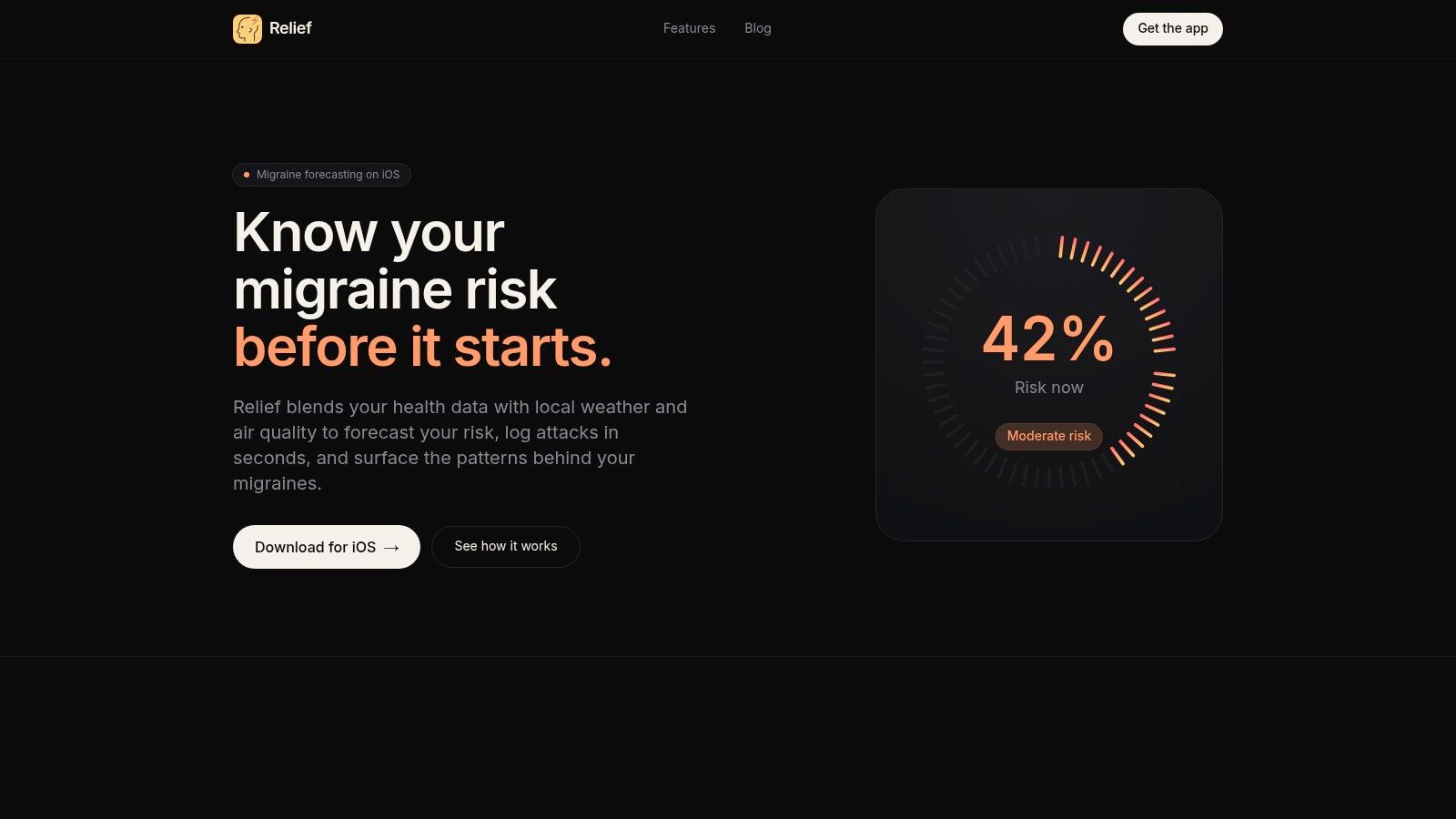
The advantage of tracking isn't just hindsight. It's seeing your own thresholds. Maybe pressure changes only matter after a short night. Maybe work posture predicts pressure headaches, while barometric shifts line up more with nausea and light sensitivity. Those distinctions can change how you plan your day and how you talk with your clinician.
If you want a practical way to log symptoms, treatments, and environmental patterns in one place, Relief can support that tracking process without replacing medical care.
Relief helps you connect the dots between your attacks and the patterns around them, so you can spot trends earlier, log symptoms quickly, and build a clearer picture of what your migraine responds to.


