MSG isn't widely considered a likely cause of headache, and the International Headache Society removed it from that list in 2018. But some people with migraine still report that MSG seems to trigger attacks, so the key question isn't “Is MSG always bad?” It's “Are you one of the people who's sensitive to it?”
If you're reading this after a meal and replaying everything you ate, you're not overthinking. Migraine can make you doubt your own body, especially when one source says MSG is a myth and another says it's a classic trigger. The science is more nuanced than either extreme.
A headache is a symptom. Migraine is a neurological disease that can involve head pain, but also nausea, photophobia (light sensitivity), phonophobia (sound sensitivity), aura (temporary neurological symptoms such as visual changes), prodrome (early warning symptoms before an attack), and postdrome (the drained, hungover feeling after). That difference matters, because a food that seems linked to “head pain” in general may not affect migraine the same way.
This article is for informational purposes and is not medical advice. Consult a healthcare provider for personalized guidance.
Table of Contents
- Why the public story and the medical story diverged
- Why this still feels personal even when the evidence is mixed
- Step 1 Build a baseline before changing anything
- Step 2 Try a short elimination phase
- Step 3 Reintroduce under controlled conditions
- Step 4 Look for a pattern not a coincidence
The MSG Controversy Unpacked
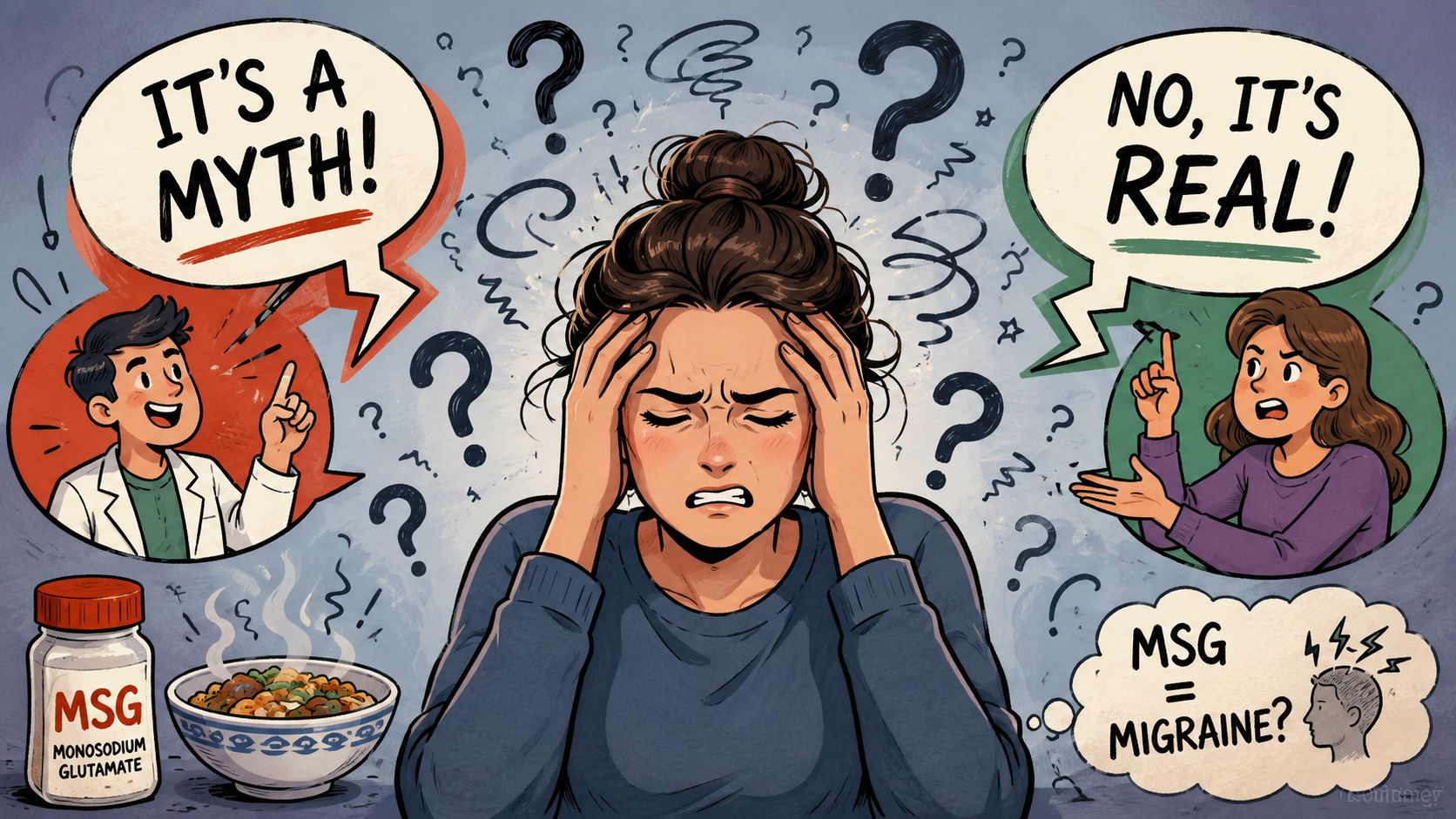
If someone has told you “MSG migraines aren't real,” that can feel dismissive. If someone else has told you “MSG always causes migraines,” that's not accurate either. Both views flatten a complicated problem.
Why the public story and the medical story diverged
The long-running MSG fear was shaped by the old “Chinese Restaurant Syndrome” narrative. That label stuck in popular culture far longer than the evidence justified, and it pushed people toward a simple explanation for symptoms that can have many causes.
The scientific view shifted as researchers looked more closely at how earlier studies were designed. In 2018, the International Headache Society officially removed monosodium glutamate from its list of likely causes of headache, and a 2016 review in The Journal of Headache and Pain concluded that no proven causal relationship exists between MSG and headache in the general population, as summarized in this review of the MSG controversy and migraine history.
That doesn't mean every person who suspects MSG is mistaken. It means the broad claim, “MSG is a standard migraine trigger for many individuals,” isn't supported.
Practical rule: Treat internet certainty with caution. “Always” and “never” are usually signs that a migraine trigger discussion has become too simplistic.
Why this still feels personal even when the evidence is mixed
Migraine is variable. One person has aura and visual zigzags. Another has vestibular migraine with dizziness. Another has chronic migraine and can't identify a single clean trigger because sleep, stress, hormones, weather, skipped meals, and foods all overlap.
That's where confusion creeps in. If you eat takeout after a long day, sleep badly, get dehydrated, and wake up with migraine, MSG may get blamed even if it wasn't the main driver. On the other hand, if you repeatedly notice a similar pattern with similar foods, that's worth respecting and testing carefully.
A useful middle ground is this: population-level evidence doesn't show MSG is a proven migraine cause for the general population, but individual sensitivity may still exist. That gap between group data and personal experience is frustrating, but it's also where careful tracking helps.
Here's the mindset that usually works best:
- Hold your experience lightly but seriously. Don't ignore your suspicion, but don't treat one bad meal as proof.
- Look for repeated patterns. Migraine triggers are more convincing when they recur under similar conditions.
- Separate trigger from timing issue. Sometimes the craving for salty or savory food happens during prodrome, so the meal can look like the cause when it may have come after the attack had already started.
- Stay specific. “Chinese food triggered me” is too broad to be useful. The restaurant meal may also involve alcohol, high sodium, poor sleep timing, bright lights, or other additives.
How Glutamate Could Affect a Migraine Brain
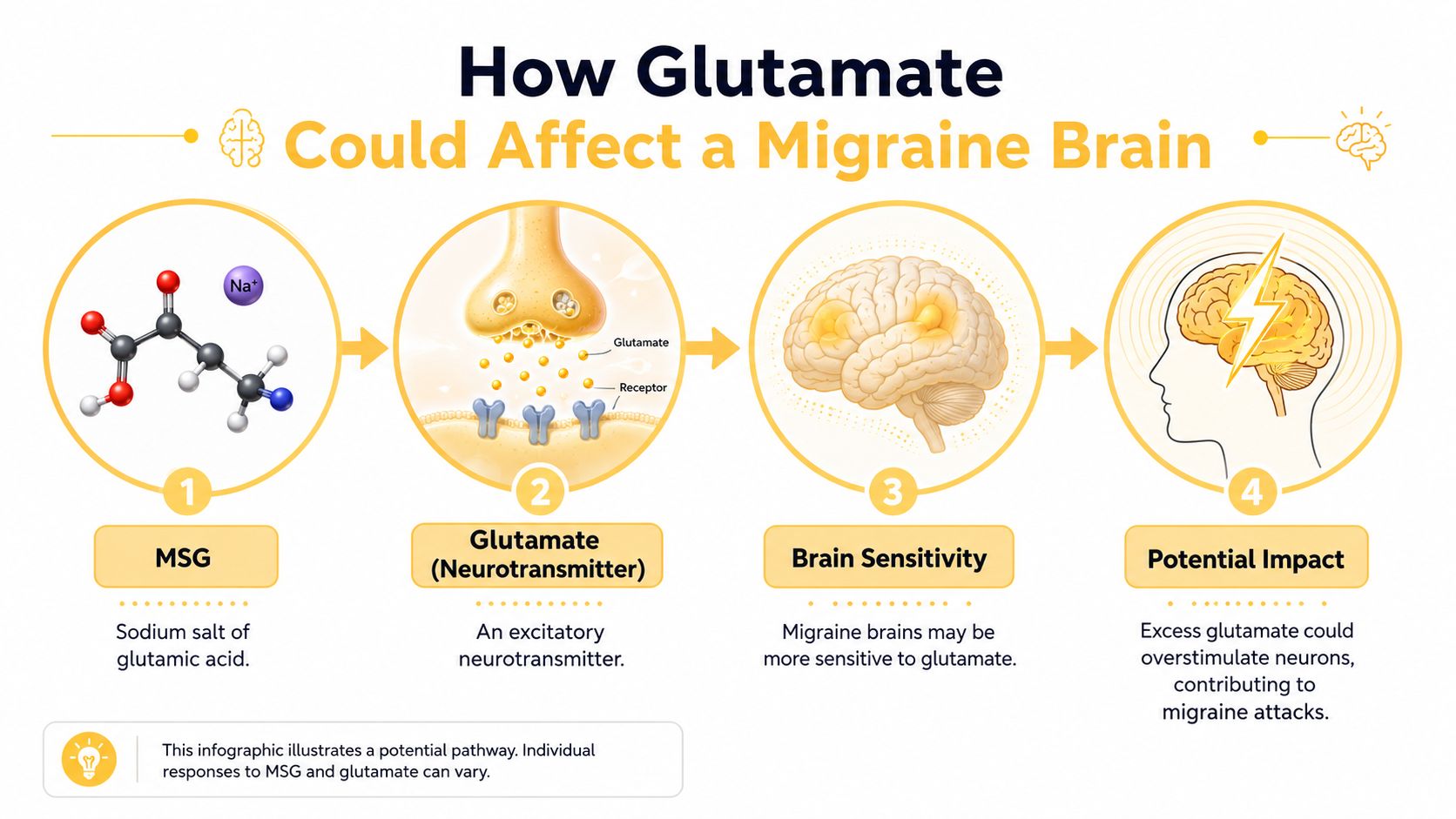
The biology is one reason this topic won't go away. There's a plausible mechanism, even though the clinical evidence is inconsistent.
What MSG actually is
MSG is the sodium salt of glutamic acid. Glutamate acts as an excitatory neurotransmitter, which means it helps nerve cells fire signals more rapidly.
A simple way to think about it is an accelerator pedal. Your brain needs some acceleration to function normally. But if certain pathways are already sensitive, more excitation may push the system closer to a migraine attack.
That idea is one reason MSG migraine headaches remain a live question for patients. According to the National Headache Institute's explanation of MSG and headaches, glutamate encourages neuronal synapses to fire more rapidly, which offers a physiological hypothesis for why a subset of people with migraine, estimated at 10 to 15% in some self-reported studies, may experience problems.
A plausible mechanism is not the same thing as proof. Biology can explain why something might happen without proving that it consistently does happen in everyday meals.
For someone with migraine, overstimulation matters because migraine isn't just pain. It can involve a whole cascade of neurological changes, including aura, nausea, sensory sensitivity, and fatigue before or after the head pain itself.
Why dose and context matter
One of the biggest points of confusion is that “MSG exposure” isn't one single thing. Context changes the picture.
Clinical trials reviewed in this PubMed summary of the updated MSG-headache literature found a dose-dependent split. When MSG was given with food at physiologic doses, typically less than 1 gram, five studies did not show a statistically significant increase in headache incidence. By contrast, unblinded beverage studies using more than 2 to 3 grams reported significant headache spikes in 10 to 15% of migraineurs.
That helps explain why one person can eat a normal savory meal without issue while another reacts to a high-dose test setup, or believes they react to heavily processed foods where multiple factors are present. It also helps explain why debates become so heated. People are often talking about different forms, different amounts, and different study designs.
A few more details can make this easier to understand:
- With food matters. Studies using MSG in meals tend to look different from studies using MSG in beverages.
- Blinding matters. If people can taste or notice what they were given, expectation can change symptom reporting.
- Migraine threshold matters. You may tolerate a food one day and react on another day when stress, poor sleep, hormonal shifts, or weather have already lowered your threshold.
That's why broad food lists often fail people with migraine. The useful question isn't whether MSG is universally dangerous. It's whether it consistently affects your migraine threshold.
Your Personal MSG Experiment A 4-Step Plan
Start with a method, not a ban. A structured self-experiment is far more useful than cutting out random foods and hoping for answers.
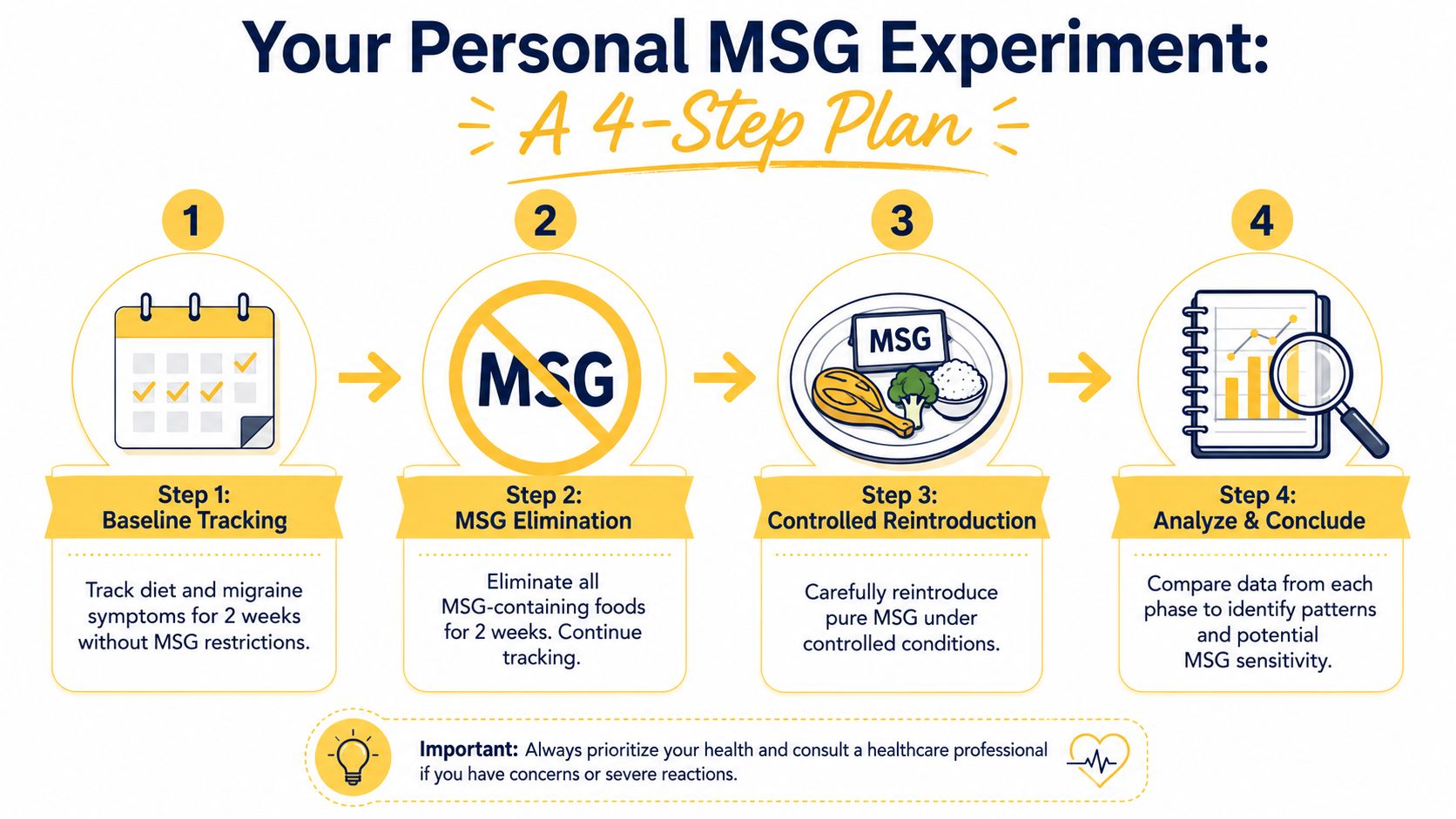
The logic for doing this is strong. The gap between clinical guidelines and patient self-management highlights the need for a rigorous, placebo-controlled self-experiment to test for true MSG sensitivity, as discussed in this PubMed record on dietary factors and headache.
A short visual can help you picture the process before you begin.
Step 1 Build a baseline before changing anything
Track your usual routine first. If you stop eating MSG today, you won't know whether any improvement came from the change itself, from better sleep this week, or from random variation.
Use a daily log for 2 to 4 weeks. Record:
- What you ate and drank
- When symptoms started
- Migraine features such as nausea, aura, photophobia, or throbbing pain
- Other likely contributors like stress, missed meals, alcohol, poor sleep, weather shifts, or menstruation if relevant
- What treatment you used and whether it helped
Be boringly detailed. “Had soup” won't help later. “Instant noodle soup at 1 p.m., migraine symptoms at 5 p.m., slept 5 hours, skipped breakfast” is much more useful.
Step 2 Try a short elimination phase
After your baseline, do a temporary elimination of obvious MSG sources and highly processed foods that commonly contain flavor enhancers. Keep the rest of your routine as stable as possible.
Many people accidentally sabotage the experiment. They also start drinking more water, going to bed earlier, eating fewer takeout meals, and reducing alcohol all at once. Those may be healthy changes, but they make it harder to isolate MSG.
A cleaner elimination phase looks like this:
- Keep meals simple. Choose foods with short ingredient lists.
- Don't chase perfection. You're looking for a practical reduction, not a chemically pure life.
- Keep logging symptoms daily. An elimination without tracking is mostly guesswork.
Watch for false reassurance: If migraines improve during elimination, that still doesn't prove MSG was the cause. It may mean the whole pattern of eating changed.
Step 3 Reintroduce under controlled conditions
If the elimination phase seems helpful, test your suspicion carefully. This is the point where many people stop, assume they have the answer, and then live with unnecessary restriction.
Controlled reintroduction means keeping the meal simple and changing as little else as possible. Don't test on a day when you slept badly, are highly stressed, or already feel prodrome symptoms. Don't test at a restaurant where many variables are bundled together.
If you decide to try a reintroduction, keep these guardrails in mind:
- Pick a quiet test day. Avoid days with obvious competing triggers.
- Use a consistent meal context. Similar meal, similar timing, similar portions.
- Record the full response. Note not just pain, but aura, nausea, light sensitivity, brain fog, neck pain, and postdrome.
If you've ever had severe reactions to foods, or if dietary restriction tends to become obsessive or overwhelming for you, talk with a clinician or registered dietitian before trying elimination and reintroduction on your own.
Step 4 Look for a pattern not a coincidence
One dramatic experience can stick in your memory for years. Migraine doesn't care about memorable stories. It responds to patterns.
Ask yourself:
| Question | Why it matters |
|---|---|
| Did attacks decrease during elimination? | This tells you whether the change might be meaningful |
| Did symptoms return after reintroduction? | This strengthens the case for sensitivity |
| Did the same pattern happen more than once? | Repetition matters more than a one-off event |
| Were other triggers active on test days? | This helps you avoid blaming the wrong factor |
You're not trying to win an argument about MSG. You're trying to decide whether avoiding it helps your life.
If the answer is yes, that's useful. If the answer is no, that's also useful. Either way, you're moving from fear to evidence.
How to Spot and Avoid Hidden MSG
Suppose your tracking suggests that MSG really may be a problem for you. The next challenge is practical: how do you avoid it without turning every grocery trip into a stress test?
A grocery store example that makes label reading easier
You're in the soup aisle deciding between two products. One has a short ingredient list with recognizable foods. The other has a long list full of flavor-building additives. You don't need to panic. You just need to slow down and scan for patterns.
The same thing happens in the snack aisle. A plain salted cracker may be easier to evaluate than a “loaded umami” flavor blend with several additive terms. Frozen meals, seasoning packets, instant noodles, canned soups, savory chips, bouillon, and packaged sauces often deserve a closer look.
A helpful mindset is “whole-foods first.” Not because processed food is morally bad, but because simpler foods usually make trigger tracking easier. Grilled protein, rice, potatoes, beans, vegetables, fruit, oats, eggs, and plain yogurt create fewer label mysteries than heavily flavored convenience foods.
If a food has five possible suspects, you learn very little from reacting to it.
Common names for MSG on food labels
You don't need to memorize every additive term in one day. Start with the most common names and build from there.
| Ingredient Name | What It Is |
|---|---|
| Monosodium glutamate | The additive itself |
| Hydrolyzed vegetable protein | A processed protein ingredient that can contain free glutamates |
| Yeast extract | A flavor enhancer often used in savory packaged foods |
| Autolyzed yeast | A yeast-derived ingredient used for savory flavor |
| Calcium caseinate | A milk-derived ingredient that may appear in processed foods |
| Textured protein | A processed protein ingredient used in some savory products |
| Protein isolate | A concentrated protein ingredient sometimes used in packaged foods |
| Seasoning blend | A broad label term that may hide multiple flavoring ingredients |
| Flavoring or natural flavor | A nonspecific label term that may require closer review in context |
| Broth concentrate | A savory concentrated ingredient common in soups and sauces |
This isn't a universal “never eat these” list. It's a detective tool for your personal experiment.
A few realistic swaps can lower stress:
- For instant noodle cups: Try plain noodles or rice with your own broth and toppings.
- For flavored chips: Try plain crackers, popcorn, or roasted potatoes with seasonings you control.
- For bouillon-heavy cooking: Use homemade stock or a simple broth with herbs and salt.
- For takeout uncertainty: Pick simpler dishes and ask about added flavor enhancers if the restaurant can answer.
Don't let the label hunt become bigger than the migraine problem itself. If you find yourself fearful of eating, skipping meals, or cutting out large food groups without clear benefit, bring that up with a clinician.
For related trigger-tracking strategies, it also helps to review ReliefMigraine articles on identifying food patterns, distinguishing prodrome from triggers, and building a useful migraine diary.
When and How to Discuss Food Triggers with Your Doctor
At some point, self-tracking hits its limit. That's not failure. It's usually the moment when your notes become more useful if another person reviews them with you.
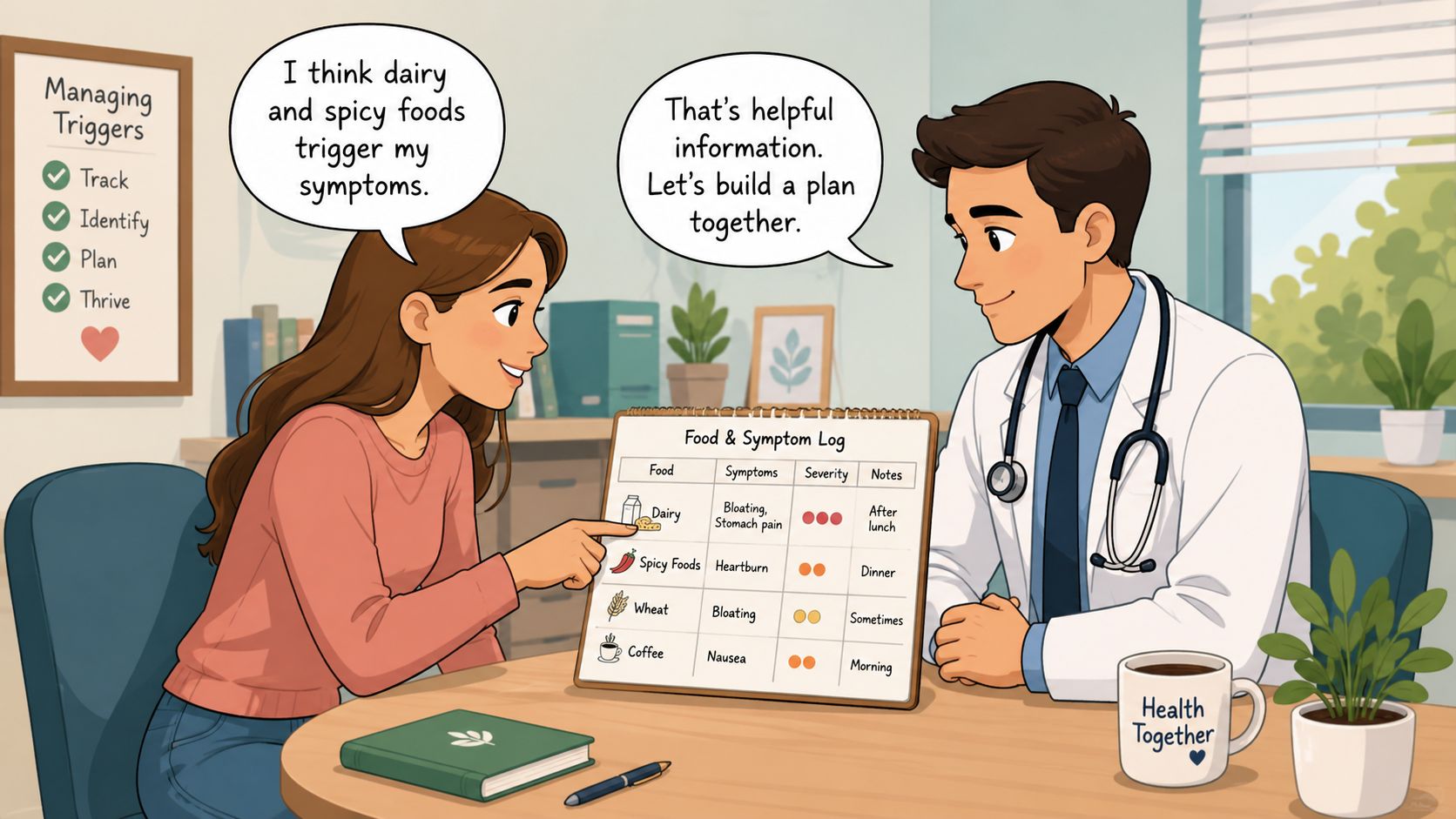
Bring data not just suspicion
A more productive appointment sounds like this: “I tracked meals, symptoms, sleep, and timing. I noticed a repeated pattern during elimination and reintroduction, but I'm not sure how confident to be.”
That gives your clinician something concrete to work with. It also makes it easier to separate migraine from other possibilities, including non-migraine headaches, medication overuse issues, gastrointestinal reactions, blood pressure changes, or symptoms that only seem food-related because of timing.
Bring these details if you can:
- Attack timing in relation to meals
- Migraine features such as aura, nausea, photophobia, phonophobia, vertigo, or postdrome
- Frequency changes during your tracking period
- Other trigger context like sleep disruption, stress, weather, exercise, and alcohol
- What restrictions you've already tried and whether they improved daily life
Your doctor can help you decide whether a food trigger strategy still makes sense, whether another diagnosis should be considered, or whether broader migraine treatment planning deserves more attention than one dietary suspect.
If you need a place to organize those records before your visit, Relief can help you track symptoms, timing, and possible triggers in one place.
A food log is most useful when it helps you and your clinician make better decisions, not when it becomes a list of foods you're afraid to eat.
Get urgent care for red flag symptoms
Some symptoms should never be handled as a food-trigger puzzle. Seek immediate medical care if you have:
- A sudden severe headache that peaks fast or feels unlike your usual migraine
- Headache with fever or stiff neck
- New neurological changes such as weakness, confusion, fainting, seizure, or trouble speaking
- Headache after a head injury
This article is for informational purposes and is not medical advice. Consult a healthcare provider for personalized guidance.
If your symptoms aren't urgent but your migraines are frequent, changing, disabling, or getting harder to manage, that's still a good reason to book an appointment. Food triggers are only one piece of migraine care. Sleep, stress regulation, exercise patterns, acute treatment timing, preventive strategies, and ruling out other causes all matter.
The goal isn't to prove you're right about MSG. The goal is to understand your migraine more accurately and reduce unnecessary suffering.
If you want a simpler way to track meals, symptoms, weather, and possible triggers over time, Relief can help you spot patterns that are hard to see in memory alone.


