You're exhausted, your head hurts, and someone has probably suggested a daith piercing like it's a simple fix. The direct answer is no, piercing for migraine relief isn't supported as an evidence-based treatment, and there's also a real possibility that a piercing could worsen symptoms or trigger pain for some people. If you're trying to sort hope from hype, the safest place to start is with what the medical literature shows.
Table of Contents
The Appeal of Piercing for Migraine Relief
A lot of people get to this idea after months or years of living with migraine, not a regular headache, but the kind of attack that can bring photophobia, meaning light sensitivity, nausea, throbbing pain, and the need to lie down in a dark room. When medicines, rest, hydration, and trigger management haven't brought enough relief, a piercing can sound appealing because it feels concrete and immediate.
Daith piercing is the best-known version. It passes through the innermost cartilage fold of the ear, and it's often discussed alongside acupuncture because both involve stimulating a small spot on the ear. That's part of why the idea spread so quickly, especially through anecdotal stories rather than clinical research.
The current medical consensus is much less exciting than the online chatter. A 2017 review in BMJ Case Reports said there was no scientific evidence to recommend daith piercing for migraine, and a 2024 review likewise concluded that the evidence does not support it for chronic migraine or tension-type headache (BMJ Case Reports review, 2024 PubMed review). That doesn't mean your pain isn't real, it means the proposed fix hasn't held up under scientific scrutiny.
Practical rule: If a migraine remedy relies mostly on stories, it deserves extra caution, not instant trust.
For readers who like to compare what's being discussed online with what's studied, the difference is stark. You can also read more about our mission and approach on Relief's about page, which focuses on understanding patterns rather than chasing hype.
How Ear Piercings Are Supposed to Work
The theory behind piercing for migraine relief comes from two ideas that sound similar but aren't the same. One is auricular acupuncture, where specific points on the ear are thought to affect symptoms elsewhere in the body. The other is modern anatomy, especially the hope that ear cartilage stimulation might influence nerves involved in pain processing.
The ear point theory
The daith sits near areas that acupuncture maps as pressure points. Supporters believe constant pressure from jewelry could act a little like a continuous nudge, the same way pressing a sore spot can sometimes feel temporarily calming. That idea is understandable, but it's still a theory, not proof.
The nerve pathway idea
Another explanation points to the vagus nerve, which helps carry signals involved in pain, stress responses, and other body functions. People often assume that if a device can stimulate that pathway, a piercing might do the same thing in a smaller, simpler way. The problem is that “close to a nerve” isn't the same as “has the same effect as a medical intervention.”
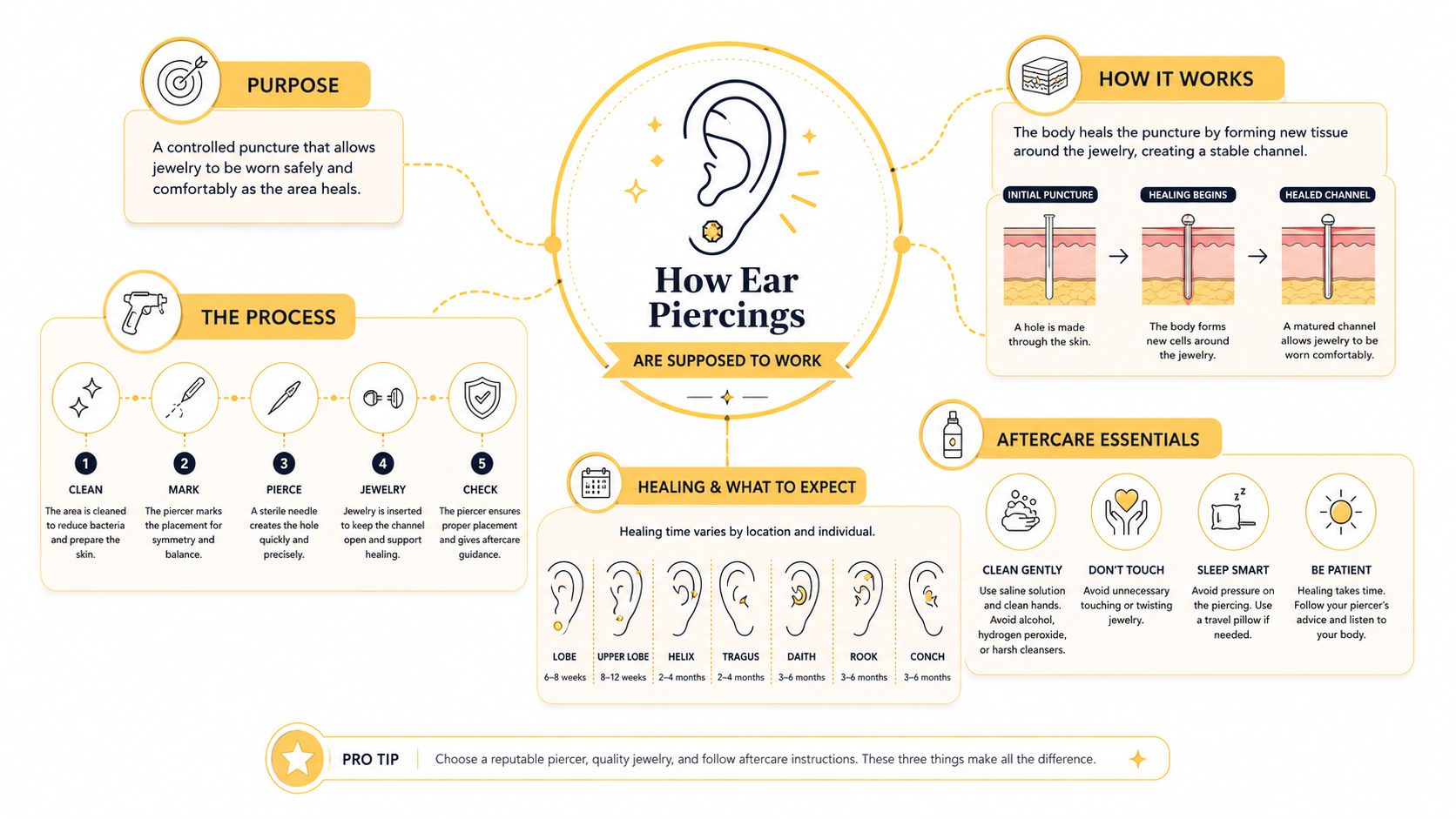
The important distinction is this. Biological plausibility is not the same as clinical effectiveness. A mechanism can sound reasonable and still fail in real-world outcomes, especially when pain conditions like migraine vary so much from person to person.
What the Scientific Evidence Says
The strongest summary is also the simplest. Current medical evidence does not support daith piercing as an effective migraine treatment. The 2024 review found 186 relevant articles, but only one retrospective study and three case reports met inclusion criteria, and no clinical trial was identified (PubMed review).
That matters because migraine treatment claims need more than anecdotes. A few stories can feel convincing, but they cannot show whether the piercing helped, whether the effect lasted, or whether something else changed at the same time, like stress level, sleep, or medication use.
A review discussed in the migraine literature noted that there were no data on daith piercing available in the scientific literature, and a 2017 BMJ Case Reports review said there was no scientific evidence to recommend it because the failure rate was unquantified and insertion carries risks (BMJ Case Reports review). That combination, weak evidence and real procedure risks, is why headache organizations do not treat it as a standard option.
Plain-language takeaway: If a treatment has no clinical trial support, you cannot assume the good stories reflect a real treatment effect.
A 2017 survey cited by the American Migraine Foundation found that 47.2% of 380 daith-piercing users said their migraine frequency decreased, but the same summary still concludes the piercing cannot be recommended because the evidence base is weak and risks remain (American Migraine Foundation). That mix of hopeful self-report and scientific uncertainty is exactly why many people stay curious, but cautious. If you want a broader overview of the issue, see the migraine piercing evidence summary.
Can a Piercing Make Your Migraines Worse
This is the question many articles skip, and it's the one more people should be asking. A 2024 case report explicitly noted that the literature had not really addressed symptom worsening or induction, and it described migraine symptoms in a patient with an auricular piercing (2024 case report). That doesn't prove every piercing will worsen migraine, but it does show the risk is real enough to discuss.
Migraine brains can be touchy during an attack. Allodynia means normal touch feels painful, so the pressure of jewelry, the trauma of the piercing, or the healing process can all feel louder to an already sensitized nervous system. If your attacks come with scalp tenderness, ear sensitivity, or a strong aversion to touch, that matters.
Why worsening can happen
A piercing adds a few possible stressors at once. There's the needle itself, the aftercare, the chance of local irritation, and the possibility of infection if healing goes badly. Any of those can be a nuisance for someone without migraine, and a bigger problem for someone whose nervous system is already on edge.
That's why the safety conversation shouldn't be limited to “Does it help?” The more useful question is, “What happens if it doesn't help, or if it makes things feel worse?” For some people, that answer is enough to step back.
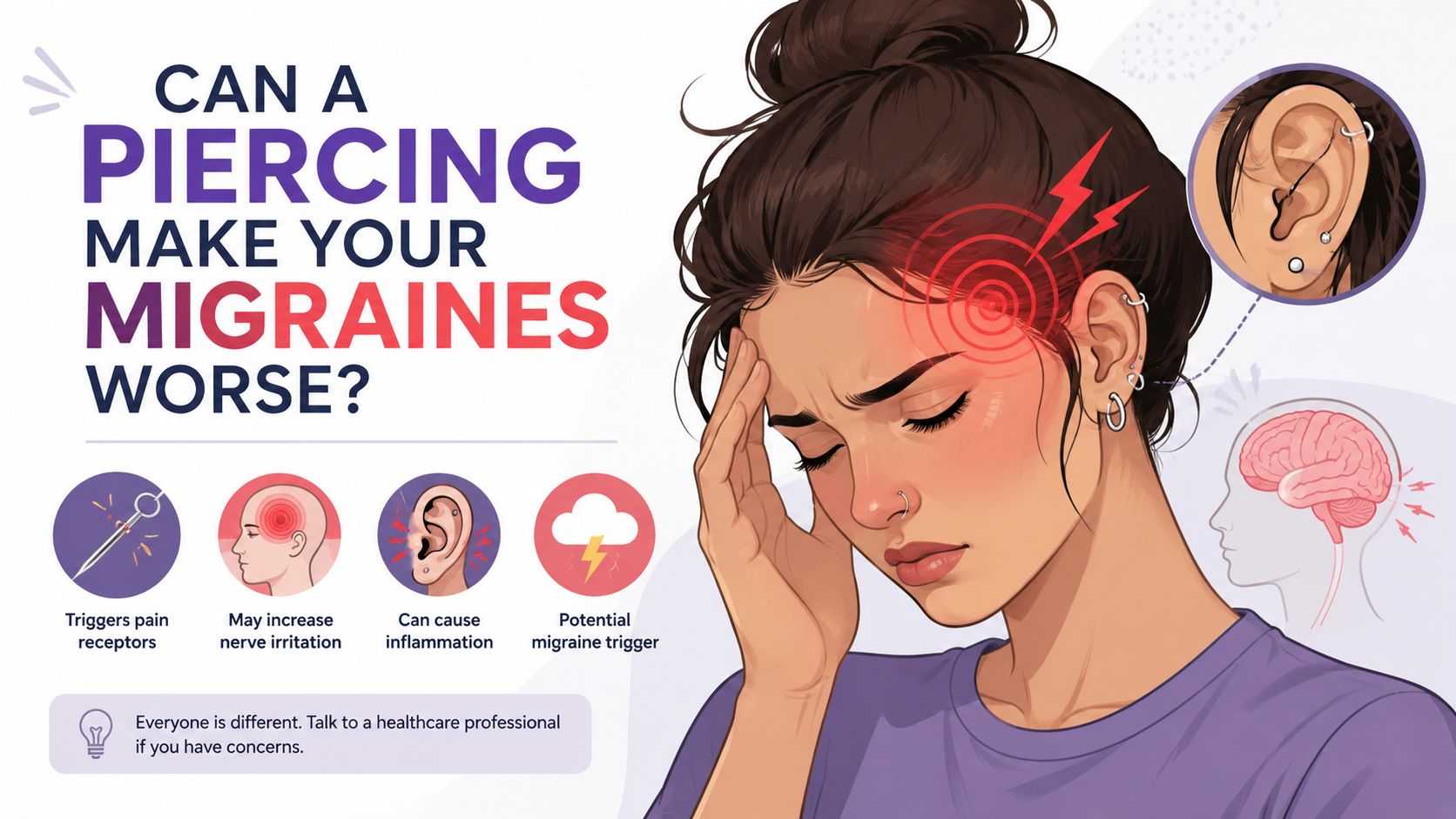
Before you treat a piercing as low-risk, remember that pain sensitivity during migraine isn't static. What feels tolerable on a good day may feel unbearable during an attack, or in the days around it.
Practical Guidance If You Decide to Proceed
If you're still considering a piercing, the safest approach is harm reduction, not wishful thinking. Look for a licensed professional piercer who uses sterile, single-use needles and implant-grade jewelry, because the main preventable problems here are infection, irritation, and poor healing. A cheap piercing in an unclean setting isn't a migraine strategy, it's an avoidable stressor.
A short checklist before you book
- Confirm sterilization practices: Ask how instruments are sterilized and whether needles are single-use.
- Check jewelry material: Choose implant-grade materials, not mystery metal.
- Look at healing standards: Cartilage piercings often heal slowly, so ask how aftercare is handled.
- Avoid rushing the decision: If you're in an active migraine flare, postpone until you can think clearly.
Aftercare matters just as much as the piercing itself. Clean the area exactly as directed by the professional, avoid unnecessary touching, and watch for signs of infection like increasing redness, heat, swelling, or discharge. If infection develops, that can become a physical stressor, and stress is a common migraine trigger for many people.
A good piercer should welcome questions and explain the risks plainly. If someone oversells the piercing as a proven migraine treatment, that's a red flag about their judgment.
For a neutral place to keep your migraine notes and symptoms organized, visit Relief. It won't replace medical care, but it can help you stay organized about patterns, timing, and possible triggers.
Tracking Your Results with Data Instead of Guesswork
If you decide to try the piercing, memory alone won't tell you whether it helped. People tend to remember the days they felt better and forget the days they still had attacks, which makes the result look more promising than it may be. A simple log gives you a clearer view.
Start with a baseline before the piercing, then track the same details afterward. Keep it plain and consistent. You don't need a perfect spreadsheet, just enough information to compare patterns.
What to log
- Attack frequency: How often migraine shows up in a week or month.
- Attack severity: Use the same scale each time, even if it's as simple as mild, moderate, or severe.
- Attack duration: How long the migraine lasts.
- Associated symptoms: Aura, nausea, photophobia, sound sensitivity, or neck pain.
- Context clues: Sleep disruption, stress, dehydration, menstrual cycle, weather changes, or missed meals.
That's the kind of pattern-tracking a tool like Relief is designed to support. It helps you connect symptom notes with environmental and personal factors, so you're not left guessing whether the piercing changed anything or whether something else shifted at the same time.
Useful standard: Compare the month before the piercing with the month after it, then look for trends instead of a single good or bad day.
If you want the cleanest read possible, avoid changing several variables at once. Starting a new preventive routine, changing sleep habits, and getting a piercing all at the same time makes the result hard to interpret. The goal isn't to prove a theory, it's to learn what your body does.
Evidence-Based Alternatives and When to See a Doctor
For migraine management, the strongest options still come from established care, not piercing trends. Lifestyle strategies like consistent sleep, hydration, meals, stress reduction, and trigger tracking can help some people reduce attacks. Medical care also separates into acute treatments, which are used during an attack, and preventive treatments, which are meant to reduce how often attacks happen over time.
If you're deciding between a piercing and established care, the biggest difference is evidence. A piercing has uncertain benefit and real procedure risks. Standard migraine care has a much stronger scientific foundation, even though finding the right plan can take time.
Seek immediate medical care for a sudden severe headache, headache with fever or stiff neck, headache with neurological changes such as weakness, confusion, or trouble speaking, or headache after a head injury. Those are not situations to wait out at home.
If your migraine pattern is changing, or your attacks are more frequent, longer, or harder to control, a neurologist or headache specialist can help you sort out next steps. You don't need to earn that referral by suffering longer.
If you want a calmer way to understand your own migraine pattern, use Relief to track symptoms, triggers, and timing in one place. It can help you spot whether something like a piercing changed your pattern, or whether your migraines are following a different trigger altogether.


