You're in a perfume aisle, passing a coworker's reheated lunch, or standing near a freshly cleaned restroom when it happens. A strong smell suddenly feels unbearable, nausea rises, pressure builds behind your eyes, and fatigue or dizziness arrives before you can get away. Sometimes the exposure starts a migraine. Other times, it makes an attack already underway much harder to tolerate.
This experience has a clinical name: osmophobia, or abnormal sensitivity to odors associated with migraine. Smell sensitivity can act as an ictal symptom during an attack, an interictal trait between attacks, or a prodromal warning sign before head pain begins. Understanding which role it plays for you can make your response more precise than trying to avoid every strong scent.
This article is for informational purposes and is not medical advice. Consult a healthcare provider for personalized guidance.
Table of Contents
When a Scent Can Wreck Your Whole Day
The perfume counter may be the first warning. You walk past, notice several fragrances layered together, and feel your stomach tighten. Within minutes, the lights seem harsher, conversation becomes difficult, and you start calculating how quickly you can reach fresh air.
At work, the trigger might be less obvious. A coworker opens a container of reheated food, someone sprays air freshener in the restroom, or a nearby colleague wears a fragrance that fills a small office. You may not have pain immediately, but your body feels as if it has gone on alert.
The same thing can happen in a cleaning-products aisle, a hotel room, a nail salon, a car, or public transportation. You leave the area, yet the reaction continues. Nausea, dizziness, tiredness, neck discomfort, light sensitivity, and head pressure can gather into a migraine attack that disrupts the rest of your day.
Your reaction isn't imaginary or a character flaw. A smell can be a meaningful part of your migraine pattern, even when other people barely notice it.
Migraine isn't just a bad headache. It's a neurological condition that can involve nausea, photophobia, which means sensitivity to light, phonophobia, which means sensitivity to sound, aura, and changes before or after head pain. Smell sensitivity belongs in that broader picture.
Research has studied this pattern for decades. The evidence doesn't mean every strong-smell reaction is migraine, and it doesn't mean every person with migraine reacts to odors. It does mean the experience deserves more careful language and practical planning. The first useful term is osmophobia.
What Osmophobia Actually Means
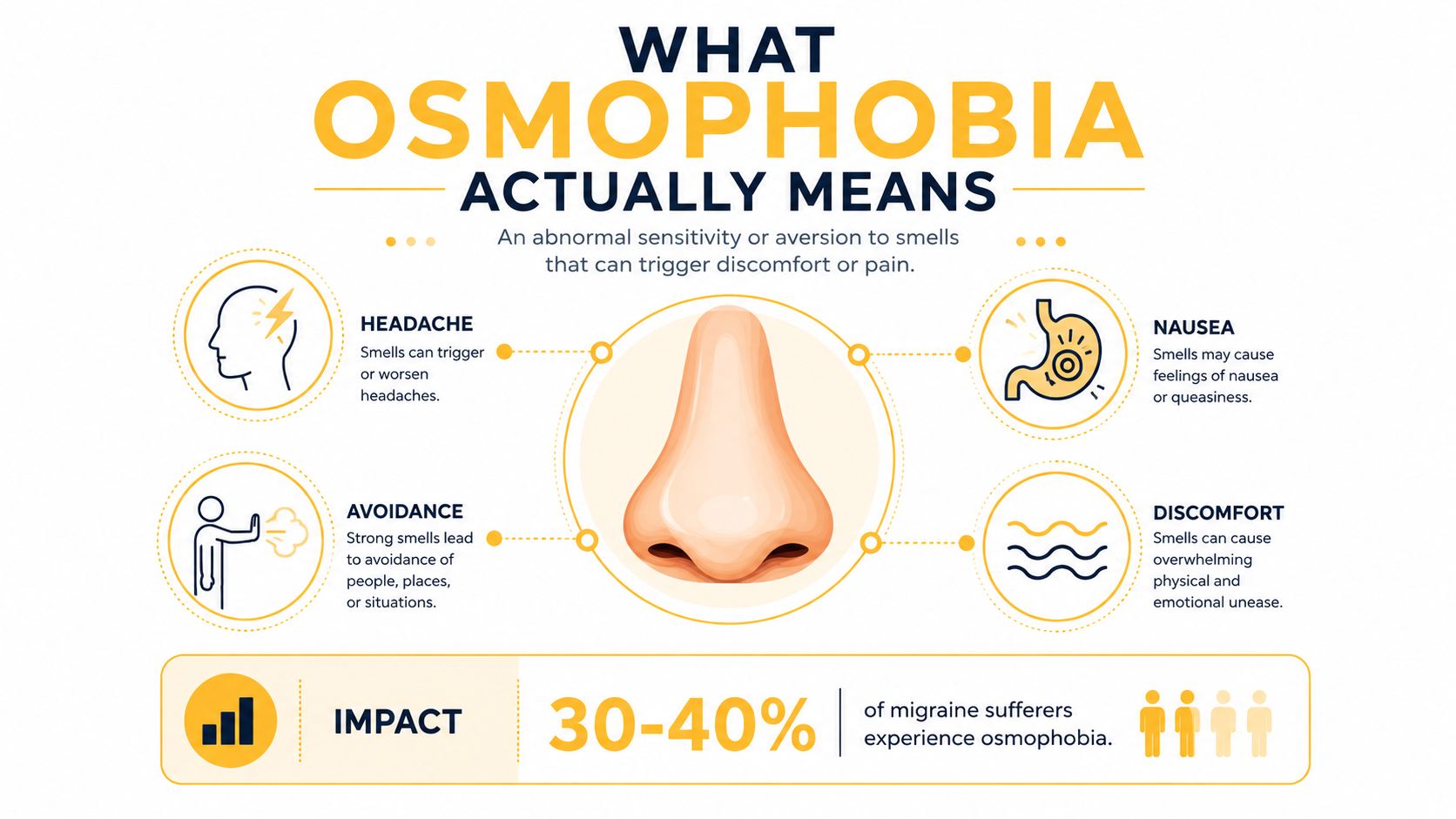
Osmophobia describes an abnormal sensitivity or aversion to odors that many people would otherwise tolerate. During or around migraine, a smell may cause discomfort, nausea, headache, or an urgent need to leave the area. A normal dislike is different. You might dislike a perfume because it isn't your style, while osmophobia can produce a physical reaction that worsens or accompanies migraine.
It also isn't the same as allergic rhinitis. An allergy commonly involves immune symptoms such as sneezing, congestion, or an itchy, watery nose. Osmophobia refers to how your nervous system reacts to an odor. The two experiences can overlap, but one doesn't automatically explain the other.
Why the symptom matters clinically
A 2025 systematic review and meta-analysis found osmophobia in 47.8% of patients with migraine, with a 95% confidence interval of 42.0% to 53.6%. In studies measuring olfactory hypersensitivity during an active attack, the prevalence was 40.1%, with a 95% confidence interval of 23.1% to 58.5% (World Journal of Otorhinolaryngology research).
That makes smell sensitivity common, but not universal. A prospective study of headache patients found osmophobia in 45.7% of migraine-without-aura attacks, while no episodic tension-type headache attacks in that sample included it (prospective osmophobia study indexed by PubMed).
The symptom can therefore provide a useful clue when a clinician considers migraine alongside other headache disorders. It still isn't enough to diagnose you by itself. Your full pattern matters, including pain features, nausea, sensory symptoms, aura, timing, and medical history.
Three Different Jobs Smell Sensitivity Does in Migraine
Smell sensitivity plays three distinct roles in migraine, and separating them changes how you respond. The same perfume can feel unbearable during an attack, remain irritating between attacks, or signal that pain may be approaching. Your timing matters as much as the odor itself.
During an attack
The ictal phase is the migraine attack in progress. An ordinary odor may suddenly seem intensely unpleasant, worsen nausea, or add to head pain. The smell may not have started the migraine. Once an attack is active, the brain may process sensory input more intensely.
Act quickly rather than investigating the cause. Leave the area, improve airflow, lower other sensory stimulation, and follow the acute plan you have discussed with a clinician. You can take the reaction seriously without proving that the odor caused the attack.
Between attacks
The interictal phase is the time between attacks. Some people continue to notice lower-level smell sensitivity even without head pain. A chronic migraine study found more abnormal olfactory acuity at baseline among patients than among age- and sex-matched controls, suggesting that altered smell processing can persist outside an attack (chronic migraine olfactory study).
That pattern can guide practical environmental changes. If scented detergent, an air freshener, or a workplace product bothers you repeatedly between attacks, reducing that exposure may make the space easier to tolerate. It does not prove that the odor alone will cause every future attack.
Before pain begins
The prodrome, also called the premonitory phase, includes symptoms that can appear before migraine pain. Smell sensitivity may be one of these early changes. A survey described in a recent review indexed by PubMed found heightened odor sensitivity before headache in 38.1% of participants and during the attack in 61.9%, so the timing differs from person to person.
A sudden change from your usual smell tolerance can become a personal warning signal. If it repeatedly appears before head pain, use it as a prompt to check for other early symptoms and reduce avoidable exposure. Treat it as a probability, not a guarantee.
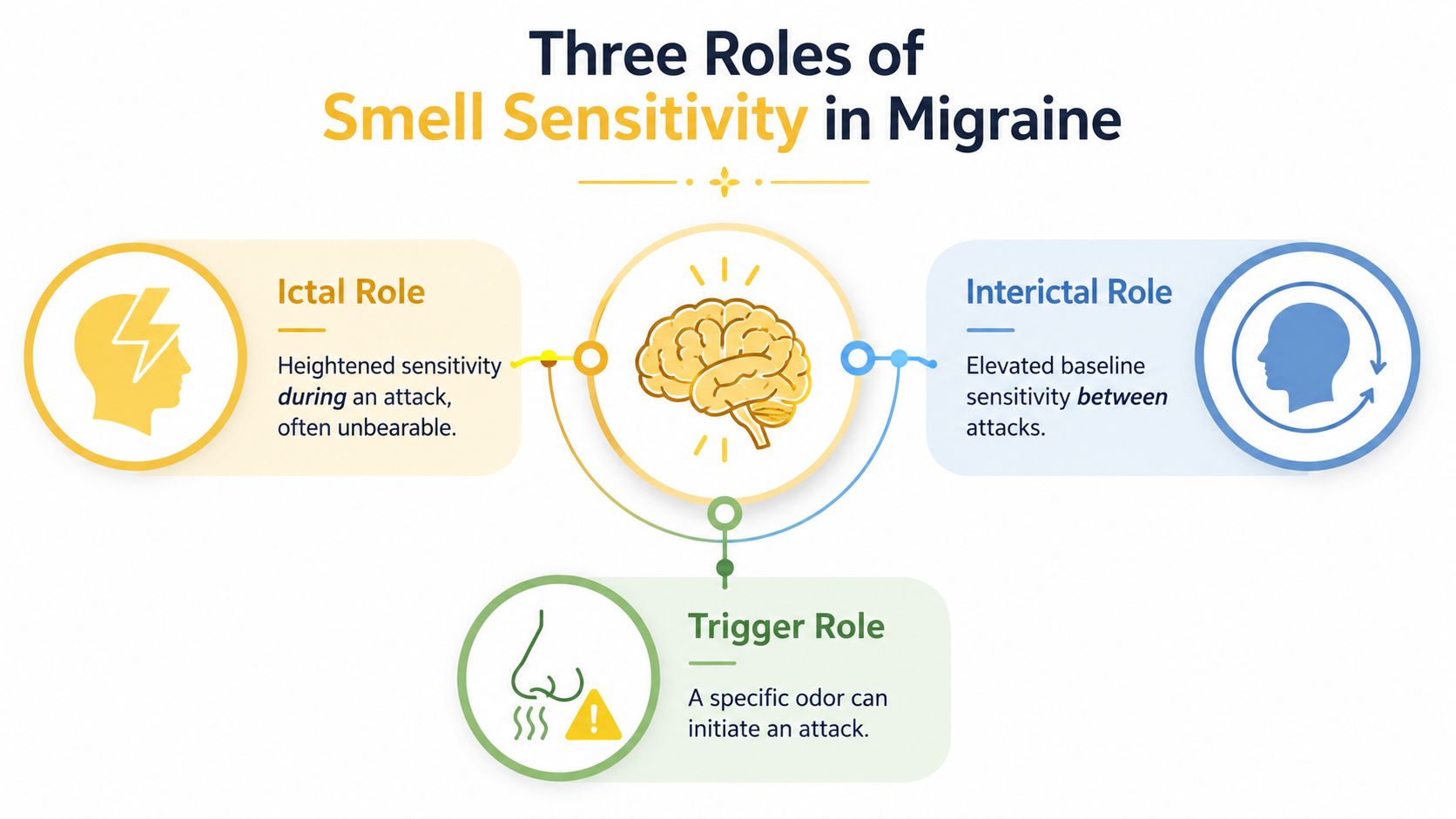
Odor sensitivity can also serve as a direct trigger. In that role, exposure comes before an attack that has not yet begun. A 2025 meta-analysis found odor-triggered migraine in 40.1% of patients when perfume was the primary trigger, as noted earlier in the article.
A simple log can separate these roles. Record the odor, timing, migraine stage, other symptoms, and what happened afterward. Over time, the pattern may show whether a scent is an attack symptom, an interictal irritant, a prodromal warning, or a trigger worth discussing in your prevention plan.
The Odors That Come Up Again and Again
A perfume aisle may bring on symptoms for one person, while coffee, cooking, or cleaning products bother someone else. Your surroundings also change the experience. An odor can feel stronger in a small, poorly ventilated room than outdoors, where it disperses quickly.
Historical findings can suggest categories to watch, but they cannot create a personal avoidance list. In a 2013 study, perfume was the most frequently reported odor trigger, followed by paint, gasoline, and bleach (historical odor-trigger study indexed by PubMed). Reviews have also described deodorants, coffee, fried foods, onion, and cigarette smoke among commonly reported odor classes. See the prevalence data above for the broader research context.
| Odor trigger | Typical exposure context | How to use it |
|---|---|---|
| Perfume or cologne | Department stores, offices, public transport | Track repeated exposure, especially if symptoms follow |
| Paint | Renovation areas, freshly painted rooms | Note whether enclosed rooms intensify the response |
| Gasoline | Fuel stations, garages, traffic areas | Record exposure even when it is occasional |
| Bleach | Cleaning aisles, bathrooms, recently cleaned rooms | Compare product exposure with room ventilation |
| Smoke | Outdoor venues, neighbors, fireplaces, traffic | Check whether smoke acts as a trigger or worsens an active attack |
| Food odors | Coffee shops, kitchens, restaurants, reheated meals | Separate specific foods, such as coffee, frying, onions, or reheated meals |
Treat the table as a set of prompts, not rules. Start with two or three odors you encounter. Log the scent, setting, timing, migraine stage, and what happened afterward. A workplace perfume exposure may belong in the trigger column, while the sudden smell of ordinary cooking during an attack may be an ictal symptom. A new sensitivity before head pain may serve as a prodromal warning. That distinction turns a vague pattern into information you can use.
Managing Smell Sensitivity Day to Day
Managing a smell sensitivity migraine works best as a layered plan. You can reduce exposure without trying to control every scent in the world, and you can pair environmental changes with medical care when attacks remain disruptive.
Start with behavioral changes
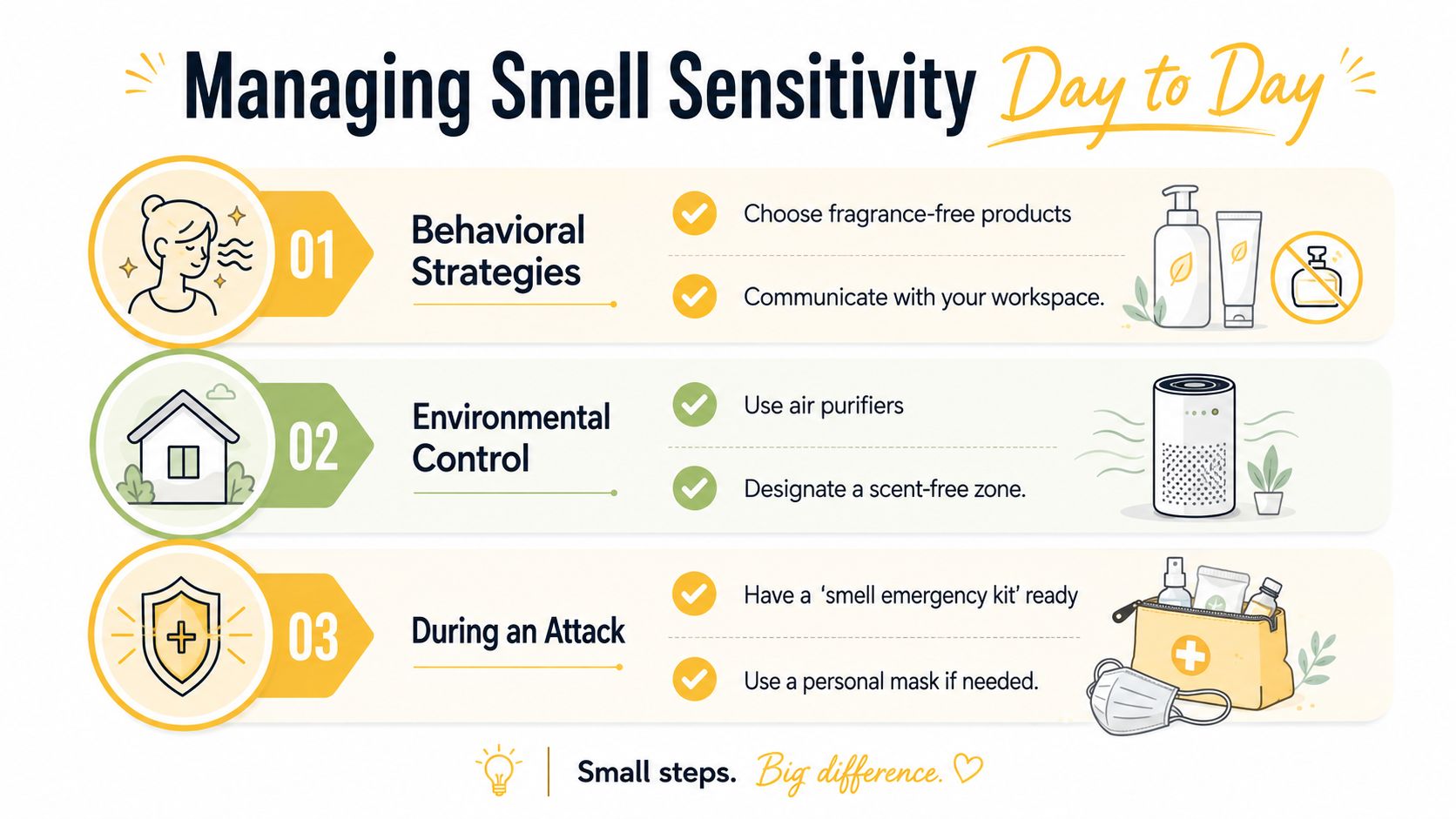
At home, consider fragrance-free versions of laundry detergent, hand soap, shampoo, body wash, dish soap, and household cleaners. “Fragrance-free” and “unscented” don't always mean the same thing, so check the product label and choose what your body tolerates.
At work, a brief, specific request may work better than a general complaint. You might say that strong fragrance can worsen a neurological condition and ask whether a colleague can avoid perfume on days when your symptoms are active. If direct conversation feels unsafe or ineffective, discuss workspace adjustments with a manager or human resources.
When an exposure begins, leave early. You don't need to remain in a perfume aisle, restroom, restaurant, or vehicle until symptoms become severe.
Change the environment
Airflow can reduce how long an odor stays concentrated. Open windows when practical, use a kitchen exhaust fan while cooking, and position a portable fan to move air away from your breathing space. At home or work, identify a room where scented products aren't used.
During shopping or travel, a well-fitting mask may reduce the amount of odor reaching you. Carrying one gives you another option when you can't immediately leave. Fresh air, distance, and a less concentrated environment may help reduce the sensory load, but they won't reliably stop every attack.
Discuss treatment categories with a clinician
For an acute attack, ask a healthcare provider whether an over-the-counter option such as an NSAID is appropriate for you, or whether a prescription acute treatment should be part of your plan. Don't start, stop, or combine medication based on an article.
If attacks occur often or interfere with daily life, preventive treatment may deserve discussion. Clinicians may consider categories such as CGRP-pathway preventives, beta-blockers, anticonvulsants, or onabotulinumtoxinA for chronic migraine, depending on your diagnosis, health history, and treatment goals. No single category is right for everyone.
Practical rule: Reduce the smell exposure you can control, prepare for the exposure you can't, and revisit the medical plan if your attacks change.
How Tracking Turns a Vague Pattern Into Useful Data
Memory tends to compress migraine days together. You may remember that perfume caused a bad attack, but not whether the exposure happened before pain, during pain, or after nausea had already started. A structured log separates those moments.
Record the following details each time a strong odor appears:
- Odor source: Write “floral perfume,” “bleach,” “frying onions,” or “cigarette smoke,” rather than only “bad smell.”
- Setting: Note whether you were in a car, office, shop, kitchen, hotel, or outdoors.
- Exposure timing: Record when it began, how long it lasted, and how close you were to the source.
- Symptoms: Mark nausea, head pain, dizziness, fatigue, photophobia, phonophobia, aura, or neck discomfort.
- What followed: Note whether an attack developed, intensified, or failed to appear.
- What helped: Include fresh air, leaving the area, a mask, rest, hydration, or your clinician-approved treatment.
Look for timing, not just presence. A smell that appears repeatedly during an attack may be an ictal symptom. A sudden sensitivity spike before pain may be a prodromal warning. An odor that precedes attacks under specific conditions may be a trigger pattern.
Patterns often need repeated entries before they become useful. Track alongside sleep, stress, weather changes, hormonal timing if relevant to you, and other symptoms, because an odor may matter more when several factors occur together. Don't treat a single coincidence as proof.
A structured app such as Relief can standardize entries for strong odor exposure alongside symptoms, medications, weather, air quality, pollen, humidity, and pressure. The purpose is not to predict with certainty. It's to turn scattered experiences into a clearer personal record you can review and discuss.
When Smell Sensitivity Deserves a Conversation With a Doctor
Some changes call for immediate medical attention rather than routine trigger tracking. Seek immediate care for a sudden, severe headache unlike any previous headache, a headache with fever or stiff neck, new weakness, slurred speech, vision loss, confusion, seizures, or a headache after a head injury.
Don't wait for a routine appointment if neurological changes appear during an attack. A new migraine-like pattern after age 50, or a major shift in headache character, also deserves prompt evaluation. These signs don't prove a dangerous cause, but they require a clinician to assess them.
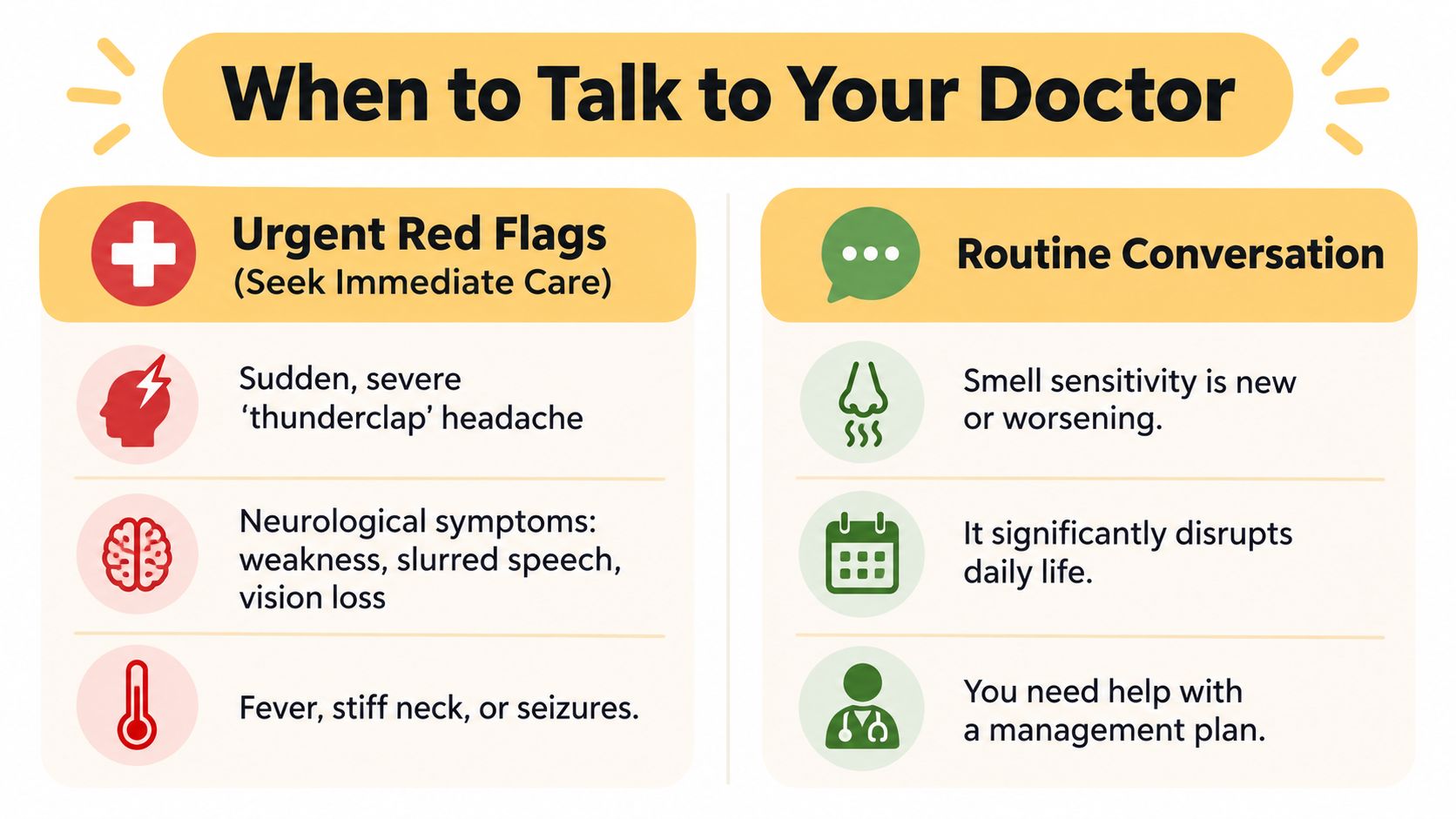
Reasons to schedule a routine discussion
Make an appointment if smell sensitivity is new, worsening, or appearing more often. Bring it up when it accompanies increasing attack severity, persistent nausea or vomiting, or symptoms that disrupt work, sleep, relationships, or daily routines.
A clinician can also help if over-the-counter treatment isn't managing attacks, or if you worry that frequent medication use may be contributing to more headaches. Don't change medication frequency without professional guidance.
Bring your log. Include the odor, exposure time, time until symptoms appeared, symptoms during the attack, what you tried, and the response. This gives the appointment a concrete starting point and helps distinguish a symptom during migraine from an exposure that may precede it.
This article is for informational purposes and is not medical advice. Consult a healthcare provider for personalized guidance.
Your Next Step With Smell Sensitivity and Migraine
Start with one simple smell log today. Write down the date, time, odor source, approximate exposure duration, how close you were to it, whether you were indoors or outdoors, and whether an attack followed within two hours.
Also record what came first. Did the smell appear before fatigue, nausea, light sensitivity, or head pain? Did you already feel different before entering the perfume aisle or cleaning-products section? Those details can help separate a prodromal warning sign from an odor that worsened an attack already underway.
Two or three weeks of consistent entries may reveal patterns that single attacks hide. You might notice that a particular odor matters mostly in an enclosed space, after poor sleep, during a certain routine, or when other migraine symptoms have already started. Treat those findings as clues, not guarantees.
Over time, smell sensitivity can shift from a frustrating liability into usable information. You may leave a high-exposure setting earlier, choose a different route through a store, prepare a mask before travel, or bring clearer evidence to a healthcare appointment. The goal isn't perfect avoidance. It's fewer surprises and earlier, calmer decisions.
For more context on how the app supports migraine awareness and tracking, visit Relief's approach to migraine management.
Relief helps you log symptoms, triggers, medications, and environmental exposures such as strong odors while bringing those entries together with weather, air quality, pollen, humidity, and pressure. Visit Relief to start identifying the patterns that may help you plan ahead.


