
You're not imagining it if a sweetened drink seems to come before a migraine. The harder question is whether stevia is the trigger, or whether the actual problem is the whole product around it. In the medical literature, stevia is generally treated as a low-risk sweetener, and the evidence does not show it as a common population-wide cause of headache or migraine, but it can still be a personal trigger for a minority of people. This article is for informational purposes and is not medical advice. Consult a healthcare provider for personalized guidance.
Table of Contents
Can Stevia Cause Headaches or Migraine Attacks
If you typed “can stevia cause headaches” while already dealing with pain, the short answer is maybe for you, but not proven as a common cause for everyone. The broader literature treats stevia as a low-risk sweetener, not a well-established headache trigger, and the science since 2010 has found little evidence for a consistent causal link between stevia and headache.
That matters because headache and migraine aren't the same thing. A headache can be a general pain pattern, while migraine often includes features like aura, meaning temporary sensory changes such as flashing lights or blind spots, and photophobia, meaning light sensitivity.
For a reader in the middle of an attack, the useful question isn't whether stevia is “bad” in a universal sense. It's whether your body seems to react to it in a repeatable way. The rest of this article assumes that possibility is real enough to test, even if the population-level evidence is thin.
Practical rule: treat stevia as a suspected personal trigger, not a proven diagnosis.
That framing keeps you from overreacting to one bad day, but it also keeps you from dismissing a pattern that keeps showing up. If the same sweetened product keeps preceding attacks, a structured test is worth your time. If it never repeats, stevia probably isn't the main story.
What the Research Says About Stevia and Sweetener Headaches
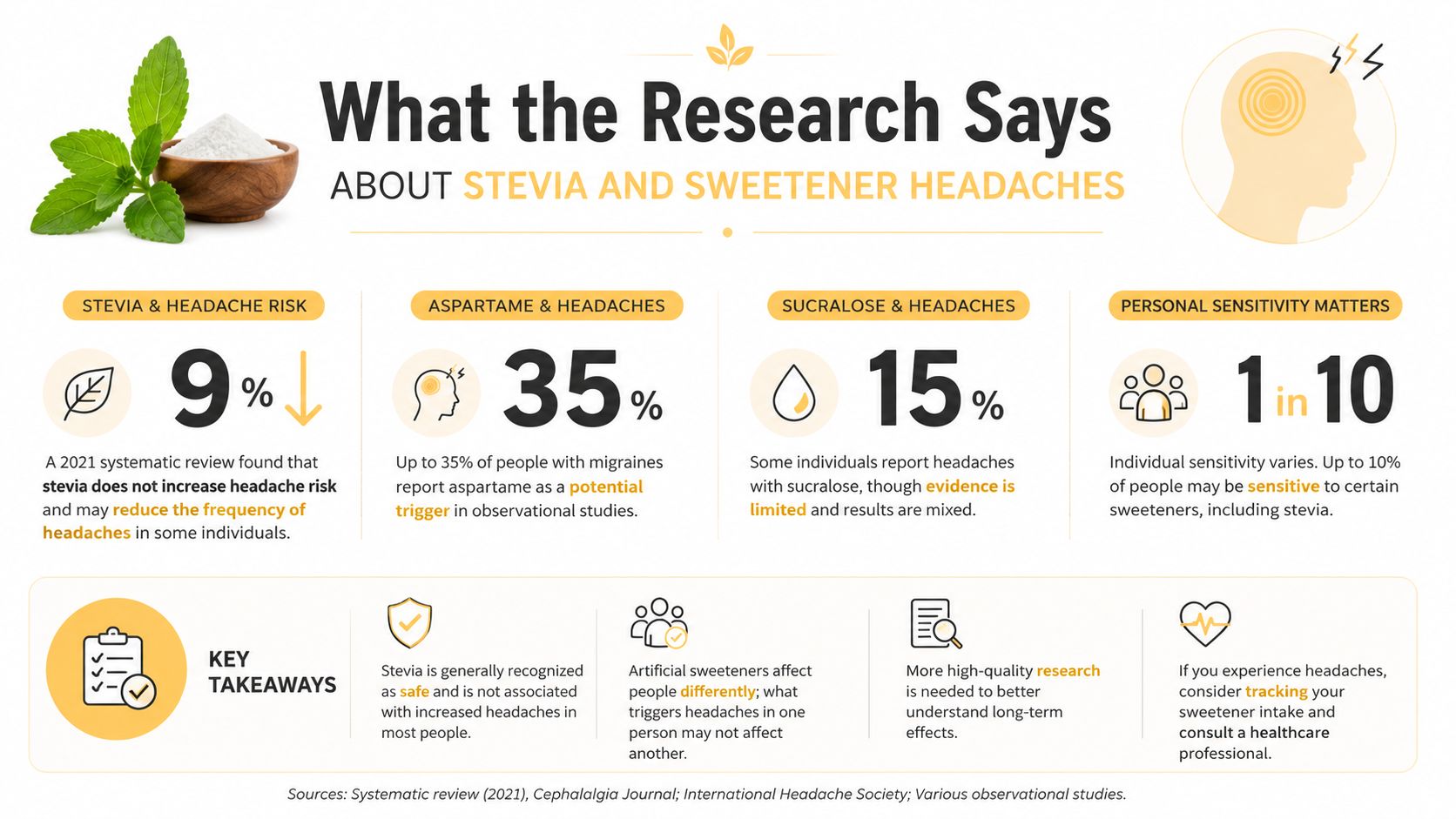
The research on sweeteners and headache does not point to a clean answer, and stevia sits near the weaker end of that evidence. Regulatory safety reviews describe high-purity steviol glycosides as GRAS under the U.S. FDA framework, and JECFA gives steviol equivalents an acceptable daily intake of 4 mg/kg body weight/day, which is about 12 mg/kg of high-purity stevia extract. That safety context matters, because a substance can be generally considered safe and still deserve a personal trial if it seems to line up with your symptoms.
Major reviews published since 2010 have found little scientific evidence for a consistent causal link between stevia and headaches. The pattern in the literature is cautious rather than dramatic, which is often the case with suspected triggers that show up in anecdotes more often than in controlled studies.
Where stevia fits beside other sweeteners
Stevia is easier to question if you place it next to other sweeteners with a longer headache history. The signal has been stronger for aspartame than for stevia, and there is also a case report connecting migraines with sucralose. Even so, broader reviews still describe the evidence for sweetener-triggered headaches as weak and inconsistent Migraine Again. That comparison helps keep stevia in perspective, because it shows how easily a headline about “sweeteners” can sound more settled than the science really is.
Peer-reviewed and review-level sources also note that hypersensitivity reactions to stevia are rare, and no published reports of stevia-related allergy have appeared since 2008 Alzdiscovery PDF_.pdf). That does not rule out a personal headache response, especially if a product includes more than one sweetener, but it does mean a direct biologic explanation for stevia alone is still thin.
The most careful conclusion is straightforward. Low risk does not mean zero risk for every person. It means the literature does not support treating stevia as a common migraine trigger, while still leaving room for individual sensitivity or for a blended product to be the actual problem.
Bottom line: the lack of strong evidence matters. It tells you stevia is not a proven universal culprit, even if it may still be part of a repeatable pattern for a small number of people.
How Stevia Could Trigger a Headache The Biological Pathways
There are plausible ways a sweetener could set off a headache, but most of them are hypotheses, not proven stevia-specific mechanisms in humans. Sweet taste receptors in the gut and brain can influence signaling, and the migraine brain may respond differently to ordinary stimuli than a non-migraine brain. That's one reason a trigger can feel obvious to you even when the scientific literature stays cautious.
Plausible pathways, not proof
One idea involves the gut-brain axis, where sweet taste, digestion, and vagal nerve signaling can influence how the nervous system feels and reacts. Another involves downstream effects on the microbiome, though that line of research is still early and not stevia-specific. Migraine biology also includes vascular and signaling pathways, including nitric oxide activity, which is why researchers keep looking at foods and additives that may alter blood vessel behavior.
Some people also react to the carriers in blended products, not the stevia itself. If a packet or bottle contains sugar alcohols or other sweeteners, the symptom may belong to the blend rather than the leaf-derived ingredient.
Working model: a sweetener can be biologically plausible without being a proven cause. Plausible is not the same as established.
That distinction matters because it keeps you from making a false leap from “this might affect me” to “this ingredient is the reason migraines happen.” The most honest answer is that there are credible routes by which sweeteners could contribute to symptoms, but the evidence tying those routes specifically to stevia is thin.
Why the Suspect Might Not Be Stevia at All
A lot of “stevia gave me a headache” stories aren't really stevia stories. They're product stories. People often drink or eat stevia + erythritol + monk fruit blends, sugar-free sodas with caffeine, or ultra-processed foods with a long ingredient list, and then try to pin the whole event on the word stevia on the front label.
Common confounders that muddy the picture
Caffeine swings can matter, especially if the sweetened product is a soda or energy drink. Hydration, skipped meals, hormonal cycle timing, sleep loss, and the natural variability of migraine can all make one food look guilty by coincidence. Even if the sweetener is present, it may not be the main driver.
The strongest neutral advice is to isolate one variable at a time. The goal isn't to convict stevia. It's to see whether the symptom pattern survives when the rest of the formulation disappears.
The goal is to isolate stevia, not to convict it.
That's especially important because migraine timing is messy. If you had a headache after a sweetened drink once, that single event may be a coincidence, a blend reaction, or a true trigger. The only way to separate those possibilities is with a cleaner test than memory usually gives you.
How to Run a Stevia Elimination and Rechallenge Test
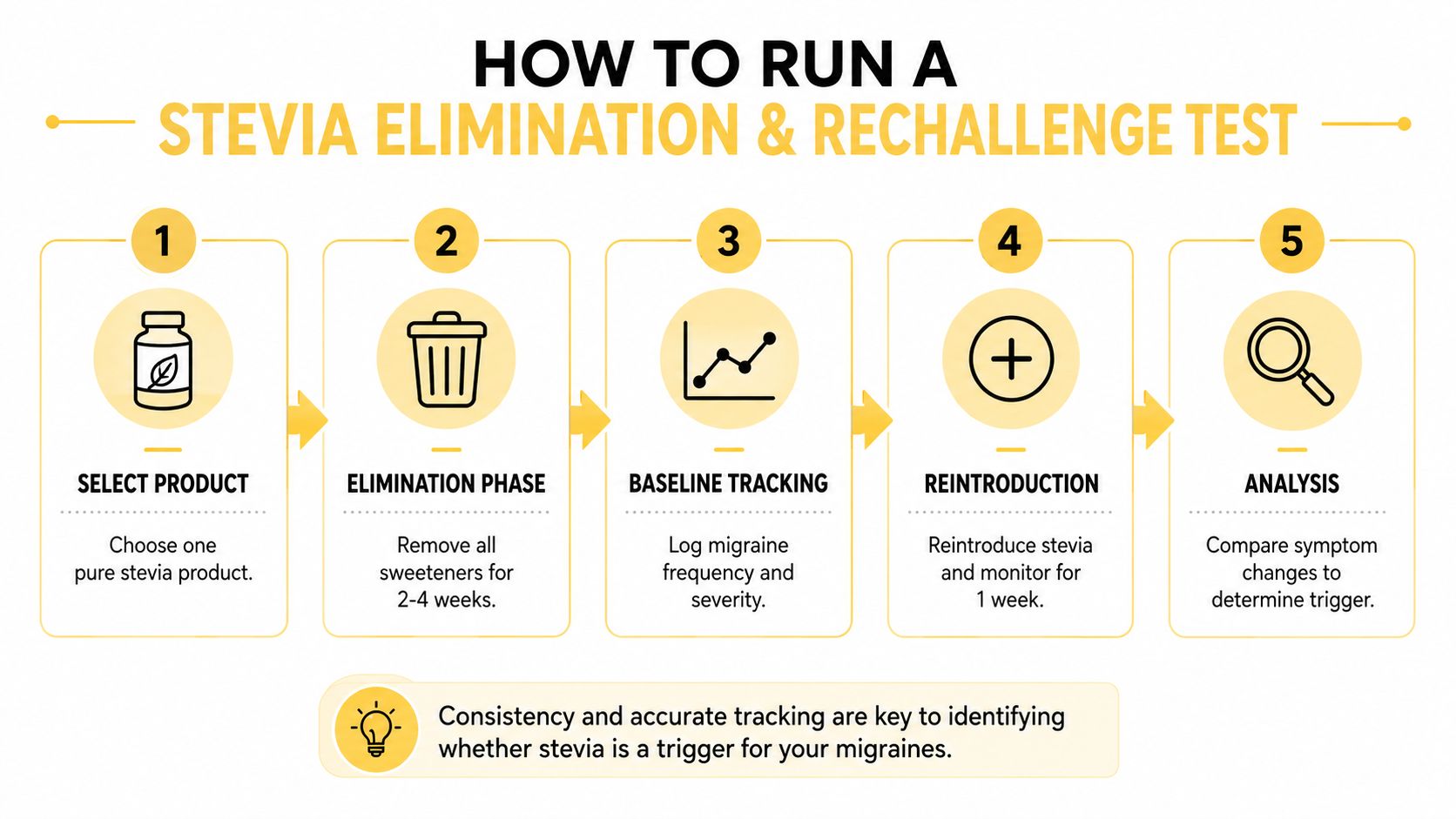
A useful home test is simple, structured, and patient. Start with one stevia product, not every sweetener in your kitchen. Then remove all sweeteners for 2 to 4 weeks, so your baseline gets cleaner and you're not comparing a “good” day to a random day Migraine Buddy.
What to record each day
Keep the log boring and specific. Note the time of intake, the product, the amount, what else you ate or drank, hydration, sleep, and the day in your menstrual cycle if that's relevant for you. Record headache or migraine symptoms in the next 24 to 48 hours, including whether you had aura, light sensitivity, nausea, or one-sided pain.
How to interpret the result
If you get a headache during elimination, that doesn't disprove stevia. Migraine can happen for unrelated reasons. If you get symptoms after rechallenge, that doesn't prove stevia either, because the day may have included another trigger.
What matters is the pattern across repeated cycles.
- Remove the variable: avoid all sweeteners for the elimination window.
- Reintroduce one product: use a normal serving on a low-risk day.
- Watch the next day or two: track symptoms without changing five other things at once.
- Repeat if needed: a pattern is more convincing than a one-off reaction.
If the result stays ambiguous, that's still useful. It means the ingredient may not be the key driver, or it may be acting only when other triggers stack up.
Sweetener Alternatives Worth Considering
If stevia keeps showing up in your log, the next question is not which sweetener is “best.” It is which one changes as little else as possible while you test. Purified stevia is not the same as whole-leaf stevia or a crude extract, and safety reviews focus on the purified form. The FDA's steviol glycosides guidance and related safety assessments are the more direct references here, because label language can blur the difference between a refined ingredient and a mixed product.
| Sweetener | Evidence as Headache Trigger | Typical Use |
|---|---|---|
| Purified stevia | Low-risk overall, but some people report personal sensitivity | Tabletop sweetener, beverages, packaged foods |
| Erythritol | Often discussed in blend complaints, but not established as a universal trigger | Sugar-free baked goods, blends, beverages |
| Monk fruit | Limited headache-specific evidence | Beverage mixes, tabletop sweeteners |
| Allulose | Less discussed in headache literature | Baking and lower-sugar recipes |
| Sucralose | Broader sweetener literature includes headache reports, but evidence remains inconsistent | Diet drinks, packaged foods |
| Aspartame | More historically studied in headache discussions than stevia | Diet sodas, gum, tabletop packets |
| Honey | Not a sweetener trigger in the same category, but still a dietary sugar | Tea, cooking, occasional sweetening |
| Maple syrup | Not usually discussed as a headache-specific trigger | Baking, breakfast foods |
| Table sugar | Often tolerated, but can still be part of a broader dietary pattern | General cooking and baking |
The practical choice is often the one that lets you test cleanly. If your usual stevia product is part of a stacked sweeteners formula, a simple swap to a single-ingredient option can make the result easier to read. A packet that mixes stevia with erythritol, flavors, or fillers gives you less clarity than a plain sweetener.
If you want two or three rotation options during elimination, pick the ones that fit your cooking style and do not add new variables. Simple, familiar ingredients are often easier to track than a long list of “better-for-you” substitutes.
When to Stop Testing and Talk to a Clinician
Self-tracking is helpful, but there's a hard safety line. Stop experimenting and seek immediate medical care for a sudden severe headache, headache with fever or stiff neck, new neurological changes such as weakness, vision loss, or confusion, or a headache after a head injury. Get urgent help if the pain feels distinctly different from your usual attacks.
What belongs in a tracker versus a clinic visit
Recurring headaches that show up after a specific sweetener are reasonable to track at home. A new pattern that starts to change your daily function deserves a conversation with a clinician, especially if the elimination test keeps giving mixed results. A clinician can also help you think through whether the pattern fits migraine, another headache type, or something else entirely.
The earlier caution remains important. This article can help you observe, but it cannot interpret your full medical picture. Personalized guidance belongs with a healthcare provider who can weigh your history, medications, and symptom pattern.
Tracking helps you bring better information to the appointment. It doesn't replace the appointment.
If you're unsure, bring your log rather than your guesses. That usually gives the conversation a lot more value than trying to remember every meal after the fact.
Using a Migraine Tracker to Spot the Real Pattern
A stevia test is more useful inside a tracker because headache patterns usually have more than one moving part. A good migraine log lets you line up sweetener intake with sleep, hydration, stress, and the day's environment, so you can see whether an attack followed a weather shift, a hormonal change, or the sweetener itself. Relief does that kind of pattern-finding by combining logged attacks with local signals like weather, humidity, barometric pressure, air quality, and pollen, and you can explore Relief directly if you want to see how it works.
What to track together
If stevia is the suspect, log it in the same place you log the rest of your attack context. Keep sweetener type, hydration, sleep, symptoms, and timing together so you are not trying to rebuild the day from memory later. That makes it easier to notice whether the same product keeps showing up before attacks, or whether the pattern is broader and the sweetener is only one part of a stacked trigger day.
Relief is for awareness and pattern recognition, not diagnosis. It helps you see exposure hit rates and trends, which gives you better questions to ask about your own triggers and a clearer record to discuss with a clinician if needed.
Use the app as your external memory for the elimination test, not as proof by itself. One clear log, reviewed over time, is usually more useful than a pile of vague impressions.
A simple next step is to run the elimination-and-rechallenge test for one stevia product, then keep the results in Relief so you can see whether the pattern repeats or disappears.


