
Sugar itself isn't a universal migraine trigger, but blood sugar swings, fasting, and reactive hypoglycemia are more consistent patterns linked with headache and migraine. The evidence is mixed, so the most useful question is often not “Should I avoid sugar?” but “What happens to my symptoms when my glucose and meal timing change?”
You may be reading this after a familiar sequence: a sweet coffee in the morning, a delayed lunch, then throbbing pain during an afternoon meeting. The timing feels too precise to ignore, especially when light and sound become unbearable or your thinking turns foggy. You're not imagining the pattern, but the food itself may not be the whole explanation.
This article is for informational purposes and is not medical advice. Consult a healthcare provider for personalized guidance.
Table of Contents
Why Sugar and Migraines Feel Connected
A sugary latte can raise blood glucose quickly. If lunch is delayed afterward, your body may be managing the contrast between incoming energy and a later fall in available fuel. For some people with migraine, that transition may be more relevant than the sugar in the drink.
Three patterns are easy to confuse:
- A spike and crash: You eat or drink something sweet, feel temporarily energized, then develop shakiness, fatigue, irritability, or head pain as glucose falls.
- A fasting dip: You skip breakfast or lunch, work through hunger, and notice symptoms building while you haven't eaten.
- Reactive hypoglycemia: You experience a low-glucose feeling after a high-carbohydrate meal, even though you did eat.
The 1935 paper “Hypoglycemic Headache,” published by Gray and Burtness in Endocrinology, helped frame headache and migraine through blood sugar levels. The paper was 12 pages long, appearing in volume 19, issue 5, on pages 549–560. Modern reviews still discuss low blood glucose as a possible precipitating factor for some people, as described in the original historical paper on hypoglycemic headache.
Your experience deserves investigation rather than dismissal. A food diary that only says “sugar caused migraine” may hide the more useful details, such as how long you had fasted, whether the meal contained protein or fiber, and when the first warning symptom appeared. A structured tracker can turn a suspicious coincidence into a pattern you can discuss with a clinician. Relief's approach to migraine awareness and tracking is one example of why those details matter.
What Counts as a Migraine Versus a Headache
A migraine is a neurological attack, not a stronger version of an ordinary headache. A tension-type headache may feel like steady pressure or tightness, while migraine can involve throbbing pain, nausea, photophobia, which means sensitivity to light, and phonophobia, which means sensitivity to sound.
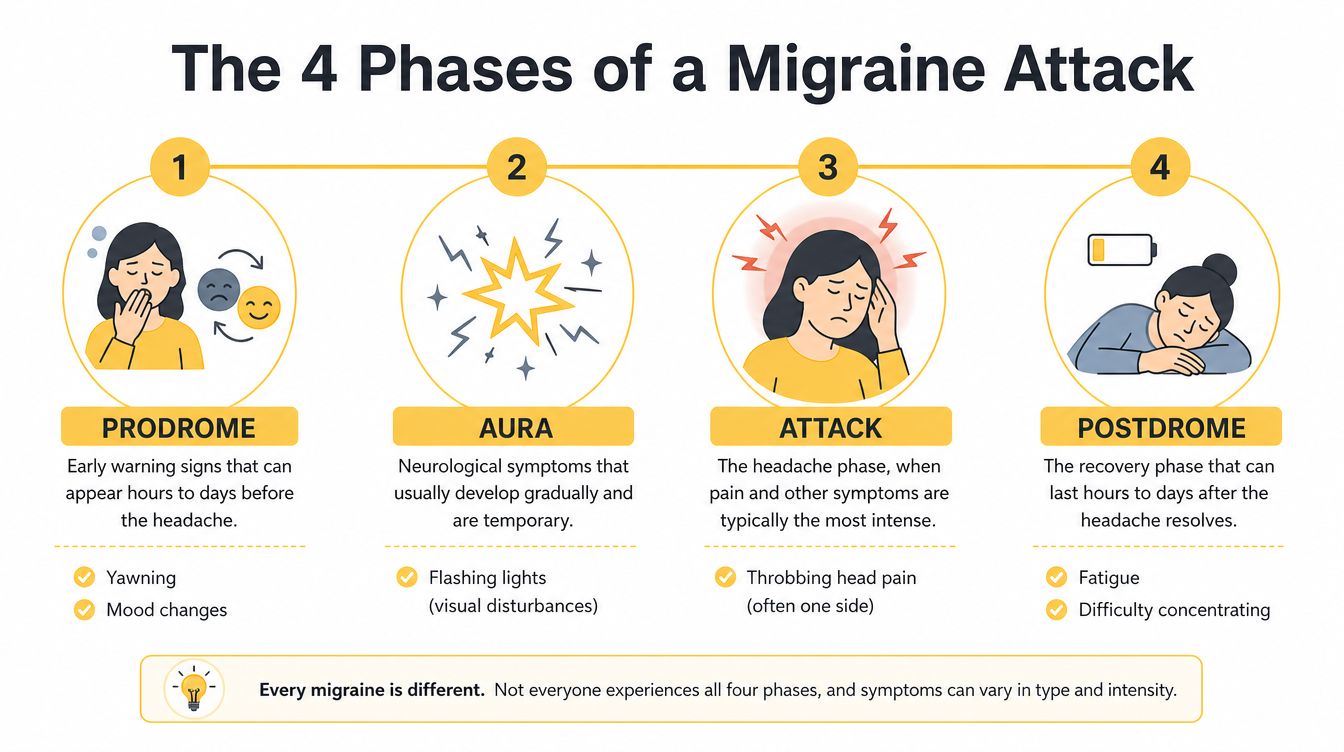
A migraine can also unfold in phases. Not everyone experiences every phase, and symptoms vary between episodic, chronic, vestibular, hemiplegic, and migraine-with-aura presentations.
Learn your earliest warning signs
- Prodrome: Subtle symptoms that can appear before the pain, such as yawning, mood change, food cravings, fatigue, or difficulty concentrating.
- Aura: Temporary visual, sensory, or language changes that occur for some people before or during the attack.
- Attack: The main phase, which may include head pain, nausea, light sensitivity, sound sensitivity, or movement intolerance.
- Postdrome: The drained, foggy, or emotionally flat period after the most intense symptoms ease.
This terminology helps you interpret timing. If you crave sweets during prodrome, the craving may be an early sign that the migraine has already started rather than proof that sugar initiated it. If you record the meal, the craving, and the first neurological symptom separately, the relationship becomes easier to assess.
Try learning your personal prodrome signature. A blood sugar event may be the first noticeable stressor, but your earliest yawning, irritability, or concentration change can show when that event crossed into a migraine attack.
What the Research Shows About Sugar and Migraines
A sweet food can appear in your notes before a migraine without being the cause. The research does not support a simple rule that sugar triggers migraine for everyone. A 2020 review of 43 diet-and-migraine studies found only 20 studies specifically focused on diet-related triggers. It judged the overall evidence quality to be low, and 68% of diet-pattern and trigger studies were cross-sectional or survey-based. The findings are summarized in the 2020 review of diet and migraine research.
These study designs cannot reliably separate cause from timing. Someone may remember eating sugar before an attack, while the food was part of an early symptom, followed a long gap without food, or coincided with another trigger. That uncertainty is why tracking the meal, the time symptoms began, and the time of the attack can be more informative than labeling sugar alone.
A later 2026 U.S. national cross-sectional analysis found a nonlinear relationship between carbohydrate intake and severe headache or migraine. Risk rose above approximately 50.5% of total energy from carbohydrates, with an inflection point at 51.1% of energy. The finding does not prove that sugar caused any individual attack or define a universal carbohydrate target. It suggests that overall intake and metabolic context may matter more than one sweet food.
| Study type | Finding | Evidence strength |
|---|---|---|
| Diet and migraine review | Evidence was mixed, and much trigger research relied on surveys or cross-sectional designs. | Low overall quality |
| National cross-sectional analysis | Carbohydrate intake showed a nonlinear association with severe headache or migraine, with risk increasing above the reported inflection range. | Observational, not proof of causation |
| Mechanistic and genetic research | Glucose regulation, insulin-related traits, and brain energy metabolism appear connected with migraine biology. | Supportive, but not a personal diagnosis |
The practical conclusion is measured: sugar isn't a universal trigger. Inconsistent carbohydrate intake, fasting, and post-meal glucose swings may be more useful patterns to investigate. Tracking can help distinguish a reaction to a specific food from a migraine linked to missed meals or unstable glucose.
How Blood Sugar Swings May Trigger a Migraine
Your brain depends on a steady energy supply. When energy availability changes quickly, neurons may become less resilient to other migraine influences, such as poor sleep, stress, hormonal changes, or sensory overload.
A 2022 scoping review concluded that migraine may involve impaired brain glucose metabolism, creating a mismatch between cerebral energy supply and demand. A review of glucose metabolism and migraine also summarized experimental findings in which hypoglycemia prolonged cortical spreading depression in animal models and lowered the threshold for inducing it by more than 50%. Cortical spreading depression is a wave of changing electrical activity across the brain's cortex, and it's considered relevant to migraine aura and attack biology.
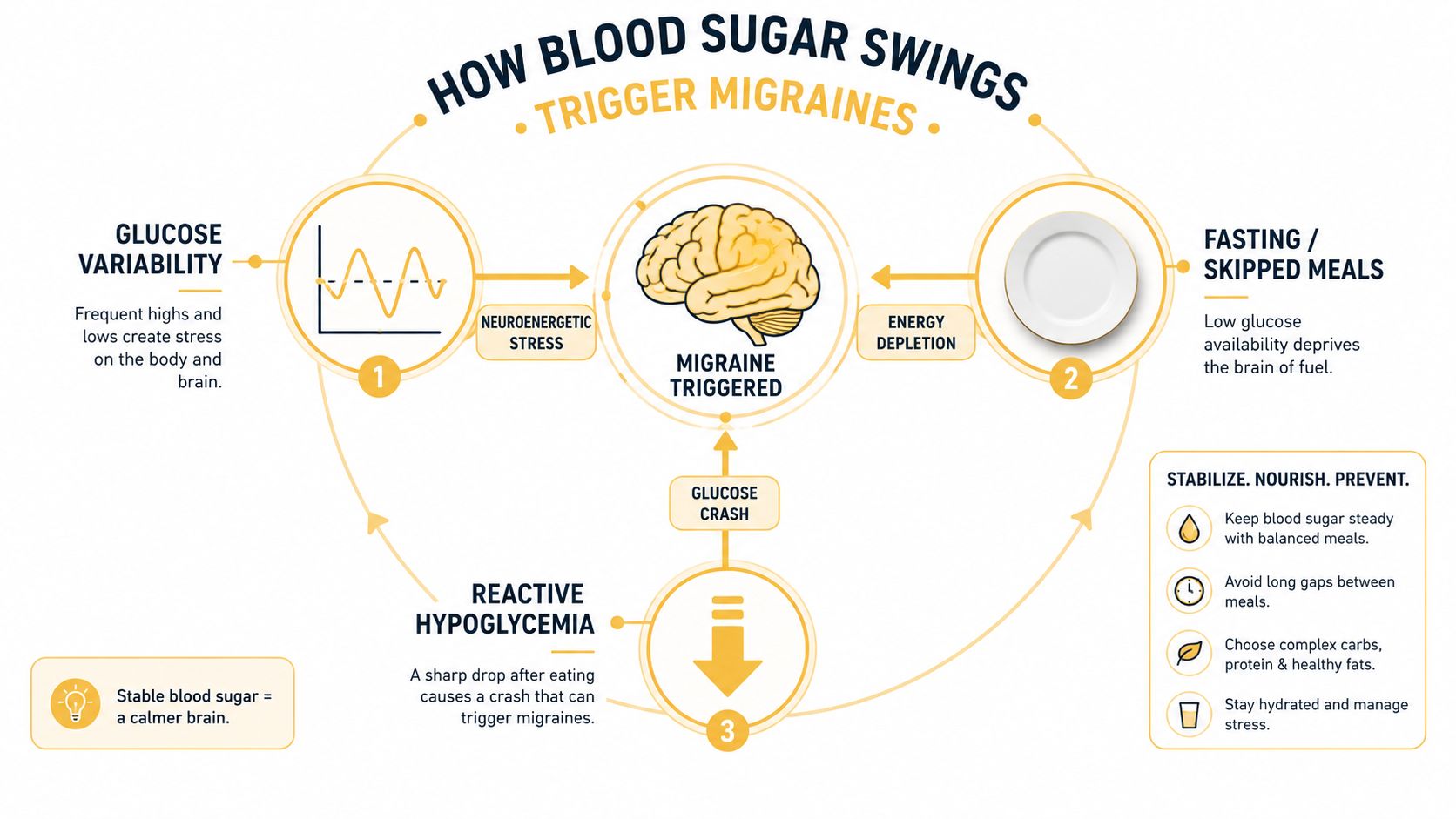
Think of glucose regulation as the brain's energy delivery system. A sweet drink may provide a fast delivery, but a later drop, a long gap without food, or a strong insulin response may create an uneven supply. That instability can place stress on systems involved in cortical excitability, vascular tone, inflammatory signaling, and neurotransmitter balance.
The model doesn't mean every glucose change causes migraine. Blood glucose naturally changes after eating, and many people can eat sweets without symptoms. The more plausible interpretation is that energy instability may lower the threshold for an attack in susceptible people, especially when several triggers arrive together.
Genetic evidence also points beyond anecdotal food avoidance. A 2023 genome-wide cross-trait study found significant genetic correlations between migraine and 2-hour glucose, fasting insulin, and HbA1c. Its causal estimate associated higher fasting glucose with a protective association, OR = 0.88, 95% CI 0.82–0.94, P = 4.48 × 10^-5, which supports the possibility that low or unstable glucose regulation may be the higher-risk state. This is population-level evidence, not a reason to alter glucose medically without professional care.
Recognizing the Timing and Feel of a Sugar-Related Migraine
The phrase “sugar migraine” can describe several different experiences. One person may notice symptoms after a sweet breakfast followed by a long gap without food. Another may develop head pain after fasting, without eating any sugar at all.
During an attack, you might experience gradual throbbing or pressure-like pain, light or sound sensitivity, fatigue, irritability, or brain fog. These symptoms aren't specific enough to prove a glucose trigger, but their timing can provide clues.
A PubMed-indexed study of spontaneous migraine attacks found that plasma glucose was higher during the attack phase than between attacks. Mean glucose was 88.63 mg/dL between attacks and 98.83 mg/dL during attacks, a difference of 10.20 mg/dL. The rise was greatest early in the attack and then fell by 1.57 mg/dL per hour from onset, as reported in the study of glucose during spontaneous migraine attacks.
| Pattern | Typical timing | Common features | Duration |
|---|---|---|---|
| Sweet meal followed by a drop | Within hours of a sugary or high-carbohydrate meal | Fatigue, shakiness, irritability, fogginess, then migraine symptoms | Varies by person and attack |
| Missed meal or extended fast | During or after a prolonged gap without eating | Hunger, weakness, concentration difficulty, head pain, sensitivity to light or sound | Varies by person and attack |
| Migraine-associated craving | Before the obvious pain begins | Strong desire for sweets, mood change, yawning, fatigue, or other prodrome symptoms | May precede the attack |
These patterns overlap, so don't treat timing alone as proof. Record whether the first symptom was hunger, a craving, fatigue, aura, nausea, or pain. That sequence may tell you more than the food label.
How to Tell If Sugar, Skipped Meals, or Crashes Are Your Trigger
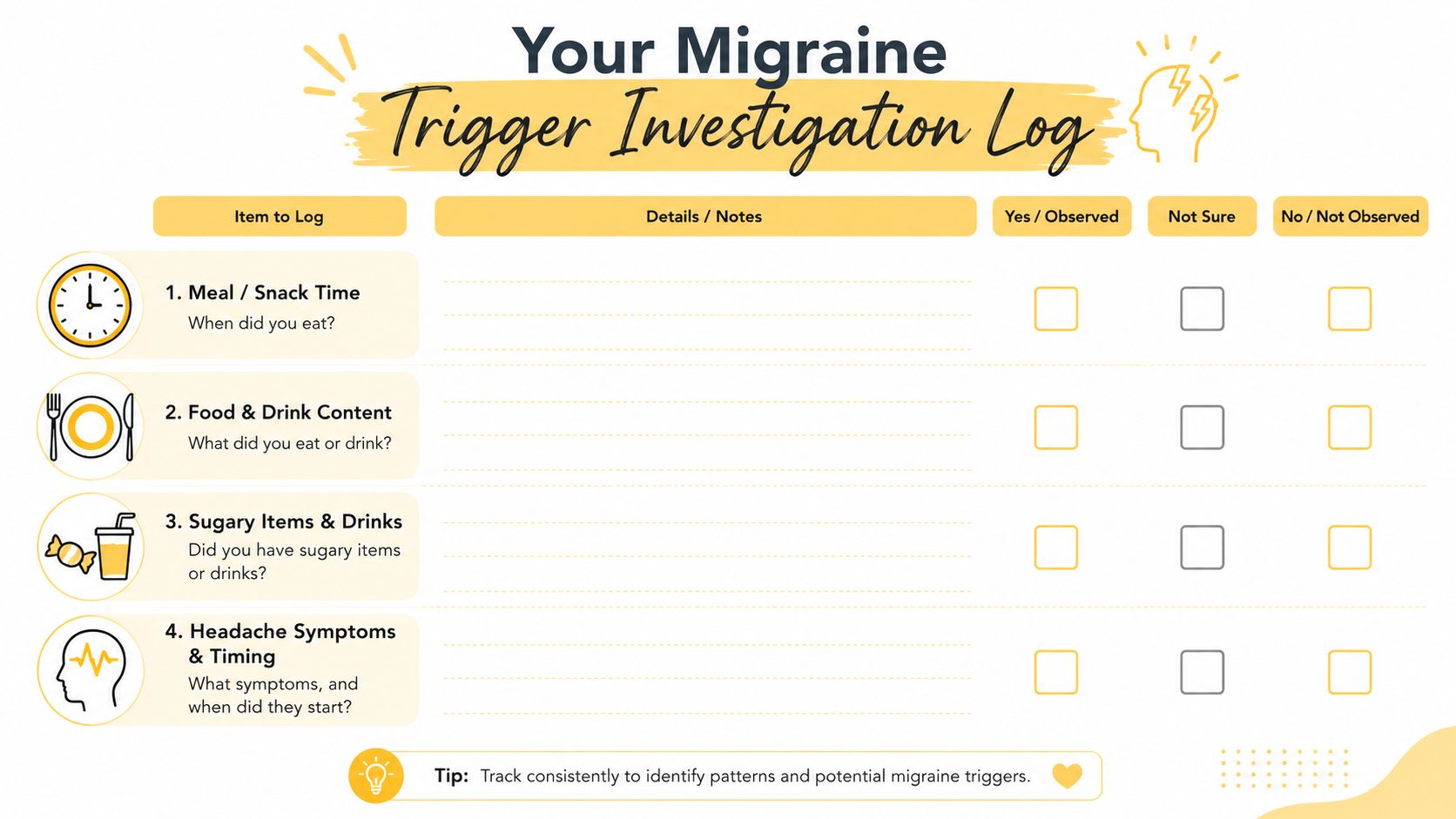
Start with a simple investigation log rather than removing every sweet food. Track enough context to separate the meal from the conditions around it.
Record the conditions around each episode
- Meal timing: Note the time of each meal, snack, sugary drink, and the beginning of any fasting window.
- Meal composition: Record whether the food included carbohydrate, protein, fat, and fiber. “Pastry alone” tells a different story from “pastry with a full meal.”
- Symptoms: Log prodrome signs, aura, pain onset, severity, nausea, light sensitivity, and postdrome fatigue.
- Possible confounders: Include sleep, stress, hydration, exercise, caffeine, illness, and menstrual-cycle timing when relevant.
- Glucose information: If you already check glucose or a clinician recommends monitoring, record readings alongside symptoms. Don't start changing medical treatment based on app or device data alone.
Look for repeated timing rather than a single memorable attack. A pattern appearing within a few hours of high-carbohydrate meals may point toward a post-meal crash. Symptoms that occur during missed meals suggest fasting may matter more than sugar. Attacks following both situations may indicate broader glucose variability.
Test one change at a time. You might pair a sweet item with a balanced meal, avoid a long gap without food, or keep meal timing steadier. Don't eliminate sugar entirely unless your log and healthcare team support that decision.
Use this video as another way to think through what belongs in a trigger log:
Practical Diet and Lifestyle Adjustments That May Help
The goal isn't dietary perfection. It's to test whether steadier energy changes your migraine pattern without creating a restrictive eating plan that's difficult or unsafe to maintain.
Start with meal structure
Some people do better when they eat at regular intervals, such as every 3–4 hours, rather than skipping meals and compensating later. Pairing refined carbohydrates with protein and fiber may slow digestion and reduce a sharp rise-and-fall pattern. For example, you could combine toast with eggs, fruit with yogurt or nuts, or rice with beans and vegetables.
A low-glycemic or Mediterranean-style pattern may be worth discussing with a registered dietitian, particularly if you're unsure how to build balanced meals. The evidence doesn't justify treating any one eating pattern as a guaranteed migraine solution.
Other candidates to trial include:
- Earlier nourishment: Eat more consistently earlier in the day if late-day hunger repeatedly precedes symptoms.
- Dessert timing: Notice whether large late-night desserts affect sleep, morning symptoms, or next-day migraine.
- Hydration: Keep fluids consistent across the day and observe whether dehydration overlaps with suspected glucose triggers.
- Caffeine moderation: Track the amount and timing that precede symptoms rather than assuming caffeine is always harmful or helpful.
- Sleep regularity: Keep sleep and wake times as consistent as your schedule allows, since sleep disruption can complicate food-trigger patterns.
- Moderate movement: Try manageable aerobic activity when you're well enough, while avoiding abrupt changes that add physical stress.
Test one adjustment at a time over 2–4 weeks, then review your log. Your response may differ from someone else's, and a registered dietitian can help personalize changes, especially if you have diabetes, another metabolic condition, or a history of disordered eating.
The Relief migraine tracking app can sit alongside your existing care by helping you record symptoms and potential triggers without treating the condition itself.
Tracking Patterns and When to See a Clinician
A useful log connects four points: what happened before the attack, when the first symptom appeared, how the attack developed, and what recovery felt like. Record meal timing, meal balance, perceived glucose dips, fasting windows, prodrome symptoms, attack severity, and menstrual-cycle timing when relevant.
Review the record after several months rather than reacting to one episode. You may find that a sugary drink only appears before attacks when you've slept poorly, skipped lunch, or exercised without eating. That distinction can prevent unnecessary restriction and gives your clinician a clearer starting point.
Relief can help organize attack details, symptoms, triggers, and related health information so you can review patterns over time. Before using any health app, read its privacy information and decide what you're comfortable recording.
Safety first: Tracking can support a medical conversation, but it can't diagnose hypoglycemia, diabetes, migraine subtype, or another cause of headache.
Seek immediate medical care for a sudden, severe headache, a headache with fever or stiff neck, new neurological changes such as weakness, confusion, trouble speaking, or vision loss, or a headache after a head injury. Contact a healthcare provider promptly if attacks become more frequent or severe, occur during pregnancy, or feel substantially different from your usual pattern.
This article is for informational purposes and is not medical advice. Consult a healthcare provider for personalized guidance. If you have diabetes or another metabolic condition, discuss major dietary changes and glucose monitoring with your healthcare team rather than making changes independently.
Relief helps you log migraine timing, symptoms, suspected triggers, and relevant health patterns so you can investigate whether sugar, fasting, or glucose swings accompany your attacks. Visit Relief to start building a clearer record for your next healthcare conversation.


