You check the weather app, see the air getting heavier, and wonder if the pounding behind your eye is about to turn into a full migraine attack. The short answer is yes, temperature, humidity, and barometric pressure can be associated with migraine risk for some people, but not for everyone, and the pattern is usually more personal than universal.
That matters because migraine is not the same as a headache. Migraine is a neurological condition that can involve head pain, but also nausea, photophobia (light sensitivity), phonophobia (sound sensitivity), aura, dizziness, fatigue, and a drained postdrome phase after the worst pain passes. If weather seems to affect you, you're not imagining it. You also don't need a perfect weather rule to start learning from what your body is already telling you.
Table of Contents
- What often confuses people
- Why personal patterns matter more than weather folklore
- What you can take from this today
- Temperature is the part you feel first
- Humidity describes moisture in the air, and that is where confusion starts
- Barometric pressure is the weight of the air around you
- These three factors usually travel together
- Not everyone with migraine is weather sensitive
- Why studies disagree
- What's still useful despite the uncertainty
- A practical interpretation
- Temperature often shows up first
- Pressure may matter most when it shifts
- Humidity is the most variable of the three
- Weather Factors and Migraine Evidence at a Glance
- Daily weather variables are tightly linked
- Interaction is often the real trigger story
- Why this matters for migraine planning
When Weather Shifts and Migraine Risk Rises
You may know this feeling well. The day starts warm, turns muggy, clouds move in, and by late afternoon you feel that familiar warning: neck tightness, irritability, light sensitivity, maybe the odd sense that your brain is slowing down before the pain fully lands.
That kind of weather-linked pattern is real for some people with migraine. It's also uneven. Some people react most to falling pressure, some to heat, some to sticky humidity, and many to combinations rather than one isolated reading. If you've ever felt dismissed, that variability is part of the reason. The science doesn't support one simple rule for everyone.
What often confuses people
A lot of readers mix up “bad weather” with one number on a weather app. But weather isn't one thing. It's a moving cluster of conditions. A pressure drop before rain can happen at the same time as a temperature swing. Humidity can climb even when the air temperature changes how that moisture feels.
Practical rule: If weather affects your migraine, your pattern may depend more on change over time than on one exact temperature or humidity reading.
Why personal patterns matter more than weather folklore
You've probably heard broad claims like “storms trigger migraines” or “humidity causes headaches.” Sometimes those statements match a person's experience. Often they're too blunt to help. Research shows weather sensitivity is heterogeneous, which means your trigger pattern may not look like someone else's at all.
That's why it helps to think in terms of tracking, not guessing. If you want a deeper overview of the weather-migraine connection, ReliefMigraine's article on whether weather can cause migraine headaches gives broader context.
What you can take from this today
Start with a calmer question: not “What weather causes migraine?” but “What weather shifts tend to show up before my attacks?” That one change in perspective is often more useful than trying to find a universal threshold.
Understanding Temperature Humidity and Barometric Pressure Basics
Weather apps give you three numbers that look simple. Your body may experience them as one shifting pattern.
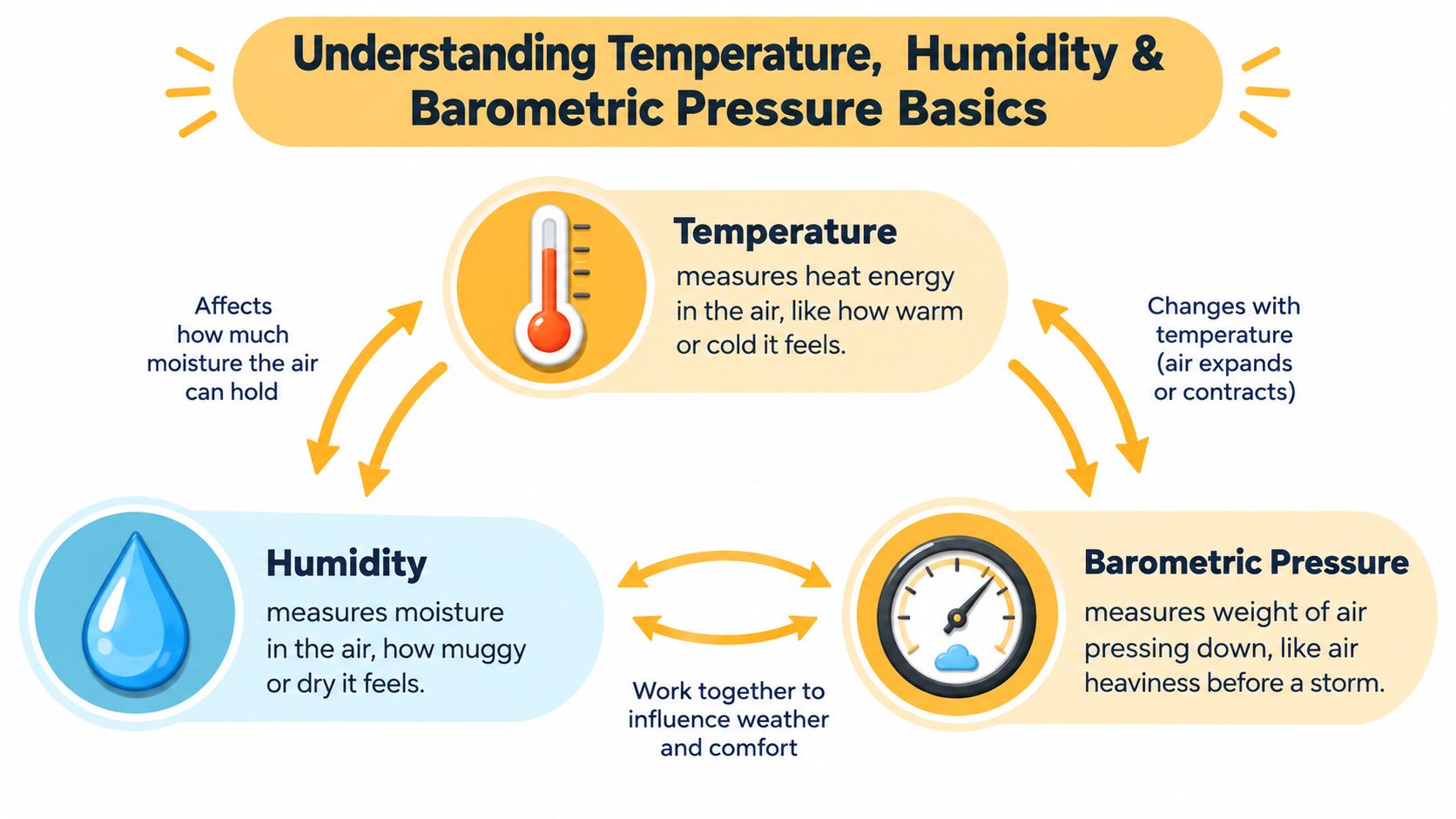
That difference matters for migraine tracking. A day can start cool, turn sticky, and end under falling pressure before rain. If you only glance at one afternoon reading, you can miss the pattern your nervous system went through.
Temperature is the part you feel first
Temperature is how warm or cold the air is. It is the easiest weather measure to notice because your skin and muscles respond quickly to heat and cold.
For migraine patterns, the more useful question is often not "Was it hot?" but "How quickly did it change?" A steady warm day may be uneventful for one person, while a fast jump from cool morning air to hot afternoon air may be harder on that person.
Rate of change can matter as much as the number itself.
Humidity describes moisture in the air, and that is where confusion starts
Relative humidity is a percentage. It compares the moisture currently in the air with the maximum amount the air can hold at that temperature. Dew point is the temperature at which the air would become saturated, according to the Environment and Climate Change Canada weather glossary.
A helpful way to separate them is this:
- Relative humidity tells you how full the air is at the current temperature.
- Dew point gives a steadier sense of how much moisture is in the air.
- How it feels can change fast because warm air can hold more moisture than cool air.
That is why the same amount of moisture can feel very different at 8 a.m. and 3 p.m. Relative humidity may shift partly because the temperature changed, not only because the air gained a lot more water.
Barometric pressure is the weight of the air around you
Barometric pressure, also called atmospheric pressure, is the force the air exerts around us. The U.S. National Weather Service explains pressure as the weight of the atmosphere and notes that changes in pressure are tied to changing weather systems in its JetStream weather school overview of air pressure.
Pressure is harder to sense directly than heat or stickiness. Many people do not notice the number itself. They notice the setup around it, such as a storm building, air feeling heavier, or a familiar pre-rain shift.
For migraine tracking, pressure works less like an isolated trigger and more like one part of a weather pattern in motion.
A pressure reading by itself is rarely the full story. The trend, whether pressure is rising, falling, or swinging quickly, is often more informative.
These three factors usually travel together
In real weather, temperature, humidity, and pressure rarely act alone. They move more like musicians in the same song than separate instruments playing one note each. Before a storm, pressure may fall while humidity climbs and temperature shifts. During a cold front, temperature may drop while pressure rises.
That combined-pattern view is more useful than hunting for one magic number. If migraine tends to follow weather for you, the useful clue may be something like "warm plus sticky plus falling pressure over six hours" rather than "anything above 70% humidity."
This is also why weather tracking can feel confusing at first. Two days with the same temperature can affect you differently because the humidity trend, pressure movement, and timing were different. The goal here is not to memorize meteorology. It is to understand what each number represents so you can spot your own repeating weather sequence with less guesswork.
What Research Really Shows About Weather and Migraine
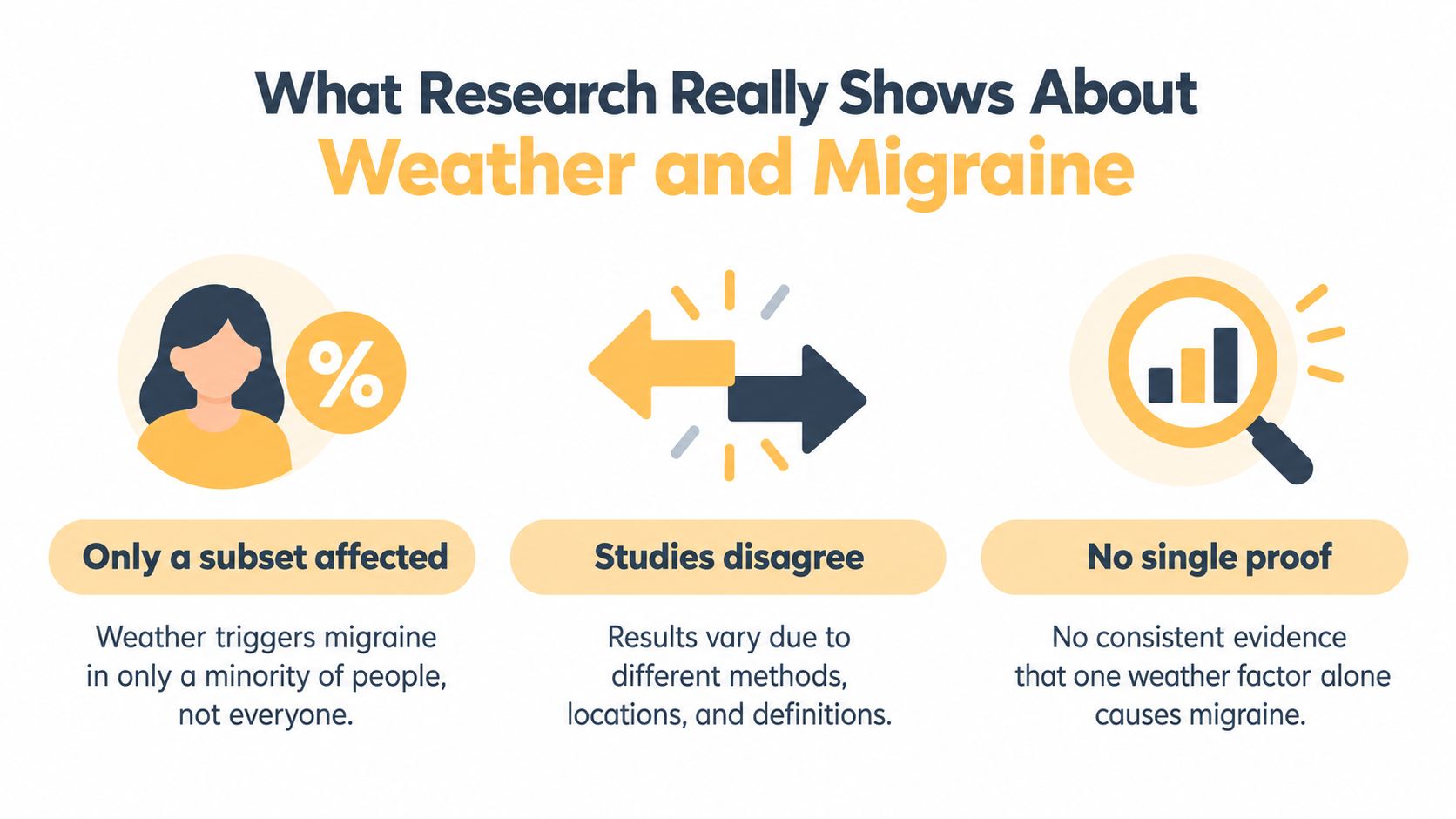
The research is real, but it's not neat. Some studies suggest weather affects migraine risk in a subset of people. Others find weak or inconsistent relationships. That doesn't mean the topic is meaningless. It means migraine and weather form a messy, individualized picture.
Not everyone with migraine is weather sensitive
A review published in 2024 concluded that weather influences migraine in only about 20% of patients, and that relationships involving temperature, humidity, and pressure are inconsistent across studies, according to the review summary available on PubMed Central. That point is worth sitting with for a moment.
If weather clearly affects you, mixed research doesn't cancel your experience. It means population averages don't capture every person's pattern.
Why studies disagree
Weather research is hard to compare because studies use different definitions, locations, time windows, and migraine outcomes. One project may look at emergency visits. Another may use home diaries. One may focus on migraine onset, another on symptom severity. Local climate matters too. A pressure swing in one region may not resemble what another city experiences.
Research also has to deal with overlapping exposures. Heat rarely arrives alone. Humidity can rise at the same time pollution changes. Pressure may drop before a storm while sleep, stress, and routine also shift.
What's still useful despite the uncertainty
A 2025 case-crossover study found that temperature and ambient pressure were both significantly associated with migraine attacks, with temperature showing OR = 1.15 (95% CI 1.02–1.29) and ambient pressure OR = 1.07 (95% CI 1.01–1.15), while humidity was not significant in that dataset, according to the study on PubMed Central.
That doesn't prove humidity never matters. It shows why single-study conclusions can't become universal rules.
Your best working model is usually this: studies suggest weather matters for some people, but your own baseline and your own trend changes are often more useful than copying someone else's trigger list.
A practical interpretation
If you've been chasing one “danger number,” the evidence doesn't really support that approach. It supports something more grounded. Track how your attacks line up with patterns, especially local weather changes in the day or two before symptoms start.
How Each Weather Factor Compares for Migraine Risk
If you want to simplify the evidence, temperature and pressure often get more attention than humidity. But none of the three works as a perfect stand-alone predictor.
Temperature often shows up first
Some studies suggest hotter conditions line up with more migraine activity. A 2015 emergency-department study reported that migraine visits increased with higher temperatures, while relative humidity showed a negative correlation, according to the PubMed abstract.
That doesn't mean every warm day is risky. It means heat is a factor worth tracking, especially if your symptoms ramp up in summer or during sharp warm-ups.
Pressure may matter most when it shifts
A 2011 diary-based study of 28 migraine patients found that migraine frequency increased when barometric pressure fell by more than 5 hPa over the day of the headache and the next day, and decreased when pressure rose by more than 5 hPa two days later. In that study, 18 of 28 patients (64%) had weather-associated migraine, and 14 of those specifically identified low barometric pressure as the cause, as reported in the PubMed study record.
A 2025 systematic review also concluded that evidence is mixed overall. Several studies found migraine frequency increased with barometric pressure drops or rapid fluctuations, fewer studies linked pressure to severity, and no included study found evidence that pressure changes affected attack duration, according to the systematic review on PubMed.
Humidity is the most variable of the three
Humidity is where readers often get frustrated. Findings point in different directions. A prospective study of 98 migraine patients across 4,406 patient-days found that higher relative humidity was associated with higher odds of migraine onset, according to the prospective study on PubMed Central. Yet other work has linked lower humidity with more migraine visits.
That doesn't make humidity useless. It means humidity may be highly context-dependent and may matter most alongside other weather conditions.
Weather Factors and Migraine Evidence at a Glance
| Weather Factor | What Studies Suggest | Consistency Across Studies |
|---|---|---|
| Temperature | Higher temperature has been associated with increased migraine risk in some datasets | Moderate, but not uniform |
| Humidity | Associations vary. Some studies link higher humidity with migraine onset, while others link lower humidity with more migraine visits | Low consistency |
| Barometric pressure | Drops or rapid fluctuations have been linked to migraine frequency in several studies | Mixed, but more repeat support for change patterns than for fixed thresholds |
If humidity is the number you watch most, ReliefMigraine's guide on humidity and headaches adds useful context on why that relationship can feel so inconsistent.
Why Combined Weather Patterns Matter More Than Single Numbers
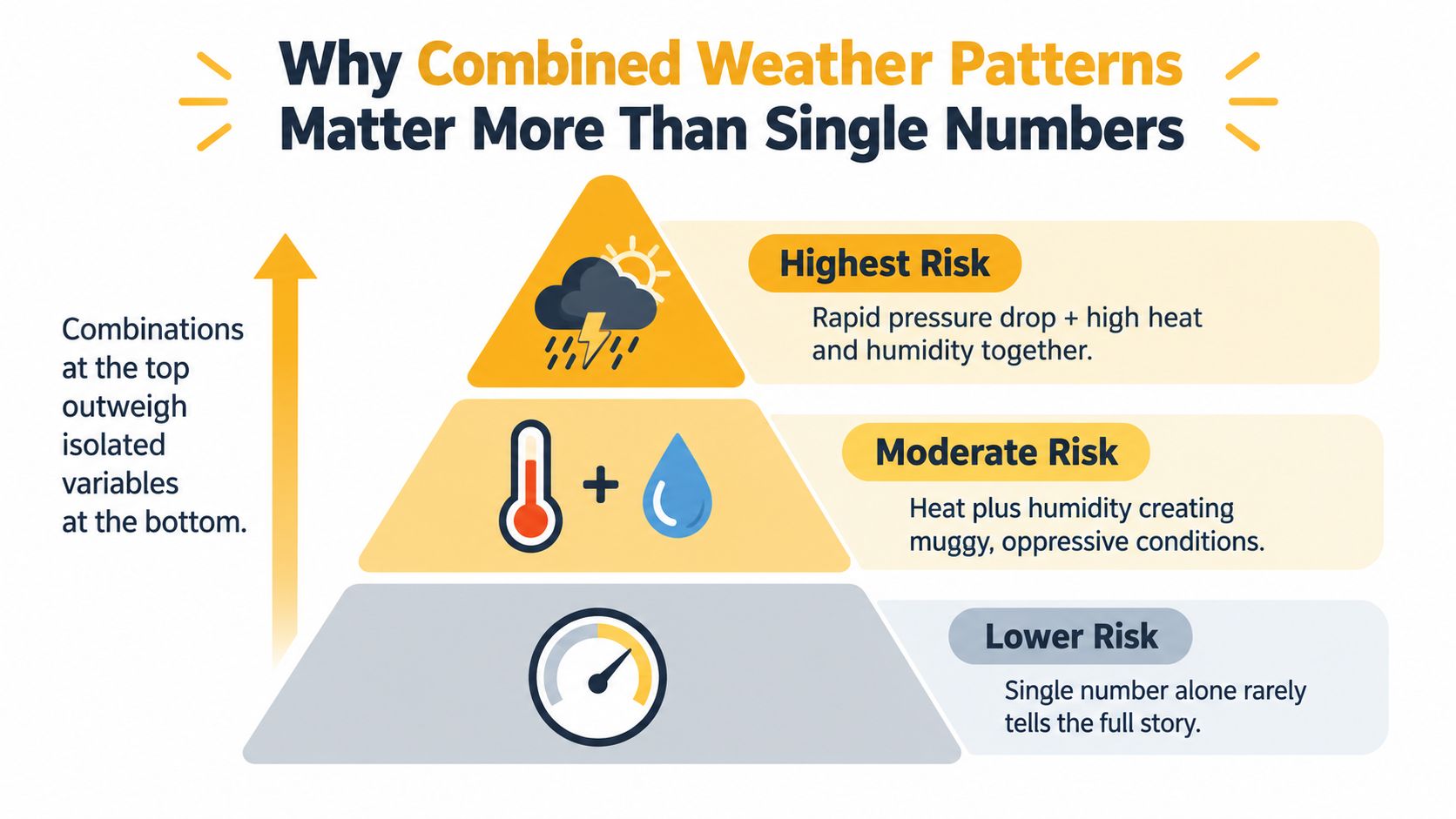
Real life doesn't hand you isolated variables. It gives you a weather stack. Heat builds through the day. Humidity traps that heaviness. Pressure starts to slide before a storm. Your body experiences the whole pattern, not one boxed metric.
Daily weather variables are tightly linked
A published analysis reported a statistically significant inverse relationship between daily mean barometric pressure and mean air temperature, with increased temperature associated with decreased air pressure (R = -0.765, P < 0.01) and increased relative humidity (R = 0.120, P < 0.01). The same study reported daily mean barometric pressure averaging 1023.0 ± 7.5 hPa, with minimum and maximum values of 1020.1 ± 7.8 hPa and 1026.1 ± 7.4 hPa, plus a diurnal variation of 6.1 ± 2.9 hPa, as described in the published analysis hosted by Dove Medical Press.
The practical point is easy to miss. Pressure often changes by only a few hPa across a day, yet those shifts can line up with meaningful temperature and humidity changes. Small weather moves can still matter if they happen in the pattern your body reacts to.
Interaction is often the real trigger story
An emerging 2026 report described evidence that humidity can modify pollution-related migraine risk. In a population-based case-crossover study of 7,032 adults, short-term nitrogen dioxide and solar radiation were associated with emergency migraine encounters, and weekly heat and humidity patterns changed that pollution link. The same report said relative humidity had the strongest association among weather variables, while pressure showed a smaller inverse association, according to the Welltory summary of the study.
Because that report is future-dated, it's best treated cautiously. Still, it points toward a very practical idea: combinations may matter more than any one weather reading.
Watch for clusters like hot plus humid, or falling pressure plus a same-day temperature swing. Those are often more informative than a single threshold like “humidity over X.”
Why this matters for migraine planning
If you've been trying to decide whether humidity alone “causes” your migraine, that question may be too narrow. A better question is whether certain weather packages show up before your attacks. That's much closer to how real environments work.
How to Monitor and Interpret Your Personal Weather Patterns
Weather science becomes useful. You don't need to become a meteorologist. You need a simple system you can keep using even when your energy is low.
Start with the visual guide below, then keep the process small enough to be realistic.
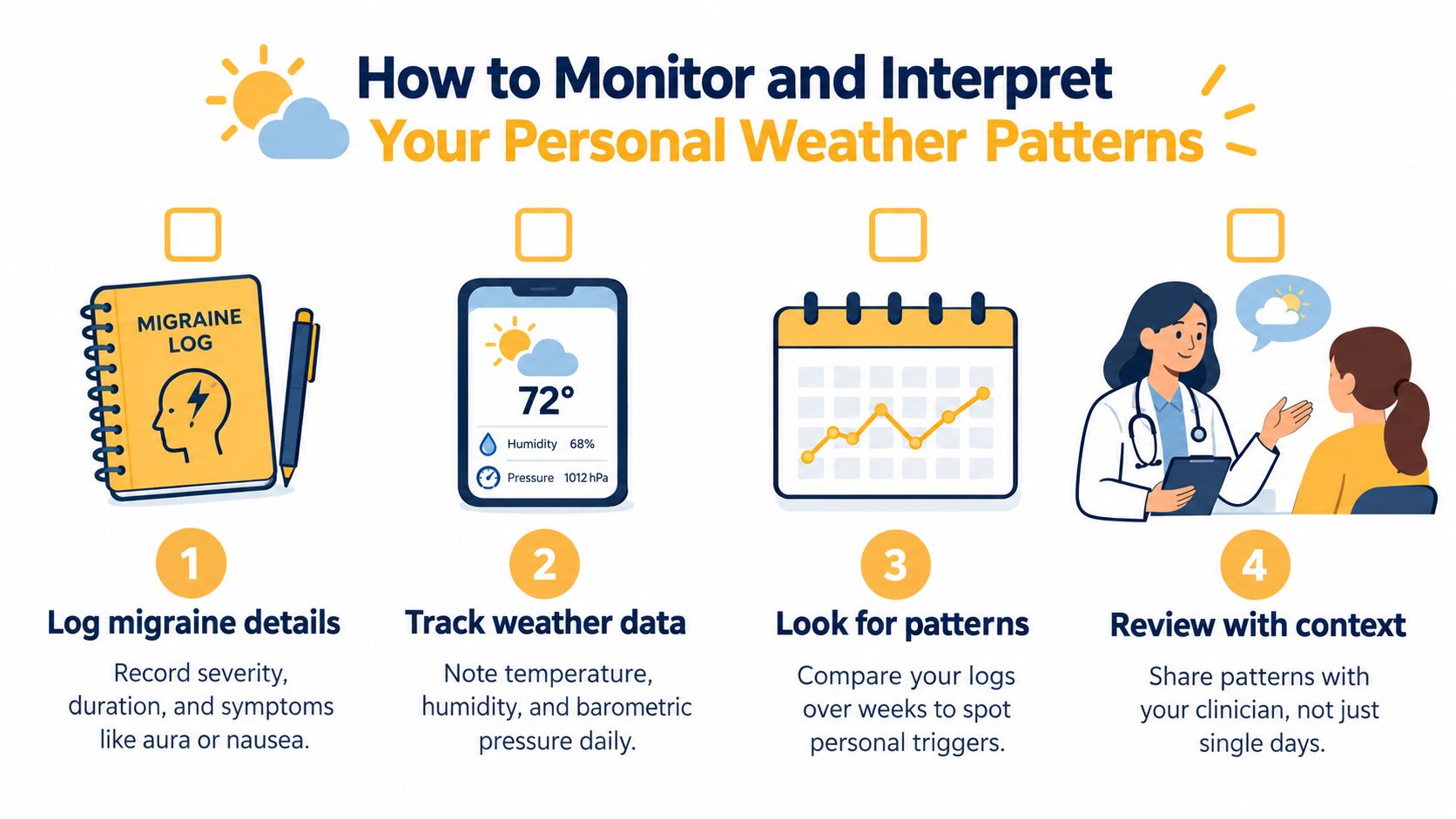
What to log each day
Don't only log pain. Migraine often starts before the pain phase.
- Symptoms before pain: note possible prodrome signs such as fatigue, food cravings, mood changes, or neck discomfort.
- Neurological features: if you experience aura, write down what happened, such as visual changes, numbness, or language disruption.
- Sensitivity symptoms: record photophobia, sound sensitivity, nausea, dizziness, or motion sensitivity.
- Timing details: note when symptoms began, when pain peaked, and when the postdrome faded.
- Context: include sleep disruption, stress, skipped meals, menstrual cycle changes if relevant to you, medication use, and unusual exertion.
A plain notebook works. A spreadsheet works. An app can make this faster.
Log weather at onset and before onset
One of the most common tracking mistakes is checking the weather only when the attack is already in full swing. Try recording weather at two points:
- At symptom onset
- During the 24 to 48 hours before onset
That's often where trend changes show up. A stable day with high humidity might not matter much for you, while a rapid rise after a dry spell might.
For people who want environmental context in one place, ReliefMigraine's barometric pressure headache map guide shows how location-based weather views can support tracking.
Here's a short explainer if video is easier than reading when your brain feels foggy.
Look for repeated exposure, not perfection
You are not trying to prove causation. You're trying to identify useful correlations.
A practical review habit:
- Scan for repeats: did attacks often start after warm, muggy days or after falling pressure?
- Compare with migraine-free days: was the same weather common even when you felt fine?
- Notice intensity changes: does one pattern seem linked to aura, nausea, or longer recovery?
- Track early response: when the pattern appears, do hydration, rest, routine protection, or your clinician-approved treatment plan help more if you act early?
If a tool shows weather and migraine logs together, focus on whether your attacks follow change patterns over time. One impressive-looking number by itself usually won't tell you much.
One option is Relief, which combines migraine logs with local weather and environmental signals such as humidity, temperature, barometric pressure, wind, and air quality so you can compare symptoms against those trends over time.
Recognizing Patterns and Knowing When to Seek Care
After a few weeks or months of tracking, the useful questions start to change. Instead of asking whether weather matters at all, you can ask whether your migraine-free streaks shorten during certain seasons, whether your total migraine hours rise during certain patterns, or whether attacks become more severe when the same cluster returns.
That kind of review can help you respond earlier. If you notice frequency climbing during periods of heat plus humidity or around rapid pressure swings, you can protect sleep, reduce overload, keep rescue plans accessible, and talk with your clinician about what you're seeing. Tracking supports awareness. It doesn't replace diagnosis or treatment.
When to get medical help quickly
This article is for informational purposes and is not medical advice. Consult a healthcare provider for personalized guidance.
Seek immediate medical care if you have:
- A sudden severe headache: especially one that feels abrupt or unlike your usual migraine
- Headache with fever or stiff neck: these can signal a medical emergency
- Neurological changes: such as new weakness, confusion, trouble speaking, fainting, or seizure
- Headache after head injury: even if symptoms seem delayed
When a routine appointment makes sense
If migraine attacks are becoming more frequent, changing in pattern, or interfering with work, caregiving, driving, or sleep, bring your logs to a healthcare visit. A pattern journal is often more useful than trying to remember rough impressions from the last few months.
Weather sensitivity can be real without being simple. The goal isn't to control the sky. It's to recognize your own pattern early enough to make the next day more manageable.
If weather shifts seem to line up with your attacks, Relief can help you log symptoms, medications, and likely triggers alongside local pressure, temperature, humidity, air quality, and pollen. Over time, that makes it easier to spot whether your migraine risk rises with isolated weather numbers or with the combined patterns that usually matter more.


