Thunderstorms and Migraines: Can Storms Trigger Attacks?
Thunderstorms and migraines: what research shows about pressure, lightning and humidity, plus a simple way to track your own storm pattern.
In this guide
Storm clouds on the radar, pressure behind your eye. Does one cause the other?
Partly, and the "partly" is where things get interesting. If your attacks tend to arrive ahead of a thunderstorm, you're describing a pattern that shows up in population data, not a coincidence your doctor should wave away. What the evidence doesn't support is the tidy version, where a storm rolls in and causes a migraine in everyone it passes over. It also can't tell you which part of the storm is doing the work.
That last gap matters more than it sounds. Most advice treats a thunderstorm as a single event, so the only lever you're given is "watch the weather." But a storm is a bundle of separate exposures, and the research on thunderstorms and migraines looks very different depending on which one you isolate. Some have solid support. Some have almost none, despite being repeated everywhere.
This guide breaks the storm apart, factor by factor, and shows you how to test which one tracks with your own attacks. Where the evidence is thin, it says so.
Can Thunderstorms Really Trigger a Migraine?
For some people, yes. Thunderstorms and the weather shifts that travel with them are associated with migraine attacks, and the association holds up across large studies. What research has not shown is that a storm causes an attack in everyone it passes over, or that the storm itself is the culprit rather than one of the changes inside it.
If your attacks seem to land with a front, you're not imagining it. Being told it's stress, or that you should stop checking the radar, is a particular kind of exhausting when you've watched the pattern repeat for years.
Some of the confusion comes from treating "headache" and "migraine" as interchangeable. They aren't. Migraine is a neurological condition, and an attack often moves through stages:
- Prodrome: early warning signs hours or a day before pain, such as yawning, food cravings, irritability, or neck stiffness.
- Aura: temporary visual, sensory, or speech changes, which some people get and many don't.
- Headache: frequently one-sided, often with nausea and with photophobia (sensitivity to light) or sound sensitivity.
- Postdrome: the foggy, drained day that follows.
Tension-type headache usually lacks those stages, and it responds to a different set of triggers.
Weather sensitivity is common, though far from universal. A UPMC HealthBeat review of weather and headache reports that, according to the American Migraine Foundation, more than one-third of people with migraine say weather changes affect their pain, while more than half of patients receiving treatment at a headache clinic report weather-triggered attacks. Storms, lightning, extreme temperatures and pressure changes are all among the reported exposures.
Weather is one candidate among several, and it rarely acts alone. Sleep debt, missed meals, dehydration, stress, hormonal shifts and bright light move the same needle, often at the same time.
Three things you can do today:
- Note the next storm you notice, before it arrives, and write down the date and time.
- Record any prodrome symptoms you feel, even vague ones like yawning or irritability.
- Capture the weather that day, including whether pressure was falling.
This article is for informational purposes and is not medical advice. Consult a healthcare provider for personalized guidance.
Storm Factors Compared Side by Side
Treat a thunderstorm as a bundle of exposures rather than one event, and the research starts to make sense. Here's how the main factors compare.
| Storm factor | What research reports | Strength of link | How to track it |
|---|---|---|---|
| Ambient pressure | Pooled odds ratio 1.07 (95% CI 1.01-1.15) | Significant but modest | Log daily pressure and whether it fell over the prior 12-24 hours |
| Temperature | Pooled odds ratio 1.15 (95% CI 1.02-1.29) | Significant | Note daytime highs and sudden swings from one day to the next |
| Humidity | Pooled odds ratio 1.04 | Not significant overall | Record it, but don't assume it triggers you without your own data |
| Lightning | Associated in one cohort; adjusted odds ratio 1.18 | Significant after adjustment; causation unclear | Mark lightning days as a separate entry from pressure |
| Wind and rainfall | Reported in some studies | Inconsistent across studies | Note wind speed and when rain started |
How to read an odds ratio without overreading it
An odds ratio compares the odds of an attack under one condition with the odds under another. A value of 1.15 means roughly 15 percent higher odds on the relevant days. That's a population average, describing a small shift across thousands of people, not a prediction about your Thursday.
A 2025 systematic review and meta-analysis of 31 studies put temperature at an odds ratio of 1.15 (95% CI 1.02-1.29) and ambient pressure at 1.07 (95% CI 1.01-1.15). Humidity came in at 1.04, with a confidence interval spanning no effect, which undercuts the widely repeated idea that muggy air alone reliably sets off an attack.
If humidity is on your own suspect list, our guide to weather and humidity as migraine triggers covers how to test it against your attack history rather than assuming it.
Practical rule: track the two or three factors that match your own experience first. A log with twenty columns gets abandoned by the second week.
What the pooled data can't settle
There's a second question hiding underneath the first: does weather change how bad an attack gets, or how long it lasts? The same review found inconsistent findings for migraine frequency, unclear links with severity, and no demonstrated relationship with attack duration. So a storm forecast can reasonably nudge your estimate of whether an attack might start. It can't promise anything about how severe it will be.
Wind and rainfall show up in some studies and not others, which is what you'd expect when the measurements themselves vary so much between research groups.
How Falling Pressure Relates to Migraine
You can't see barometric pressure, which is much of why the subject feels abstract. It's the weight of the air above you, and it falls as a low-pressure system moves in ahead of a storm.
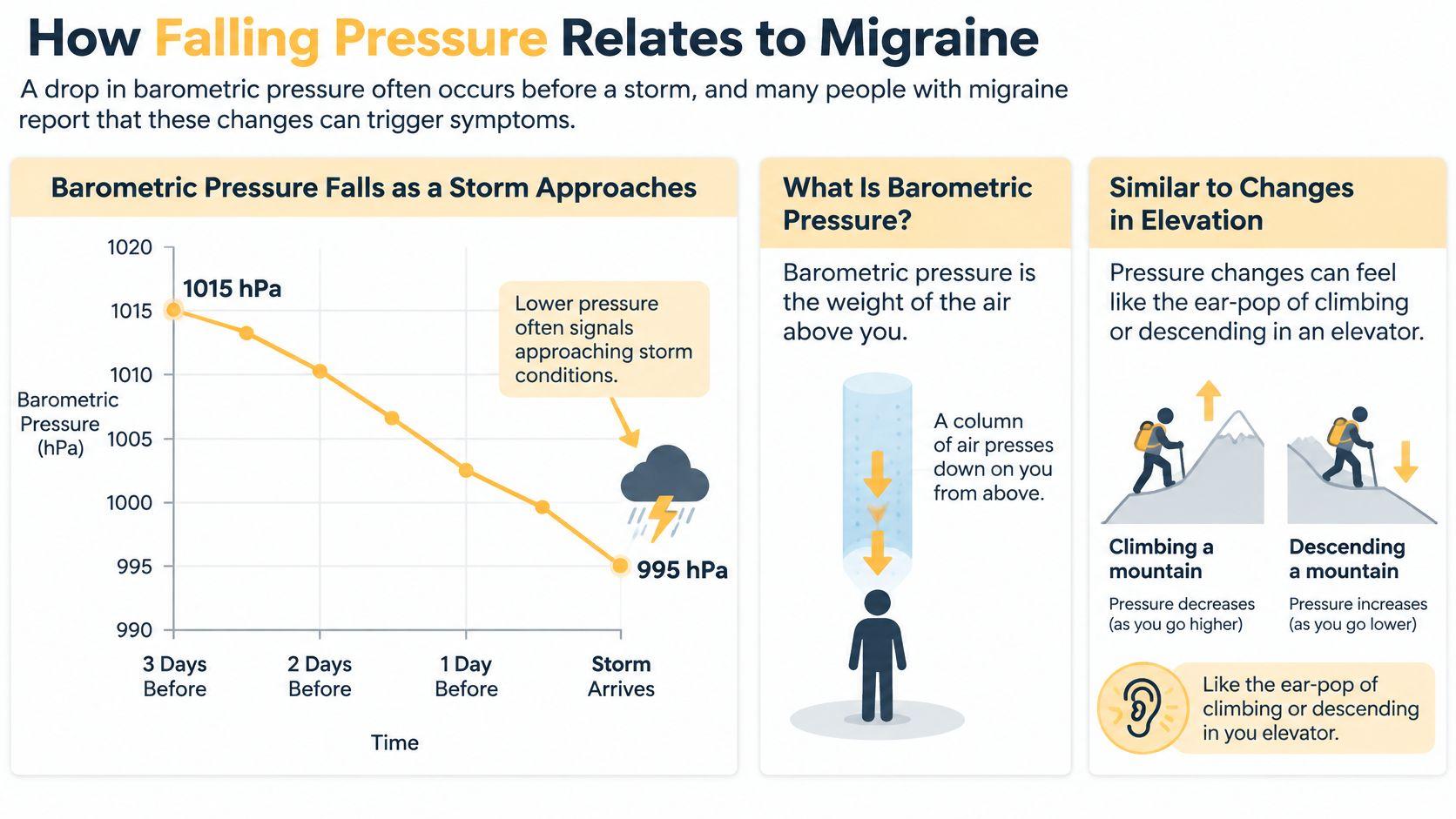
The sensation sits closer to the ear-pop of a plane climbing or descending than to anything you'd call weather. Your sinuses and middle ear register the change even while the number in the app looks meaningless.
What a controlled experiment showed
A pilot experiment gives the idea some biological footing. Fifteen healthy participants spent eight-minute periods at reduced barometric pressure and developed headaches during the decompression or when pressure returned to ambient levels, as described in a 2024 review of weather and migraine. Healthy volunteers aren't people with migraine, and a pilot isn't a trial. What it does establish is that pressure change alone can produce head pain, which makes this a plausible pathway rather than a folk belief.
Migraine and tension-type headache diverge here
The gap between diagnoses shows up in survey data too. In a small Japanese study, 75 percent of participants with migraine reported attacks tied to falling barometric pressure, compared with 20 percent of people with tension-type headache, as summarized by the American Migraine Foundation. The sample was small, so read that 75 percent as a signal about migraine specifically, not as your personal odds.
If you'd rather see the pattern than read it, this short walkthrough covers the sequence.
A single reading tells you almost nothing. What matters is the slope: how far pressure fell across the previous 12 to 24 hours, and how quickly. Watch for the drop, not the number, and keep a record that shows the trend over several hours so you can line it up against when your symptoms started.
Is Lightning the Trigger or Just a Marker
Lightning is the most cinematic part of a storm and the hardest to study, because it never arrives alone. It comes bundled with the pressure, temperature, humidity and wind changes that define the weather around it.
The contrast is a familiar one: an attack building as the sky darkens, then the flat, washed-out hours afterward.

A peer-reviewed observational cohort of 90 people with migraine in the Midwestern United States found headache odds were higher on lightning days than on non-lightning days, at an odds ratio of 1.31 (95% CI 1.07-1.66). After adjusting for temperature, humidity, barometric pressure and wind, the association weakened to 1.18 (95% CI 1.02-1.37) and stayed statistically significant, according to the peer-reviewed cohort study on lightning and headache.
What the adjusted figure actually asks
Adjusting for the other storm variables poses a sharper question: does lightning carry information the rest of the weather doesn't already carry? The answer was a smaller but still positive effect. That's consistent with lightning contributing something of its own, or with it marking a more violent storm whose other features weren't fully captured.
Lightning may be the smoke alarm rather than the fire. It tells you something is happening. It doesn't tell you what's burning.
The design limits the conclusion. An observational cohort watches what happens without controlling the exposure, so the clinically relevant trigger could still be a rapid pressure change, a sharp temperature shift, sleep torn apart by a 3 a.m. thunderclap, stress, dehydration, or pollutants moving with the storm.
A modest average effect also doesn't mean every person with migraine is lightning-sensitive. Many in that cohort presumably had attacks on ordinary days too.
How to test it on yourself
If lightning is on your suspect list, give it its own column, separate from pressure. Then compare three kinds of day: lightning with a steep pressure drop, lightning with stable pressure, and a pressure drop with no lightning anywhere near you. Whichever keeps appearing alone is the better candidate, and whichever only appears alongside everything else is probably a passenger.
Track Your Own Storm Pattern
Memory is a poor record keeper. You remember the storm that flattened you and forget the four that passed without incident, which is why a written log beats intuition even when intuition has been right before.

The log that's actually sustainable
Start with one row per attack. Record the start time, the stage you were in (prodrome, headache or postdrome), and severity on a 0-10 scale. Then add the day's context, and only the parts you can capture in under a minute:
- Pressure trend over the previous 12 to 24 hours, not the raw reading.
- Temperature swing from one day to the next, plus the daytime high.
- Humidity, wind and any lightning, each in its own space.
- Sleep length, meal timing, fluid intake and stress, since these stack with weather.
- Menstrual cycle day, if that's relevant for you.
Label each day as a storm day, a storm within 24 hours, or no storm. That third label is the one people skip, and it's the one that makes comparison possible.
Four steps from data to pattern
- Keep the log for six to eight weeks. Shorter windows catch luck, not patterns.
- Compare attack days with your usual days, not with a single dramatic storm.
- Look for repeated overlap. One attack after one thunderstorm is a coincidence until it happens again.
- Take the summary to a healthcare provider and ask which patterns deserve attention.
If you want a structured way to sort signal from noise, our guide to identifying your migraine triggers walks through the comparison method in detail.
Scale helps here. A 2023 Japanese study involving more than 15,000 people with migraine reported associations between headaches and changes in barometric pressure, humidity and rainfall, as reported by USA Today, while noting that migraines often involve several triggers firing together. A thunderstorm may be one contributing factor alongside disrupted sleep, missed meals, heat, dehydration, stress or light exposure.
Tracking shows you a pattern. It doesn't prove a cause, and a pattern that has appeared once isn't a pattern yet.
Relief fits the workflow by comparing the days before your attacks with your usual days to find triggers, looking at pressure, humidity, temperature swings, sleep and the stress signal. Personal adjustments to the forecast start after about 10 attacks or a month of regular use, and every forecast score is a risk index for today rather than the chance of an attack, so false alarms happen, more often in the first weeks.
This article is for informational purposes and is not medical advice. Consult a healthcare provider for personalized guidance.
On the next storm day, write down what you noticed before you forget it.
Planning Your Day Before a Storm Arrives
A forecast tells you a storm is coming. It doesn't tell you an attack will follow, and false alarms are part of the deal.

A storm-day checklist
- Keep sleep and meal times steady. A front is a load on your system, and skipping lunch adds another.
- Drink fluids steadily through the day instead of one heroic glass at 6 p.m.
- Have your usual acute plan within reach, as agreed with your clinician, so you're not searching for it at the worst moment.
- Move the demanding thing earlier. Shift a presentation, an exam or a hard deadline forward if the calendar allows it.
- Cut glare if light bothers you. Dim screens, lower the blinds, and take the seat away from the window if photophobia is part of your attacks.
- Tell one person your plan. A colleague, partner or friend who knows what to do saves you explaining mid-attack.
The medication habit worth questioning
Acute pain relief has a ceiling that isn't about dose. Using it on many days of the month can itself produce medication-overuse headache, a pattern where the treatment starts feeding the problem. Ask your clinician what a safe monthly limit looks like for you, rather than deciding by feel during a bad stretch.
Before you refill: if you're reaching for acute pain relief more days than not, that's a conversation to have with your clinician, not a habit to push through.
If you're the one supporting someone with migraine
Partners and caregivers can take on the boring parts: keeping the checklist visible, noticing when someone goes quiet or stops eating, and handling logistics so the person with migraine doesn't have to negotiate them mid-prodrome. Students and people in deadline-heavy jobs can build a buffer into the calendar the day before a forecast storm, when the pressure drop is already underway.
When a Storm Headache Needs Urgent Care
Most storm-linked attacks, however miserable, are not emergencies. A handful of symptoms are, and they don't wait for a convenient moment.
Call your local emergency number for any of these:
- A sudden, severe headache that peaks within minutes
- A headache with fever and a stiff neck
- Neurological changes such as one-sided weakness or numbness, slurred speech, vision loss, confusion, or a seizure
- Any headache after a head injury
A headache that is unusual, changing, or the worst you have ever had also needs prompt assessment.
The thunderclap pattern deserves its own explanation, and our guide to what a thunderclap headache feels like and why it needs urgent assessment covers the signs in more detail.
For everything short of that, book an appointment if your attacks are becoming more frequent, if the pattern has changed in character or location, or if the plan you've been using no longer helps. Those are ordinary reasons to get checked, not overreactions.
Weather apps can tell you a storm is coming, but they can't tell you whether your body will respond to the pressure drop, the temperature swing, or something else entirely. Relief compares the days before your attacks with your usual days, so the factors that line up with your migraines become visible instead of guessed at. Each morning you get a forecast score with the reasons behind it, and logging an attack takes seconds.
This guide is general information, not medical advice, and it isn’t a diagnosis. Talk to your doctor about your own headaches.