A muggy morning arrives, you check the forecast, and by late morning the familiar pain has started behind one eye. Weather and humidity may be connected to migraine for some people, but humidity isn't a universal trigger or a reliable explanation on its own. The useful question is more personal: which humidity pattern, alongside which temperature, pressure, season, and health conditions, tends to appear before your attacks?
This article translates the research into a practical way to track that pattern. You'll learn why relative humidity and dew point aren't interchangeable, what the evidence can and can't prove, and how hour-by-hour weather data can become a signal rather than another number to worry about.
This article is for informational purposes and is not medical advice. Consult a healthcare provider for personalized guidance.
Table of Contents
Why Humidity Keeps Showing Up in Your Migraine Diary
You've had another difficult week. Looking back through your diary, you notice that several attacks began on days described as humid, heavy, or stormy. That pattern can feel persuasive, especially when the same weather seems to return before symptoms.
The humidity-migraine link is real enough to study, but it isn't simple enough to treat as a universal rule. In a prospective diary-based cohort of 98 adults with migraine, a 26.5% increase in the three-day moving average of relative humidity was associated with 28% higher odds of migraine onset, mainly during the warmer season from April through September, according to the published cohort research.
That finding helps explain why humidity may keep appearing in your own records even while broader research remains mixed. Humidity is one of the weather variables that changes over the course of a day and can overlap closely with the hour an attack begins. A weather app might show one daily percentage, while your body experiences a rising morning value, a damp afternoon, or a sharp change after a front moves through.
Three reasons the pattern feels so noticeable
It changes quickly. Outdoor moisture can shift as air warms, cools, or moves through a weather system. Indoor conditions can differ from the outdoor reading, particularly when heating or air conditioning is running.
It interacts with other conditions. Temperature changes can alter relative humidity without adding or removing the same amount of water vapor. Pressure changes, sleep disruption, dehydration, and heat exposure may occur during the same weather pattern, making it difficult to isolate humidity.
It has a memorable physical quality. A sticky afternoon, foggy morning, or stormy evening is easy to remember alongside pain, nausea, aura, or light sensitivity. That memory can help you spot patterns, but it can also make a single striking day feel more conclusive than it is.
A useful starting point: treat humidity as a possible context signal. Don't label it a trigger until your own records show a repeated relationship.
Migraine itself is more than a generic headache. It can include aura, temporary neurological symptoms such as visual or sensory changes; photophobia, sensitivity to light; and phases such as prodrome before pain and postdrome afterward. Your pattern may also differ if you experience chronic, episodic, vestibular, or hemiplegic migraine.
The rest of the evidence points in the same practical direction. Humidity may matter for some people, during some seasons, and alongside particular combinations of temperature and pressure. Hourly tracking can help you test that possibility without assuming that every damp day will lead to an attack.
How Humidity Actually Works in the Air Around You
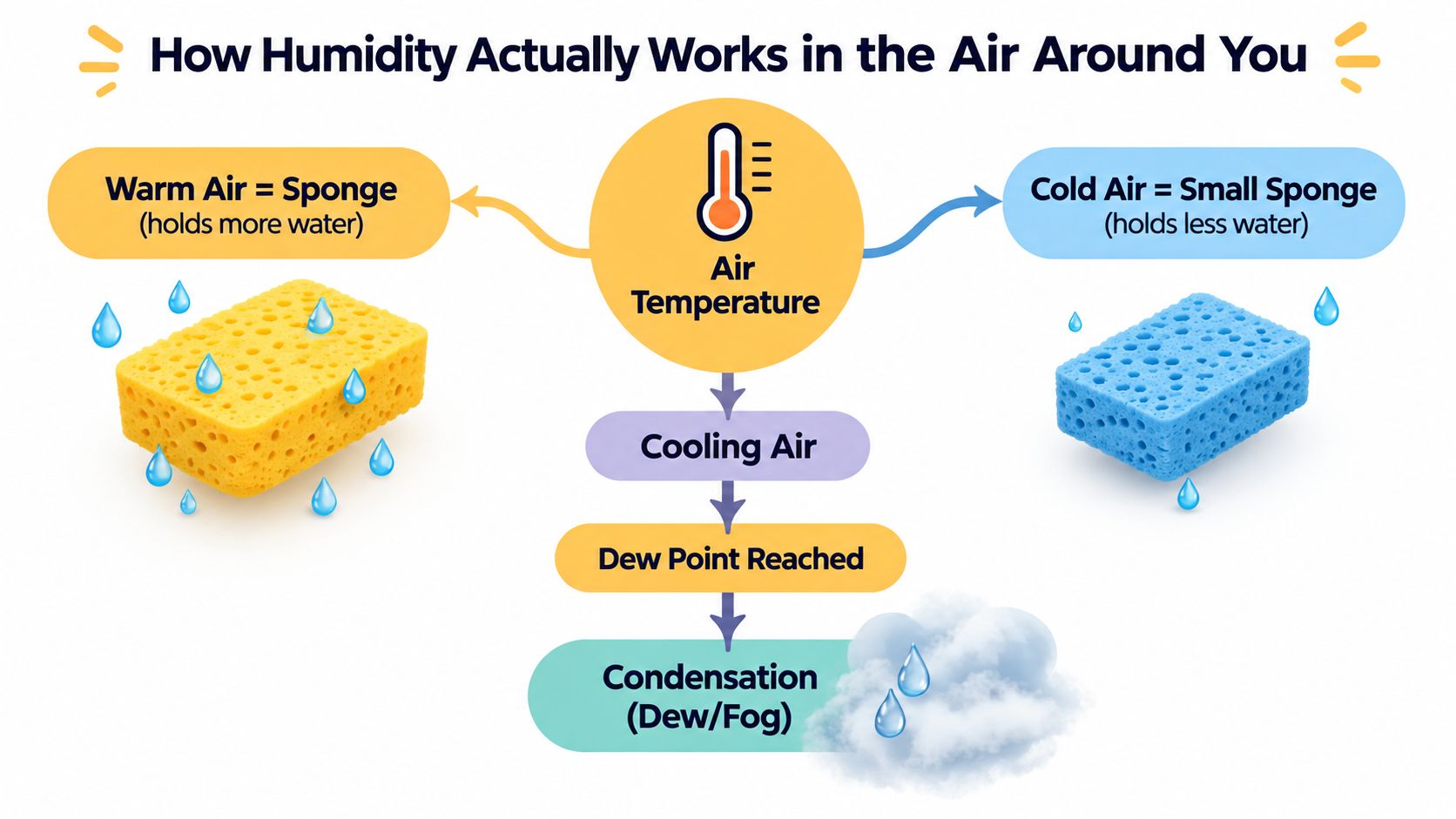
Humidity describes water vapor in the air, but weather apps usually present it through relative humidity, a comparison rather than a direct measure of moisture. Think of air as a sponge. Warm air is a larger sponge that can hold more water vapor, while cold air is a smaller sponge with less capacity.
Relative humidity tells you how full that sponge is at its current temperature. If the air contains the same amount of water vapor all day, relative humidity can fall as the air warms and rise as it cools. That's why a morning and afternoon can show different relative humidity readings even when moisture has not changed to the same degree.
Relative humidity and dew point are not the same
Dew point reflects the actual water-vapor content more directly. If air cools to its dew point, it reaches saturation and relative humidity becomes 100%, producing condensation such as dew, fog, or clouds. A large gap between air temperature and dew point generally indicates drier air.
Two days at 60% relative humidity can feel very different because the temperatures may differ. A warmer day can contain substantially more water vapor at the same relative humidity, which is why dew point is often more useful for judging how sticky or muggy conditions may feel. Weather-service guidance describes dew points around 55 to 65°F as often feeling sticky or muggy in practical comfort terms, as explained in the National Weather Service glossary.
Absolute humidity is another way to describe the amount of water vapor in a given volume of air. You won't always see it in a standard forecast, and many migraine studies use relative humidity instead. For everyday tracking, record the relative humidity shown by your weather source, then add dew point and temperature when available.
Indoor air deserves its own line in your notes. Heating can make winter air feel dry, while air conditioning can change the indoor environment in another direction. A single outdoor percentage can't tell you what you breathed, slept in, or worked in for most of the day.
What the Latest Research Actually Finds
The research doesn't support a simple statement such as “humidity causes migraine.” It shows several narrower findings, and those findings don't all measure humidity in the same way.
The prospective cohort described earlier followed 98 adults with migraine using diary data. Its result linked a 26.5% rise in the three-day moving average of relative humidity with 28% higher odds of onset, mainly in the warmer months, rather than establishing that every humid day produces an attack. That distinction matters because an association describes a pattern in a group. It doesn't prove that humidity alone caused an individual attack.
A later 2025 systematic review and meta-analysis of 31 studies reached a more cautious conclusion. Weather changes reported as triggers were significantly associated with migraine attacks, with a risk difference of 0.47 and a 95% confidence interval of 0.40 to 0.54, but humidity specifically was not statistically significant overall, with an odds ratio of 1.04 and a 95% confidence interval of 0.97 to 1.11, as reported in the PubMed-indexed review.
Two findings can be mixed without being contradictory
The cohort may capture a susceptible subgroup during a particular season and with a particular measure of humidity. A meta-analysis combines studies from different climates, populations, definitions, and measurement methods. The combined result can therefore look small or uncertain even when one carefully observed group shows a meaningful association.
| Study | Design | Sample size | Humidity measure | Headline finding |
|---|---|---|---|---|
| Prospective migraine cohort | Diary-based prospective cohort | 98 adults | Relative humidity over a moving period | A 26.5% increase was associated with 28% higher odds of onset, mainly in the warmer season |
| 2025 systematic review and meta-analysis | Review and meta-analysis | 31 studies | Weather exposures, including humidity | Weather changes were associated with attacks overall, but humidity was not statistically significant overall |
The broader evidence also includes research connecting lower temperature plus higher humidity with attack onset and greater headache intensity, supporting the idea that combined conditions may matter more than a single reading. The clinical review of weather-related migraine evidence explains why forecasting systems should consider humidity alongside temperature and pressure.
The most defensible working statement is simple: humidity may modulate migraine risk for some people, but it isn't a standalone trigger for everyone. A personal pattern can be meaningful without applying to the whole migraine population.
When Humidity Matters More Than Other Times
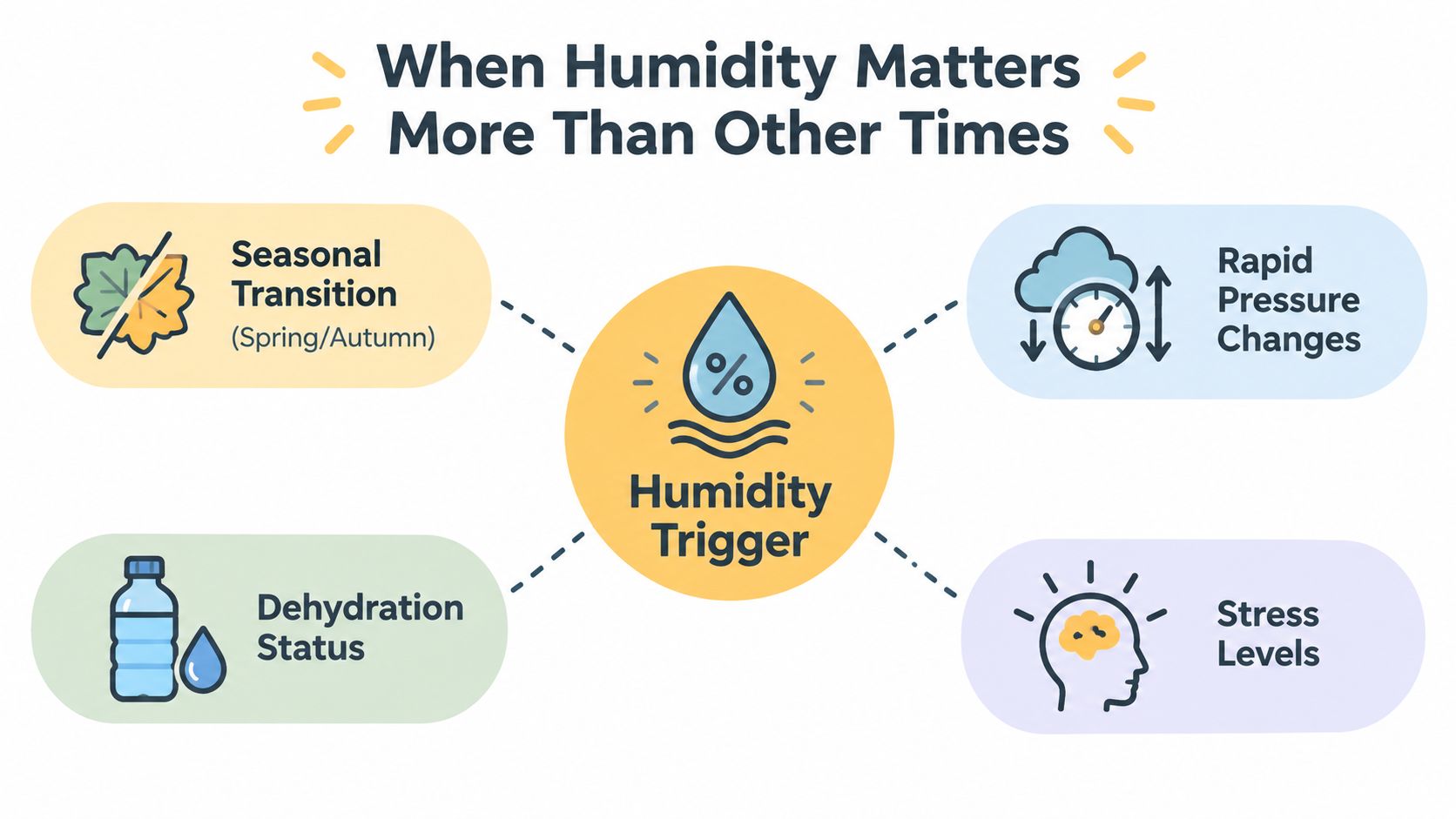
Humidity doesn't act in a vacuum. A humid day may also bring a temperature swing, a pressure drop, reduced sleep, bright reflected light, less fluid intake, or a disrupted routine. Those conditions can form one changing environment, and your nervous system may respond to the combination rather than to one isolated variable.
Think of humidity as one brick in a load-bearing wall. Temperature, pressure, sleep, hydration, stress, light, and hormonal changes form the rest of the structure. Removing one brick from the record can make the whole pattern harder to interpret.
The modifiers worth tracking
Season can change the meaning of a reading. The cohort evidence found its humidity association mainly during the warmer season. Seasonal transitions can also bring unstable weather, changing daylight, altered routines, and indoor climate changes.
Temperature changes can disguise the signal. Relative humidity may rise as air cools and fall as air warms. Record temperature and dew point so you can tell whether moisture itself changed or whether the percentage shifted because the air temperature changed.
Pressure systems often travel with moisture changes. A front can bring rain, a pressure fall, wind, and a rapid change in humidity. If pressure seems relevant to you, the guide to barometric pressure changes and migraine can help you track that variable separately.
Indoor conditions may not match the forecast. A heated bedroom, air-conditioned office, or poorly ventilated room can create a different exposure from the one reported outdoors. Note where you spent the hours before symptoms started.
The American Migraine Foundation describes evidence linking low barometric pressure, pressure changes, higher humidity, and rainfall with increased headache occurrences in a Japanese study involving more than 15,000 physician-diagnosed people with migraine, while emphasizing that weather research remains mixed. You can read that context in the American Migraine Foundation overview of weather and migraine.
A useful diary pairs each humidity reading with:
- Temperature and dew point: Record both when your weather source provides them.
- Pressure and weather changes: Note rain, storms, fronts, or a noticeable pressure shift.
- Body and routine factors: Add sleep quality, fluid intake, meals, stress, light exposure, and time spent indoors.
- Migraine phase: Record prodrome, aura, pain onset, associated symptoms, and postdrome rather than marking only “headache.”
How to Read an Hour by Hour Humidity Forecast
A daily humidity percentage is a snapshot. An hourly forecast gives you a curve, and the shape of that curve may be more useful than the highest number.
Start by looking for direction. A gradual rise overnight may not mean the same thing as a sharp change after rain. A falling relative humidity value may reflect daytime warming rather than drier air, so compare it with dew point and temperature rather than reading the percentage alone.
Read the forecast in four passes
First, scan the curve. Mark the hours when humidity rises, falls, or changes direction quickly. These inflection points deserve comparison with your symptom timeline.
Next, compare dew point. If relative humidity moves but dew point stays fairly stable, temperature may be driving much of the change. If both move, your actual moisture exposure may have changed more substantially.
Then, check the night. An overnight peak may coincide with poor sleep, condensation, a stuffy room, or repeated waking. Sleep disruption can become a separate factor even if humidity isn't the direct cause of pain.
Finally, add your location. Outdoor data won't fully describe a bedroom, classroom, workplace, or car. If you have an indoor monitor, record that reading as a separate exposure rather than treating it as interchangeable with the local forecast.
For a simple 24-hour example, suppose humidity rises during the night, reaches its daily high near dawn, falls as the day warms, then rises again after evening cooling. Don't label the whole day “high risk.” Instead, compare each turning point with your actual timeline. Did prodrome begin overnight? Did pain start after the morning rise? Did nothing happen during the dry middle of the day?
A practical log can stay short:
- Timestamp: When did you check the forecast and when did symptoms change?
- Relative humidity: Record the displayed value.
- Dew point and temperature: Add both when available.
- Indoor or outdoor exposure: Note where you were.
- Symptoms: Record onset, aura, nausea, photophobia, pain intensity, and recovery.
The hour-by-hour forecast guide can help you use this kind of timeline without reacting to every fluctuation. The aim is pattern detection across repeated observations, not a decision based on one afternoon.
Practical rule: don't ask whether humidity was “high.” Ask what changed, when it changed, and what your body was doing at the same time.
What Your Personal Humidity Patterns Can Look Like
Several weeks of paired weather and symptom records can reveal patterns that population averages can't. These examples are plausible tracking profiles, not diagnoses or promises that your experience will match them.
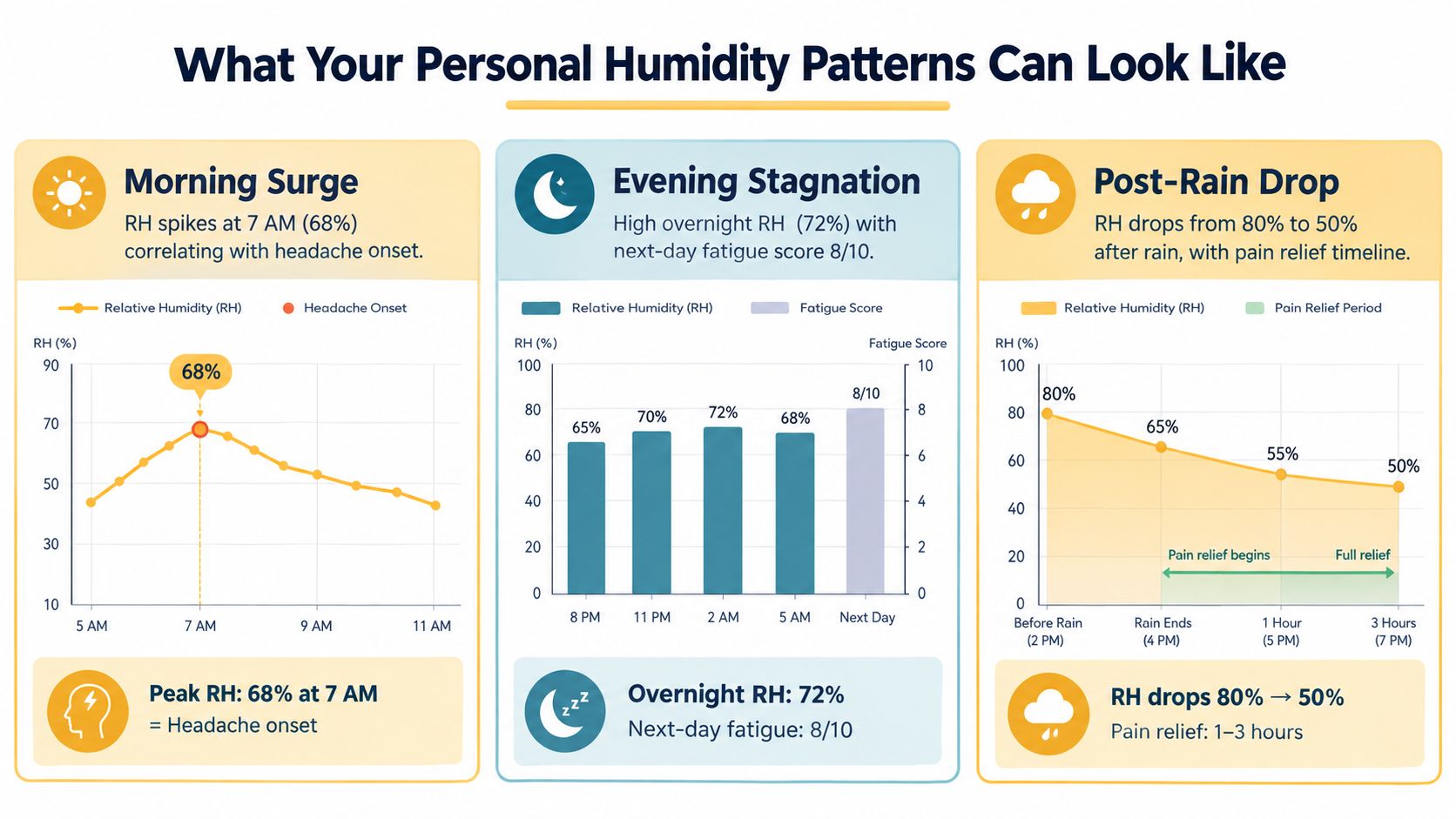
A morning surge
Your chart may show relative humidity rising before dawn, with symptoms clustering later in the morning. The useful observation isn't the percentage by itself. It's the repeated timing between the overnight change, your wake-up routine, fluid intake, sleep quality, and migraine onset.
That pattern might prompt you to discuss morning symptoms with a healthcare provider, keep fluids available, protect your sleep schedule, or examine whether the bedroom environment differs from the outdoor forecast.
Dry indoor winter air
You might find that outdoor conditions look moderate while your heated indoor environment feels much drier. Evening attacks could then overlap with long hours indoors, warm rooms, missed breaks, screen exposure, or reduced fluid intake.
The practical response isn't to assume a humidifier will prevent migraine. You could measure the room, record symptoms, and discuss safe environmental adjustments if dryness repeatedly appears alongside discomfort. Avoid making large changes that create mold or excessive dampness.
A frontal passage
Another pattern may show humidity rising with rain, then falling as the system moves through, while pressure changes at the same time. Your symptoms might appear during the passage, later that day, or the following day rather than immediately.
That delay is important. If you only compare the weather at the moment pain begins, you may miss the exposure that preceded it. A timeline that includes the prior hours can show whether the relevant feature was a peak, a crash, or the wider combination of moisture and pressure.
You can make these comparisons with a paper diary, a spreadsheet, a weather station, or an app that places environmental exposure beside symptom entries. The environmental exposure assessment guide offers a way to think about location, timing, and multiple exposures together.
Treat every pattern as a hypothesis. If you repeatedly see the same sequence, bring the record to a healthcare provider rather than changing medication or starting a treatment based only on the forecast.
What Humidity Cannot Tell You and What Comes Next
Humidity cannot tell you that an attack will happen. It can't distinguish migraine from another type of headache, identify your personal mechanism, or account for sleep, hormones, hydration, stress, light, illness, and medication use. Even when research finds an association, that relationship doesn't prove that humidity caused a particular attack.
The evidence is mixed because people respond differently to the same conditions, and studies measure weather in different ways. A weather alert should support awareness, not replace clinical care or make you feel responsible for symptoms you can't control.
Try these steps this week:
- Record symptom onset, not just the day an attack occurred.
- Pair humidity with dew point, temperature, pressure, sleep, and indoor location.
- Review repeated patterns with a healthcare provider before making treatment changes.
Seek immediate medical care for a sudden severe headache, a headache with fever or stiff neck, new neurological changes, or a headache after a head injury. These symptoms need urgent assessment and shouldn't be explained away as weather sensitivity.
Relief combines local humidity, temperature, barometric pressure, air quality, and pollen with your symptom and attack logs to provide an hour-by-hour personal risk view. If you want to compare weather exposure with your own migraine timing rather than rely on population averages, visit Relief and start tracking the patterns that matter to you.


