You've probably had this moment: you're under office LEDs, or out in bright sun, and your eyes start protesting before the migraine fully arrives. Tinted lenses for photophobia can help by filtering the wavelengths most likely to trigger pain, not just by making everything darker. This article is for informational purposes and is not medical advice. Consult a healthcare provider for personalized guidance.
If light sensitivity is part of your migraine pattern, the useful question is not “Do tinted lenses work?” It's “Which tint, which density, and which setting?” The answers depend on the kind of light that bothers you, where you wear the lenses, and whether you're trying to preserve indoor visibility or block harsher outdoor glare.
Table of Contents
- What the evidence does not promise
- Match the tint to the room, not just the label
- When medical care should come first
Living With Light Sensitivity and Migraine
When light hits like a flare instead of a background detail, everyday places become hard to tolerate. Office fluorescents, bright windows, store aisles, and even screens can feel too sharp when photophobia. That's the medical term for light sensitivity, and it often shows up with migraine, during aura when some people see visual changes, in the prodrome before pain starts, or in the postdrome when the attack has eased but the nervous system still feels raw.
For a long time, many people were told to “just wear sunglasses.” That advice misses the point. Dark lenses can reduce glare in the short term, but the more useful approach for migraine-related light sensitivity is often a spectrally selective tint that blocks the most provocative wavelengths instead of dimming everything.
A helpful mental model is this, your visual system is not reacting to brightness alone. It's reacting to the type of light, especially the short wavelengths that can feel harsh under LEDs, screens, and some indoor fixtures. That's why two lenses that look similar in a store can behave very differently once you wear them in real life.
You don't have to guess blindly, and you don't have to treat every light-sensitive day the same way. The rest of this guide focuses on practical tint choices, how they differ, and how to think about them in a migraine routine without overpromising what they can do.
How Tinted Lenses Reduce Photophobia
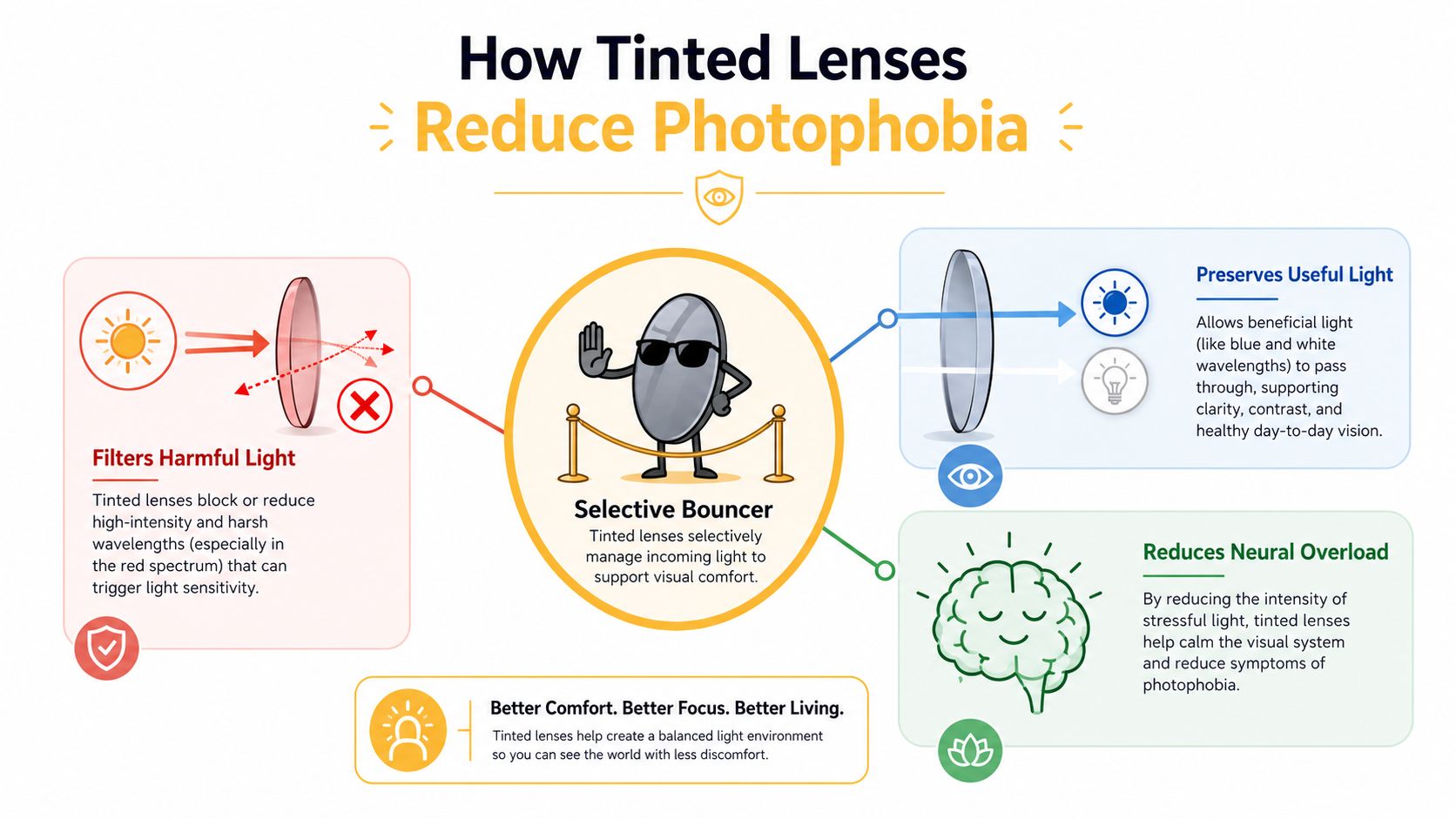
Think of the lens as a selective bouncer at the door of a club. A regular gray lens mainly turns the lights down for everyone. A precision tint looks at the spectrum, keeps more useful light moving through, and blocks more of the light that tends to stir up discomfort.
Why the 480 to 520 nm band matters
The most relevant range for many light-sensitive migraine patients is the 480 to 520 nm blue-green band. Clinical and review sources describe FL-41-style lenses as targeting that range because it is repeatedly linked with light discomfort, especially around fluorescent lighting, LEDs, and screens. The idea is not to create a dark tunnel, it's to reduce the part of the spectrum that seems most irritating while keeping the scene usable.
That's why spectral selectivity matters more than the color of the lens by itself. A rose tint can be thoughtfully engineered, while another pink-looking lens may behave very differently. The best lens is usually the one that suppresses the troublesome wavelengths without making everything so dark that your eyes struggle indoors.
A useful benchmark is about 35 to 40% visible light transmission for true FL-41 lenses, according to a light-sensitivity resource on FL-41 glasses. That range is light enough to avoid excessive dark adaptation for indoor wear, but strong enough to reshape the light reaching the retina in a meaningful way. In practice, that balance is what makes a precision tint feel wearable instead of overly gloomy.
Practical rule: if a lens only feels “dark,” but doesn't feel calmer under your actual triggers, it may be the wrong tool for your light pattern.
Types of Tinted Lens Colors and Materials
A person with photophobia may react very differently to the same lens color, because light sensitivity is shaped by the spectrum, the setting, and the eye condition behind the symptoms. A clinical study of colored glasses in people with visual symptoms found that 76% of the 51 participants had photophobia, and among those affected, 85% reported relief with one or more colored lenses. Blue, green, red, and purple were the colors that helped most often in that group, and the study reported no adverse events, which supports a careful, individualized trial instead of assuming one tint works for everyone (PMC study on colored glasses and visual symptoms).
How the main options differ in practice
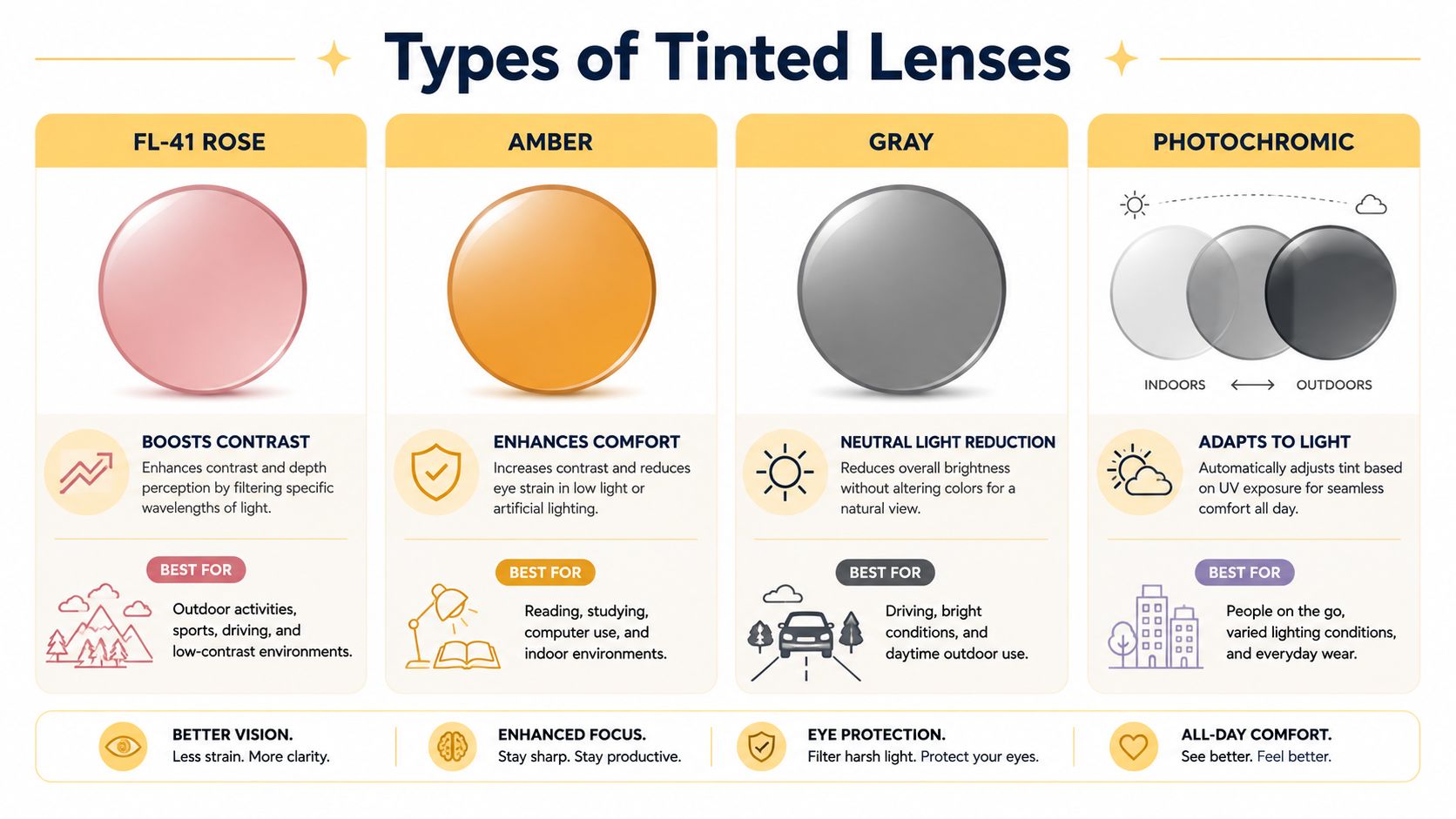
FL-41 rose is the best-known choice for migraine-related light sensitivity because it is built to filter troublesome short wavelengths instead of making everything darker. A clinical source also reported 76% clinically significant improvement in light-evoked unpleasantness among patients with chronic ocular pain, dry-eye symptoms, and photophobia using FL-41. That finding helps explain why this tint keeps showing up in migraine discussions, especially for people whose symptoms flare under fluorescent lights, LEDs, and screens.
Amber and similar warmer tints are often selected when someone wants more contrast and comfort without a rose cast. Gray is more neutral, so it mainly lowers brightness rather than shaping the spectrum in a targeted way. Photochromic lenses change with light level, which can be useful if you move between indoors and outdoors, but they are not the same thing as a precision photophobia tint.
The key question is not which color looks best. It is whether the tint matches your symptoms and the places where your eyes struggle, from bright offices to low-lit rooms to screen-heavy days.
The comparison video below can help you picture the differences more quickly.
If fluorescent lighting is your main problem, a selective tint usually makes more sense than a generic dark lens.
What Clinical Studies Reveal About Tints
A person with photophobia often wants one simple answer, a lens that makes bright light feel easier right away. Clinical studies show the best results usually come from a tint that matches the way light triggers symptoms, rather than a color chosen because it looks dark or familiar.
A 2005 study of essential blepharospasm found that photochromatic modulation with tinted lenses could substantially raise light tolerance. One lens configuration increased tolerated light intensity to 3.5 times the level tolerated by the blepharospasm group, and several lens settings produced statistically significant gains versus no lens, with P values from 0.04 to 0.007 (PubMed study). In the same study, 71% of patients said the greatest relief from photophobia came from the most preferred lens. That matters because it shows two things can be true at once, a lens can improve measured tolerance and still need to feel comfortable enough for real daily wear.
Migraine research points in a similar direction, while also showing why spectral selectivity matters. In a study of 37 people with chronic migraine, lenses that maximally blocked 480 nm light improved both HIT-6 headache impact scores and photophobia scores over two weeks (PMC migraine study). The important detail is not just that the lenses were tinted. It is that they targeted a narrow band of light in the blue-green range, the same range many people find irritating under fluorescent lighting, LEDs, and bright screens.
That selective range, roughly 480 to 520 nm, helps explain why some tints feel calming while others do little. A lens does not need to make everything darker to be useful. It can act more like a filter that trims the wavelengths most likely to provoke discomfort, while leaving the rest of the scene easier to see.
The caution in the research is just as useful. A review of tinted lenses and filters found the overall evidence equivocal, meaning the field has not shown a consistent benefit for every patient. Reviews also note that some optical tints can help photophobia, while red tint may exacerbate migraine-associated photophobia. That is why a tint should be treated like a symptom-matching tool, not a universal fix (Aston review PDF).
A practical way to read the studies is this. Some people notice a clear change quickly, some notice a smaller but still meaningful shift, and some do not respond at all. The best way to test a tint is to compare how you feel under the lighting that normally bothers you, then keep track of whether the change holds up in everyday life, not just in a quiet exam room.
Choosing the Right Tint and Lens Format
The easiest way to choose a tint is to start with your real day, not the catalog page. If you spend most of your time indoors, especially around screens or fluorescent lighting, a lighter lens can preserve readability and color perception. If your day swings between inside and outside, a mid-density option may be more practical. If you're outdoors in harsh brightness, a stronger tint may make more sense.
Match the transmission to the environment
Commercial and clinical sources suggest 25% transmission for indoor use near fluorescent lights, LEDs, and digital devices, 50% for a hybrid indoor-outdoor option, and 80% for outdoor use. One source also reports that an outdoor FL-41 version filters 93% of harsh 480 to 520 nm wavelengths and provides 100% UVA and UVB blocking, while its FL-41 lenses remove up to 25x more blue light at 480 nm than typical clear or yellow-tinted blue-light glasses (Zenni FL-41 lens overview).
That doesn't mean darker is better. Overly dark lenses can make adaptation harder and reduce usability indoors, especially if you move in and out of different lighting all day. The safest approach is usually the minimum density that controls your symptoms.
Pick the format that fits your life
- Prescription lenses: Best if you already need vision correction and want the tint built into your everyday glasses.
- Clip-ons: Helpful if you want flexibility and don't want a second full frame.
- Wraparound frames: Useful when side light, glare, or outdoor brightness is part of the problem.
Bring a simple script to an eye care professional. Ask how the tint behaves in the actual places you struggle, whether the lens has a measured transmission curve, and how it will look under your work lighting. That kind of conversation is much more useful than asking for “the migraine glasses.”
Care matters too. Keep the lenses clean, use the case, and avoid treating them like a one-day fix. If you can test them in the environments that trigger symptoms, you'll learn far more than you would by trying them only in a showroom.
Common Misconceptions About Tinted Lenses
A pair of tinted lenses can make light feel less punishing, but it does not cure photophobia or migraine. The useful role is narrower and more practical. Tints can be an adjunct, an added tool that may reduce strain while you and your clinician keep an eye on the bigger pattern of symptoms.
What the evidence does not promise
A recent review described the evidence for FL-41 and related tints as preliminary rather than conclusive (recent review on tinted lenses). That matters because tint response is not one-size-fits-all. Migraine light sensitivity can behave like a custom filter inside the visual system, where one person reacts strongly to a narrow band of light and another responds to a different pattern entirely.
The more useful question is not whether a tint sounds good in theory, but whether it helps in the part of the spectrum that bothers you most. For many people, that means paying attention to the 480 to 520 nm range, where harsher blue-green light often lives. A tint that filters the wrong wavelengths can feel disappointing even if it looks dark enough.
Red tints need careful handling. A separate review noted that red tint may exacerbate migraine-associated photophobia (Aston review PDF). If a lens leaves you more headachy, more visually tired, or oddly off-balance, the problem may be the tint itself rather than your tolerance for glasses in general.
Match the tint to the room, not just the label
A lens that works outdoors can feel too heavy under office lighting. A lighter option may be enough at a desk, while a denser tint may be more useful in a bright store, on a commute, or near reflective surfaces. Matching tint density to real-world settings matters because symptoms are usually tied to context, not just to the color of the lens.
That is also why a measured, symptom-based routine helps more than guessing from the frame tint alone. If you are trying to sort out what helps, the Relief app for migraine tracking can help you compare the tint you wore with the lighting around you, so the pattern becomes easier to see over time.
When medical care should come first
Seek immediate medical care for sudden severe headache, headache with fever or a stiff neck, neurological changes such as weakness, confusion, or trouble speaking, or headache after head injury. Those situations are not for trial-and-error with eyewear.
Get an exam if your eye pain is new, if your light sensitivity feels very different from your usual migraine pattern, or if you are not sure this is migraine at all. Tinted lenses can support comfort, but they should not delay proper evaluation when something feels off.
Bottom line: use tints as part of a broader plan, not as proof that red-flag symptoms can be ignored.
Wearing Lenses and Planning With Relief App
The most useful way to think about tinted lenses is as one part of a pattern-based routine. You may notice that a certain tint helps in fluorescent offices but feels unnecessary on cloudy days, or that a different density works better when you're outdoors versus at a desk. Logging those differences makes the choice less emotional and more practical.
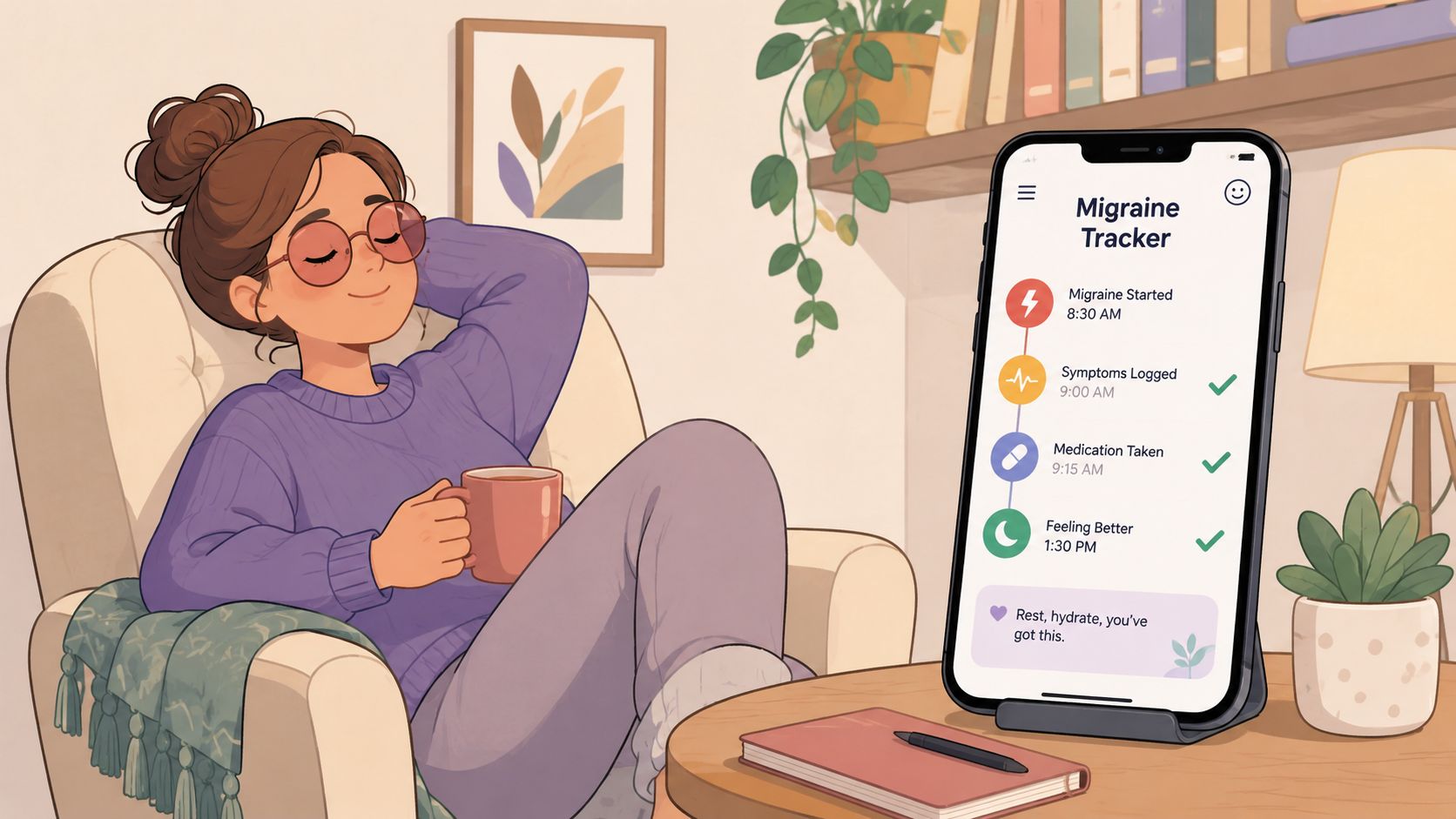
That's where tracking helps. If you keep a record of light exposure, attack timing, and the tint you wore that day, you start to see whether the pattern is tied to weather, screen time, commuting, or a specific indoor environment. The same habit can also show you when a lens is doing enough, and when you may need a different format or a clinician's input.
A few related guides may help alongside this one, especially if you're sorting out triggers or symptom timing, including understanding migraine aura and visual symptoms, tracking migraine triggers with more accuracy, and spotting early migraine warning signs. Use the same calm, repeatable process for tints that you use for other migraine variables, because consistency beats guesswork.
This article is for informational purposes and is not medical advice. Consult a healthcare provider for personalized guidance.
If light sensitivity keeps interrupting your days, start logging what kind of light hurts, when it happens, and which tint you wore. Relief helps you connect those patterns so you can make better decisions before the next flare starts.
Relief helps you notice migraine patterns before they snowball, so you can connect light sensitivity, weather, and daily habits to the days that feel hardest. If you're comparing tinted lenses for photophobia and want a clearer way to track what helps, visit Relief and see how your own data can guide the next step.


