
If you're trying to figure out topiramate dosage for migraines while already dealing with brain fog, light sensitivity, or another attack that won't quit, the core answer is simple. For migraine prevention, the usual evidence-based target is 100 mg/day, often given as 50 mg twice daily, but the dose is usually built up slowly so your body has time to adjust. That gradual ramp matters because migraine prevention is about finding the lowest dose that helps without making side effects harder to live with.
This article is for informational purposes and is not medical advice. Consult a healthcare provider for personalized guidance. If you have a sudden severe headache, headache with fever and a stiff neck, neurological changes, or headache after a head injury, seek immediate medical care.
Table of Contents
- Introduction and Disclaimer
- Understanding Migraine and Headache Differences
- Who may discuss it with a clinician
Introduction and Disclaimer
Migraine can leave you tired before the day even starts, and then the medication question adds another layer of stress. If you're staring at a new prescription and wondering whether the dose is too low, too fast, or just plain confusing, you're not alone.
The clearest way to think about topiramate dosage for migraines is as a stepwise process, not a single number. The common adult target sits at 100 mg/day, usually split into two doses, but the path to get there is intentionally gradual so side effects don't hit all at once.
That slow build is especially important for people who've already been dismissed or who are juggling work, school, caregiving, or frequent attacks. A practical plan, plus good symptom tracking, helps you and your clinician tell the difference between “not enough time yet” and “this dose isn't a good fit.”
Understanding Migraine and Headache Differences
Migraine isn't just a bad headache. It's a neurological disorder that can move through phases, including the prodrome before the attack, aura in some people, the headache phase itself, and the postdrome after the pain eases.
Aura means temporary neurological symptoms, often visual changes like flashing lights or zigzags. Photophobia is sensitivity to light, and phonophobia is sensitivity to sound. Those features help separate migraine from a routine tension-type headache, sinus pressure, or a short-lived ache after a long day.
Topiramate is used for migraine prevention, not for quick relief of every headache. That distinction matters because someone with recurring migraine attacks needs a preventive plan, while someone with occasional non-migraine headache may need a completely different approach.
Practical rule: If your attacks come with light sensitivity, sound sensitivity, nausea, or aura, write those features down. That pattern helps a clinician confirm whether migraine prevention is the right conversation.
Indications for Topiramate in Migraine Prevention
A person who keeps missing work, sleep, or school because of migraine often starts asking the same question, what medication can reduce the attacks before they begin? Topiramate is one of the options clinicians consider when attacks are frequent enough, disruptive enough, or persistent enough that prevention makes sense. In practice, that often means episodic migraine that keeps coming back, or chronic migraine where headache days begin to crowd out normal life.
Topiramate also comes up after another preventive has already been tried and either caused side effects or did not help enough. The goal is not to choose a stronger medicine for its own sake. The goal is to find a preventive that fits the pattern of the person sitting across from the clinician.
Who may discuss it with a clinician
- People with recurring attacks: If attacks keep interfering with work, sleep, parenting, or school, prevention becomes more relevant.
- People who need a slow, flexible ramp: Topiramate's dose can be adjusted gradually, which helps some people stay on treatment long enough to judge benefit.
- People with other neurologic needs: It is also used for seizure disorders, so clinicians sometimes consider overlap in treatment goals.
- People who want a clear trial period: Migraine prevention with topiramate is often limited to a defined period before reassessment.
That said, topiramate is not a universal fit. If thinking clearly is already hard, or if pregnancy is possible, the benefit and risk conversation matters a great deal. A clinician should weigh the likely migraine reduction against the downsides, rather than treating prevention as a one-size-fits-all decision.
Evidence Supporting Topiramate for Migraines
A patient starting migraine prevention often wants a simple question answered first. Does this medicine lower the number of attacks, or does it only sound convincing on paper? For topiramate, the answer is that it has shown real preventive benefit for many adults.
A meta-analysis of 9 studies with 1,737 participants found that topiramate reduced headache frequency by about 1.2 migraine headaches per month versus placebo, with an odds ratio of 3.18 for responders and a number needed to treat of 4 (meta-analysis). That pattern matters because migraine prevention is usually about small but meaningful gains, not a total stop to attacks. For many people, fewer migraine days can mean fewer lost afternoons, less reliance on rescue medicine, and less time spent recovering after an attack.
What the trial numbers mean in plain language
An NNT of 4 means that, in the study setting, treating about four people leads to one extra responder compared with placebo. It does not promise the same result for every reader, but it does show that topiramate has a real preventive effect rather than a purely theoretical one.
The dose story is just as important as the response story. Pooled trial analyses showed that 100 mg/day and 200 mg/day both reduced migraine frequency versus placebo, but the added benefit of 200 mg/day was not clearly better than 100 mg/day. That is why experts settled on 100 mg/day as the usual target dose, and why the evidence for dose and target-dose evidence points clinicians toward the lower effective target rather than pushing dose higher for its own sake (dose and target-dose evidence).
That also fits real-world dosing. Some people respond at lower doses and do not need to reach the full target before they notice fewer attacks. Others need slower changes if tingling, sleepiness, or word-finding trouble starts to build, especially when organ-specific adjustments are part of the plan. A practical way to track that balance is to use a Relief app template with separate fields for daily dose, migraine days, rescue medicine use, and side effects, so the next dose decision is based on a clear pattern instead of memory.
Bottom line: The goal is the dose that gives useful prevention while still being tolerable enough to keep taking.
Standard Titration Schedule Overview
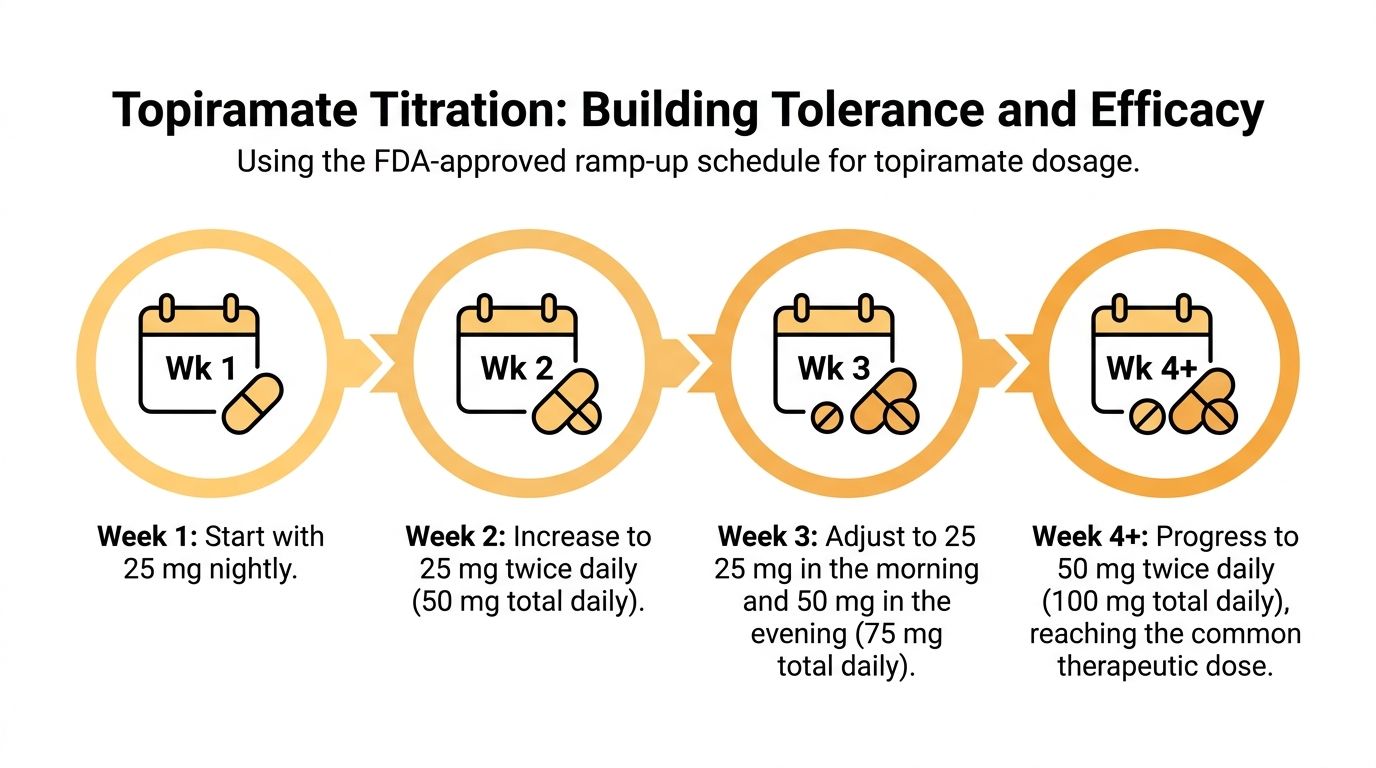
A migraine preventive dose of topiramate usually starts low and rises in small steps, like turning a dial instead of flipping a switch. The FDA-approved adult schedule begins with 25 mg nightly in week 1, then moves to 25 mg twice daily in week 2, then 25 mg in the morning and 50 mg in the evening in week 3, and then 50 mg twice daily from week 4 onward to reach 100 mg/day (FDA label).
That gradual rise gives the body time to adjust. If tingling, fatigue, or brain fog starts to interfere, clinicians may pause at a dose longer before increasing again.
For many readers, the schedule can feel more like a set of training wheels than a final destination. The point is to reach a dose that helps migraines while still being tolerable enough to keep taking.
The usual maintenance dose for migraine prevention is 100 mg/day in two divided doses, often expressed as 50 mg twice daily. Some people settle in comfortably at that level, while others need a slower ramp if they are sensitive to dose changes or if kidney or liver adjustments are part of the plan.
How to think about the ramp
A dose increase works a bit like stepping up stairs in a dark hallway, with each step giving you a chance to check your footing. The goal is steady progress, not speed.
That is why the early weeks matter so much. If a side effect appears right after an increase, the current dose is the most likely cause, which makes the pattern easier to recognize and discuss with a clinician.
Why clinicians go slowly:
- Tolerability: Smaller increases can keep side effects from becoming too disruptive.
- Clarity: Gradual changes make it easier to tell which dose is linked to a new symptom.
- Retention: People are more likely to stay with a preventive when the first few weeks feel manageable.
A Relief app template can make this easier to follow in real life. Track the daily dose, migraine days, rescue medicine use, and side effects in separate fields, so dose decisions are based on a clear week-by-week pattern rather than memory.
Detailed Topiramate Dosing Tables
Clinical practice doesn't always move in a perfect straight line. One study found that about one-quarter of patients respond to lower doses, while about half of responders still need 100 mg/day, which shows why flexible dosing conversations matter (real-world response patterns).
That doesn't mean everyone should stay low or push high. It means there's room for a clinician to judge whether a partial response is enough, whether side effects are limiting, or whether escalation is still reasonable.
Week-by-week migraine titration reference
| Week | Morning Dose (mg) | Evening Dose (mg) |
|---|---|---|
| Week 1 | 0 | 25 |
| Week 2 | 25 | 25 |
| Week 3 | 25 | 50 |
| Week 4+ | 50 | 50 |
This table reflects the common FDA migraine schedule and the 100 mg/day target. Some clinicians may slow the ramp if the patient is struggling, but the basic pattern is the same, start low and increase stepwise.
How to read the table without overthinking it
A lower dose can still be useful if it's the most you can tolerate right now. The key question is not “Did I hit the textbook dose yet?” It's “Am I getting enough benefit to justify continuing this path?”
If you and your clinician decide to stay below 100 mg/day, that can still be a valid trial. The evidence supports the target dose, but clinical practice data also show that some people respond earlier and don't need the full maintenance amount.
Renal and Hepatic Dosing Adjustments
Kidney and liver function affect how many medications stay in the body and how quickly they clear. With topiramate, that means the standard titration schedule may need to be more cautious if a clinician knows there's reduced clearance or another safety concern.
The exact adjustment depends on the person's medical history, lab results, and what else they're taking. That's why the dosing conversation should happen with a clinician rather than by guesswork at home.
What to ask about if you have kidney or liver issues
- Kidney history: Ask whether your renal function changes the pace of titration.
- Kidney stones: Bring up any past stones, since that history changes the risk conversation.
- Other medications: Some combinations can add to metabolic or cognitive side effects.
- Follow-up labs: Ask which baseline and periodic checks make sense for you.
Topiramate is also handled differently in people who are pregnant or planning pregnancy, because the safety discussion changes a lot in that setting. In practice, that's one of the most important reasons the medication plan should be individualized rather than copied from a standard titration card.
If you've ever been told your kidneys “run a little slow,” don't ignore that when discussing topiramate. Small clearance differences can turn a manageable dose into a rough one.
Common Side Effects and Management Strategies
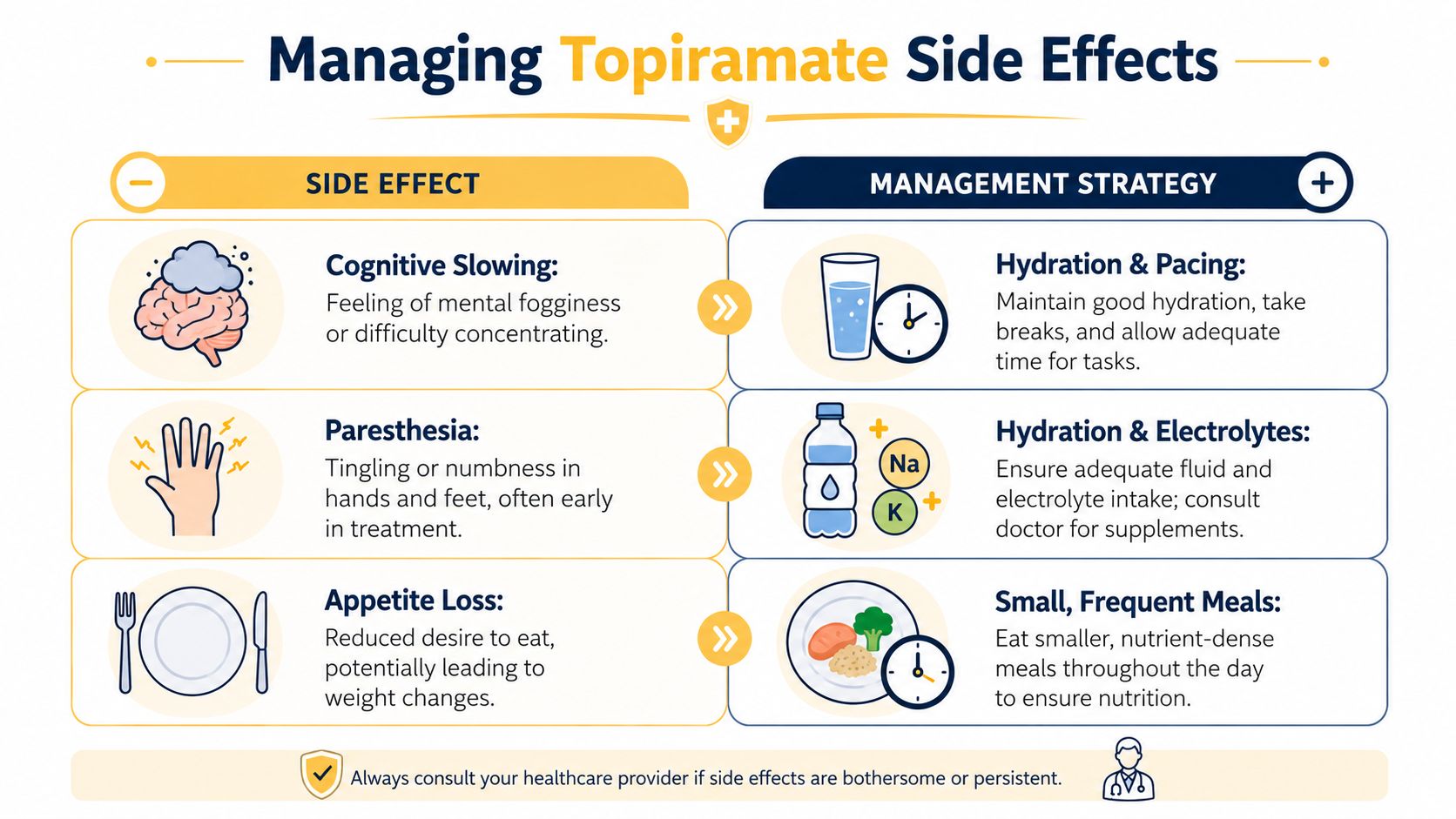
Topiramate's preventive effect is real, but so is its side-effect burden. Independent review work notes adverse events like cognitive slowing and paresthesia and estimates a discontinuation burden of about 80 patients per 1,000 (review summary).
That number is one reason early counseling matters. If you know what to expect, you're less likely to panic when a symptom shows up, and more likely to report a meaningful problem before it becomes a reason to stop abruptly.
Common complaints people notice
- Cognitive slowing: This can feel like mental fog, slower word-finding, or trouble staying organized.
- Paresthesia: Tingling or numbness in the hands, feet, or face often shows up early.
- Appetite loss: Some people notice reduced hunger, which can affect eating patterns.
- Fatigue: A dose that's fine at night may still leave you sluggish the next morning.
Practical ways people often cope
Hydration and pacing can help with tingling and fatigue, especially during dose increases. Smaller, more regular meals may help if appetite drops enough that you start skipping food, and bedtime dosing can sometimes make daytime tiredness less noticeable.
The key is not to tough it out without speaking up. If the side effects are mild and temporary, they may fade as your body adjusts. If they're affecting work, driving, school, or mood, the dose needs a conversation, not just endurance.
Drug Interactions and Precautions
Topiramate doesn't exist in a vacuum. Other medications can change how it feels, how safe it is, or how well it fits into your migraine plan.
This is especially important if you're taking more than one prescription, because a migraine preventive can interact with treatments for mood, seizures, contraception, or other chronic conditions. Bring a full med list, including supplements, to every medication review.
Medication categories worth flagging
- Other carbonic anhydrase inhibitors: These can increase the chance of overlapping metabolic issues.
- Oral contraceptives: Topiramate can matter in pregnancy planning, so contraception discussions are important.
- CNS depressants: Combining sedating medicines can make cognitive slowing or drowsiness worse.
- Other seizure medicines: Shared neurologic treatment plans may need closer oversight.
Pregnancy deserves special attention. Newer review literature notes a dose-related teratogenic risk signal, with greater concern at doses above about 100 to 125 mg daily, so pregnancy planning and effective contraception need to be discussed before treatment starts (pregnancy risk review).
If your migraine pattern changes, or if a new medication gets added, don't assume your old topiramate plan still fits. Small interaction changes can shift tolerability more than people expect.
Contraindications and Red Flags
Topiramate is not for every person and every situation. Some medical histories make the risk side of the equation too heavy, especially when safer alternatives exist.
A clinician should be extra cautious if there's a history of metabolic problems, eye issues, kidney stones, or pregnancy-related concerns. The earlier those issues are raised, the easier it is to avoid a medication mismatch.
Seek immediate medical care if you notice
- Sudden severe headache
- Headache with fever and stiff neck
- New neurological changes, like weakness, confusion, or trouble speaking
- Headache after a head injury
These are not routine migraine follow-up symptoms. They need urgent evaluation because they can signal something more serious than a usual migraine attack.
Reasons to stop and call your clinician promptly
- Visual changes: Blurred vision or eye pain can be a warning sign.
- Severe mental slowing: If everyday thinking feels dramatically different, report it.
- Persistent vomiting or dehydration: These can make medication tolerability worse.
- Pregnancy or possible pregnancy: Topiramate needs a new conversation right away.
Monitoring and Patient Counseling Guidelines
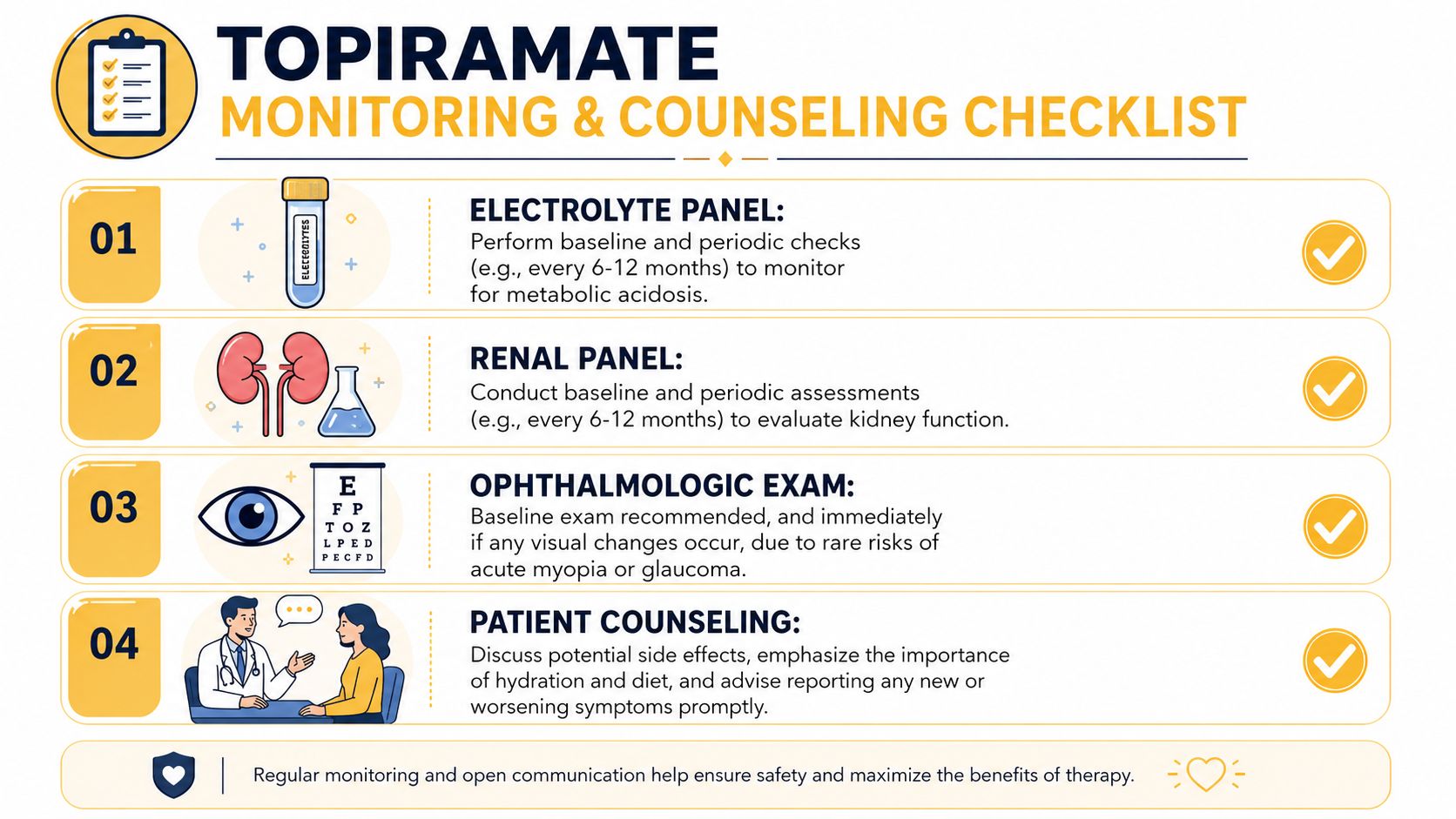
A migraine prevention plan works best when the dose is checked against real-life response, not just written on a prescription. One person may feel clear benefit at a lower dose, while another needs slower changes because side effects show up early. That is why follow-up matters, it helps separate “this medicine is helping” from “this dose is too hard to tolerate.”
Clinicians often review symptoms, ask about side effects, and decide whether any lab checks are needed. The timing depends on the person and the treatment course. The NHS advises that topiramate used for migraine prevention may be reviewed after 6 to 12 months of stable treatment (NHS duration guidance).
What to track between visits
- Headache pattern: Write down how often migraines happen, what time of day they start, and whether the attacks feel different from your usual migraine.
- Cognitive changes: Note word-finding trouble, slower thinking, or trouble focusing, even if the change seems mild at first.
- Fluid intake and eating: Skipped meals and low fluid intake can make a medication week feel harder to judge.
- Any visual symptoms: Treat new or sudden vision changes as something to report right away.
Small details matter here. A diary that shows the day the dose changed, the day side effects began, and the days migraine symptoms improved gives a clinician a much clearer picture than memory alone.
A practical follow-up checklist
- Electrolytes: These may be checked when there is concern about metabolic changes.
- Renal function: This matters more when kidney clearance may affect how the drug is handled.
- Eye symptoms: Report any change in vision promptly, even if it seems brief.
- Tolerance at the current dose: Tell your clinician whether the present dose feels manageable, borderline, or too difficult to continue.
Real-world dosing often looks a little different from trial schedules. Some people do well at a lower dose than expected, and others need more time between increases because the body needs a gentler pace. A careful review helps the clinician decide whether to hold, adjust, or taper.
If it is time to come off topiramate, do not change the dose on your own. The safer approach is a clinician-guided step-down after a stable preventive period, especially if the medicine has been helping.
For daily tracking, use the Relief app template for dose and symptom logs so each dose change, side effect, and migraine day is recorded in one place.
Using Relief App to Track Dosage and Symptoms
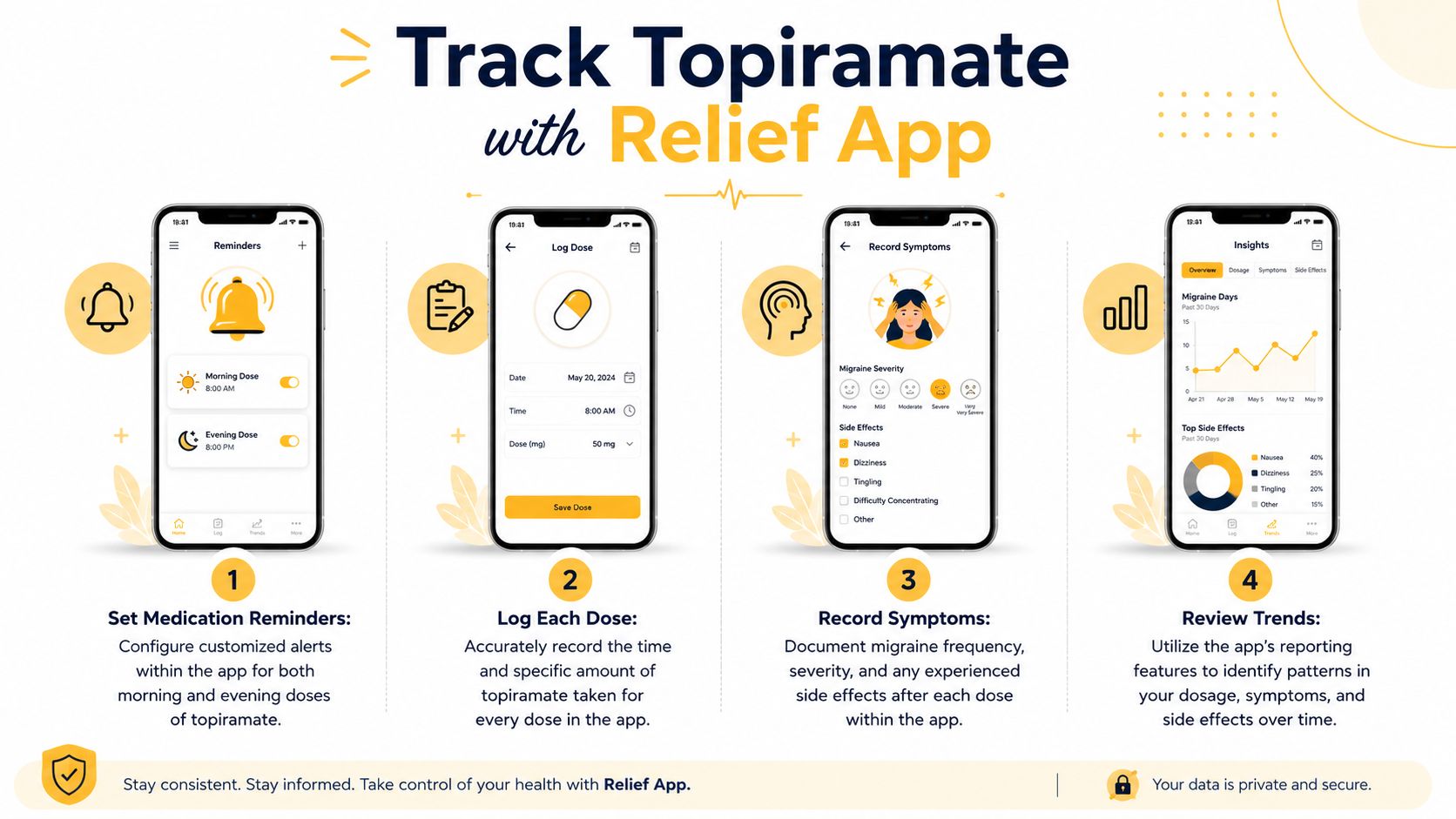
A dosing plan works better when you can see it on the page, not just remember it in your head. Tracking each dose, each side effect, and each migraine day helps you and your clinician tell whether the medication is helping, stalling, or causing more trouble than benefit.
Start with the basics inside the app at Relief. Set a reminder for your morning and evening doses, log the exact time you took each one, and note any tingling, fogginess, appetite change, or breakthrough migraine symptoms the same day.
A simple tracking routine
- Log the dose immediately. Don't rely on memory after a migraine-heavy day.
- Record symptoms in plain language. “Head pressure,” “light sensitivity,” and “can't focus” are all useful.
- Add context when something feels off. Sleep loss, travel, stress, or skipped meals can explain why a week changed.
- Review trends before follow-up visits. You want a clean picture of whether the current dose is helping.
That habit turns a vague medication trial into a useful clinical conversation. If you can show when the dose changed, when the side effects started, and whether migraine frequency shifted, your next appointment gets much easier.
Keep your topiramate plan organized, your symptoms visible, and your questions ready, and use Relief to spot patterns early so your next provider conversation is based on real migraine data, not guesswork.


