Trigeminal Neuralgia and Migraines: How to Tell Them Apart
Trigeminal neuralgia and migraines can feel alike. Learn how each differs, where symptoms overlap and when to seek medical care.
In this guide
Trigeminal neuralgia causes brief, electric-shock facial pain that lasts from a fraction of a second to 2 minutes, often set off by something as ordinary as chewing, talking or a touch on the cheek. Migraine usually brings throbbing or pulsing head pain that runs for hours and may arrive with nausea, vomiting or sensitivity to light, and the two conditions can affect the same person at the same time.
If you've heard "it's just a headache" or "it's probably stress" more often than you've heard a clear explanation, that gap is probably why you're reading this. Brief shocks get dismissed as twitches. Days-long pain gets dismissed as dramatics. The accurate label usually arrives late, and sometimes it arrives twice, because trigeminal neuralgia and migraines don't politely exclude each other.
Scale explains part of why the first guess is often wrong. The World Health Organization estimated that headache disorders affected about 40% of the world's population, roughly 3.1 billion people, in 2021, and migraine ranked as the third-largest contributor to age-standardized disability-adjusted life years among neurological diseases that year, behind stroke and neonatal encephalopathy (WHO headache disorders fact sheet). A common condition gets assumed first. A rare one has to be argued for.
Trigeminal Neuralgia and Migraine at a Glance
Both conditions are neurological, both are severe enough to interrupt work and sleep, and both get waved away by people who've never had either. The practical difference sits in the shape of an attack.
The International Classification of Headache Disorders, 3rd edition defines trigeminal neuralgia as recurrent attacks of unilateral facial pain confined to one or more divisions of the trigeminal nerve. Each attack lasts from a fraction of a second to 2 minutes, feels electric-shock-like, shooting, stabbing or sharp, and is triggered by normally harmless stimulation in the affected area, such as touching the face.
Migraine is a recurrent neurological disorder, not a synonym for headache. Attacks typically throb or pulse, often on one side of the head, and bring nausea, vomiting and sensitivity to light or sound, which clinicians call photophobia and phonophobia. Same nerve territory, entirely different timing and companion symptoms.
Read the pattern, not the single attack
The table follows the same definitions and sets a typical attack of each against the other.
Trigeminal neuralgia and migraine compared by attack feature
| Feature | Trigeminal neuralgia | Migraine |
|---|---|---|
| Pain quality | Electric-shock, stabbing or shooting | Throbbing or pulsing |
| Typical duration | Fraction of a second to 2 minutes | Commonly 4 to 72 hours if untreated |
| Typical trigger | Light touch, chewing, talking, brushing teeth or wind | Often no single trigger; sleep, stress, weather or hormonal shifts for some people |
| Location | One side, within one or more trigeminal divisions | Often one side of the head, sometimes both |
| Associated symptoms | Usually none beyond the facial pain | Nausea, vomiting, photophobia and phonophobia |
| Aura | Not a feature | Some people have aura before or with the headache |
Two cautions before you use it. Migraine varies enormously. It can be episodic or chronic, with or without aura, and it takes vestibular and hemiplegic forms that look nothing like a textbook attack. It affects people of all genders, though it's more common in women, so treat the right-hand column as typical patterns rather than a checklist you must pass.
And no single row settles anything. A stabbing pain doesn't confirm trigeminal neuralgia; a throbbing one doesn't rule it out. What a clinician weighs is the pattern across many attacks, meaning duration, reliability of triggers, where pain starts, and what travels with it.
A useful frame: one attack is a data point. Six weeks of attacks is a pattern.
That's the reason to record rather than remember. This article is for informational purposes and is not medical advice. Consult a healthcare provider for personalized guidance.
Red Flags That Need Prompt Medical Care
Some headaches need a phone call, not a tracking app. Handle these first.
- A sudden, severe or unusual headache, particularly one that reaches full intensity within seconds.
- Headache with fever and a stiff neck.
- Neurological changes, such as one-sided weakness, difficulty speaking, vision loss or confusion.
- Headache after a head injury, even one that seemed minor at the time.
Not a monitoring tool: Relief doesn't monitor emergencies. For a sudden, severe or unusual headache, call your local emergency number immediately.
Book a review, not an emergency
Once those are ruled out, a different set of signals deserves a timely appointment with a primary care clinician, a neurologist or a facial pain specialist.
Get new electric-shock facial pain assessed. Especially when ordinary touch, teeth brushing or a cold breeze reliably sets it off. Those attacks belong in front of a clinician rather than a trigger spreadsheet.
Report numbness or sensory change that doesn't lift. Fading tingling is one thing. Persistent numbness in the cheek, lip or tongue is another.
Describe pain that stays put and stays. Sustained, one-sided facial pain without the on-off rhythm of paroxysms is worth a proper look.
Flag any change in an established pattern. New duration, new aura symptoms, new facial involvement in what you'd always called migraine.
Say so when nothing you've been advised helps. Poor response is information, not a personal failure.
Trigeminal neuralgia can have secondary causes, which is why a clinician investigates before settling on a label, and NHS guidance on trigeminal neuralgia puts specialist assessment and imaging inside that pathway rather than at the end of it. Asking for reassessment is reasonable. It's also the step people delay longest.
This article is for informational purposes and is not medical advice. Consult a healthcare provider for personalized guidance.
Why Facial Pain and Migraine Get Confused
Facial pain that keeps returning tends to collect a label fast, and the label is usually migraine, delivered with a shrug. The shrug isn't malice. It's arithmetic.
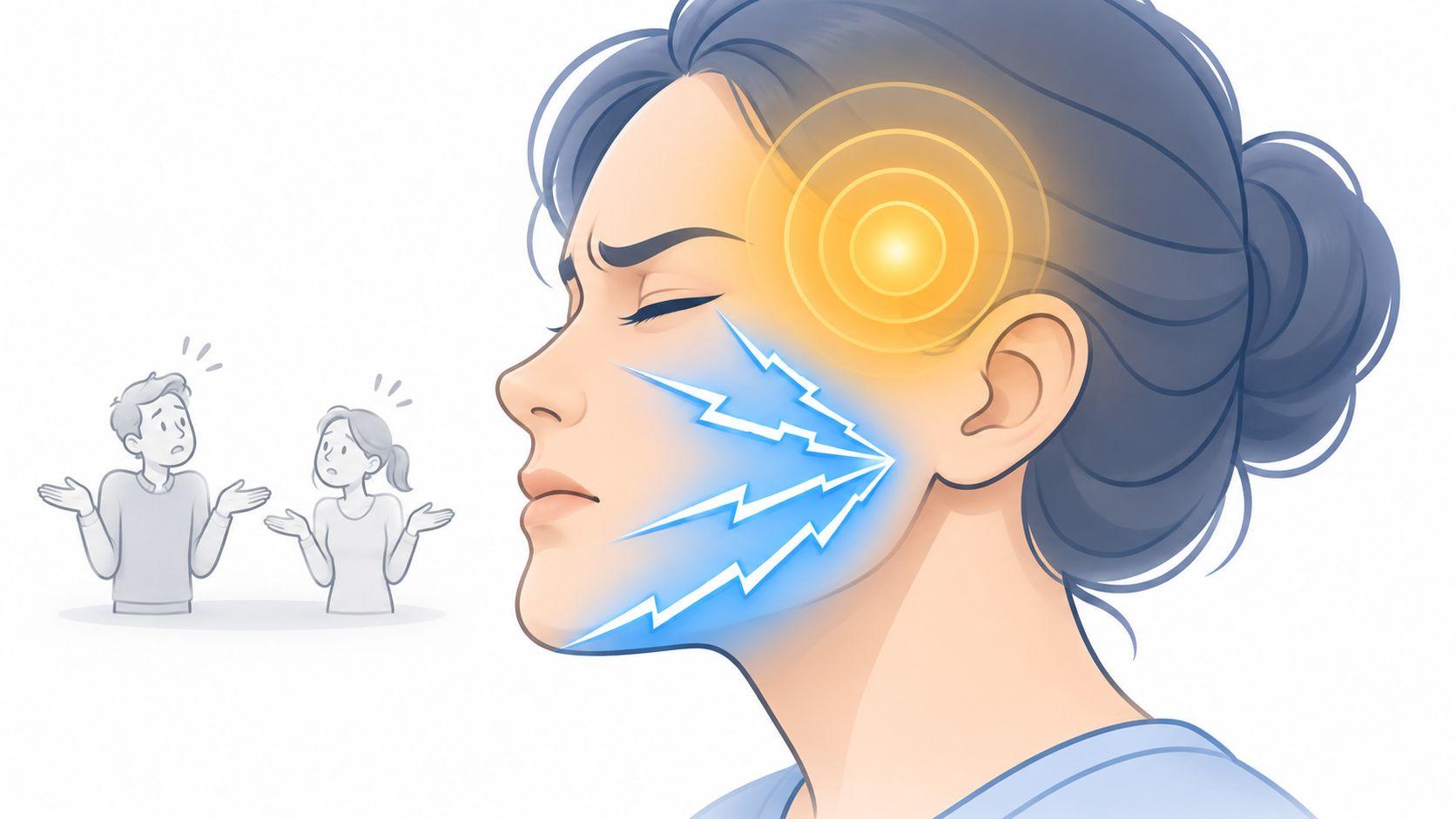
A systematic review covering 17 studies, more than 170 million people and 12 countries estimated pooled global incidence of trigeminal neuralgia at 25.33 cases per 100,000 person-years, with a higher rate in females than males, roughly 43.8 versus 21.9 per 100,000 person-years (review of trigeminal neuralgia epidemiology). It also found the maxillary and mandibular divisions affected more often than the ophthalmic division, which is why the pain so often lands on a cheek or jaw and gets blamed on a tooth.
Where the two conditions overlap
Both conditions travel the same wiring. Trigeminal neuralgia and migraine involve trigeminal nociceptive pathways, so the face can hurt in both. But the attack phenotypes are distinct in ways that matter for triage: duration, triggerability, facial distribution, aura, nausea and photophobia, and whether onset was gradual or instantaneous (review of trigeminal pain mechanisms).
Migraine is better understood as a disorder of trigeminovascular processing. Cortical spreading depression is associated with aura and can activate peripheral and central trigeminal pathways, while calcitonin gene-related peptide, or CGRP, modulates meningeal and vascular nociception. A brief, stimulus-evoked facial shock points toward a trigeminal neuralgia pattern. A prolonged attack with sensory hypersensitivity or aura points toward migraine biology.
If you want the two described side by side in plain language before your next appointment, this short walkthrough is a reasonable starting point.
Add the awkward part. Migraine can present mainly as facial pain with little or no head pain, and the two disorders can coexist, so long nauseating headaches alongside brief facial shocks may be two separate phenomena rather than one confusing one. Dental pain, temporomandibular joint problems and cluster headache wander into the same conversation, which is why self-diagnosis struggles here.
The risk is concrete. A log that files everything under one label hides two attack types with different triggers and different responses to treatment, and a clinician reading a single muddled migraine entry has nothing to pull apart. If tingling or numbness is part of your picture, our guide to facial tingling and headache patterns explains what those sensations can and can't tell you.
What to Record So Each Pattern Stands Out
Suppose one morning starts with a two-second jolt in the cheek when you brush your teeth, and hours later a throbbing pain builds with nausea and light sensitivity. One notebook line labeled "migraine" glues those events into a single illness. Separate timestamps let a clinician see two patterns on the same page: brief facial shocks in one column, a longer migraine attack in the other.
Sequence is the part memory smears first. In people with migraine aura, the headache often arrives close on the heels of the first visual or sensory change, so logging aura onset separately from headache onset shows the order of events that a single memory of the attack tends to blur. A facial shock runs on a different clock. You can usually count it in seconds. Touch or chewing may set it off, and it can return many times while the migraine is still one long arc from early signs through recovery.
People are often told it is "just migraine" when both are present. Overlapping symptoms make that easy. Nausea can sit next to a shock. Light can hurt during either bad day. The fields below keep those features from collapsing into one story.
Nine fields that separate the patterns
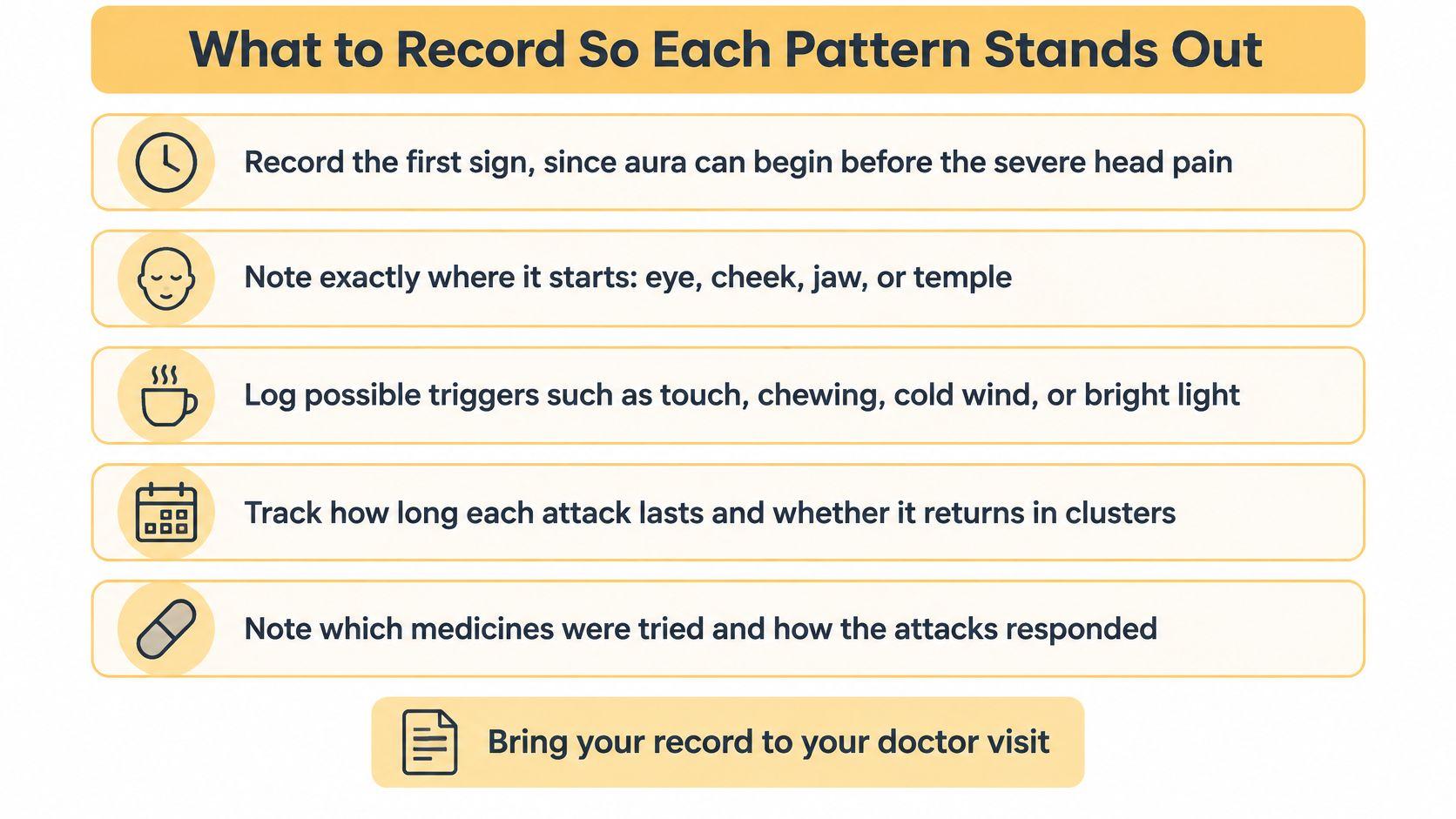
- Time of the first sign. Anything new counts, including a flicker of light or an odd smell.
- Aura type and start time. Visual, sensory or speech changes get their own timestamp, apart from the headache.
- Headache onset and peak. When the throbbing began and when it was worst.
- Duration of each facial shock, in seconds. Mark where on a simple printed face outline it hit: eye, cheek, jaw or temple.
- Pain quality in your own words. "Electric shock" and "throbbing" send a clinician in different directions.
- Triggers you noticed. Touch, chewing, cold wind, poor sleep, skipped meals, weather shifts.
- Nausea, vomiting, and light or sound sensitivity. These features pull an attack toward the migraine column.
- Medication taken and the time. No dosage needed, just what and when, so response can be judged.
- Recovery time. How long until you felt like yourself again.
Read down the list after a mixed day and the split is usually obvious. Shocks cluster around touch and last seconds. The migraine entry stretches across aura, headache, sensory sensitivity and a slow return to baseline.
Relief starts a migraine record when you tap "I feel something" and then follows early signs, aura, headache and recovery, each with its own timer, so the sequence survives the day instead of collapsing into one memory of pain. On the trigger side, it compares the days before your attacks with your usual days, looking at pressure, humidity, temperature swings, sleep and the stress signal.
These comparisons show patterns only. They can't establish or rule out trigeminal neuralgia.
A strong weather correlation does not make a shock-like, touch-triggered attack benign, and a clean pressure chart does not explain a new numb patch on your cheek. The log hands a clinician better questions. It does not answer them.
How Clinicians Tell the Two Apart
A clinician sorting facial pain starts with the history, and the history is more diagnostic than commonly recognised. A 2024 clinical review notes that trigeminal neuralgia is frequently confused with migraine, cluster headache, temporomandibular disorder and dental conditions, and recommends a careful history covering unilateral distribution, paroxysms lasting seconds to two minutes, touch or chewing triggers, oral symptoms, prior trauma or surgery, infection and possible multiple sclerosis (clinical review of trigeminal neuralgia diagnosis). It also describes MRI of the brain and brainstem as part of the recommended evaluation.
What the clinician asks first
Expect questions that sound oddly specific. Does the pain ever cross the midline? How long does a single shock last, and can you count it in seconds? Does brushing your teeth set it off? Has there been dental work, facial surgery, an infection, a head injury? Does anything suggest multiple sclerosis? Each answer narrows the differential before any scan happens.
The examination follows the same logic. Sensory testing across the three divisions of the face, a neurological examination, and a look at the jaw joint and oral cavity. Migraine, by contrast, is usually diagnosed clinically using ICHD-3 criteria, with imaging reserved for atypical features or red flags.
Why imaging enters the conversation
A 2025 evidence review recommends brain MRI with and without contrast for suspected trigeminal neuralgia, both to evaluate causes such as tumors or multiple sclerosis and to assess candidacy for surgery. Read that as exclusion and planning, not as a verdict about your particular pain.
| Pattern in your log | Key history points | Usual next step |
|---|---|---|
| Brief shocks triggered by touch or chewing | Unilateral, seconds to 2 minutes, oral triggers | MRI of brain and brainstem and specialist review |
| Hours-long throbbing headache with nausea or light sensitivity | Attack duration, aura, trigger pattern | Clinical diagnosis by ICHD-3 criteria; imaging if atypical or red flags are present |
| Both attack types in one log | Separate timing, triggers and responses for each | Clinician review of both patterns before settling on one label |
| Possible secondary cause | Prior trauma, surgery, infection or suspected multiple sclerosis | Investigation to exclude the cause |
The question worth asking out loud isn't only "is this migraine or trigeminal neuralgia". It's "when does a migraine tracking routine stop being enough, and what evaluation should happen next". Persistent one-sided pain, sensory change, neurological findings, unusual attack duration or poor response to standard migraine treatment all point toward reassessment rather than another month of trigger experiments.
Bring the log and this table to the appointment. A clinician can work with a pattern. A clinician can only guess at a memory.
Treatment Options Compared for Each Condition
The treatment paths for trigeminal neuralgia and migraines are not interchangeable, and treating them as if they were is how people end up on the wrong regimen for years. The underlying logic differs: one aims at an irritated or compressed nerve, the other at a neurological disorder with vascular and neurochemical involvement.
Trigeminal neuralgia care
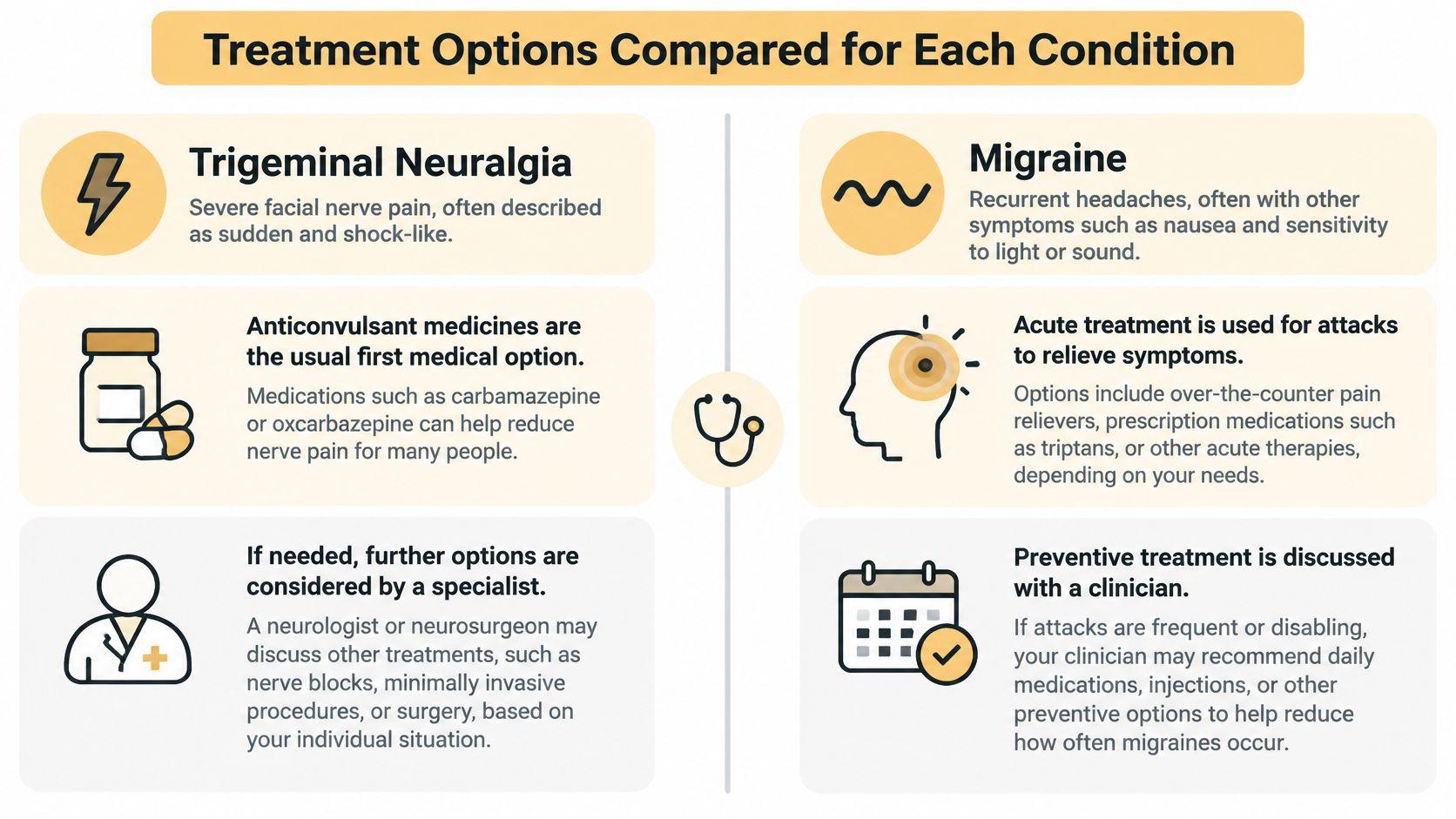
Medical treatment comes first in many cases, and the NHS describes an anticonvulsant medicine class as the usual first option, alongside specialist evaluation that may lead to surgery relieving pressure on the nerve. Surgical options exist for a reason. For trigeminal neuralgia with demonstrated neurovascular compression, a 2021 Royal College of Surgeons guideline strongly recommends offering microvascular decompression before stereotactic radiosurgery to patients who are medically fit and willing to undergo posterior-fossa surgery.
The durable-outcome figures are striking. In a five-year prospective comparison, 59% of the surgical group versus 19% of the medically managed group were pain-free without medication, a relative risk of 3.03 (95% CI 1.67 to 5.50), and at least a 50% reduction in pain occurred in 65% versus 43% respectively (Royal College of Surgeons trigeminal neuralgia guideline).
Those numbers don't justify surgery for everyone with facial pain. Imaging has to demonstrate neurovascular compression and exclude secondary causes, and the clinical features still decide the diagnosis.
Migraine care
Migraine management splits into acute treatment for an attack and preventive treatment to reduce how often attacks occur, and the categories are different from the ones above.
| Approach | Trigeminal neuralgia | Migraine |
|---|---|---|
| Lifestyle and self-care | Limiting known triggers such as cold wind or certain chewing | Regular sleep, meals, hydration and stress management may help reduce frequency for some people |
| Over-the-counter options | Ask a pharmacist or clinician whether any option is suitable for brief shocks | Used for attack pain; ask a pharmacist or clinician about suitability |
| Prescription treatment | An anticonvulsant class is usually the first medical option (NHS) | Acute and preventive options chosen by a clinician |
| Procedures | Microvascular decompression or stereotactic radiosurgery when suitable | Not typically surgical; specialist-directed options in some cases |
| Emerging research | Ongoing studies of newer nerve-targeted options | CGRP-targeted treatments are an active area of research and use |
Lifestyle work is the part you control, and it's worth doing well: consistent sleep and wake times, regular meals, hydration, and stress management that fits your week. Over-the-counter options cover attack pain for some people and not others. Prescription choices, preventive or acute, belong to a clinician who knows your history, your other medications and your contraindications. CGRP-targeted treatments are an active area of research and use, which is a reason for cautious interest rather than a reason to skip the basics.
No medication here is named as a best choice, and no dose is offered, because those decisions depend on interactions, monitoring and the diagnosis you're carrying. If you're weighing prescription routes for attacks and prevention, our overview of migraine medication options walks through the categories without pushing one.
The practical safeguard: recurrent shock-like, touch-triggered facial attacks, or new neurological findings, go to a clinician for assessment. They don't get logged as weather-related migraine and left there.
This article is for informational purposes and is not medical advice. Consult a healthcare provider for personalized guidance.
Bring a Clear Attack Log to Your Next Appointment
Preparation is the part of care you can control this week. Work through this list before your next visit.
- Export or print a summary of the last several months. Include the fields you've been tracking: timing, duration, location, quality, associated symptoms.
- Sort attacks into three groups. Brief shock-like episodes, hours-long migraine-like episodes, and the ones that feel like both.
- Add typical triggers and what helped for each group. Skip any dosage you haven't confirmed with a clinician.
- List red-flag symptoms with dates. Numbness, new weakness, a changed pattern, a shock that arrived without a trigger.
- Write three questions. Whether you might be dealing with one condition or two, whether imaging is warranted, and when to come back.
Write those three questions down rather than planning to remember them. Appointments compress, and the question that mattered most at 3am is the one that evaporates in the room.
If you're starting from a blank page, our migraine log template gives you the fields to capture from your first attack onward.
Clinicians note that migraine and trigeminal neuralgia may coexist, which is exactly why a log that separates attack types is more useful than a single label; self-diagnosis can't distinguish overlapping disorders, but a clear record lets a clinician see two patterns instead of one (Merck Manual Professional overview of trigeminal neuralgia).
A clear log turns a vague description into something a clinician can act on, and that's the whole point. This article is for informational purposes and is not medical advice. Consult a healthcare provider for personalized guidance.
If you're trying to work out whether your facial shocks and your long headaches are one pattern or two, the fastest way to find out is to record them separately and bring the record to someone who can examine you. Relief tracks early signs, aura, headache and recovery with a timer for each stage, lines up attacks against pressure, humidity, sleep and stress, and turns months of history into a report you can hand to your clinician.
This guide is general information, not medical advice, and it isn’t a diagnosis. Talk to your doctor about your own headaches.