
You're standing in the kitchen and the room seems to tilt. Turning your head makes the floor feel unsteady, bright light becomes uncomfortable, and yet you may not have a headache at all. Vestibular migraine symptoms are migraine-related balance and motion symptoms, including vertigo, dizziness, imbalance, nausea, and sensory sensitivity, that can happen with or without head pain.
That combination can be frightening, especially when other people expect migraine to mean throbbing pain. Your experience is real, and learning which symptoms to track can help you describe the pattern clearly to a healthcare provider.
Table of Contents
When Dizziness Feels Like More Than Just Being Off-Balance
You might notice the problem while walking through a supermarket. The shelves seem to move, turning your head toward a sound makes you feel pulled sideways, and the bright overhead lighting adds a layer of discomfort. Later, you try to explain it, but “dizzy” feels too vague. There was no obvious injury, no simple explanation, and perhaps no headache to make the experience look like migraine.
Vestibular migraine is a migraine disorder in which vestibular symptoms, meaning symptoms involving balance and spatial orientation, become prominent. Those symptoms can include vertigo, a false feeling of spinning or movement, imbalance, motion sensitivity, and dizziness. Head pain may occur, but it isn't required during every episode.
The formal framework recognizes several types of vestibular symptoms, including spontaneous vertigo, positional vertigo, visually induced vertigo, head-motion-induced vertigo, and head-motion-induced dizziness with nausea. Episodes last 5 minutes to 72 hours, and the diagnostic framework requires at least five attacks involving moderate or severe vestibular symptoms. At least half of the episodes must also include a migraine feature, such as migraine-type headache, photophobia and phonophobia, or visual aura, as described in the International Classification of Headache Disorders criteria for vestibular migraine.
Why the label can be missed
The word “migraine” often makes people think first about head pain. That expectation can delay recognition when dizziness, nausea, balance problems, or light sensitivity lead the episode instead.
Vestibular migraine affects about 1% to 3% of adults, while reviews describe it in about 7% to 16% of neurology and neuro-otology clinic patients and about 10% of headache-clinic patients, according to an NIH-hosted clinical review. The condition is therefore much more concentrated in specialty care than in the general population.
You don't need to force your symptoms into a classic headache pattern. Describing what happens before, during, and after dizziness gives your clinician more useful information than reporting that you “feel off.”
The Full Spectrum of Vestibular Migraine Symptoms
Vestibular migraine can feel different from one person to the next, and even your own episodes may not follow the same pattern. The central symptom may be spinning, rocking, swaying, light-headedness, or difficulty staying visually oriented.
Core vestibular experiences
- Spontaneous vertigo: Spinning or movement begins without an obvious change in position.
- Positional vertigo: Changing position, such as rolling in bed or looking upward, brings on the sensation.
- Visually induced vertigo: Busy patterns, scrolling screens, supermarkets, traffic, or large moving scenes make you feel dizzy.
- Head-motion-induced vertigo: Turning or nodding your head creates a spinning sensation.
- Head-motion-induced dizziness with nausea: Movement causes disorientation or motion sickness without necessarily producing a full spinning sensation.
The clinical pattern often centers on balance rather than dramatic spinning. One series reported unsteadiness in 91%, balance disturbance in 82%, light-headedness in 77%, and vertigo in 57% of patients. Vertigo and headache occurred together in only 48%, so a headache-free episode doesn't automatically rule out a migraine-related vestibular event, as shown in the clinical series indexed by PubMed.
Associated migraine and ear symptoms
Photophobia means sensitivity to light, while phonophobia means sensitivity to sound. Nausea, visual aura, head pressure, and sensitivity to movement may accompany the vestibular symptoms. Some people also notice aural fullness, a blocked or pressurized ear feeling, tinnitus, or mild hearing changes.
A large clinical study found photophobia and phonophobia in 90.1%, nausea in 80.2%, aural symptoms in 60.3%, and headache in 49.6% of patients with vestibular migraine, according to its PubMed record. These findings reinforce an important distinction: migraine isn't synonymous with headache.
| Symptom | Prevalence | Description |
|---|---|---|
| Unsteadiness | 91% | Feeling unstable, wobbly, or unsure while standing or walking |
| Balance disturbance | 82% | Difficulty maintaining orientation or judging where your body is in space |
| Light-headedness | 77% | A faint, floaty, or disconnected sensation |
| Vertigo | 57% | Spinning or movement of you or your surroundings |
| Headache with vertigo | 48% | Head pain and vertigo occurring together |
| Headache during attacks | 49.6% | Head pain reported in a large clinical study |
The diagnostic criteria don't require every symptom in this table. They focus on the number, duration, and intensity of vestibular episodes, a personal or past migraine history, and migraine features in at least half of those episodes. A symptom log can show your clinician whether imbalance, visual sensitivity, nausea, or head pain tends to lead.
Practical rule: Log the symptom that stops you from functioning, even when it isn't the most familiar migraine symptom.
This article is for informational purposes and is not medical advice. Consult a healthcare provider for personalized guidance.
Why You Might Feel Off-Balance Even Between Attacks
Vestibular migraine doesn't always switch neatly from “on” to “off.” You may recover from a severe spinning episode but continue to feel slightly unsteady in the shower, uncomfortable in a moving car, or overwhelmed by a crowded visual environment.
Recent reviews describe persistent vestibular symptoms during attack-free periods. These may include motion intolerance, oscillopsia, a sensation that the visual world bounces or shifts, nausea, photophobia, phonophobia, aura, and cochlear symptoms such as aural fullness, tinnitus, or mild hearing loss, as discussed in a 2025 narrative review.

The sensitive alarm system analogy
Think of your balance and sensory systems as an alarm system. During a flare, the alarm becomes loud and disruptive. Between flares, the alarm may quiet down without fully returning to its usual setting. A normal supermarket aisle, phone screen, or quick head turn can then produce a disproportionate response.
That analogy doesn't mean the symptoms are imaginary or caused by anxiety. Persistent sensitivity can make you question yourself, particularly when a brief appointment captures you on a better day. Recording your baseline helps show the difference between an obvious attack and the lower-level sensitivity that remains around it.
What baseline tracking adds
Write down how steady you feel when you aren't having a clear attack. You might use simple descriptions such as “comfortable walking,” “mild sway when standing,” “car ride difficult,” or “screens trigger eye strain.” Include whether the symptom is constant, comes in waves, or appears only in particular environments.
Tracking baseline sensitivity matters because a calendar containing only dramatic vertigo episodes can understate your actual burden. The full pattern may include severe flares, lingering visual discomfort, and reduced tolerance for movement between attacks.
Distinguishing Vestibular Migraine from Other Dizziness Disorders
Dizziness has many possible causes, and the symptoms overlap. Vestibular migraine is diagnosed from the overall pattern, not from one sensation alone. A healthcare provider may consider the timing of episodes, what triggers them, hearing changes, neurological symptoms, migraine history, and examination findings.
Comparing the patterns
| Condition | Episode duration | Key features | Hearing symptoms |
|---|---|---|---|
| Vestibular migraine | 5 minutes to 72 hours under formal criteria | Vertigo or dizziness with motion or visual sensitivity, nausea, photophobia, phonophobia, aura, or migraine history | Aural fullness or tinnitus may occur; hearing changes can be mild |
| BPPV | Usually brief, triggered episodes | Intense positional spinning after movements such as rolling over or looking up | Hearing symptoms aren't the defining feature |
| Meniere's disease | Episodic vertigo | Vertigo with fluctuating hearing changes, ear pressure, and tinnitus | Hearing symptoms are central to the pattern |
| Vestibular neuritis | Sudden severe vertigo that can persist for days | Marked imbalance and nausea, often beginning abruptly | Hearing is generally less prominent than balance symptoms |
| Stroke | Sudden onset, variable duration | Dizziness or vertigo with new neurological changes, severe imbalance, speech or vision problems, weakness, or numbness | Hearing symptoms may or may not occur |
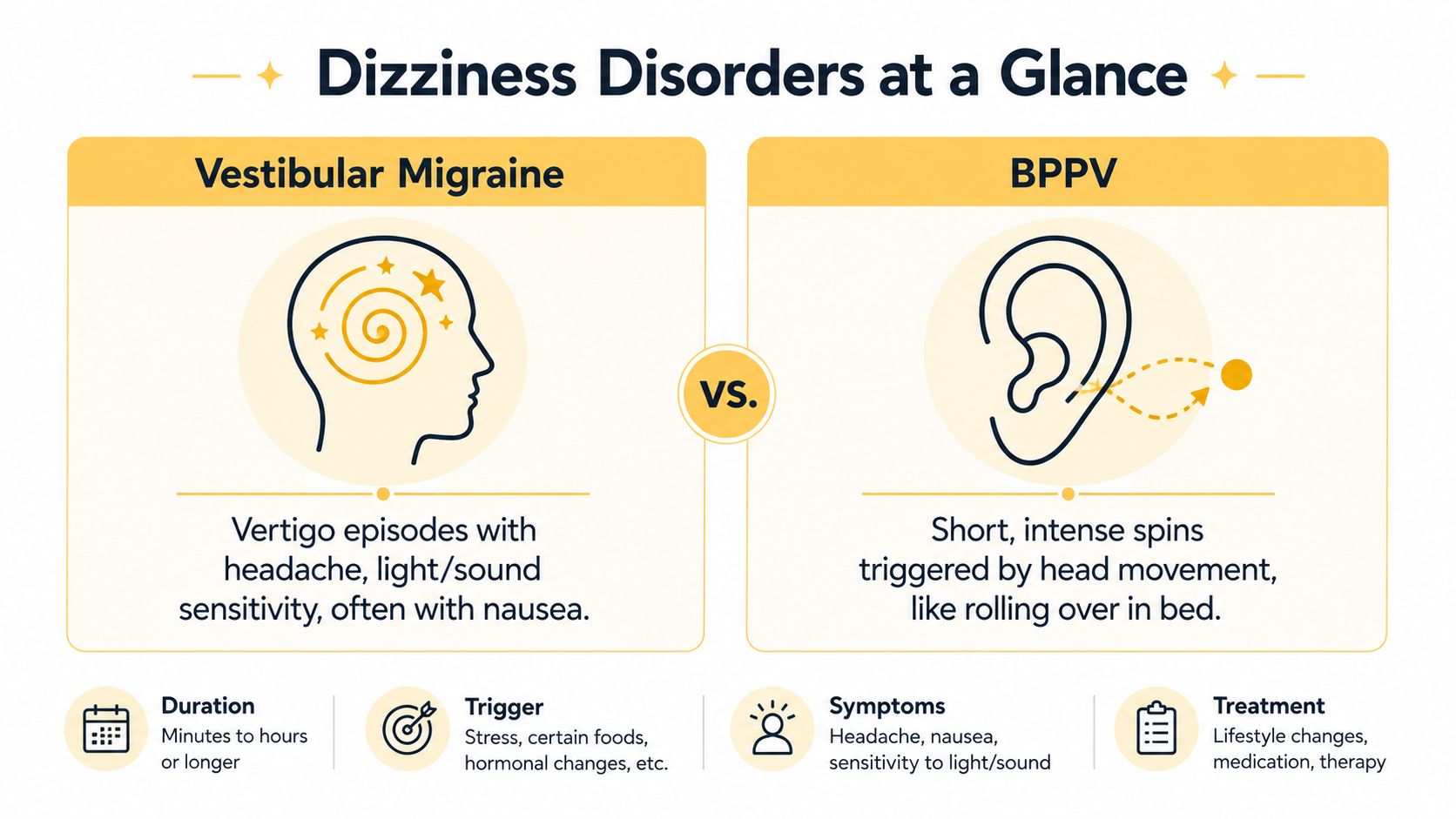
BPPV is often strongly linked to a particular head movement. Meniere's disease raises more concern about fluctuating hearing symptoms, while vestibular neuritis tends to present as a sudden, sustained vestibular illness rather than a recurring migraine-linked pattern. Stroke requires urgent assessment when dizziness begins suddenly alongside neurological changes.
The distinctions aren't always clean. A recent review notes that only 10% of people meeting vestibular migraine criteria in a population study were told migraine caused their dizziness, highlighting how often people lack a clear explanation, as reported in PubMed's record for the diagnostic review.
The following video provides a general visual explanation of vestibular migraine symptoms and related dizziness patterns. It isn't a substitute for an examination or diagnosis.
Bring your timeline to an appointment. “The room spun when I rolled left, lasted briefly, and never came with light sensitivity” gives a clinician a more useful starting point than “I get dizzy.”
What to Track and How to Log Your Symptoms Effectively
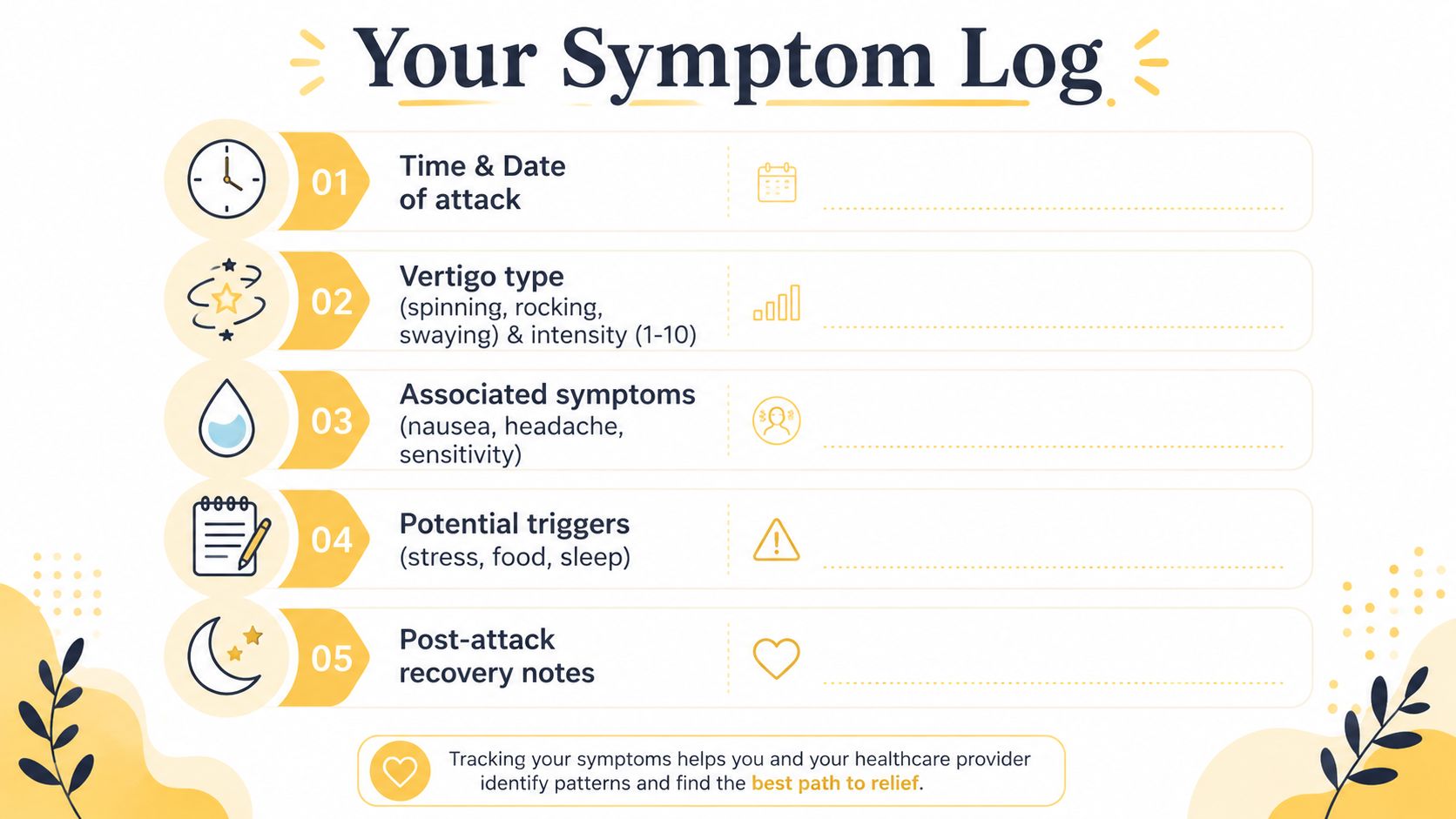
A useful log captures more than the worst moment. Record the attack itself, the recovery period, and your background sensitivity. That creates a timeline your memory may not provide, especially when episodes blur together.
During an attack
Note the start time, end time, and the main vestibular sensation. “Spinning,” “rocking,” “swaying,” “falling sideways,” and “light-headed” describe different experiences, so use the word that fits rather than choosing a general label.
Record intensity in a consistent way, such as a personal scale, and add associated symptoms:
- Sensory symptoms: Light sensitivity, sound sensitivity, visual aura, or difficulty looking at moving scenes.
- Body symptoms: Nausea, vomiting, sweating, ear pressure, tinnitus, or hearing change.
- Head symptoms: Headache, head pressure, neck discomfort, or no head pain.
- Context: Sleep quality, stress, hydration, movement, screens, weather, air quality, and any medication taken.
Don't assume a food is a trigger because it appears before one episode. Dietary factors vary substantially, so record what you ate and look for a repeated personal relationship rather than following a universal trigger list.
Between attacks
Give your baseline a brief check-in. Log balance while walking, tolerance for car travel, sensitivity to screens or busy places, fatigue, and whether you feel fully recovered.
Include timing details that may reveal a pattern, such as time of day, day of the week, hormonal-cycle phase if applicable, weather changes, barometric pressure, sleep regularity, stress, and environmental exposures. Consistency matters more than elaborate writing. A short entry made regularly can be more useful than a detailed entry made only after severe episodes.
Apps can reduce the friction of logging. Relief combines symptom, trigger, and medication entries with environmental information such as weather, air quality, and pollen, and its migraine tracking information can help you review patterns over time.
For your next entry: Record what the dizziness felt like, what you were doing when it began, which sensory symptoms appeared, and how steady you felt after the obvious attack ended.
When to Seek Immediate Medical Care
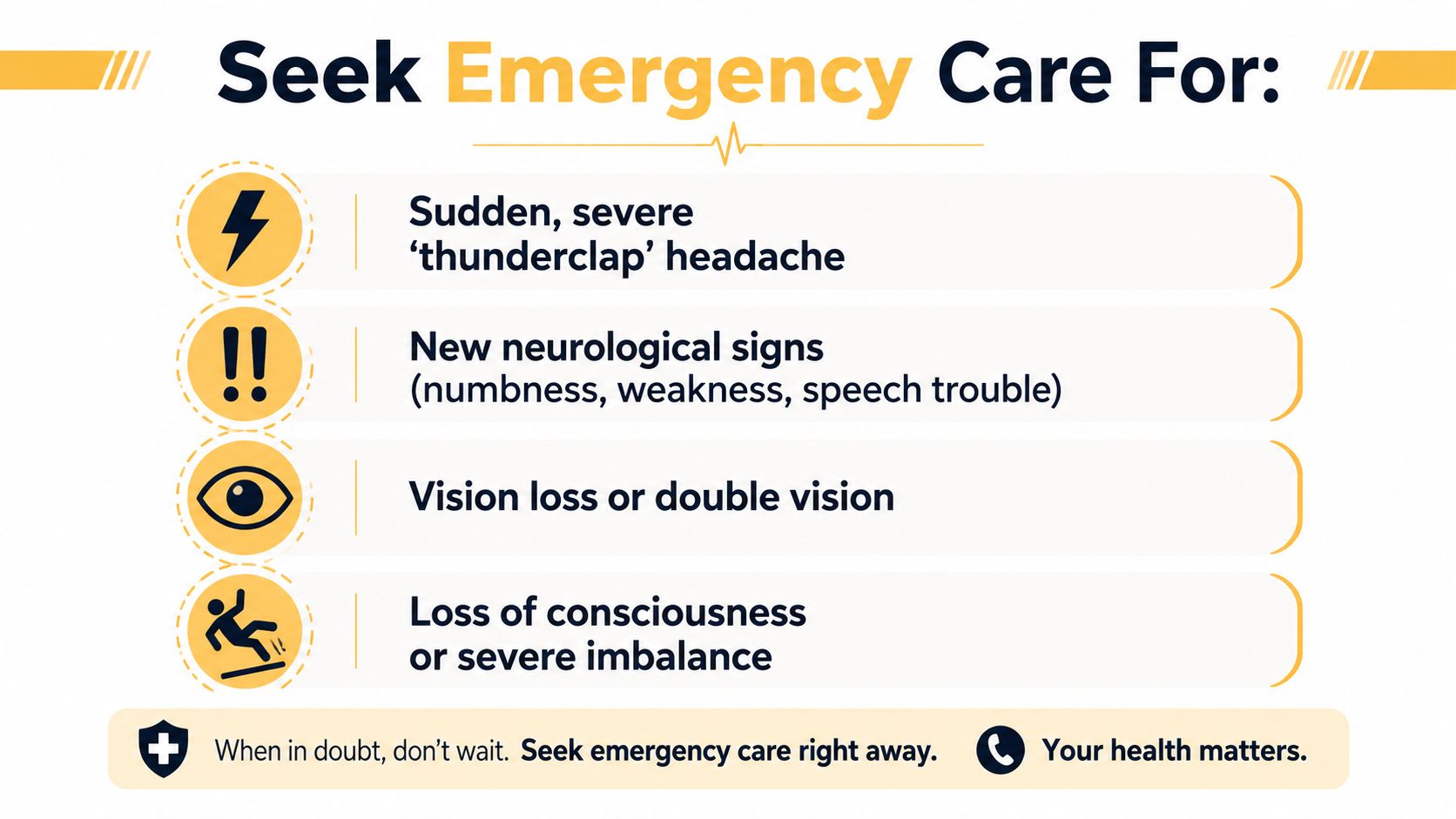
Some symptoms need urgent assessment, even if you have a history of migraine. Seek immediate medical care for a sudden, severe headache unlike your previous migraines, a headache with fever or a stiff neck, new weakness or numbness, difficulty speaking, vision loss, confusion, loss of consciousness, or a headache after a head injury.
Sudden hearing loss also needs prompt evaluation. Severe new imbalance with neurological symptoms can signal a serious problem, including stroke, while fever and neck stiffness can point toward infection. You shouldn't wait for a familiar migraine pattern when the presentation is new, abrupt, or frightening.
When to arrange a routine appointment
Schedule medical care if dizziness is new, changing, interfering with work or daily activities, recurring without an explanation, or not responding to your current management approach. Bring your symptom log, including the timing of episodes and your between-attack baseline.
Seeking help isn't overreacting. A careful evaluation can separate vestibular migraine from other disorders and guide an appropriate plan.
This article is for informational purposes and is not medical advice. Consult a healthcare provider for personalized guidance.
Building Your Management Approach
Managing vestibular migraine usually involves several connected pieces rather than one universal fix. Medical care may include an acute plan for attacks and preventive treatment when episodes are frequent or disabling. Your healthcare provider can decide which options are appropriate after considering your symptoms, medical history, other conditions, and current medicines.
Lifestyle measures can support that care. A consistent sleep routine, regular hydration, manageable activity, stress-reduction practices, and attention to personal triggers may help reduce vulnerability for some people. The important word is personal. A food, weather pattern, screen exposure, or sleep disruption may matter to you and not to someone else.
Tracking adds the missing feedback loop. If you record only vertigo, you may miss the visual sensitivity that builds beforehand. If you record only attacks, you may overlook the baseline imbalance that limits your day. A complete log can help you and your clinician decide whether a strategy is helping, whether symptoms are changing, and which patterns deserve closer attention.
Vestibular rehabilitation may be appropriate for some people, but exercises should be selected with qualified guidance, particularly when movement reliably worsens symptoms. Lifestyle tools and symptom diaries can support medical care, but they can't replace evaluation or prescribed treatment.
A clinician familiar with migraine and vestibular disorders can help interpret overlapping symptoms. Your job isn't to diagnose yourself. It's to bring a clear record of what happens, when it happens, and how it affects your ability to move through ordinary environments.
Relief is an iOS tool that combines symptom logging with local weather, air quality, and pollen information, helping you review personal and environmental patterns rather than relying on memory alone.
Use Relief to log vertigo type, balance changes, sensory symptoms, triggers, and recovery while keeping environmental conditions alongside your entries. Start recording your baseline today, then bring the resulting pattern to a healthcare provider for a more focused conversation.


