For many people with migraine, changes in barometric pressure, humidity, and air quality can act as environmental triggers, and some patterns may precede an attack by hours or days. The exact combination depends on your personal sensitivity, so a weather and AQI forecast is a useful starting point, not a verdict.
You may notice the warning before you check your phone: pressure behind your eyes, unusual fatigue, light sensitivity, or the familiar shift in concentration that can accompany the prodrome, the early phase before migraine pain begins. Then the forecast shows falling pressure, rising humidity, or worsening air quality. That connection can feel validating, especially if you've been told that weather sensitivity is “just in your head.”
It isn't imaginary. Research links weather changes and air pollution with migraine and headache risk, but it also shows that people respond differently. The practical aim isn't to avoid every cloudy day or treat an AQI number as a diagnosis. It's to learn which combinations tend to appear before your attacks, then use that information to make reasonable decisions about activity, rest, indoor air, and medical planning.
Important: This article is for informational purposes and is not medical advice. Consult a healthcare provider for personalized guidance.
Table of Contents
When the Sky Changes, Your Head Hurts
You wake with a heavy feeling around your temples. The room seems too bright, your neck feels tight, and the thought of commuting through warm, hazy air makes you uneasy. Maybe the migraine hasn't started yet, but your body has already changed its plans for the day.
That experience can reflect several overlapping processes. A drop in atmospheric pressure, a humidity shift, heat, wind changes, or higher pollution may coincide with the beginning of an attack. A migraine isn't just a headache. It can include aura, temporary visual, sensory, or language symptoms that may occur before or during an attack, as well as nausea, photophobia, or sensitivity to light, and postdrome, the drained "after" phase that follows the main symptoms.
Research doesn't support one universal weather trigger. A 2025 systematic review of 14 studies involving 2,696 people found evidence that barometric-pressure changes may influence migraine frequency, while evidence about attack severity remained inconsistent in the published review. A separate neurology review concluded that migraine can relate to pressure, humidity, and wind, but described the overall weather effect as limited and causal evidence as inconsistent in its assessment of the literature.

Why your personal pattern matters
A population-level association tells you that a factor may matter across groups. It doesn't tell you whether today's pressure change caused your migraine, or whether the same change will affect you next month. That distinction matters because migraine is shaped by several variables at once, including sleep, stress, meals, hydration, hormonal changes, illness, sensory load, and medication use.
Air quality adds another layer. The WHO Ambient Air Quality Database released version 8.0 in June 2026, with measurements from 8,023 human settlements across 127 WHO Member States, Associate Members, or territories, covering 2010 to 2024. Monitoring is broader than it once was, but local exposure can still differ from a citywide number.
That makes tracking worthwhile. Instead of asking whether “the weather” causes your migraine, ask a more useful question: which changes, in what sequence, tend to appear before my symptoms?
Understanding the Air Quality Index Scale
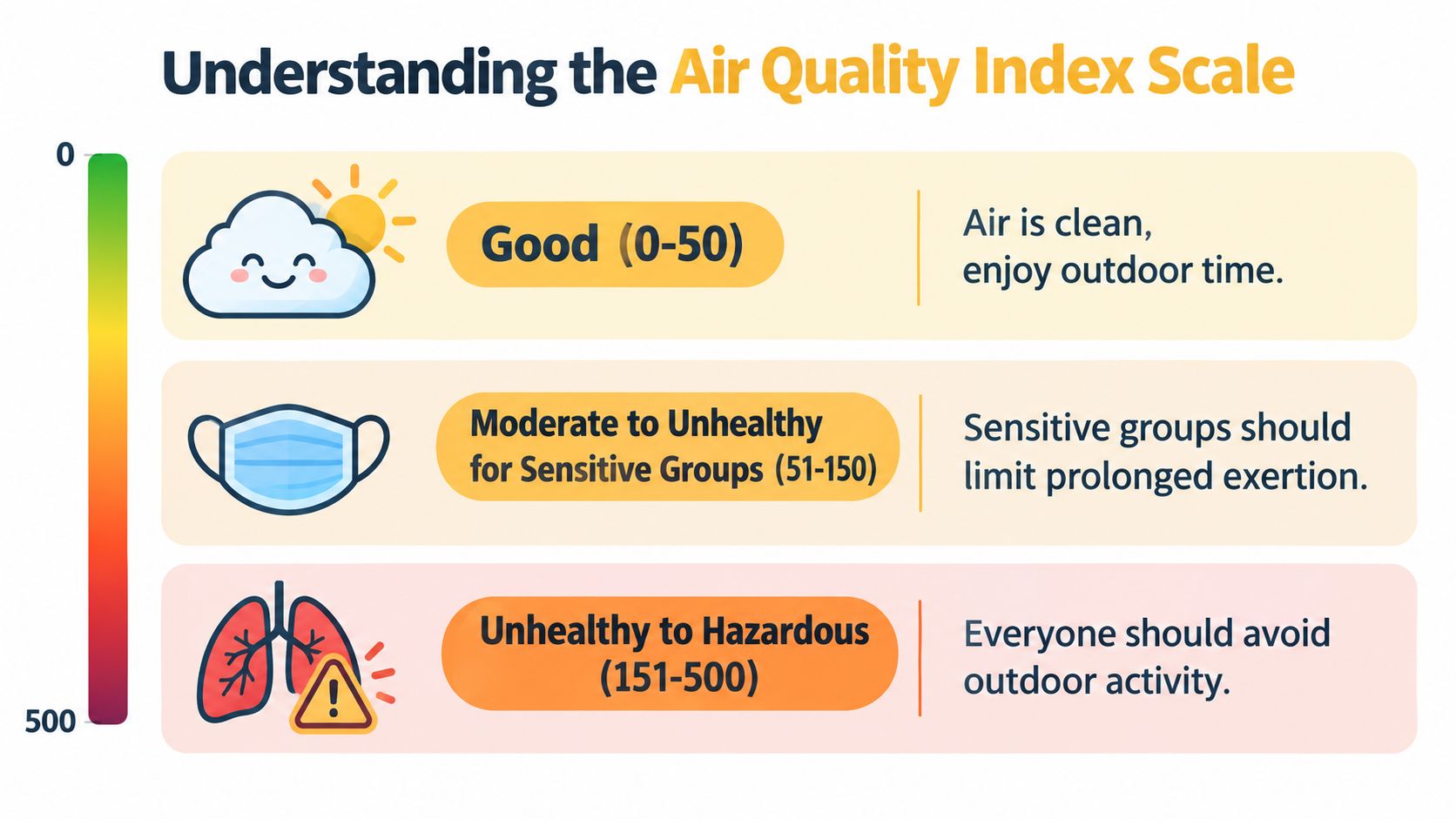
The Air Quality Index, or AQI, translates pollutant measurements into a number and color category. It isn't a direct measurement of your personal exposure, and it doesn't predict migraine by itself, but it gives you a common language for deciding whether outdoor conditions deserve attention.
Start with the number, then check which pollutant is driving it. Ozone and fine particles can behave differently, and a forecast may combine measurements from monitors with satellite and model estimates. That matters when conditions vary between a busy road, a quiet residential area, and your indoor space.
Read the number in context
Good, 0 to 50: Air pollution is low by the index's standard. You may still experience a migraine on a good-AQI day if another factor, such as pressure or sleep disruption, is relevant to you.
Moderate, 51 to 100: Conditions may be acceptable for many people, but sensitive individuals can notice symptoms when exposure is prolonged or when the number changes quickly. If you identify pollution as a personal factor, pay attention to how you feel during outdoor exertion.
Unhealthy, 101 and above: More people may experience health effects as pollution rises. Consider reducing prolonged outdoor exertion, especially during visible smoke, haze, or strong odors. Migraine-related symptoms may include pressure, fatigue, sensory sensitivity, or brain fog, but these symptoms aren't specific enough to identify a cause on their own.
The AQI scale extends to 500, but the health meaning isn't captured by a single daily average. A sudden spike during your commute may matter more to you than a steady reading that stays within your usual range. Compare the hourly pattern with your symptoms rather than relying only on the headline number.
For a practical explanation of what your local readings measure, use this guide to measure air quality for migraine tracking. Record the pollutant, time, location, and whether you were indoors or outdoors. That small amount of context can prevent an AQI number from becoming an oversimplified explanation.
How Weather and Air Quality Interact
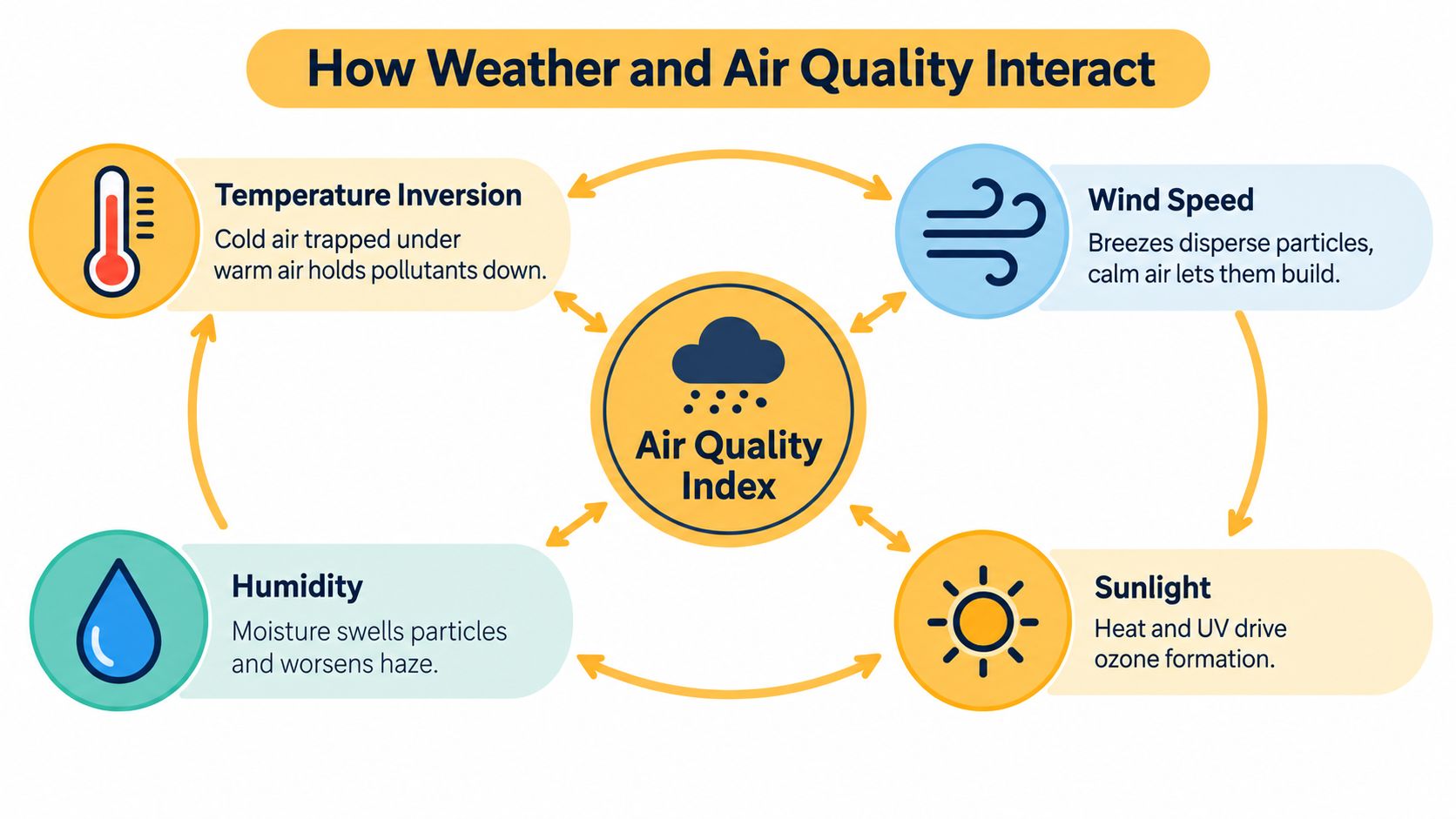
A hot, stagnant afternoon can produce both a difficult pollution reading and conditions that matter to people with weather-sensitive migraine. Temperature, pressure, wind, humidity, and sunlight influence how pollutants form, move, and remain near the ground. They can also coincide with environmental changes linked to migraine symptoms.
A temperature inversion forms when warmer air settles above cooler air near the surface. The cooler lower layer can trap pollution where people breathe, particularly when wind is calm. Humidity can change particle behavior and haze, while sunlight and heat contribute to ozone formation. The result is a combined exposure pattern, not two separate checklists.
Heat can change the meaning of a pollution reading
A systematic review of 62 studies found interaction effects between high temperatures and pollutants such as ozone, PM10, PM2.5, and nitrogen dioxide. It reported stronger ozone effects in tropical climates, along with interaction signals involving ozone and PM2.5 during transitional weather in the cited neurology research.
These findings do not mean heat causes migraine whenever pollution rises. They suggest that the combination may provide more useful context than either measure alone. A hot day with high ozone may call for a different plan than a cool day with the same AQI, particularly if your records show that pattern before attacks.
Pressure adds another variable. A study of 7,054 headache patients found that each 5°C increase in ambient temperature during the preceding 24 hours was associated with a 7.5% higher acute headache risk. Lower barometric pressure was associated with nonmigraine headache risk during the 48 to 72 hours before presentation, according to the study record. A separate pressure analysis reported migraine most often after atmospheric pressure fell by 6 to 10 hPa relative to standard pressure, with rates of 23.5% at 1005 to less than 1007 hPa and 26.5% at 1003 to less than 1005 hPa in its pressure analysis.
Your own response may differ. Review temperature, humidity, and barometric pressure patterns alongside hourly AQI changes to identify combinations that matter to you, rather than treating each factor as an isolated trigger.
What to Do on High AQI Days
You don't need perfect air to make a sensible plan. You need enough information to reduce avoidable exposure and notice early symptoms before the day becomes harder to manage.
Adjust exposure before symptoms escalate
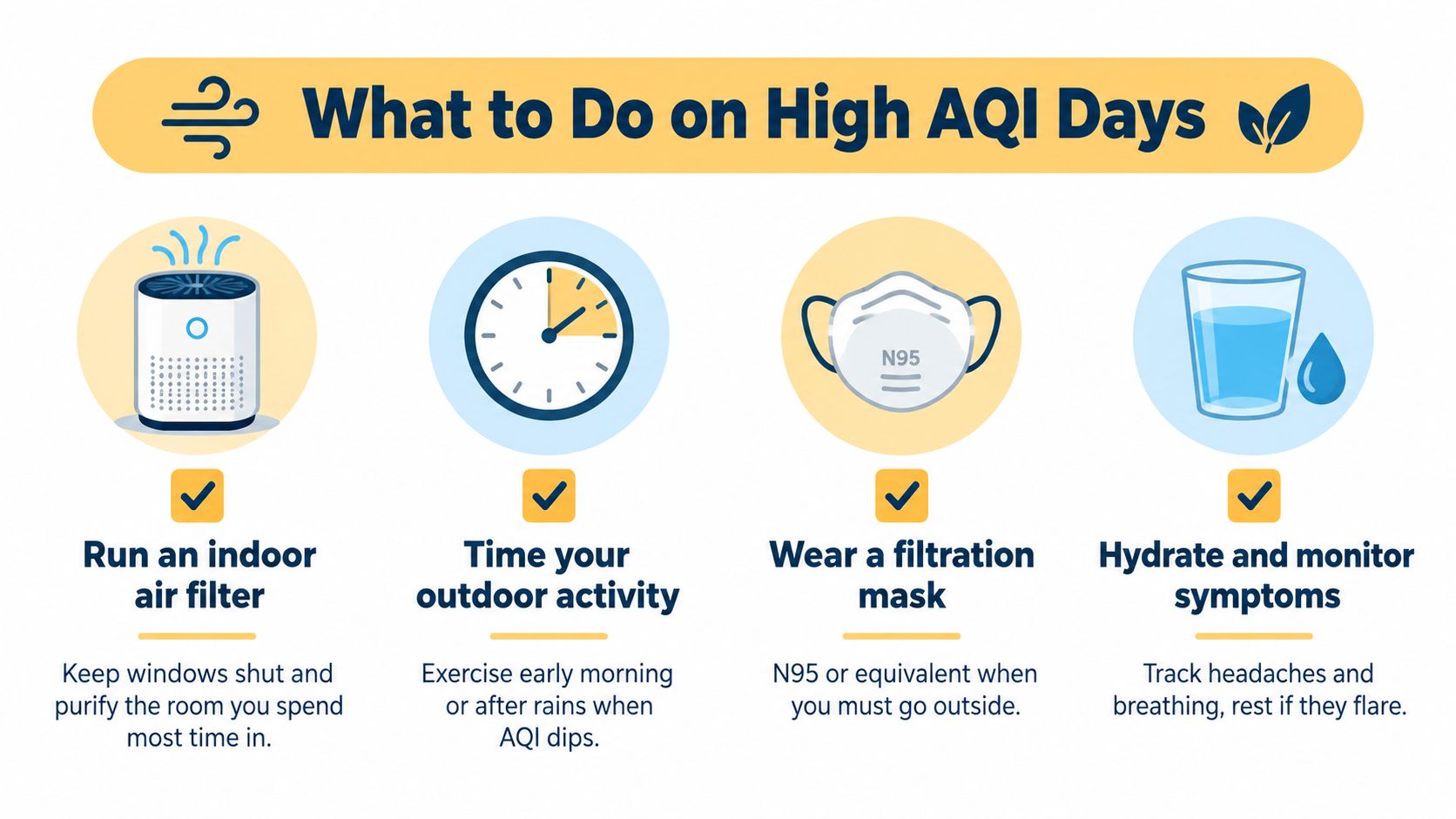
Run a HEPA air purifier in the room where you spend the most time, particularly during smoke or haze. Keeping windows closed may reduce outdoor particle entry, although indoor air quality can also be affected by candles, cooking, cleaning products, and poor ventilation.
Shift outdoor exercise when conditions are better, if your schedule allows. A lower AQI window may occur after weather changes, but don't assume that morning or post-rain conditions are always safer. Check the local reading rather than relying on a fixed rule.
Use a well-fitting filtration mask, such as an N95 or equivalent, when you must spend time outdoors in polluted air. A mask won't address pressure changes or every migraine trigger, but it can reduce inhaled particles.
Use a simple decision check
Stay indoors: Consider shortening outdoor time when AQI rises into a range you've previously associated with symptoms, or when smoke and haze are visibly increasing.
Wear filtration protection: Use a suitable mask for unavoidable outdoor exposure, especially near traffic, smoke, or dust.
Watch the early phase: New light sensitivity, nausea, visual changes, unusual fatigue, or pressure may signal the beginning of a migraine. Reduce sensory load and rest if you can.
Discuss medication changes with your clinician: Don't start, stop, or alter medication based on an AQI forecast alone. Ask your healthcare provider in advance how to follow your existing migraine plan when environmental conditions worsen.
Weather and AQI data can support decisions, but they can't replace medical care. This article is for informational purposes and is not medical advice. Consult a healthcare provider for personalized guidance.
From General Forecast to Personal Prediction
A generic forecast can tell you that pressure is falling or AQI is worsening across your area. It can't tell you whether that pattern has preceded your migraines, how quickly your symptoms tend to follow it, or whether the risk is different when you also slept poorly.
That gap matters because street-level exposure isn't uniform. NASA's discussion of air-quality monitoring gaps notes that monitor coverage is sparse globally and that smartphone apps may combine satellite, model, and ground measurements rather than rely on a direct reading from your exact location. NOAA-related forecasting guidance also leaves practical planning limited because air-quality forecasts generally extend about 48 to 72 hours.
Population risk versus personal susceptibility
A general forecast is useful for answering, “Should I check conditions before going outside?” A personalized record is better for questions such as:
| General forecast | Personal tracking |
|---|---|
| Shows regional AQI and weather conditions | Connects conditions with your logged symptoms |
| May represent a broad area | Adds timing and location context |
| Indicates possible population-level risk | Tests whether a pattern repeats for you |
| Helps you plan exposure | Helps you decide which signals deserve attention |
Relief combines migraine logs with local weather, air quality, and pollen signals, including humidity, temperature, barometric pressure, heat, UV, and AQI. Its hour-by-hour forecast is designed to show how environmental conditions may relate to your risk, while your attack logs give the system information about what tends to happen in your own history. You can see how hour-by-hour migraine forecasting works.
The feedback loop is straightforward: log an attack, include symptoms and relevant context, then compare the preceding hours and days with the forecast. Over time, that record may help separate a recurring personal signal from a coincidence. It won't prove causation or guarantee an attack prediction, but it can make your decisions more informed than checking a citywide AQI number in isolation.
Myths About Weather and Migraine Triggers
Myth: Weather-sensitive migraine is imaginary.
Research finds measurable population-level associations between migraine and environmental conditions. A 2025 meta-analysis of 31 studies found significant associations between migraine attacks and temperature, with an odds ratio of 1.15, and ambient pressure, with an odds ratio of 1.07. It also found that increased PM10, PM2.5, nitrogen dioxide, carbon monoxide, and ozone were associated with higher migraine clinical-visit risk in the published analysis.
That evidence validates the possibility of sensitivity, but it doesn't identify your trigger automatically. An association across studies isn't proof that one weather shift caused your attack.
Myth: Everyone with migraine should avoid the same conditions.
People differ. One prospective cohort of 98 migraine patients, covering 4,406 person-days, found that a 26.5% increase in the three-day moving average of relative humidity was associated with 28% higher odds of migraine onset. Temperature and pressure were generally null in that analysis, the association was strongest in warm weather, and ozone showed more signal in the cold season, as reported in the cohort study.
That contrast is the point. One person may notice humidity, another pressure changes, and another pollution during heat. A forecast helps most when you use it to guide observation rather than to label every attack in advance.
You can't control the sky. You can control whether you check the forecast, plan exposure, record symptoms, and ask for medical help when the pattern changes.
Avoidance also has limits. If you treat every fluctuation as dangerous, you may narrow your life without learning whether the factor is relevant. Trigger identification works better when you compare repeated exposure patterns with your symptom history.
Tracking Your Own Patterns
Start with a simple record. Each day, note whether you had migraine symptoms, the time they began, the preceding symptoms, and whether you experienced aura, nausea, photophobia, or unusual fatigue. Add the local AQI, the main pollutant if available, temperature, humidity, wind, and barometric pressure.
Build a useful timeline
Log conditions before the attack, not only during it. A humidity change may matter across a rolling three-day window, while temperature or pressure may be more relevant over the preceding day or several days. The research supports testing time windows rather than assuming every trigger acts immediately.
Then add exposure details that a citywide forecast can't provide:
- Location: Note whether you were at home, near traffic, outdoors, or in another building.
- Activity: Record exercise, commuting, walking, or prolonged time outside.
- Indoor conditions: Include smoke, candles, cooking, open windows, or an air purifier.
- Competing factors: Record missed meals, disrupted sleep, stress, illness, and other changes without assuming any one caused the attack.
Look for repetition over weeks and months, not a single dramatic coincidence. If migraines occur after pressure falls but also follow poor sleep, the useful conclusion may be that several factors combine. If AQI rises repeatedly before attacks while other routines stay similar, that pattern deserves discussion with your healthcare provider.
Relief is a tracking and awareness tool, not a cure or replacement for medical care. It brings symptom logs together with local environmental signals so you can review patterns instead of relying on memory, and it can help you notice whether weather and AQI changes consistently appear in your own history.
Seek immediate medical care for a sudden, severe headache, a headache with fever or stiff neck, new neurological changes, or a headache after a head injury. These symptoms need urgent evaluation rather than weather tracking.
If you want to turn weather and AQI observations into a personal record, visit Relief to log attacks, symptoms, and possible triggers alongside local environmental conditions. Use the resulting patterns to plan more thoughtfully, then bring meaningful changes or concerns to your healthcare provider.


