You're in a meeting, trying to follow the conversation, when your vision starts to blur. A weather front moved through overnight, and now the familiar warning signs are building. Weather can influence migraine risk for some people, but it isn't a universal trigger, and climate change is altering the background conditions in which those short-term changes occur.
Weather describes what's happening in the atmosphere now, such as temperature, humidity, wind, and barometric pressure. Climate describes longer-term patterns and extremes. Understanding both can help you move from being blindsided to spotting your own patterns earlier. This article explains what the research says, why your response may differ from someone else's, and how personal tracking can make hourly forecasts more useful.
Table of Contents
Why Weather and Climate Matter When You Live With Migraine
A migraine isn't just a bad headache. It's a neurological condition that may include throbbing pain, nausea, light or sound sensitivity, dizziness, or changes in vision. Some people experience aura, a temporary sensory disturbance such as flashing lights, blind spots, tingling, or difficulty speaking before or during an attack.
The timing can feel unfair. You may have slept reasonably well, eaten normally, and planned your day carefully, only to develop symptoms after a sudden shift in the atmosphere. A change in pressure, temperature, or air quality may be one part of that pattern, alongside sleep disruption, stress, hormones, illness, or other personal factors.
Weather is the immediate signal
Weather is the atmospheric snapshot around you. It includes the pressure outside your home, the temperature during a particular hour, the humidity in the air, wind movement, and pollutants such as nitrogen dioxide or ozone.
Those conditions can change quickly. For some people, an alteration in pressure or temperature may coincide with migraine onset within a short period. For others, the same conditions have no noticeable effect.
Climate changes the background
Climate is the longer-term pattern behind daily weather. The United Nations climate change overview reports that Earth's average surface temperature is now about 1.42°C warmer than in the late 1800s, and that 2015 through 2024 was the warmest decade on record. It also notes that each of the last four decades has been warmer than any previous decade since 1850.
A warmer climate doesn't mean every day will be hotter than the last. It means the baseline is shifting, and extreme heat, floods, droughts, wildfires, and stronger storms become more likely or intense. Those changes can affect sleep, hydration, air quality, routines, and the day-to-day weather patterns you use to plan.
Practical rule: Treat weather as a possible short-term input, not a complete explanation for every attack.
Keeping that distinction matters emotionally as well as scientifically. If a forecast doesn't predict your migraine, that doesn't invalidate your experience. It may mean that your sensitivity depends on a combination of variables that a general weather app doesn't show.
The Core Difference Between Weather and Climate
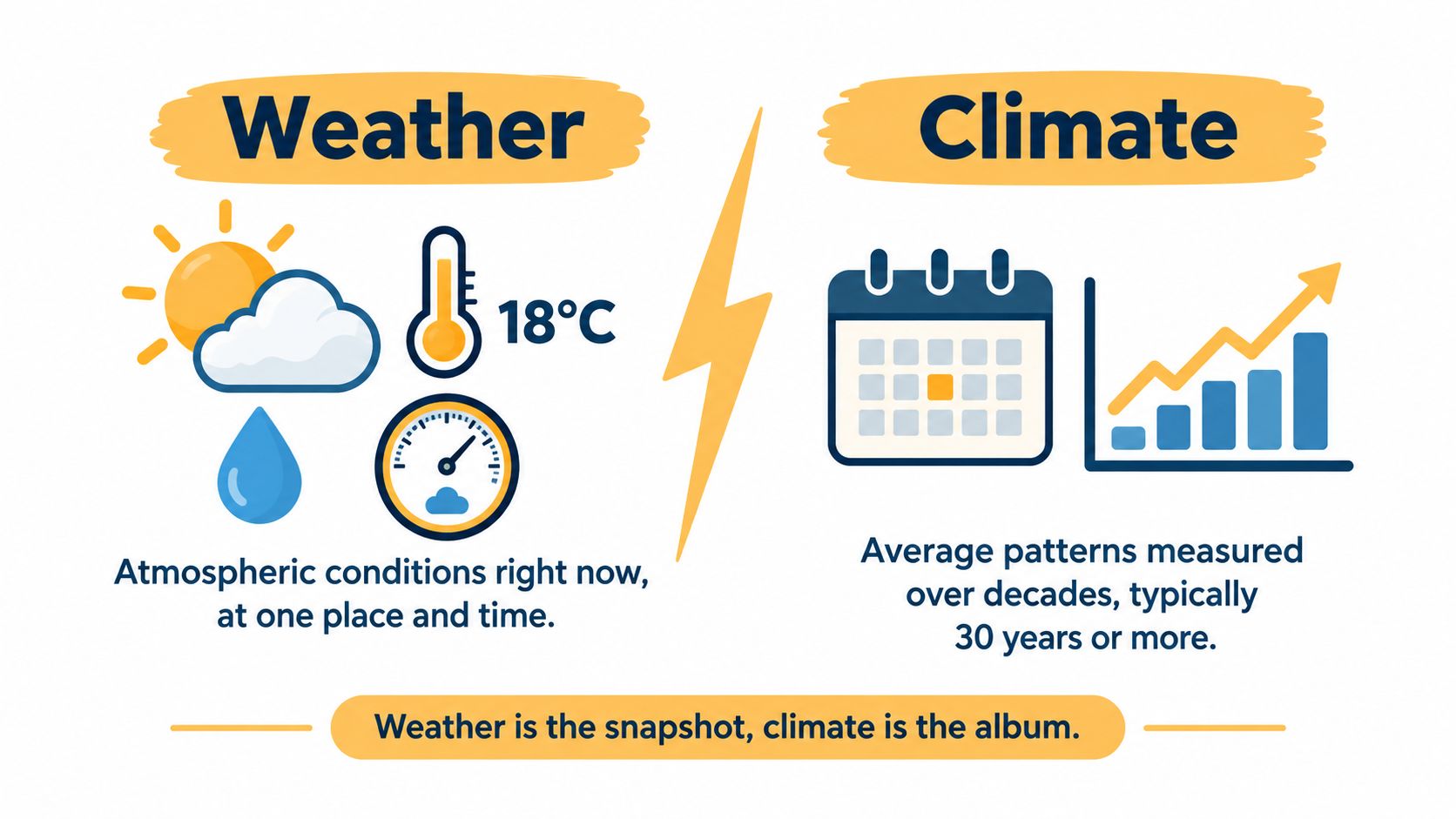
Weather answers a short-term question: What are the atmospheric conditions at this place and time? You might check today's temperature, the current barometric pressure, humidity, wind, or air-quality reading before leaving home.
Climate answers a broader question: What patterns and extremes are typical over many years? It includes long-term averages, but also the range of conditions that occur and how often unusual extremes appear.
The wardrobe analogy is useful. Weather tells you whether you need a jacket this morning. Climate tells you that your city usually has mild winters, while still allowing for an occasional cold spell.
What that means for migraine
A single pressure drop before an attack is a weather event. A longer-term observation that your region is experiencing more frequent heat extremes or less familiar seasonal patterns is part of the climate picture.
The World Health Organization's climate and health fact sheet says 3.6 billion people live in areas highly susceptible to climate change. It estimates that climate change could cause about 250,000 additional deaths each year between 2030 and 2050 from undernutrition, malaria, diarrhoea, and heat stress alone. These figures describe broad health risks, not migraine specifically, but they show why changing environmental conditions matter for everyday health planning.
Climate indicators also help explain why historical expectations can become less reliable. Atmospheric carbon dioxide reached 430.2 parts per million in 2025, more than 50% above pre-industrial levels, according to the same WHO source. You don't need to interpret that measurement personally to understand the practical point: the conditions surrounding daily weather are changing.
A migraine forecast should therefore combine the immediate snapshot with your own history. The climate trend won't tell you whether an attack will begin this afternoon, but it provides context for why unusual heat, persistent warm periods, smoke, and changing seasonal patterns may appear more often.
What the Research Says About Weather Triggers and Migraine
A forecast can show the same pressure change to everyone, while only some people notice a migraine response. Research therefore points to modest associations, seasonal effects, and meaningful differences between individuals rather than a rule that “bad weather causes migraine.”
A 2025 systematic review and meta-analysis found that temperature was associated with migraine attacks with an odds ratio of 1.15, with a 95% confidence interval of 1.02 to 1.29. Ambient pressure had an odds ratio of 1.07, with a 95% confidence interval of 1.01 to 1.15. Humidity was not statistically significant overall, with an odds ratio of 1.04 and a 95% confidence interval of 0.97 to 1.11. These findings come from the peer-reviewed meta-analysis available through PubMed Central.
The same analysis found associations between migraine visits and several pollutants:
| Variable | What the evidence indicates | Reported odds ratio |
|---|---|---|
| Temperature | Associated with migraine attacks | 1.15, 95% CI 1.02–1.29 |
| Ambient pressure | Associated with migraine attacks | 1.07, 95% CI 1.01–1.15 |
| Humidity | Not significant overall in the analysis | 1.04, 95% CI 0.97–1.11 |
| PM10 | Associated with increased migraine-visit risk | 1.07 |
| PM2.5 | Associated with increased migraine-visit risk | 1.04 |
| NO2 | Associated with increased migraine-visit risk | 1.08 |
| CO | Associated with increased migraine-visit risk | 1.08 |
| O3 | Associated with increased migraine-visit risk | 1.12 |
All odds ratios in this table come from the same systematic review and meta-analysis linked above.
An odds ratio describes a pattern across analyzed data. It cannot predict whether a particular exposure will cause your next attack. Your response may be smaller, larger, or absent.
Why combinations matter
A 2026 case-time-series analysis covering 69,808 health events found that migraine attacks were more likely to begin after relatively higher NO2 or O3 exposure, colder winter temperatures, warmer summer temperatures, and changes in barometric pressure. The analysis detected effects in short lag windows of 0 to 3 days, showing that timing and season can alter the meaning of a signal. A plain-language discussion appears in this neurologist-reviewed PBS NewsHour explanation.
Long-term warming, more frequent extremes, and shifting seasonal baselines can change how often familiar combinations appear. Generic weather apps usually describe current conditions for a broad audience. Personal tracking can connect hour-by-hour pressure, temperature, air quality, sleep, hydration, and symptoms, helping you identify which combinations matter to you.
For another explanation of how these variables interact, compare your records with the evidence on temperature, humidity, and barometric pressure. Use population findings as context, not as a personal prediction.
Seasonal Patterns People With Migraine Often Notice
Seasons can create repeating combinations of environmental change. That doesn't make a season a diagnosis or guarantee an attack. It gives you a starting hypothesis to test against your own records.
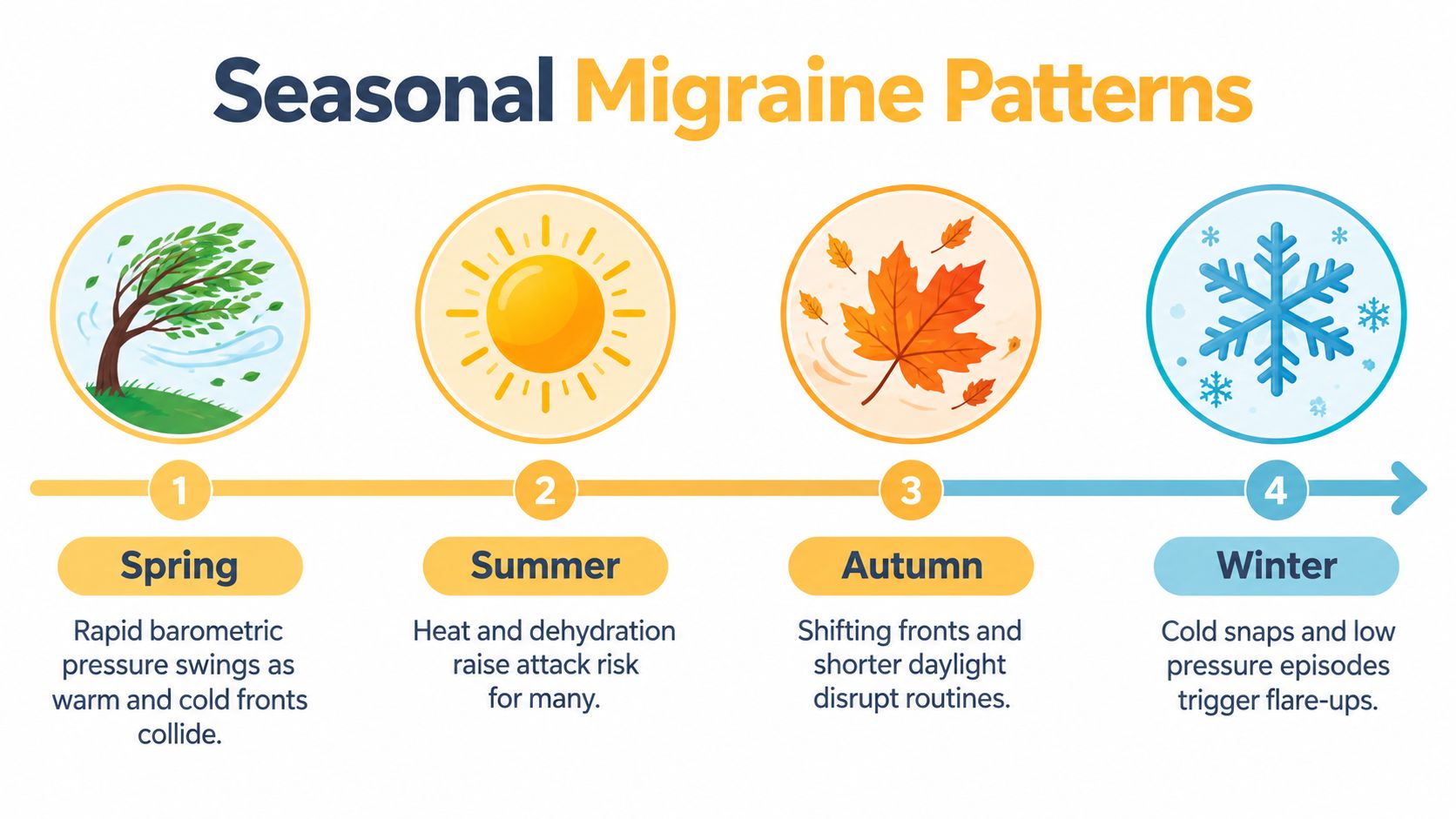
In spring, warm and cold fronts may alternate, producing noticeable pressure changes. Pollen and changing routines can appear at the same time, which makes attribution difficult. If an attack follows a front, pollen exposure, poor sleep, or several overlapping factors may all deserve consideration.
Summer often brings heat, humidity, bright light, disrupted sleep, and changes in hydration. A hot, humid day may affect one person while a sharp evening pressure change affects another. The American Migraine Foundation's review of seasonal migraine research describes temperature and ambient pressure as associated with migraine in a meta-analysis, while humidity wasn't significant overall.
A season can change the meaning of a signal
In a prospective diary-based cohort of 98 adults with episodic migraine in Greater Boston, higher relative humidity was linked to higher odds of migraine onset during the warm season, from April through September. That result shows why a humidity reading shouldn't be interpreted in isolation. The American Migraine Foundation's seasonal migraine summary explains the seasonal finding.
Autumn may bring warm afternoons and cool nights, shifting fronts, shorter daylight, and smoke exposure in areas affected by wildfires. Winter can involve cold air, dry indoor conditions, trapped pollutants, and abrupt warming events. Some people notice attacks during cold snaps, while others react more strongly when temperatures rise quickly.
You may find a pattern such as an attack beginning several hours after a spring pressure change, or symptoms appearing after a summer combination of heat and poor sleep. Write the observation down as a hypothesis rather than a conclusion.
A useful seasonal record includes the date, approximate attack start, weather conditions, air quality, sleep, meals, hydration, stress, and menstrual or hormonal changes if relevant to you. You're looking for repeated personal patterns, not proof that every attack has one external cause.
Why Your Triggers Are Not Everyone's Triggers
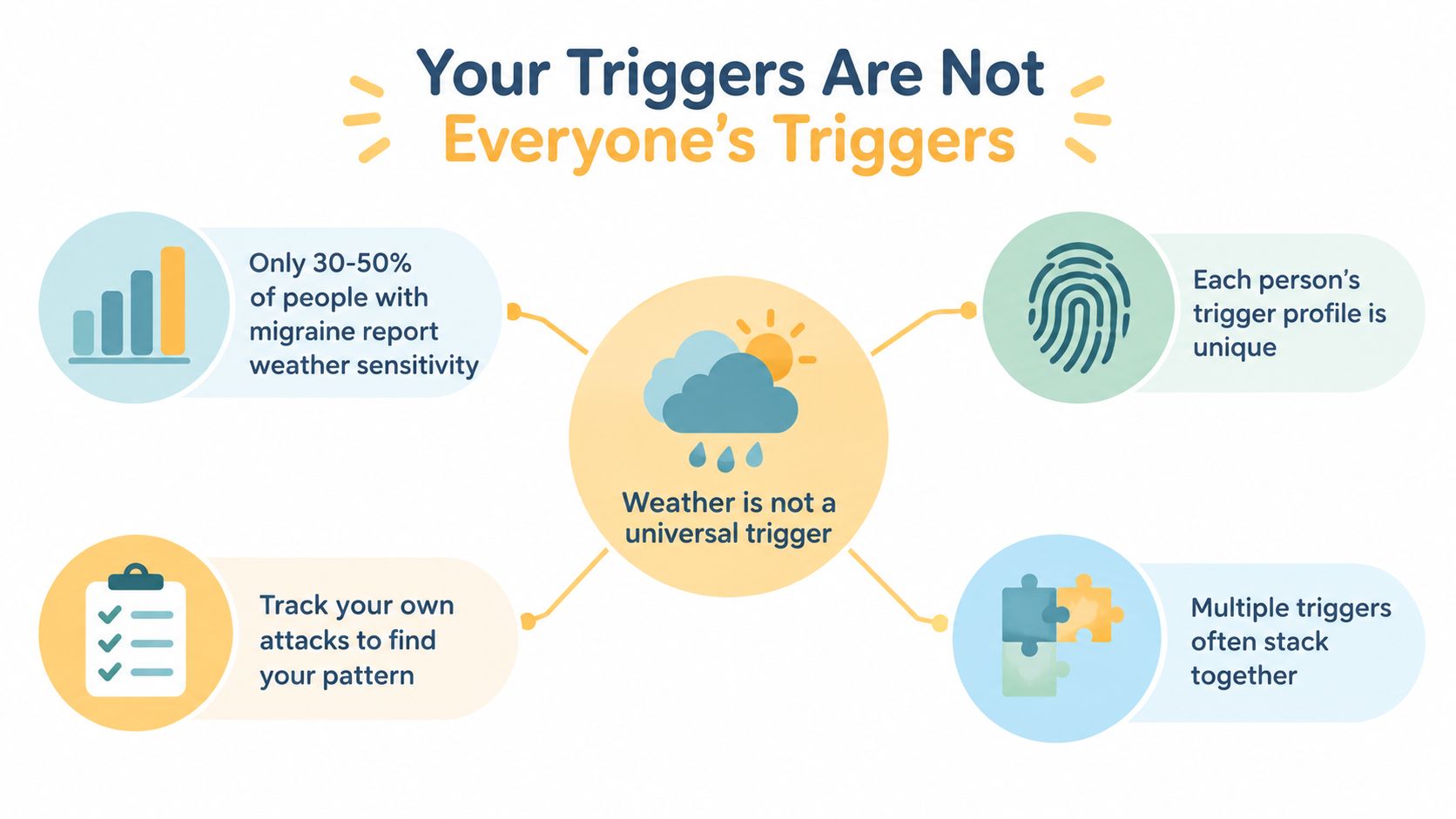
Weather sensitivity isn't universal. The same pressure change that precedes one person's migraine may pass unnoticed by someone else, and a person who reacts to temperature may not react to humidity or air pollution.
A study of 20 people with migraine followed over 12 consecutive months found that attack onset and high headache intensity were associated with lower temperature and higher humidity. Later analyses didn't show a consistent association across the full group, reinforcing the point that weather responses can vary by person. The 12-month migraine and weather study illustrates why individual records matter.
Your threshold is personal
Migraine symptoms can include pain, nausea, photophobia, which means sensitivity to light, phonophobia, which means sensitivity to sound, dizziness, or cognitive difficulty. People may live with episodic migraine, chronic migraine, migraine with aura, vestibular migraine, or other presentations, and their environmental sensitivities may differ.
A weather signal may also combine with other stressors. Poor sleep can lower your tolerance for a difficult day, while heat can make dehydration more likely. That doesn't mean the weather independently caused the attack. It may have contributed to a combination that crossed your personal threshold.
A summary of a Japanese study reported that 75% of people with migraine had attacks associated with a drop in barometric pressure before a typhoon, compared with 20% of people with tension-type headache. The finding, described in this PubMed Central review, can help distinguish patterns in research, but it can't determine what your own symptoms mean.
Weather sensitivity is best treated as a probability to investigate, not a verdict about what will happen.
That mindset protects you from two common mistakes. You don't have to dismiss your experience because a generic forecast looks normal, and you don't have to blame every attack on a cloud front. Personal logging helps separate a recurring association from a memorable coincidence. The guide to identifying migraine triggers can help you build that record without treating every variable as equally important.
How Hour-by-Hour Forecasting and Tracking Help You Anticipate Risk
A daily forecast might tell you the high temperature and chance of rain. That's useful for clothing, but it may miss the timing that matters to your migraine pattern.
Start with a simple log. Record the attack start time, duration, pain location, symptoms, suspected triggers, and any medication taken. You can also note sleep, meals, hydration, stress, light exposure, pollen, air quality, temperature, humidity, wind, and pressure when those details are available.
Build your own comparison
Look back at your records and compare attacks with the preceding hours or days. You might notice that attacks tend to follow a rapid pressure change, a warm spell, a polluted commute, or a combination of heat and insufficient sleep.
Don't search for a perfect threshold immediately. Ask more practical questions:
- Timing: Did symptoms begin during the change, afterward, or without an obvious delay?
- Combination: Were temperature and pressure changing together?
- Season: Does the same signal behave differently in summer and winter?
- Repetition: Has a similar pattern appeared repeatedly in your own log?
- Confounders: Were sleep, hydration, stress, illness, or routine also different?
Suppose your forecast shows a substantial pressure decline overnight, and your log contains several attacks after similar changes. You might choose to protect your sleep routine, drink fluids regularly, reduce avoidable strain, and keep your clinician-approved acute treatment available. That's preparation, not a promise that an attack will occur or a recommendation to change medication use.
A more useful migraine forecast combines the rate of pressure change, humidity, temperature movement, wind, and air-quality signals with your personal history. It can present risk by hour instead of reducing the day to one high and one low temperature. The hour-by-hour migraine forecast approach explains why timing can be more actionable than a general daily label.
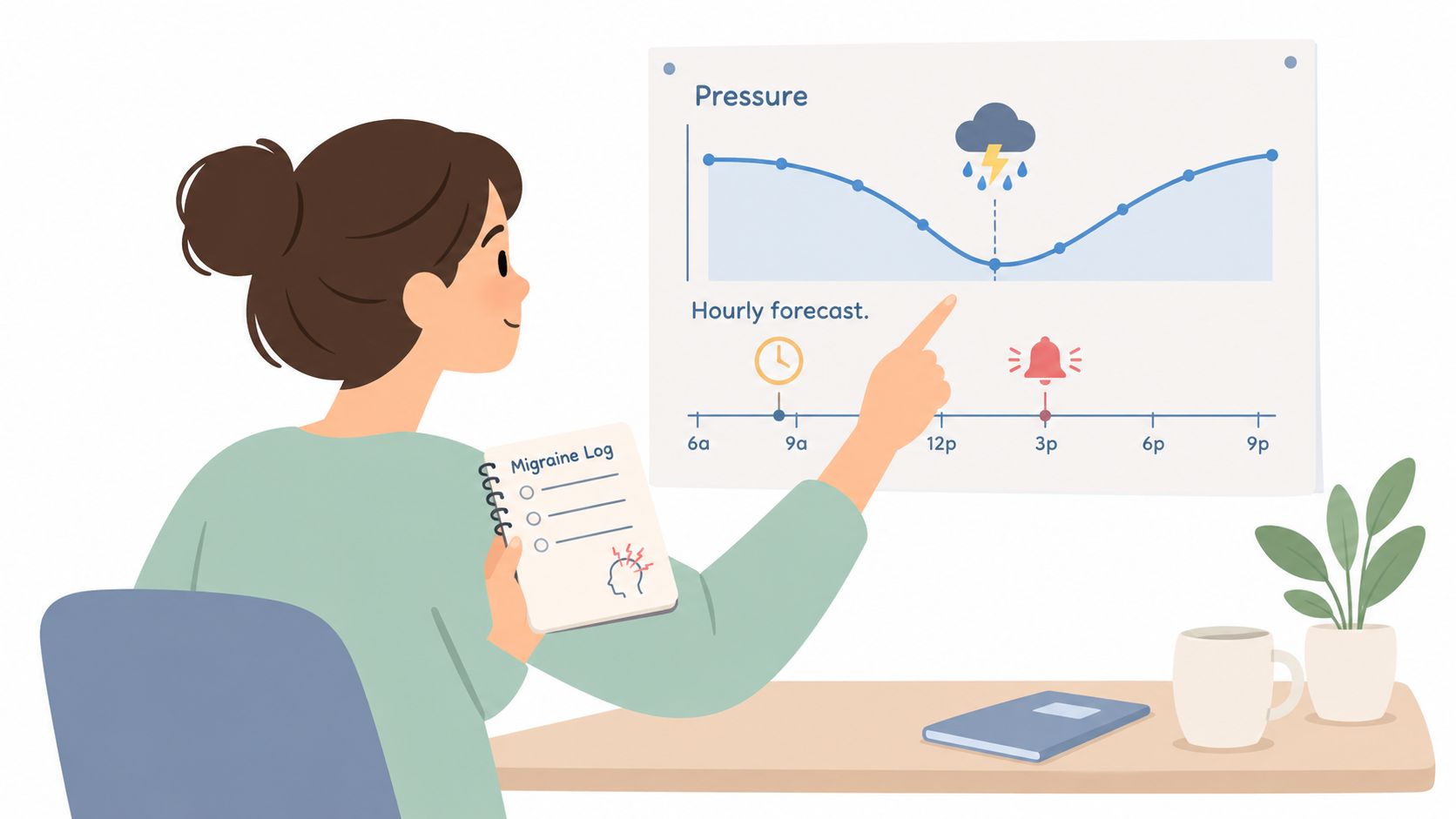
The goal isn't to monitor the sky anxiously all day. It's to use a forecast as one planning input, then check it against what your body and history have shown you.
When to See a Doctor and Bringing It All Together
Weather tracking can support awareness, but it can't diagnose migraine or explain a new neurological symptom. Seek immediate medical care for a sudden, severe headache, a headache with fever or stiff neck, new neurological changes, or head pain after a head injury.
New or changing headache patterns also deserve professional assessment, especially if attacks are becoming more frequent, more intense, harder to treat, or interfering with work, sleep, or daily activities. Don't assume that a weather connection makes a symptom harmless. A healthcare provider can evaluate your history and discuss appropriate lifestyle, over-the-counter, or prescription options without relying on a forecast alone.
This article is for informational purposes and is not medical advice. Consult a healthcare provider for personalized guidance.
The larger picture has two layers. Weather gives you the short-term conditions, including pressure, humidity, temperature, wind, and air quality. Climate changes the background, with a warmer baseline and more frequent or intense extremes affecting the conditions people encounter. Those long-term shifts don't let anyone predict a specific attack, but they make it more useful to understand local exposure rather than relying only on historical expectations.
Personal logging remains the most important link between those layers. A generic weather app can show what the atmosphere is doing, but it can't know whether your symptoms tend to follow pressure changes, warm-season humidity, winter pollution, or a different combination altogether.
A tracking app can bring those pieces together by letting you log attacks alongside local environmental data, then highlighting repeated relationships in your own history. Relief combines migraine logs with signals such as humidity, temperature, barometric pressure, wind, air quality, pollen, and UV, and provides an hour-by-hour risk view for planning. It's a tool for awareness and lifestyle management, not a replacement for medical care.
Relief helps you log severity, symptoms, triggers, and medications while viewing local weather and environmental signals alongside your history. Visit Relief to explore an hour-by-hour way to spot patterns and plan around possible migraine risk.


