You wake before the storm, notice a familiar heaviness behind your eyes, and check the forecast with a sinking feeling. A weather headache forecast can help you plan, but it can't reliably tell you that an attack will happen. The most useful approach combines changing weather conditions with your own symptom history, sleep, meals, stress, and previous migraine patterns.
That distinction matters. Weather may lower your migraine threshold, yet a pressure change that affects you one day may pass unnoticed the next. The aim isn't to blame every attack on the sky. It's to turn an unsettling pattern into information you can use.
Table of Contents
- Record the environmental context
- Capture your personal timeline
- Review patterns without forcing a conclusion
When the Sky Changes, Your Head Follows
You wake before the storm, with heaviness behind your eyes and no clear explanation for it yet. The room is quiet, rain has not started, and the forecast shows falling pressure or a sharp temperature change. Soon you are weighing plans, wondering whether pain is coming, and questioning the connection you have noticed before.
You are not imagining the experience. Research supports an association between weather changes and migraine for some people, while individual responses still vary. A 2025 meta-analysis of 31 studies found significant associations between migraine attacks and weather changes reported as a trigger. Temperature and ambient pressure also showed significant associations (2025 systematic review and meta-analysis).

A research association does not produce a personal forecast. A generic weather app can show atmospheric changes, but it cannot account for poor sleep, a missed lunch, early prodrome symptoms, or your own history of attacks after similar pressure shifts.
The useful question to ask
Ask, “What usually happens to me in these conditions, and what can I do when my risk appears higher?” That question turns weather information into a practical decision aid.
Your response can stay measured. Weather sensitivity deserves attention, while each pressure drop does not deserve the same weight. Use the forecast alongside your symptom history and daily routine, rather than treating it as a verdict.
On days that resemble your pattern, keep sleep and meals consistent, maintain your usual fluid intake, and reduce avoidable sensory strain. Review the acute-care plan you have discussed with a healthcare provider so treatment is available if symptoms develop. These measures cannot guarantee prevention, yet they may help you avoid combining several factors that lower your migraine threshold.
Practical rule: Treat weather as a planning signal, and let your own log decide how much weight it carries.
A useful personal forecast develops through comparison. Record when symptoms begin, which conditions were changing beforehand, and whether sleep, meals, stress, or other factors were present. After enough entries, you may find that falling pressure matters mainly after poor sleep, or that temperature changes deserve more attention than pressure. That pattern gives a generic forecast personal meaning and helps you plan without putting your day on hold for every approaching storm.
What the Research Actually Says About Weather and Migraine
The evidence supports weather as a meaningful trigger for some people, but it doesn't support a single threshold that applies to everyone. A 2025 review found significant associations for temperature, with an odds ratio of 1.15, and ambient pressure, with an odds ratio of 1.07. Humidity wasn't significant in that review, and the researchers noted substantial variation between studies (systematic review and meta-analysis of weather conditions and migraine).
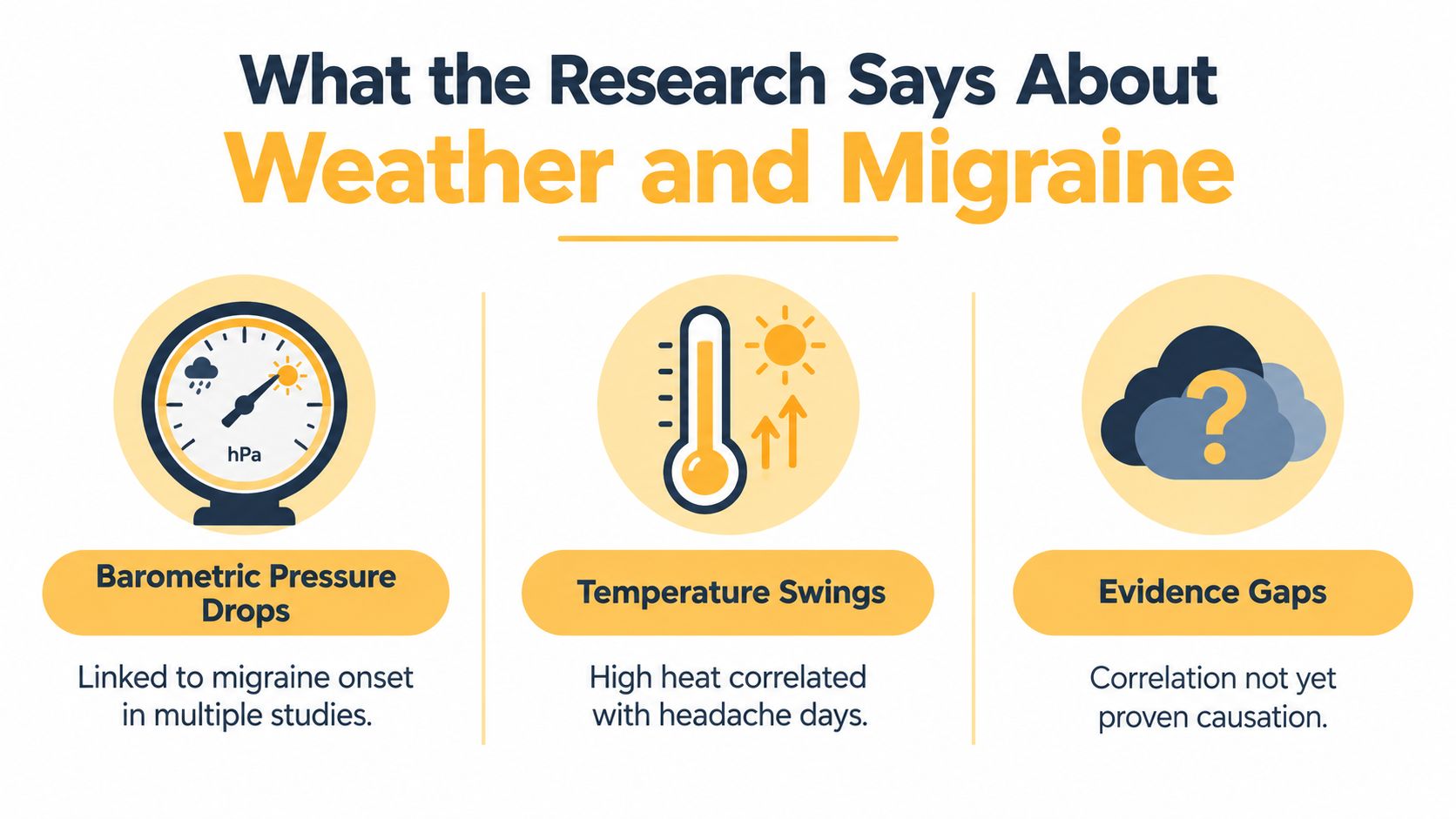
Barometric pressure is one of the clearest signals to track, especially its direction and short-term change. In a yearlong diary study of 28 migraine patients, 18 people, or 64%, linked migraine development with weather change. Migraine frequency increased when the pressure difference from the headache day to the next day fell by more than 5 hPa, while monthly average pressure wasn't associated with headache frequency (barometric pressure and migraine study).
Why a population pattern doesn't become your forecast
Other research shows why caution matters. In a prospective diary-based study, only 13% of participants could be clearly identified as weather-sensitive. The authors concluded that an individual migraine prognosis based solely on meteorological data wasn't possible (weather sensitivity and migraine diary study).
A separate 100-patient, 12-month study tested individualized forecasts using four-hour weather intervals and changes in pressure, humidity, temperature, and clock time during the previous 24 hours. The researchers found that weather alone wasn't feasible for intervention because attacks were relatively infrequent, which made positive predictive values too small even among confirmed weather-sensitive participants (individualized migraine forecasting study).
That's the central trade-off. Weather can correlate with attacks while still producing too many false alarms for a dependable standalone forecast. A generic app can show changing conditions, but your history determines whether those conditions are useful to you.
For a focused explanation of pressure trends, see this guide to barometric pressure changes and migraine. Treat the information as context, not proof that your next headache has been caused by the weather.
Building Your Personal Weather-Headache Log
A useful log doesn't need to become another exhausting task. The goal is to capture enough detail to compare the hours before symptoms with the hours before migraine-free periods.
Use a consistent format and record weather alongside your body's signals. A daily summary can hide the timing that matters, so note changes during the day whenever practical.
Record the environmental context
Track these variables in the same place as your symptom notes:
Pressure trend: Record whether pressure is rising, falling, or relatively stable. The direction and speed of change may be more informative than one isolated reading.
Temperature: Note the current temperature and meaningful shifts from the conditions you experienced earlier. Include heat exposure, cold air, glare, or time spent outdoors.
Relative humidity: Log humidity as context rather than assuming it's a trigger. It may matter differently when combined with heat, poor sleep, or other exposures.
Air quality and pollen: Add these when they're available in your local forecast. Don't assume an exposure caused the attack, but preserve the information for later comparison.
Capture your personal timeline
Record the time you first notice a change, not just the time pain becomes severe. Include yawning, unusual fatigue, mood changes, neck discomfort, food cravings, nausea, light sensitivity, or difficulty concentrating.
Use a simple template such as:
- Morning: Sleep quality, wake time, pressure direction, temperature, humidity, and any early symptoms.
- Midday: Meals, fluids, outdoor exposure, stress, sensory load, and symptom changes.
- Evening: Pain level, associated symptoms, weather shift, and any steps taken under your existing healthcare plan.
- Next day: Whether the attack developed, eased, or remained absent.
The migraine log template can help you keep these details together instead of scattering them across notes, calendars, and memory.
Review patterns without forcing a conclusion
Look for repeated combinations rather than one dramatic coincidence. You might find that attacks cluster after falling pressure, or that the apparent weather link disappears when sleep and meals remain consistent. You may also discover that the weather is present but not sufficient, with attacks occurring only when several personal stressors overlap.
Keep the log long enough to compare different types of days, including days with similar weather when you remained migraine-free. That comparison prevents confirmation bias, the tendency to notice evidence that supports your first impression while overlooking exceptions.
Understanding Migraine Phases and Early Weather Signals
A pressure drop may appear on your weather app in the morning, while your first warning sign is unusual yawning or difficulty concentrating. Knowing how an attack unfolds helps you compare those events without assuming that weather caused the migraine. Migraine is a neurological condition with recognizable phases. A headache is a symptom with many possible causes, so the terms are not interchangeable.
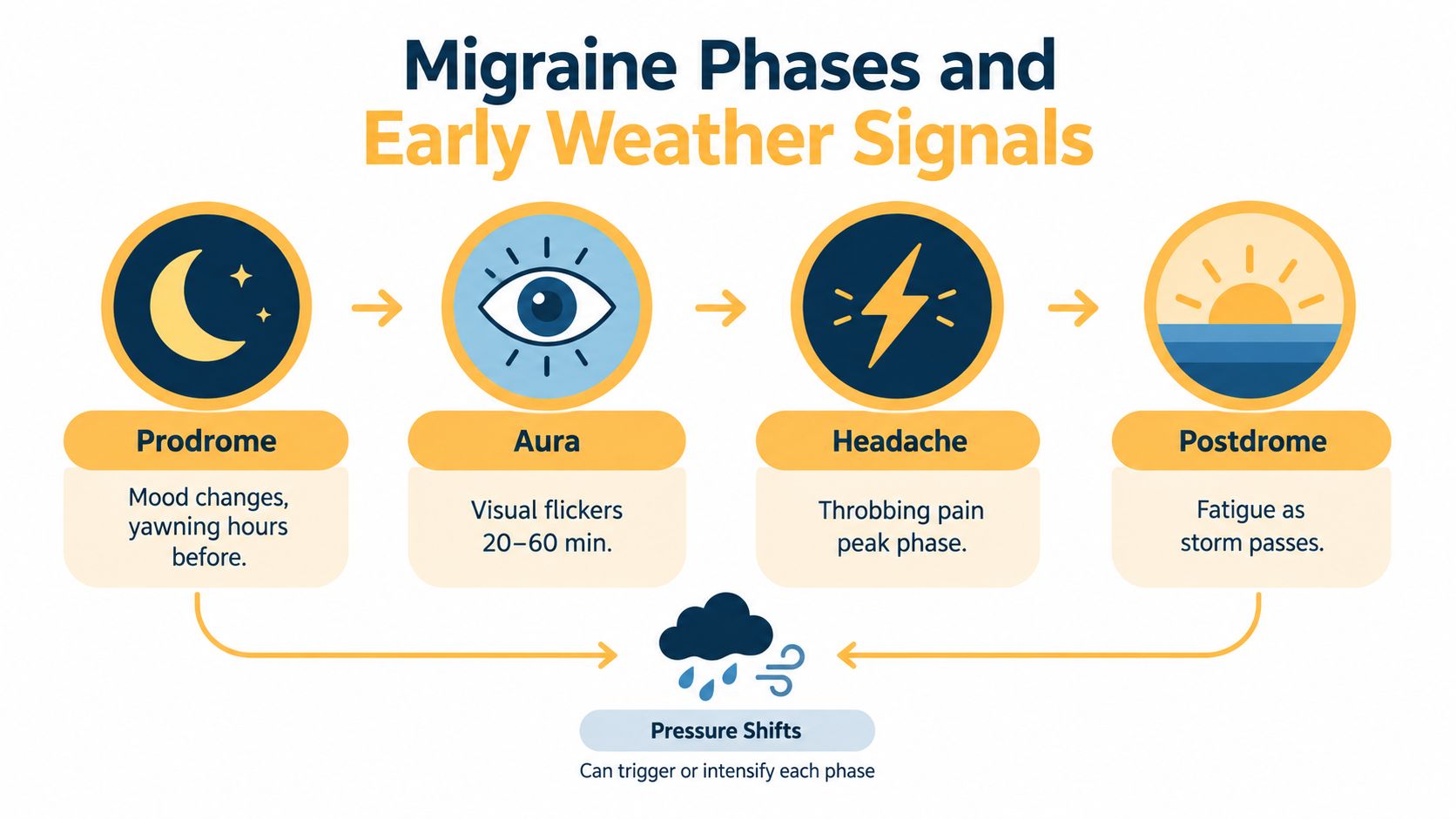
The Cleveland Clinic describes four commonly recognized phases. Prodrome may begin up to 24 hours before head pain and can involve fatigue, mood changes, yawning, food cravings, or difficulty concentrating. Aura consists of visual, sensory, motor, or speech-related symptoms and may last 5 to 60 minutes (Cleveland Clinic migraine overview).
Separate early symptoms from aura
Timing guidance differs by source. The Cleveland Clinic describes prodrome beginning up to 24 hours before pain, while ICHD-3 allows a wider 2 to 48-hour window. Use both as reference points, then record your own onset times to see which range fits your attacks.
Prodrome occurs before aura in migraine with aura and before pain in migraine without aura. Early symptoms can include fatigue, mood changes, yawning, cravings, or concentration problems. Aura is a separate neurological phase. Visual flickering, zigzag lines, tingling, language difficulty, or other neurological symptoms may occur during it, but not everyone with migraine experiences aura.
Seek medical advice for a new, severe, prolonged, or unfamiliar neurological symptom rather than assuming it is your usual aura.
Match weather signals to your timeline
Research does not establish one weather schedule that applies to every person. Your log can test whether falling pressure tends to precede prodrome, heat appears near pain onset, or storms disturb sleep and routine. Generic forecasts cannot predict your next attack on their own. They become more useful when compared with your personal symptom history.
| What you notice | What to record | Why it matters |
|---|---|---|
| Early body changes | Yawning, fatigue, mood changes, cravings, concentration changes | These may signal prodrome rather than a weather effect |
| Neurological symptoms | Visual, sensory, motor, or speech changes and their timing | This helps separate aura from earlier warning symptoms |
| Pain phase | Onset time, intensity, nausea, photophobia, and phonophobia | These details show when the attack becomes established |
| Recovery period | Fatigue, cognitive slowing, and sensitivity after pain improves | Postdrome can affect your day after head pain fades |
Check your personal weather pattern before pain appears, but treat it as planning information, not a diagnosis or proof of cause. Compare weather with sleep, meals, stress, and symptoms, then follow the steps in your existing healthcare plan when familiar warning signs emerge.
Using Apps to Automate Your Weather Headache Forecast
Manual notes are useful, but a tracking habit has to be sustainable. An app can bring local weather conditions and your symptom history into one view, reducing the need to copy readings from several services.
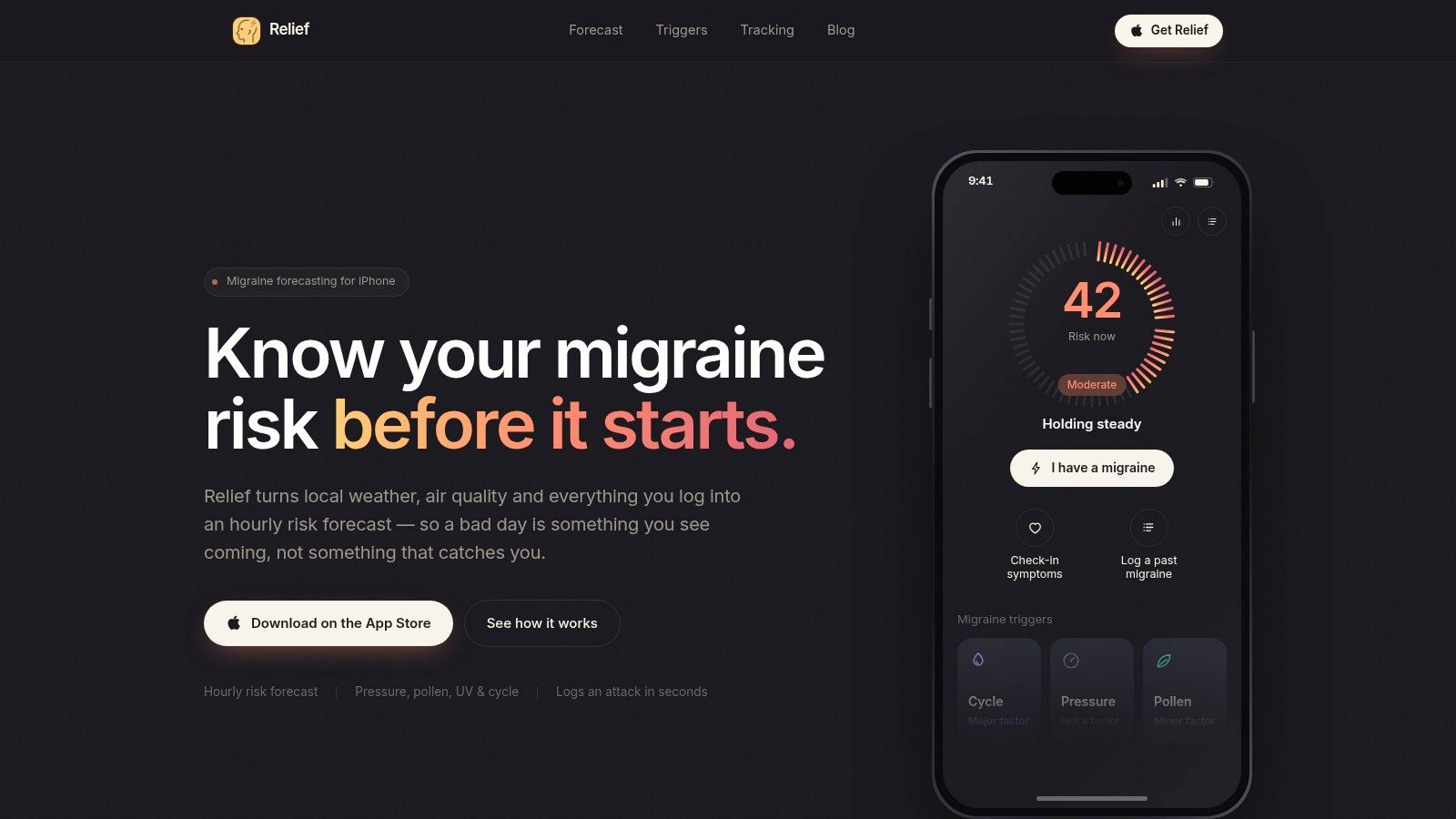
Relief combines personal check-ins with local weather, air-quality, and pollen information to produce an hour-by-hour risk forecast. You can log an attack with details such as severity, symptoms, triggers, and medications, then compare those records with environmental conditions over time. Relief is a tracking and awareness tool, not a medical treatment or replacement for professional care.
A practical daily workflow
Open the app when you plan your day and review the hourly trend rather than focusing on a single weather number. Look at pressure, humidity, temperature, wind, air quality, and pollen together, then compare the conditions with your recent check-ins.
When an attack occurs, log it as close to the start as you can. Later, review exposure hit rates to see which conditions have appeared repeatedly around your attacks. A hit rate can highlight a correlation, but it doesn't prove that the exposure caused the migraine.
Use migraine-free streak analytics in the same cautious way. They can help you compare periods with different weather patterns and routines, while total migraine hours, average attack time, and changing severity add context that a simple attack count misses.
For more detail on using technology for pattern-based planning, explore this guide to a migraine forecast app.
The forecast should become a quiet prompt to check your basics, not a reason to monitor the sky anxiously. If your personal history shows that certain conditions often coincide with attacks, you can plan lower-demand periods, protect sleep, keep meals predictable, and follow the acute-care strategy already agreed with your clinician.
When Forecasts Fail and What to Do Instead
A weather headache forecast can fail even when weather really influences your migraine. The reason is mathematical as much as medical: when attacks are relatively uncommon, a system may flag many high-risk conditions that don't lead to pain. The 100-patient, 12-month forecasting study described earlier reached this limitation even among people considered weather-sensitive.
Treat a forecast as a probability guide. A high-risk signal means, “Pay attention to your routine and symptoms,” not, “An attack is certain.” A low-risk signal also doesn't cancel other triggers, including poor sleep, missed meals, stress, hormonal changes, illness, or an attack already beginning in prodrome.
Decide what action is proportionate
Use a light-touch response when the forecast looks unfavorable but you feel well. Check whether you can protect sleep, eat regularly, keep fluids steady, reduce avoidable sensory strain, and avoid taking on unnecessary demands. Don't change prescription treatment or medication timing without a plan from your healthcare provider.
If you notice your familiar early symptoms, follow the personal plan you've already discussed with a clinician and record what happens. If forecasts repeatedly alarm you without corresponding attacks, reduce their influence and focus on the patterns that your diary supports.
A missed forecast isn't a personal failure. It's evidence that the model needs context, or that weather isn't a major driver for that episode.
Know when weather is irrelevant
Seek immediate medical care for a sudden, severe headache, a headache with fever or a stiff neck, neurological changes, or a headache after a head injury. New weakness, numbness, confusion, fainting, seizure, trouble speaking, double vision, or vision loss that doesn't behave like your usual aura also requires urgent assessment.
Don't use a familiar weather pattern to explain away a rapidly changing headache pattern. This article is for informational purposes and is not medical advice. Consult a healthcare provider for personalized guidance.
Tracking won't make migraine predictable in every case, but it can replace helpless guessing with a clearer record of what your body does under particular conditions. Relief brings weather and symptom logging together so you can identify patterns, review your risk signals, and plan with more confidence. Visit Relief to start tracking your personal weather-headache pattern.


