The storm hasn't arrived, but your head already knows it's coming. If a falling barometer seems to bring on throbbing pain, nausea, light sensitivity, or that familiar pressure behind your eyes, weather pressure headache relief starts with tracking your personal response, not chasing a universal “safe” pressure number.
Research supports a real connection for some people, but it doesn't support the idea that every migraine is caused by low pressure. A 2024 NIH review found that weather-related factors appear to affect migraine attacks in about 20% of cases, while the overall evidence remains inconsistent across studies (NIH review of weather and migraine). Your most useful goal is to identify whether pressure changes reliably precede your attacks, then prepare during your own risk window.
This article is for informational purposes and is not medical advice. Consult a healthcare provider for personalized guidance.
Table of Contents
- Stabilize the basics first
- Use movement and stress reduction as adjustable dials
- Consider over-the-counter options carefully
What Weather and Pressure Headaches Really Are
A weather-related headache isn't necessarily a separate medical condition. For many people, it's a migraine attack or tension-type headache that appears after an atmospheric change, such as a pressure drop, temperature swing, humidity shift, or strong wind. Migraine can include throbbing pain, nausea, photophobia, meaning sensitivity to light, phonophobia, meaning sensitivity to sound, and aura, meaning temporary neurological symptoms such as visual changes before or during an attack.
The proposed mechanism is more complicated than “low pressure equals pain.” Pressure changes may affect air-filled sinus spaces, blood vessels, and signaling through the trigeminal nerve, a major pain pathway in the head and face. Those effects can overlap with congestion, facial pressure, neck tension, or a migraine's sensory symptoms, which is why people often describe the experience as a sinus headache even when the wider pattern looks more migraine-like.
The number that matters is personal
A 2011 diary study of 28 migraine patients found that weather change was associated with migraine development in 18 patients, or 64%, and 14 patients specifically attributed their headaches to low barometric pressure (PubMed study). The same study found that migraine frequency rose when pressure dropped by more than 5 hPa between the headache day and the following day.
That doesn't make 5 hPa a universal danger line. Another study found migraines occurred most often when pressure fell by 6 to 10 hPa from standard atmospheric pressure, with attack rates of 23.5% at 1005 to under 1007 hPa and 26.5% at 1003 to under 1005 hPa (study on atmospheric pressure fluctuations). These figures describe study populations, not a prediction for your body.
Don't confuse it with every kind of head pain
Cluster headache tends to follow a different pattern, often involving severe one-sided pain around the eye with prominent symptoms on the same side. A sinus infection may involve facial pain alongside infection symptoms, while migraine can produce nasal congestion and facial pressure without an infection. The overlap is real, so use symptom tracking to describe patterns rather than trying to diagnose yourself from the weather report.
Practical rule: Treat pressure as a possible trigger to test, not an explanation you must accept.
Forecasting and Monitoring the Pressure Shift
A weather app showing “low pressure” is too crude for useful migraine planning. You need to see how quickly pressure changes, what else is shifting, and whether those conditions have preceded your attacks before.
Start with local data that reports barometric pressure in hectopascals, or hPa. Look for an hourly curve rather than a single daily reading. A steep downward slope means pressure is falling quickly. A nearly flat line means the absolute pressure may be low, but the immediate change is limited. For many people, the rate and size of the shift are more informative than the number on its own.
Build a personal risk view
Track these signals together:
- Barometric pressure: Record the current hPa reading and the change over the preceding 3 to 6 hours.
- Pressure direction: Mark whether the curve is falling, rising, or stable.
- Humidity: Note unusually damp or dry conditions, especially if humidity repeatedly appears alongside your attacks.
- Temperature: Record sharp swings rather than relying only on the daily high and low.
- Air quality: Check ozone and particulate matter, since environmental exposure can overlap with weather sensitivity.
- Timing: Compare the weather shift with the exact time your prodrome, the early phase before the main headache, begins.
The research doesn't justify one universal weather formula. A 2025 meta-analysis of 31 studies found significant associations between migraine attacks and weather changes reported as triggers, with significant associations for temperature and ambient pressure, while humidity wasn't statistically significant in that analysis (2025 meta-analysis). That result supports monitoring pressure and temperature, but it doesn't mean humidity is irrelevant for you.
| Metric | What to Watch | Typical Trigger Range | Typical Shift Speed |
|---|---|---|---|
| Barometric pressure | Falling pressure near attack onset | More than 5 hPa in the diary study, or 6 to 10 hPa in another pressure study | Compare hourly readings and the prior 3 to 6 hours |
| Absolute pressure | Readings below the local baseline | Study-specific readings included 1005 to under 1007 hPa and 1003 to under 1005 hPa | Treat as context, not a universal threshold |
| Humidity | Sharp move toward unusually damp or dry conditions | No reliable universal range | Compare the hours before symptoms |
| Temperature | Fast warming or cooling | No universal trigger range | Check same-day swings |
| Air quality | Ozone and particulate matter changes | No universal trigger range | Compare alerts with symptom onset |
Choose data that matches your location
Not every weather service provides pressure at the same resolution. A regional forecast may smooth out the pressure curve, while a nearby personal weather station can show a more relevant local shift. If an alert seems wrong, compare the reading with local station data instead of assuming your body is unpredictable.
Apps that combine weather with migraine logging are more useful than weather alerts alone because they attach exposure data to an actual attack record. Relief, for example, combines local weather, air quality, pollen, and health data to produce an hour-by-hour migraine risk forecast, while logging lets its model compare factors such as pressure with your recorded symptoms. It's a tracking and awareness tool, not a medical treatment or substitute for care.
Pre-Emptive Habits Before the Pressure Drops
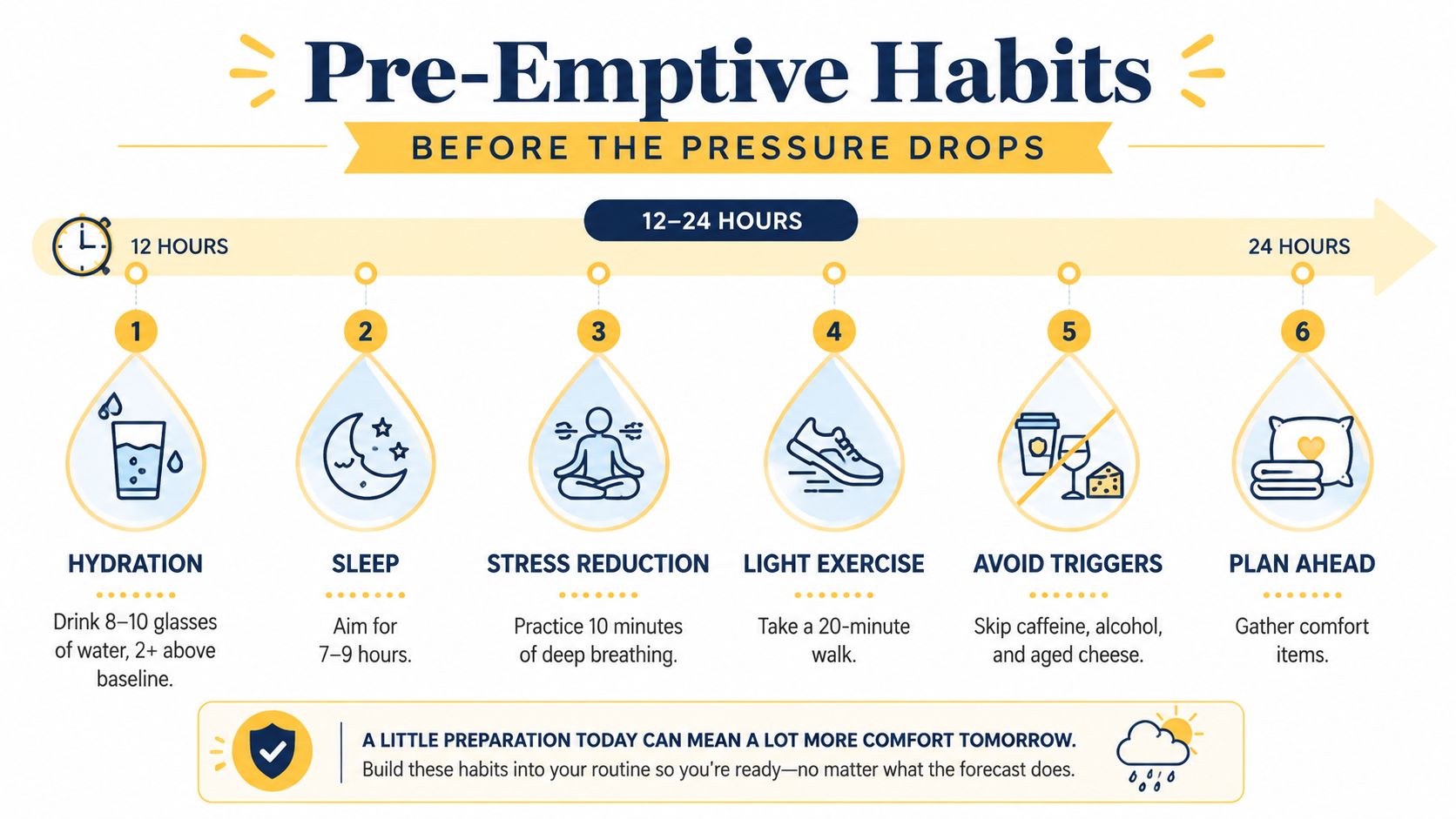
The best preparation window is the period before your usual symptoms begin. If your log shows that attacks often follow a falling pressure curve, use the 12 to 24 hours before that shift to remove avoidable stressors. Don't turn this into a rigid ritual. Test one change at a time so you can tell what helps.
Stabilize the basics first
Keep fluids available and drink consistently rather than waiting until thirst appears. Pressure changes may coincide with heat, disrupted routines, or poor sleep, so hydration is a practical variable to test, not a guaranteed fix.
Protect your usual sleep timing. A late night, an unusually long sleep, or repeated waking can stack with a weather trigger. Keep caffeine timing consistent if you use it, because abruptly changing your normal intake can create a separate withdrawal-related headache that muddies the pattern.
Eat at regular intervals during a high-risk weather window. You don't need to adopt a universal “migraine diet.” Commonly identified food triggers vary widely, so log foods only when you suspect a repeatable connection. Alcohol is worth skipping when pressure changes already appear to raise your risk, especially if alcohol has shown up before your attacks.
Use movement and stress reduction as adjustable dials
Gentle activity, such as an easy walk, may be reasonable before symptoms start if movement usually feels good. Hard exertion can backfire for some people, particularly when you're already sleep-deprived, dehydrated, or noticing prodrome symptoms.
Stress reduction doesn't mean your migraine is “just stress.” It means nervous-system load can join the weather shift. Try slow breathing, a quiet transition between tasks, or a brief period without bright screens. Test these as individual choices, not obligations you can fail.
Consider over-the-counter options carefully
Some adults use an over-the-counter nonsteroidal anti-inflammatory drug, or NSAID, or acetaminophen at the first sign of an attack rather than waiting for peak pain. Whether a product is safe depends on your health history, other medicines, allergies, and how often you use it. Follow the product label and ask a pharmacist or clinician if you're unsure.
Frequent use of acute headache medicines can create additional problems, including medication-overuse headache. Don't build a preventive routine around pain relievers without professional guidance.
Quick At-Home Relief When the Headache Starts
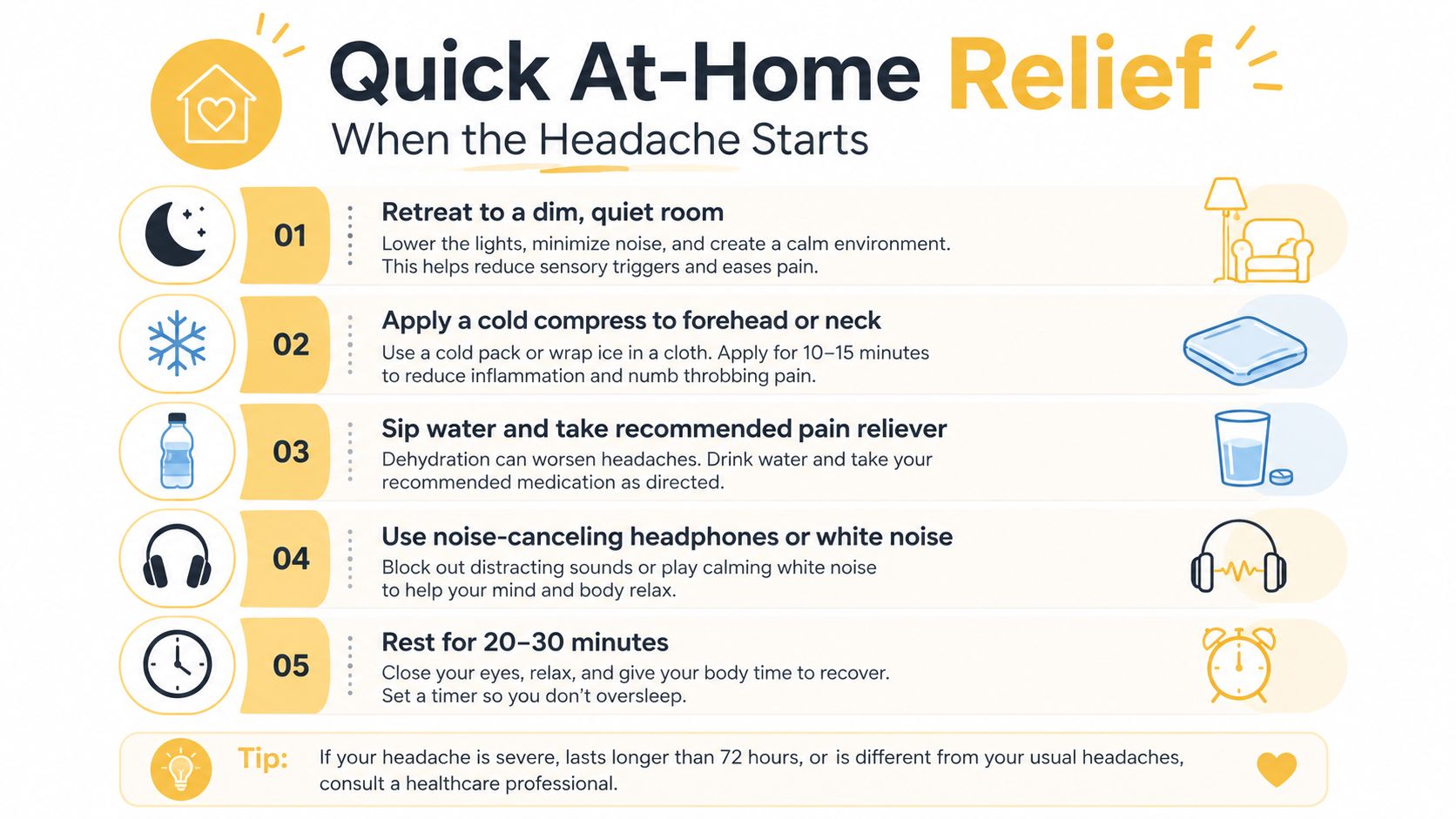
Once pain begins, reduce sensory input before trying to do ten things at once. Migraine brains often become more reactive to light, sound, movement, and strong smells, so a quieter environment can remove several aggravating inputs immediately.
Match the tactic to the pattern
- Dim the room: Turn down lights, close curtains, lower screen brightness, and reduce noise. This is especially useful when photophobia or sound sensitivity is part of your attack.
- Try cold first: Place a cold compress on your forehead or temples if the pain feels throbbing or heat-sensitive. Protect your skin with a cloth.
- Use warmth for tension: Apply gentle warmth to the neck if tight shoulders, jaw clenching, or prolonged laptop posture are adding a tension component.
- Sip fluids: Drink water gradually. An electrolyte drink may be useful if you've been sweating, eating poorly, or dealing with heat, but it isn't required for every headache.
- Adjust the room: If indoor air feels unusually dry or damp, a humidifier or dehumidifier may improve comfort. Avoid chasing an exact humidity number. Focus on whether the room feels irritating and whether the change helps.
- Reset your posture: Let your jaw hang loosely, lower your shoulders, support your neck, and move away from a hunched position.
- Breathe slowly: Gentle nasal breathing can help you stop bracing your face and neck. Stop if nasal congestion makes it uncomfortable.
- Massage lightly: Use soft circular pressure on the temples or scalp if touch feels soothing. Skip massage if it increases pain.
The order matters less than the signal. Cold may suit throbbing pain, warmth may suit muscle tension, and fluids may matter most when a hot day, missed drinks, and pressure change arrive together.
If you use an over-the-counter pain reliever, take only as directed on its label and consider your personal contraindications. Don't combine products casually, and seek advice if you need acute medication repeatedly.
A brief rest period can give the intervention time to work. If you're alone and symptoms feel unusual or severe, let someone know rather than trying to push through.
Tracking Attacks to Find Your Personal Pattern
A single storm proves almost nothing. Weather changes constantly, and migraine attacks have multiple possible contributors. A useful log connects the exposure, the timing, and the symptoms closely enough for you to compare similar days.
Record the pressure reading and its movement before onset, not just the weather at the time pain becomes severe. Include the temperature swing, humidity, air quality if available, sleep the night before, hydration, meals, stress, and any medication taken. Note whether symptoms began with prodrome signs such as yawning, fatigue, mood change, or sensory sensitivity.
Keep the log simple enough to maintain
| Field | Example entry |
|---|---|
| Date and onset time | Tuesday, afternoon onset |
| Pain location | One-sided temple pain |
| Intensity | Mild, moderate, or severe |
| Migraine features | Nausea, light sensitivity, aura, or dizziness |
| Pressure | Current hPa reading |
| Pressure change | Change over the prior 3 to 6 hours |
| Temperature | Noticeable rise or fall |
| Humidity and air quality | Local readings at onset |
| Sleep and hydration | Normal, disrupted, low, or adequate |
| Medicine or comfort measure | Product taken or tactic tried |
| Outcome | Improved, unchanged, or worsened |
A practical pattern often needs several logged attacks, not one memorable weekend. The plan for this article calls for looking after 6 to 10 attacks, but treat that as a tracking horizon rather than a verified scientific threshold. The diary evidence does show that a pressure drop of more than 5 hPa can be associated with higher migraine frequency in some people, while monthly mean pressure showed no association with headache frequency in that study (year-long diary analysis).
Look for repeatability, not perfect prediction
Compare your entries with archived hourly weather data. Ask whether attacks cluster after a similar falling slope, whether the change happens hours before symptoms, and whether pressure matters only when sleep or temperature also shifts. A personal threshold may resemble the 5 to 10 hPa ranges reported in studies, but your own data may show a smaller change, a different exposure window, or no pressure pattern at all.
A spreadsheet works if you'll use it. An app can reduce manual work by connecting local conditions to each entry. Relief is one option that combines tracking with environmental signals, including pressure, humidity, temperature, wind, pollen, and air quality.
Bring a clean summary to a clinician rather than handing over an unfiltered data dump. Highlight the pressure pattern, symptom profile, frequency changes, and what helped. That gives the conversation a practical starting point without pretending the weather alone explains every attack.
When a Pressure Headache Needs a Doctor
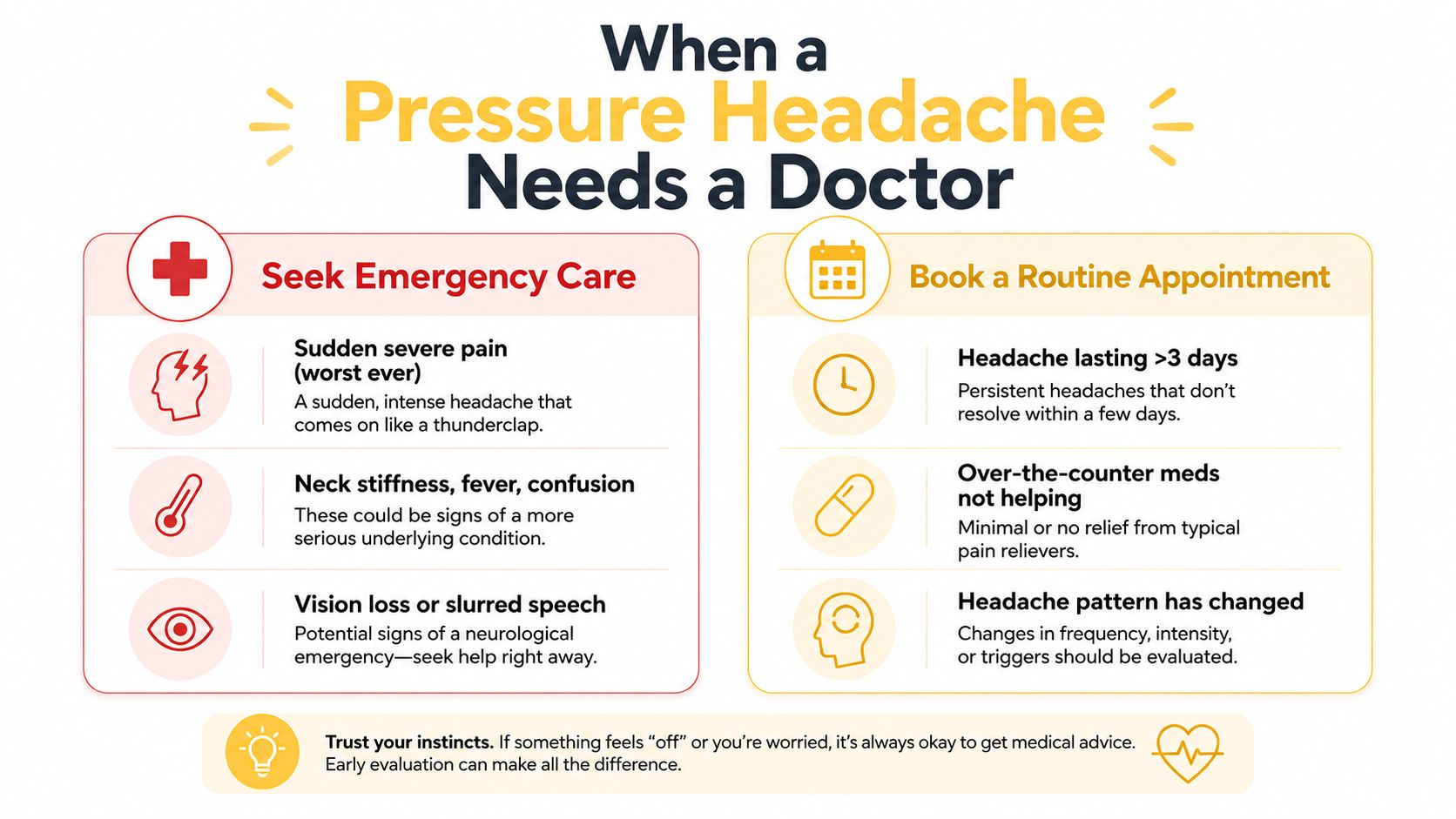
Most familiar, stable headaches don't require emergency care, but new or alarming symptoms shouldn't be blamed on the weather. Seek immediate medical care for a sudden, severe headache, especially one you'd describe as the worst headache of your life.
Get urgent help for a headache with fever and a stiff neck, new weakness, one-sided numbness, vision loss, slurred speech, confusion, or another neurological change. A headache after a head injury also needs prompt evaluation. Don't wait for the barometer to stabilize if the pain keeps escalating despite your usual relief measures.
Book a routine appointment when the pattern changes
Arrange a non-urgent appointment if headaches are becoming more frequent or severe, your usual symptoms change, headaches wake you from sleep, or over-the-counter options no longer provide adequate relief. A new headache later in adulthood also deserves professional review, especially if it doesn't resemble your established pattern.
Bring your log, including pressure readings, onset timing, aura or other neurological symptoms, sleep, hydration, and medicines used. The purpose isn't to prove that weather caused the headache. It's to give your clinician a clearer view of what changed and what needs attention.
For more information about the publisher and its approach to migraine tracking, visit Relief's about page.
Relief helps you connect local weather conditions, including pressure, with logged migraine symptoms and timing, so you can spot the patterns that matter to you. Visit Relief to track attacks, review environmental signals, and prepare for your next pressure shift with better information.


